
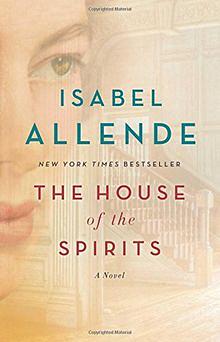
The House of the Spirits fills another hole in my A Century of Books project, and although I believe I’ve read at least one book by Allende, it isn’t this one.
For a long time, you don’t have any sense of when this novel is set. Even when it mentions a big war in Europe, you’re not quite sure if it’s World War I or II. (It’s I.) It took a lot of attention to establish a time setting for this expansive, wandering account that, although generally written in chronological order, sometimes skips forward and sometimes backward. I finally figured out that the novel takes place from shortly before World War I until 1973.
Although the novel contains some information about previous generations, it concentrates mostly on Clara, her children, and her granddaughter Alba. It is narrated mostly by Clara and Alba, with short passages by Esteban Trueba, Clara’s husband.
Clara lives in the house of the spirits, where she can see and hear the wandering spirits and is herself clairvoyant. When Clara is still quite young, Esteban Trueba falls in love with her older, green-haired sister Rosa, and they become engaged. But Rose dies, and Trueba goes off to reclaim the family estate, ruined by his father. There, if he wasn’t one already, he becomes a brutal man with an uncontrollable temper.
Clara grows up in her eccentric family performing experiments in the supernatural with her mother and some of her friends. When Trueba returns years later, having accomplished his goal of making his estate the most prosperous in the area, he asks if the family has any more marriageable daughters. There is Clara.
The novel follows the couple’s story and that of its descendants, their eccentricities and fates, in a wandering way. It ends shortly after Chile’s brutal military coup in 1973.
This is an eccentric, enthralling novel. Although I am not usually a fan of magical realism, in this novel it seemed almost organic. I think once you start it, you just can’t help being pulled along.

 What? Me Read?
I did read this years ago and while I can’t really remember anything about it I must have enjoyed it because I read everything she wrote for ages, and I wouldn’t say I like magical realism either, funny isn’t it?!
Yes, but it’s not really a big part of the story. I think for my South American writers it’s just part of the culture.
I remember being blown away by this novel when it first came out. It was momentous that a woman from Latin America had written a book like this.
I’ve only tried one of her books – can’t remember the title, but not this one – and I’m afraid I didn’t get on with it at all. But I have that problem a lot with South American authors – I just can’t seem to get into their style.
I usually do, too. I dislike magical realism for one thing, but this one was outstanding. And I tried an Allende years ago and didn’t get on with it, either. You might try it if it sounds interesting.
I’ll bear it in mind if I decide to do another Wanderlust challenge. I always find that area of the world hard to fill.
I read this years ago but remember loving it at the time. Her book Paula is also very moving.
Maybe I’ll try that.
Isabel Allende is one of my all time favourite authors, and this is one of my favourites of her books. I read it in 2009 and it was one of the earliest books I ever reviewed. I even tried to convince my husband that we should name our daughter Alba, but it didn’t make it past the short list. My husbands family are from Chile and so Allendes books and personal story are even more meaningful for me.
Thanks for the comment. I will certainly be looking for more by Allende.
Hi, Becky, I checked out your blog but didn’t see any way to subscribe to it.
Thanks for letting me know, I’ve fixed this now and there are lots of subscribing options