
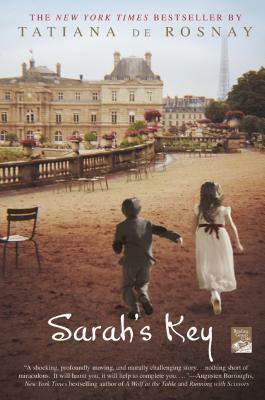
In 1942, Sarah Starzynski is 10 years old, a Jewish child in Paris. There have been rumors of a raid on Jewish homes, but usually the French police take only the men. So, Sarah’s father hides in the basement while Sarah, her mother, and her four-year-old brother go to bed as usual.
But this time, the French police are there to take everyone. They don’t seem to know about her brother, so Sarah locks the little boy in his secret place, thinking she will come back soon and let him out. In the street, her mother has hysterics and screams her father’s name so that he comes out. All of them are taken to the Vélodrome d’Hiver, ultimate destination Auschwitz.
In 2002, Julia Jarmond, an American journalist who lives in Paris, is assigned to write an article about the 60th anniversary of the infamous roundup at Vel’ d’Hiv’, as the velodrome is known. Julia has never heard of it before. Aside from the ultimate destination, the Vel’ d’Hiv’ is known because, like with Hurricane Katrina, thousands of people, mostly women and children, were there for days without food, water, or sanitary facilities.
As part of her research, Julia asks French people if they know about this story. Most of them claim not to, but Julia learns from her father-in-law, Edoard, that the flat her husband Bertrand has been renovating became a possession of the family after the removal of its Jewish family on the night of the Vel’ d’Hiv’. In fact, that family was the Starzynskis.
The novel follows Sarah’s journey for a time, alternating with Julia’s story, as her personal life becomes entwined with her desire to find out what happened to the Starzynskis, particularly Sarah, who was not recorded as having died in Auschwitz. After about half the book, Sarah’s narrative stops.
I know I never read this book before, but some plot points seemed familiar, so perhaps I saw the movie. The plot was compelling enough, but I still had some issues with it, particularly that I couldn’t imagine that after a while a four-year-old child wouldn’t have made enough noise to be found in almost any apartment building.
I had more problems with the writing, though, particularly of Sarah’s sections, and the characterization. I think Sarah’s sections are written in a way to suggest childishness—the sentences are short, most of them in a subject-verb-object order that results in choppiness. Her reactions are naïve, much more so than I can imagine from any Jewish child of ten at that time and place. And ten-year-olds can have as complex thoughts as adults. She seemed, especially at first, more like a much younger child.
The writing is better for Julia’s parts, but there are still inapt word choices and no very strong use of language. It’s mediocre. For example, a glass of limoncello is described as “a beautiful yellow.” Ho-hum.
I felt the novel was interesting enough to finish, but just barely.

 What? Me Read?
A lot of authors seem to struggle with child characters and don’t get the voice right. This book sounds interesting, but I’m not really tempted to read it.
I didn’t think it was that good.
I saw the movie based on this book and had some of the same problems you had with the book. In terms of the story itself, it just didn’t do it for me–and it sounds like the book is the same. Think I’ll pass on reading the book.
It sounds uncaring to say it, but I’m tired of books about this period of history – I feel as if all the stories have been told. I’m also never keen on child narrators so I think this one is a pass for me!
I know what you mean. I don’t know if you’re familiar with the program Masterpiece, which takes British programs and shows them over here. For a while, I stopped watching it because every show was either about WW I or WW II. I just got tired of it. Now I’m getting a little tired of reading about it.
We’re definitely obsessed with both wars over here, especially WW2. And it seems to be getting worse as time goes by – now we get all these sentimental stories about love in concentration camps and so on. It makes me feel a bit queasy, to be honest.
Yeah, that really bugs me, or love between, for example a Jewish girl and a Nazi soldier–so likely. Most of those programs were about the changing ways of life because of WW2. I think things changed more for people on your side of the pond than mine, although by now, all our lives are different.