
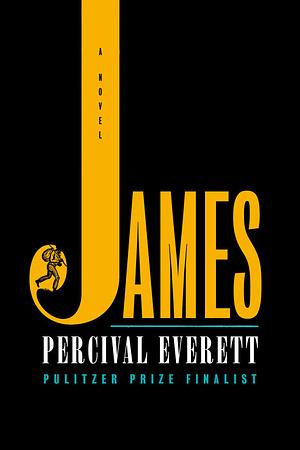
I read James for both my Booker Prize project and my Pulitzer Prize project, which it won. As most people know by now, it is a retelling of Twain’s Huckleberry Finn from the point of view of the slave Jim.
Aside from generally following the plot of the original novel about halfway, James lives in a world that is much more violent than Huck Finn ever had a clue about. Everett has taken a liberty and placed the novel in the 1860s instead of the 1830s or 40s, when the original is set. He also uses a striking conceit: when among themselves the black characters speak more correctly—and sometimes with erudition—than most of the white characters.
Jim—or James, as he prefers to be called—hears that Judge Thatcher is going to sell him away from his wife and daughter, so he escapes and hides on a small island on the Mississippi. Unfortunately for him, Huck Finn has heard that his dreaded father is in town, so he fakes his own death and runs away, ending up on the same island. James realizes right away that he will be blamed for Huck’s “death.”
The two stick together and encounter what Huck thinks of as adventures and James knows to be deadly peril. After all, a slave is lynched later in the book for being suspected of stealing the nub of a pencil from his master. That he did steal it to give to James is beside the point.
The book follows the same basic outlines as Huckleberry Finn until James gets away from the Duke and the Dauphin, but all of the situations are much more deadly. Eventually, James’s inner anger is set aflame.
Everett’s books are witty, but they are also very angry. And he has some surprises for us.
This novel is fast moving and really interesting. It shows facets of the “institution” of slavery in all its ugliness.

 What? Me Read?
I read James last year, when I was doing my own Booker project (I actually made it through the entire list, but only a few days before the prize was announced). I liked James but must admit I wasn’t totally wowed. My own reaction is no reflection on Everett, who’s an enormously talented writer; I’ve just gotten pretty resistant to novels that riff off other novels (maybe it’s all those Pride and Prejudice in Out Space type things I keep seeing in the bookstores!) I’ve also never much liked Mark Twain and his novels, including Huckleberry Finn, my least favorite of his works. That being said, Finn was a perfect vehicle for Everett, who, after all, has a lot to be angry about and who did a great job at using a beloved classic as a means of having his readers re-examine many of their beliefs! James was the first novel I’ve read by Everett but it won’t be the last. He’s a great writer with a lot to say.
Yes, not a Huck Finn fan, either, and I agree about authors reworking other people’s books. That being said, I’ve read some good ones.
You liked this more than I did! I felt it was because I didn’t much enjoy Huck Finn and it was basically the same story told from a different perspective. I gave up halfway through at the Duke and King section, which I had disliked in the original, so clearly didn’t reach the point where the stories diverged.
Oh, I don’t like Huck Finn, either.
I read James for two book club meetings this month. I ended up also rereading Huck Finn and that led me to read a big bio of Mark Twain. It was great fun getting so deep into all of this!
Wow, you’ve been immersed!
I read James earlier this year, at the same time as reading the Underground Railroad by Colson Whitehead. I found the book very interesting and a creative way to explore the experience of slavery and of being black in that time. The way in which it’s told as a retelling of Huckleberry Finn is itself I think a way of reclaiming their own stories, told through their perspective of their own experiences and encouraging people to think more deeply about different perspectives. The thought I was left with is that although there was a search for ‘freedom’, the main character and everyone else in that time could never really be free of their experiences and trauma and racism.
And actually, that probably applies to now. To add to what you said about then, though, even Harriet Beecher Stowe’s famous abolitionist novel showed other races in a stereotypical way, hence the phrase “Uncle Tom.”
I do wonder how immersed I would be in this book. Of course I know the basics of the story of Huck Finn but it isn’t such an iconic part of my reading life as it might be if I was American. I guess the only way to know will be to actually read the book! One day.
Thanks for sharing this review with the Historical Fiction Reading Challenge.
I think it’s good even if you’re not that familiar with the original. I haven’t read Huckleberry Finn since I had to, in high school.