

For week two of Nonfiction November, the host is Frances at Volatile Rune. The prompt is Choosing Nonfiction: There are many topics to choose from when looking for a nonfiction book. For example: Biography, Autobiography, Memoire, Travel, Health, Politics, History, Religion and Spirituality, Science, Art, Medicine, Gardening, Food, Business, Education, Music. Maybe use this week to challenge yourself to pick a genre you wouldn’t normally read? Or stick to what you usually like is also fine. If you are a nonfiction genre newbie, did your choice encourage you to read more?
I’m not actively reading nonfiction this month unless something comes up in my pile. I usually use this month to read other people’s entries and get ideas for books to read in the future. I put a bunch of books on my To Read list last year, but so far, I have only managed to read a few of them. That doesn’t mean I don’t intend to read them.
As far as genres, although I tend to read mostly history and biography, particularly of literary figures, and a bit of true crime, I will read any topic if it seems interesting, even science, which in general I don’t have much interest in. About the only topics I won’t read are self-help and health, because I’m really uninterested in those topics. But psychology, for example, which is related, I find interesting. (I also won’t read business books, especially the “Ten Traits” type, because they are based on very little research and are generally stupidly thought through—and thank goodness, I’m no longer working.)
I thought I’d use this week to talk about some of the more unusual, for me, nonfiction books I read during the year. Unfortunately, I have only posted reviews of one of them so far.
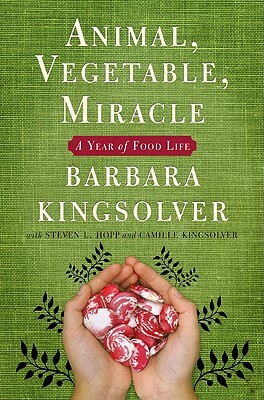
Although I don’t tend to read about health, this year I read Animal, Vegetable, Miracle: A Year of Food Life by Barbara Kingsolver. Now, granted, this book is partially memoir, but it also has lots of information on food topics and the importance of eating fresh food. I actually read this book because it filled a hole in my A Century of Books project that I was trying to get done last year. (It came over into this year by four months!) That’s because, although I tend to like Kingsolver and think she has written wonderful books, she can also be preachy. And she is, a bit, in this book. But it also has lots of information about food topics I hadn’t thought about, includes a bit of memoir, and has tasty sounding recipes!

Now, I like books about maps and mapmaking. I don’t often see one, but I think books about mapmaking and the related subjects, geography and geology, can be interesting. I haven’t reviewed it on my blog yet, but one of my best books, whenever it comes up (it may not make it until next year) will be Pocket Atlas of Remote Islands: Fifty Islands I Have Not Visited and Never Will by Judith Schalansky. This is a lovely book that I read about on someone else’s blog. I’d like to give them credit, but I can’t remember who they are. (I did a quick search hoping a familiar blog name would pop up, but it didn’t, although I saw lots of copies for sale on eBay, surprisingly.) This book is interesting not just because of the islands Schalanksy chooses to talk about but also because of the things she chooses to tell about them, including a topographical map, one story about each place, and the distance from other locations. This is probably the most unusual book about maps I have ever read.

Finally, another as yet unreviewed book for me is Fenwomen: A Portrait of Women in an English Village by Mary Chamberlain. This is a sociology study from the 1970s, when feminism was just starting to make inroads in academia, but it was also the very first book published by Virago, and its reception was fairly astonishing, at least it would probably seem so to people nowadays. It simply interviews as many women in a small village in the fens as it can about their lives, their work, and so on. The updated version that I got includes an Introduction from 2010 that talks about what happened when it was published and includes about twenty pages of beautiful photos at the end.
I’m looking forward to getting new ideas for nonfiction this year.

 What? Me Read?
I find the Pocket Atlas of Remote Islands a fascinating prospect. I love the subtitle: Fifty Islands I have not Visited and Never Will. I hope that is indicative of the tone of the book.
It’s pretty light and entertaining.
Animal, Vegetable, Miracle is one of the only Barbara Kingsolver books I haven’t read. I tried it once and wasn’t in the right space. The Fen sounds so interesting. Both the history of the book and the topic.
I spent my Week Two post on genres in general only highlighting a few books, like you.
https://headfullofbooks.blogspot.com/2025/11/nonfiction-november-week-two.html
I’ve been reading all of the posts in the Linky, and I’ll go back and do it again toward the end of the week.
History, biography and true crime are the topics I tend to read too, although I’m also happy to branch out and try different things. Fenwomen sounds interesting!
Yes, it was!
I love collecting titles during this month too, and then read the books throughout the next year. Of course the temptation for me is to start all of them now…which is of course impossible. ha.
Yes, I didn’t honestly get to some of the ones I bought last year because of this event. I’ll get to them eventually, though.
Thanks for sharing your thoughts, I generally avoid self help and business too
I think the source for The Pocket Atlas you might find is Kate at booksaremyfavouriteandbest.com , she read it for the Islands category of my challenge.
Happy Nonfiction November
That might be, since I follow her. Thanks!
I’ve been collecting titles like crazy!
I love history books, especially those that are huge overviews of a time period or those that cover niche time periods.
The huge overviews, not so much. Huge is okay, but I think too much detail can make me start not following.
I had forgotten about Fenwomen, thank you for the reminder; I heard a programme about it on the radio ages ago and meant to get a copy!
Oh, that’s interesting. Glad to help!
The Fenwomen book sounds interesting and will probably be even more interesting to readers in the future – a snapshot of life in a time and place. Hope you find lots of interesting books to add to your TBR – I’ll be doing my best not to add any! 😉
I thought it was interesting now. For the 70s, some of them still seemed to be living a fairly primitive life.
I’ve struggled with business books too. The ones I’ve read were kind of superficial. I didn’t need a book to tell me that stuff.
They are so obvious you have to wonder why they seem to sell so well.
I really liked the Kingsolver. I saw the Pocket Atlas one somewhere too – but where??? I hope you enjoy finding some interesting ones to add to your TBR. Nearly my week and I’m still so behind with my blog reading!
I need to look at the ones from later this week.
Like you I read mostly history and biography, but if an interesting subject comes up, I can venture out into the unknown. If you are interested in maps, geography I can recommend Prisoners of Geography: Ten Maps That Tell You Everything You Need to Know About Global Politics by Tim Marshall. He looks at different countries and how their geography has influenced the country they have become. Very interesting.
I hope you will find some interesting nonfiction during November.
Thanks.