
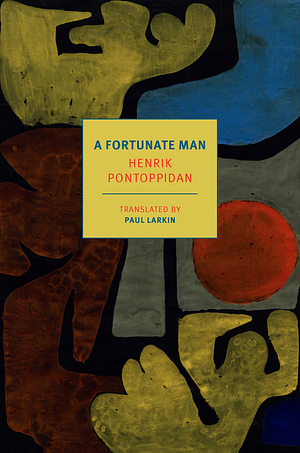
Yes, here it is, time for the Pontoppidan Review-along. Join me and FictionFan and post your own review or leave comments! FictionFan and I decided to read A Fortunate Man, but others of you may have chosen some other work by Pontoppidan.
A Fortunate Man is considered the most important work by Danish Nobelist Henrik Pontoppidan. It is an ambitious work that attempts to capture all the ideas and events affecting Danish life in the mid to late 19th century, and it is also considered to be quite autobiographical. The tensions between the new industrialism and accompanying modern ideas and traditional views of religion is one of the many themes of this novel.
Per Sidenius grows up in rural Jutland in a household dominated by a strict and self-righteous father—a Lutheran vicar. Per is a high-spirited boy, and his father and entire family treat him as if his boyish antics are paving the way to hell. His mother has been bedridden as long as he can remember. Per does not feel as if he belongs there.
This upbringing results in a young man who can’t wait to leave his home and deny all of his father’s religious beliefs. He wants to be an engineer, so his father finds the money—they are poor—to send him to technical school in Copenhagen. But Per is an arrogant youth determined to make his way, and he finds school a waste of time. Instead, he reads voluminously and starts working on a massive project. The growth of Denmark has been stunted since the country lost territory to Germany in the war of 1864. Per feels that Denmark has become a backwater, especially technologically, with its prominent citizens only protecting the status quo. He conceives of a plan to reopen the many waterways that used to cross the Jutland Peninsula, beginning with a freeport in the East, with the idea of revitalizing the entire area. (His dream of lining this waterway with warehouses and factories doesn’t exactly suit our modern sensibilities, but this was the Industrial Revolution.) But he is an unknown very young man with no backing or credentials. Once he finishes his plans, he finds he’s not getting anywhere. And he needs money just to live.
Per falls in with the Salomons, a family of wealthy Jews. He thinks perhaps his problems will be solved by marriage to one of their daughters and is extremely attracted to the younger one, Nanny. However, as he gets to know them, he realizes he cares for the older sister, Jakobe, a much more intelligent and cultured girl. He is also attracted at first by the family’s relaxed and hospitable approach to life. (Later, though, he starts being embarrassed by their outgoing manners and love of show, so beware, this novel contains lots of anti-Semitism. Even Per, engaged to a Jewish girl, tends to stereotype them, as in general, there is a lot of stereotyping of people of various nationalities and groups like Danish farmers, too.)
At first, Jakobe doesn’t like Per, but he is persistent and wins her over so that eventually her parents reluctantly betroth her to Per. Although Jakobe’s brother Ivan works hard to promote Per’s plan and try to line up backers, Per himself is condescending and rude to the money men (they’re a bunch of money-grubbers, he thinks!) and seems to lose interest in the project. Instead, he goes off traveling, supposedly to study but seeming to do little of that (all the while being supported by Mr. Salomon).
Per feels he is never at home anywhere. His father dies, and this death affects him by having him begin to obsess about and eventually re-embrace Christianity, just not the bleak one his father represented. And frankly, he treats Jakobe shamelessly, just before they are supposed to be married.
Pontoppidan is a Realist writer, and I often think that the Realists spend too much time on the negatives of human behavior. Almost up to here, I was rooting for Per, but when he starts delving into religion and we have to read excerpts from religious philosophies and endless ruminations by Per, I lost most of my interest (religion is a black hole to me), and frankly I felt that his behavior from there to the end was even more self-serving than before. In a quest for self-realization, which sounds laudable, I felt as if he would decide what he wanted to do and then find self-justifications for his actions.
Spoilers ahead! There is a scene where he’s basically unloading his family (he feels it would be “best” for them), and first he tells his religious wife that he doesn’t believe in God (is he lying?) and then lies to her that on a business trip to Copenhagen he met another woman, so it will be “easier” for her to split from him. She’ll understand that. (Of course, she’s a simpleton who doesn’t understand anything, at least not according to him.) When she leaves in anger, he looks up to heaven and asks if that was the right sacrifice. Doesn’t believe in God? His sacrifice? He just wants to be free and has found a way to do it. I ended up hating this guy. And then there’s the letter he gets from her years later thanking him for doing the right thing. Sure. I totally buy that.
I really enjoyed Pontoppidan’s The White Bear and about a half to three quarters of this novel. But at some point, I began to feel as if I had been reading it forever. The rest of the novel made me at first bored and then angry. I suspect from reading Pontoppidan’s Wikipedia page that this novel is at least partly biographical. If it is, he wasn’t a very nice man.
A very slight issue. I’m not sure how New York Review Books prepares its reprints and whether machine reading is involved, but usually their editions are immaculate. In this one, though, I spotted three confusions of homonyms in the first 100 or so pages. Interestingly, two of them were the reverse confusion of “bear” and “bare.” That is, in one instance “bare” should have been used but “bear” was, and in the other, the reverse. (One might have been “bear-faced.” I can’t remember.) I couldn’t tell if this was a machine-reading error not detected by an editor, an editing error, or a translation error.
Check out other reviews of Pontoppidan’s books for this event here. I’ll add them as I become aware of them:
- FictionFan (A Fortunate Man and Emanuel)
- Just Reading a Book (A Fortunate Man)
- Kelly’ Thoughts and Ramblings (Emanuel)

 What? Me Read?
Interesting, I didn’t dislike Per as much as you but he’s not an easy person and his dilemma over money is strange, he drops one girl he’s in love with because she won’t further his future success but on the other hand he does despise the money grubbers; a very mixed up young man. I’m glad I’ve been introduced to Pontoppidan though, thank you for organising!
Thanks for your great review, Jane! I liked Per longer than FictionFan did, I think, but he seemed to lose interest in things as soon as he was assured of them, and his treatment of Jakobe was terrible. He didn’t seem to miss that girl he was in love with much, either!
I think I got to like him more as I realised how young he was and gave him excuses!
I liked him more when he was young. As he matured, he did NOT improve!
Great review! Ha, I’m glad I wasn’t alone in coming to dislike Per intensely. That letter – haha! My reaction to it was exactly the same as yours – yeah, sure. It’s one way to let your hero off the hook for being a jerk, I suppose. I don’t want to get too spoilery, but I felt what Pontoppidan did to Jakobe was much the same – designed to make things easier for Per with no consideration of how it affected her character. But I did enjoy all the political and society stuff, and I think I enjoyed the religious stuff more than you. I’m not religious at all, but I still find churches and faith struggles quite interesting to read about. It was a very long book, though – very long!
I have an odd reaction to books about religion. Sometimes I am interested, but I think it was his spiritual cogitations that bugged me. After all, he was even more of a jerk, in my opinion, after he went back to being religious, very self-serving. Maybe that letter said something like “Thanks for doing what you did. I have finally realized what an awful human being you are, so I’m happier without you.”
Haha, that’s definitely what it *should* have said anyway! Will your read Emanuel, do you think?
Maybe, but not for a while.
Homonym slips in published books drive me crazy. It feels like 4 times out of 5, people will write “pallet” instead of “palate” or “palette” (or vice versa) and “diffuse” instead of “defuse.” It always makes me wonder whether publishers even bother paying a human proofreader. AI is unlikely to catch stuff like that.
The Prophets of Eternal Fjord by Kim Leine is a very good (and also fairly long) novel about a priest in Denmark and Greenland. I also liked The Bell in the Lake by Lars Mytting, which is set in Norway.
Pontoppidan’s The White Bear is also about a priest in Greenland, and I liked it a lot.
NYRB’s books are usually immaculate as far as such slips are concerned, which made me wonder about the translation. But you’d think someone who was qualified to translate such a work would know the difference between these homonyms. The transposition, twice, of “bear” and “bare” really took me aback, though. I suppose if they machine-read an old manuscript—sometimes those letters get blurred together, and there are some conventions of merging letters in old manuscripts that the machine reader might not understand (like f, for example). Maybe it would be stupid enough to mix up those two words. But that’s why they need to be read by humans!
Years ago, when I was still reading eBooks, I bought the complete works of six different classic authors from Delphi Press. Such a deal! But in one copy in particular, I think of the oldest novels, I found typo after typo, to the point where I sent in a list to the publishers, which they were happy to get. It was clear that they went straight from machine reading of a blurry old manuscript to eBook.
It’s interesting seeing the different takes on this book. Per sounds like a confused young man, but isn’t that the case for many young people? I believe Emanuel addressed some of the same issues as this one, but in a simpler, shorter manner. I enjoyed my book and thank you for suggesting this review-along. I would never have been introduced to this author otherwise!
It was all FictionFan’s idea, but it was fun! She suggested it after she read my review of The White Bear. I didn’t understand Per as being confused. I think he was too much of an egotist. The more I think about it, the more I believe he was one of those people who likes striving for things but then loses interest after he has them. And he also didn’t really follow through all the way on anything.
Well I’m being kind calling him confused. I don’t think much of folks who seemingly only enjoy the chase, losing interest once they’ve achieved their goal – especially in relationships.
Neither do I.
I seem to have been a bit more sympathetic towards Per but I agree it would have been very difficult to be around someone so selfish, whatever did Philip Salomon think of him I wonder?! There’s so much to discuss we could go on for ages! But with regards the copy, this was the first NYRB book I had read and I was surprised at the number of errors, I thought the worst was ‘Salmon’ instead of Salomon, incredible, it must be a machine reading?
I guess so. I missed that one!