
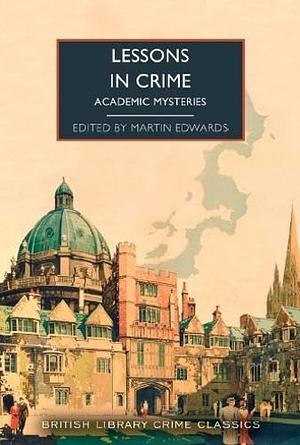
Another British Library Crime Classics volume features mystery stories set in schools. Many of these seem a little more benign in general than their usual collections, only a couple featuring actual murders. In fact, it’s almost halfway through the book before we encounter an actual murder, although earlier there is an attempted one.
In “The Greek Play” by H. C. Bailey (1932), Reggie Fortune’s goddaughter invites him to her school play because she thinks something disturbing is happening. It is.
Sherlock Holmes and Watson visit a school from which a wealthy man’s son has disappeared in “The Adventure of the Priory School” by Arthur Conan Doyle (1904).
Another student disappears in “The Missing Undergraduate” by Henry Wade (1933).
I really enjoyed “The Gilded Pupil” by Ethel Lina White (1936) about a governess who is unwittingly used to trap a wealthy man’s daughter.
“Murder at Pentecost” by Dorothy L. Sayers (1933) doesn’t feature Lord Peter Wimsey but Montague Egg, and some schoolboys help solve the murder of the master.
Schoolboys assist again in the search for a diamond hidden in what was once a private home but is now a school in “Ranulph Hall” by Michael Gilbert (2000).
It’s Raffles versus an old school nemesis during a reunion in “The Fields of Philippi” by E. W. Hornung (1905).
The anatomy professor is substituted for the corpse in “Lessons in Anatomy” by Michael Innes (1946).
I intensely disliked Detective Chief Inspector Dover in “Dover Goes to School” by Joyce Poster (1978). Fat, slovenly, lazy Inspector Dover seems to solve the crime by accident in a story I think was supposed to be funny.
“When the Deaf Can Hear” by Malcolm Gair (1959) is an almost too basic story about the disappearance of some club money.
“Low Marks for Murder” by Herbert Harris (1973) follows languages master George Faraday as he plots to murder the headmaster.
The three most repellent sixth formers in existence form the main characters in “The Harrowing of Henry Pygole” by Colin Watson (1974).
“Dog in the Nighttime” by Edmund Crispin (1954) is very short, as Gervase Fen expeditiously solves the mystery of another missing diamond.
Headmaster Richard Lumsden’s cruelty to a boy is repaid in “Battle of Wits” by Miriam Sherman (1968).
Finally, “The Boy Who Couldn’t Read” by Jacqueline Wilson (1978) features another cruel instructor.
Some of these stories of comeuppance are too far over the top, and at least one story is so abbreviated that it made me think it might be an incident taken from a longer book. In general, like all such collections, the stories are mixed in interest and craft. Overall, the feel of the volume is a little more lighthearted than usual with these collections, with some exceptions that are notably cruel.


For some reason, I always feel a bit short-changed if there isn’t a murder. Not sure what that says about my mental state… ;)
There are some murders, but not as many as in the other collections.