Review 1366: Guard Your Daughters

About every nine months to a year, I sign up for a six-month subscription with Persephone Press. I have enjoyed most of these books and have found several delightful. Such was the case with Guard Your Daughters, originally published in 1953.

Morgan loves her home and family, but her family is very isolated. Her sister, Pandora, is married, but none of the other four girls have opportunities to meet people, particularly men. Their father is a famous mystery writer who tends to remain aloof from his fans, but the actual problem is their mother. They adore her, but her mental problems require her to have absolute calm.

When Gregory’s car breaks down outside the house, Morgan insists he stay for supper and then is hard-pressed to come up with a meal because of the straits of post-war England. All seems to go well until the girl’s mother meets Gregory and declares he is not to be invited back.

Chafing under a life of restriction, Morgan hopes to be allowed to visit Pandora. However, their mother decides that Cressida is to go instead.

On a jaunt to the movies with her youngest sister, Teresa, the girls are offered a ride by Patrick, a cousin of nearby Lord Malfrey. When he finds out who their father is, he is excited to meet him. All goes well until they find out Patrick has ulterior motives.

This novel is charming, reminding me a little bit of I Capture the Castle or Cold Comfort Farm. It is light, with a more serious ending, and you come to care for this eccentric family.

Related Posts

Nightingale Wood

Sisters by a River

Bramton Wick

Review 1365: The Witch Elm

Best of Ten!
Tana French is really good at evoking an atmosphere of dread, the knowledge that things are not going to turn out well. In The Witch Elm, though, she departs from her usual Dublin Murder Squad series somewhat. Instead of a narration from the point of view of one of the cops, it is written from that of another character and takes quite a while to work up to the murder.

The novel begins with a crime, however. Toby is out for drinks with his friends celebrating not having been fired from his job. He works PR for an art gallery that had been preparing a show of disadvantaged artists put together by a man named Tiernan. Toby found out that the most gifted work was not done by the alleged artist but by Tiernan himself, but it was so good that Toby didn’t tell. Now his boss has found out and cancelled the show but is allowing Toby to minimize the damage.

After Toby arrives home, he is awakened by robbers, who beat him badly. He nearly dies and suffers neurological damage and memory loss. He is enraged, though, when the police detective implies that the attack was personal, so he must know his attacker.

During his recovery, he tries to keep his friends and family from realizing how badly hurt he was, and he is not happy when he is contacted by his cousin, Susanna. It turns out his Uncle Hugo is dying of brain cancer, and Susanna would like him to stay with Hugo at his home, Ivy House, where Toby and his cousins, Susanna and Leon, lived every summer when they were kids. He decides to go, taking along his girlfriend, Melissa.

Although at first the time at Ivy House seems idyllic, the three enjoying living together only interrupted by family Sunday lunches, and Toby helping Hugo with his genealogical research, the house has a secret. When Hugo calls a family meeting to discuss the disposition of the house, Susanna’s son Zach finds a skull in a hole in the wych elm at the back of the garden.

Soon, the house is overrun by police, who discover a skeleton in the tree. The family imagines it could have been there a long time—until it is identified as Dominic Ganly, a schoolmate of Toby’s, Susanna’s, and Leon’s, a boy who supposedly committed suicide by drowning the summer after school ended.

Toby cannot imagine how Dominic got inside the tree, but his memories of that time are intermittent. Detective Rafferty, however, thinks he knows something, appears in fact to think that Toby did it. Toby starts to wonder if he did.

This is truly one of French’s darkest novels, about the damage small acts can create, even for innocent people, and about how people can be blinkered by their own interests. I was riveted throughout, wondering where it was all going.

Related Posts

The Trespasser

The Secret Place

Broken Harbor

Review 1364: Madame de Treymes

If you have read Edith Wharton’s The Age of Innocence, the situation in her novella, Madame de Treymes, will seem familiar. As Madame de Treymes was written before The Age of Innocence, perhaps Wharton was trying out some ideas in this novella that she developed more fully in the later novel.

John Durham is in love with Madame de Malrive. He knew her as Fanny Frisbee in their younger days in New York, but now she is separated from her husband and has a young child. He proposes to her, expressing himself willing to adapt to any conditions she may make, but she says her husband’s family will never agree to a divorce. She has used her leverage because of her husband’s dissolute life to keep her son and does not want to jeopardize her custody.

Fanny says that the family never explicitly states its intentions, and she never knows what they are going to do. Her sister-in-law, Madame de Treymes, seems to be sympathetic, however, and she asks John to try to discover from her the family’s intentions.

Durham arranges a meeting with Madame and is first inclined not to believe the stories he’s heard about her. However, the meeting goes badly wrong.

This novella is about the inability of the aristocratic French and the Americans of the same class to comprehend each other. A misunderstanding on both sides results in unforeseen circumstances. This novella is subtle and more of a character study than a plotted piece, about the gulf between two very different cultures. I read this interesting novella for my Classics Club list.

Related Posts

The Age of Innocence

Obscure Destinies

Someone At a Distance

Review 1363: Into the Water

Jules has been estranged from her sister, Nel, since she was thirteen. That’s why, when Nel called her asking for help, she didn’t even bother listening. Now Nel is dead, having fallen from the top of a cliff into the river in the Drowning Pool, the location of several suicides by women as well as witch drownings centuries before.

When Jules travels to Beckford to take charge of her fifteen-year-old niece, Lena, she finds a lot of rumors going around. Louise Whittaker, whose daughter, Katie, died in the same place as Nel a few months ago, thinks Nel was responsible for her daughter’s death because of her research into the Drowning Pool. Is there a connection between the deaths, and did Nel commit suicide? Nickie Sage, the local psychic, thinks the police should be looking at an earlier death, that of Lauren Slatter, who died at the Drowning Pool when her son Sean was six.

I have to say that Hawkins is good at throwing in plot twists and keeping your attention. Although this novel is probably classified as a thriller, it is not so much suspenseful as it is complex. It keeps you guessing.

Related Posts

The Girl on the Train

In a Dark, Dark Wood

The Widow’s House


Review 1362: Begin Again

In the 1930’s, generational social changes away the Victorian age occurred, including sexual and social liberation. Begin Again follows four young women recently down from Oxford as they try to redefine themselves in the light of these changes.

Leslie is living at home, but she regularly visits her friends Jane and Florence in London. She has a romantic idea about the freedoms the two girls have and wants to get a place of her own in London, an artist’s studio, using her inheritance. Her mother doesn’t want her to use up her inheritance and has suggested she live with her aunt. Leslie, in truth, would like a little opposition to her plans instead of her mother’s acceptance and prefers complete independence to living with her aunt.

Jane and Florence are living the realities of the independent life, which means no servants and often very little food. Jane takes everything in her stride and doesn’t seem to have any deep feelings for anything or anyone. Unfortunately, this includes her boyfriend, Henry, who wants constant assurances of her devotion.

Florence, however, hates her office job and sometimes feels miserable about her and Jane’s lack of comforts. She feels that the girls who started work straight out of school have the advantage over her and that her Oxford education is not valued at work.

Sylvia lives in her parents’ home but has a lover, Claude. Despite their mutual devotion, Sylvia has kept Claud away from her family, assuming they will not get along. She believes in being absolutely honest and behaving honestly rather than worrying about how others are affected by this honesty. Her younger sister, Henrietta, has been taking Sylvia’s beliefs seriously, maybe more seriously than Sylvia intends, and is thinking of embarking on an affair with a middle-aged married man.

Each of the girls has to adjust her theoretical views about life to deal with reality. This is a sometimes amusing, true-to-life novel about how naive, idealistic young women learn to adapt between the gaps of Victorian and Edwardian values and Oxfordian theories and real life. I enjoyed it very much. The characters are depicted affectionately and seem very real.

Related Posts

My Mortal Enemy

The Home-Maker

Someone at a Distance

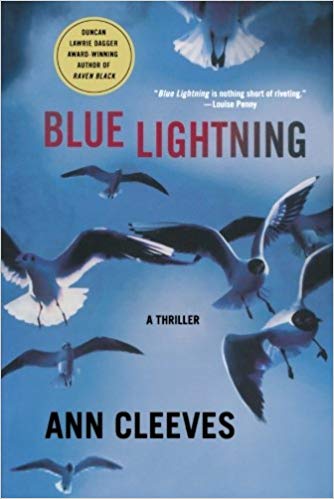
Review 1361: Blue Lightning

Cover for Blue LightningI started watching the Shetland television series, based on Ann Cleeves’s books, before reading the books but found that they had changed the TV series just enough to allow the books to still surprise (or vice versa). Unfortunately, however, I accidentally read one of the later books before this one, so I knew about a key plot point going in.

Inspector Jimmy Perez takes his fiancée, Fran, home to Fair Isle to meet his parents. A storm comes in shortly after their arrival, making the island inaccessible. So, although he is supposed to be on vacation, when Angela, the scientist at the island bird research center, is found murdered, Jimmy must begin working the case by himself.

He finds that Angela, although married to the site administrator, Maurice, was quite free with her favors, especially to younger, fit men. That would seem to make Maurice a suspect, but he doesn’t appear to care. Further, Angela was not well liked, being arrogant and rude to most people. The night of her murder, she had a big fight with her stepdaughter, Poppy.

Jimmy’s team and the Fiscal finally make it over to the island, but they have only been there a short time when Jane, the cook at the research center, is also found dead. Jimmy thinks she must have found out or witnessed something.

As usual, Cleeves keeps us guessing. I thought I knew who the murderer was through most of the novel only to be wrong about that and the motive. There is a shocking event toward the end of the novel. I couldn’t judge its effect, because that was the thing I knew about.

Related Posts

Raven Black

Red Bones

White Nights

Review 1360: Abide with Me

Cover for Abide with MeElizabeth Strout is known for her compassionate explorations of true-to-life characters. Set in the late 1950’s, Abide with Me explores the states of mind of Tyler Caskey, a troubled minister, and his congregation.

Tyler is in mourning for his wife, who passed away from cancer. His mother has insisted on caring for his youngest daughter, Jeanne, while his five-year-old daughter, Katherine, lives with him.

Tyler is afraid he has lost his relationship with God. He is performing his duties without joy or inspiration. Katherine is having troubles in Kindergarten, because her teacher can’t understand that she is grieving. Aside from this, Tyler only feels comfortable talking to his housekeeper, Connie, and rumors are beginning to go around.

Misunderstandings divide the minister from his congregation. Strout builds tension as the pressures upon the minister build.

This is another insightful and touching novel by Strout. In some ways, it reminded me of Gilead by Marilynne Robinson, except that it doesn’t require as much erudition to understand it.

Related Posts

My Name Is Lucy Barton

Anything Is Possible

Gilead

Review 1359: Go to My Grave

Cover for Go to My GraveDonna Weaver and her mother have invested everything in The Breakers, a large house on the Galloway coast that they have made available as either a self-catered or fully catered vacation rental. Donna is excitedly awaiting their first guests, an anniversary party of cousins and their spouses, while her mother attends a hospitality convention.

When the guests arrive, however, it becomes clear that they have all been there before. Twenty-five years ago, they attended a 16th birthday party for Sasha, the man whose wife, Kim, has planned this trip.

The reactions of the guests when they recognize the house make it clear that they do not relish memories of this party. Then, shortly after they arrive, things begin appearing in the house that hearken back to that occasion. What is happening in the house? Is one of the guests trying to gaslight the others?

Occasionally, we see flashbacks to 1991, when a 14-year-old local girl named Carmen is invited to the party. When she arrives, she brings along her 12-year-old sister.

This novel is truly riveting, although the answer to what is happening seems a little too contrived. Although McPherson is known for her “cozy” thrillers, this one is probably more accurately described as a modern gothic thriller. The ending to it is a bizarre mixture of cozy and chilling. I didn’t know quite what to think of it, but the best term I can come up with is “morally challenged.” We are presented with an ambiguous conclusion to tone down the ending, but I know very well what I think happened.

Related Posts

The Day She Died

House. Tree. Person

As She Left It

Review 1358: Literary Wives! A Separation

Today is another review for the Literary Wives blogging club, in which we discuss the depiction of wives in fiction. If you have read the book, please participate by leaving comments on any of our blogs. Be sure to read the reviews and comments of the other wives!

Emily of The Bookshelf of Emily J.
Eva of Paperback Princess
Lynn of Smoke and Mirrors
Naomi of Consumed By Ink

* * *

The unnamed narrator of A Separation receives a call from her mother-in-law, Isabella. Isabella has been trying to contact her son Christopher, the narrator’s husband, and demands to know where he is. What Isabella doesn’t know is that the narrator has been separated from Christopher for six months because of his infidelities. She has promised him to tell no one, which has become awkward because for three months she has been living with another man, Yvan.

Isabella can’t believe the narrator doesn’t know where Christopher is. His mother has traced him to a hotel in rural southern Greece and demands that the narrator go there to find out what is going on. For some reason, Isabella is alarmed.

The narrator makes some inexplicable decisions during this novel, almost as though she is obeying instinct rather than thinking. The first one is in not telling Isabella that she and Christopher are separated. The second is in actually doing what Isabella asks.

When she arrives at the hotel, she finds that Christopher is indeed staying there, researching a book on death rituals. However, he has been away for a few days. The narrator decides to wait for his return. Soon, something happens that forces her to re-evaluate her relationship with Christopher.

This novel is a carefully observed work about the complexities of marriage, love, betrayal, and loss. As the narrator, with her secret, is forced more and more back into the role of wife, she uncovers feelings about her husband that she didn’t know she had. Although a fairly simple story plotwise, the novel delves into the layers beneath the facades of marriage. This is a much more intelligent, sophisticated look at marriage than we have yet read in this club.

What does this book say about wives or about the experience of being a wife?

This novel is one of the most complex and true-to-life that we have read for this club, while not really looking at what the marriage was like while the couple were still together. Even though the narrator considers her marriage over, and in fact, goes to Greece planning to ask for a divorce, she finds that the bonds of marriage affect her more strongly than she would have guessed. She finds herself forced back into the role of wife, for example, experiencing the dichotomy of having to make decisions she doesn’t feel she has the right to. The situation forces her to re-evaluate her relation to Christopher and his family. She is bound in ways she didn’t expect.

Literary Wives logoEven though Christopher was the one who strayed and her relationship with Yvan didn’t begin until after they separated., she feels she has betrayed him in some way through that relationship.

I wonder about Kitamura’s decision to make the narrator the only unnamed character in the novel. I have only seen this device used a couple of times, and I can only put a name to one of them now, Daphne du Maurier’s shy, self-effacing narrator in Rebecca. Surely the reason that Kitamura used this device is not the same. Of course, the novel is narrated in first person, and we don’t think of ourselves by our names. Still, no one calls her by her name, either. Perhaps Kitamura uses the device because in some ways the narrator seems to be functioning blindly and is at times an unreliable narrator because she is unaware of her own motivation. I wonder if anyone else has an insight into this.

Related Posts

Stay With Me

After You’d Gone

First Love