
 This week’s Best Book is Between the Woods and the Water by Patrick Leigh Fermor!
Author: whatmeread
Day 370: The Preacher
 A little boy on vacation in the fishing village of Fjällbacka goes out early one summer morning and sees the body of a young woman in a crevice called the King’s Cleft. When the police come to remove the body, they discover bones of two more women beneath it. The medical examiner finds that many of the bones were broken, not only in the recent corpse but in the old remains, in exactly the same way.
Eventually, the older bodies are identified as Siv Lantin and Mona Thernblad, two young women who disappeared 25 years before. Although those crimes were never solved, Gabriel Hult reported that he saw his brother Johannes with Siv Lantin the night she disappeared. Johannes later committed suicide, according to his family because he was innocent and couldn’t bear the suspicion.
Patrik Hedström is on vacation with his massively pregnant wife Erica, the main character of Läckberg’s first novel, but he is called back to head this investigation. Soon the situation becomes more urgent, because another young woman who is staying in a local campground with her parents disappears while hitchhiking into town.
Fearing that Johannes Hult is perhaps not actually dead, Patrik has his body exhumed. Johannes is indeed dead, but he was murdered, not a suicide, and semen found on the most recent victim’s body belongs to a close relative of Johannes.
This situation still leaves Patrik with several suspects in the feuding Hult family, all descendents of a leader of an odd religion that believes in faith healing. Gabriel Hult inherited the property of patriarch Ephriam Hult, known as “The Preacher,” leaving Johannes’ sons Stefan and Robert poverty stricken. Gabriel’s son Jacob runs a farm for reforming delinquent teens and continues with his grandfather’s religious work, although he does not have the ability of faith healing that his father and uncle supposedly possessed as boys.
While Patrik stresses over the case, Erica suffers in the oppressive summer heat and tries to cope with holiday guests who descend upon them without notice.
As with Läckberg’s previous novel, The Ice Princess, I liked this book perhaps more than it deserves. Patrik and Erica make attractive, likeable main characters, and the characterizations seem to have more depth in general than I’ve found with other Swedish police procedurals. However, again, Läckberg’s writing seems clumsy at times, particularly the dialogue.
Aside from a confusing typo early in the book where Johannes is referred to as Stefannes, I had a serious problem with the chronology of the mystery. The older crimes took place in 1979 and yet 30ish Patrik and Erica both say they remember them, not that they heard of them. This discussion confused me so much that I actually looked up the original publication date of the book, thinking that it may have come out earlier than I thought, but it was published in 2004. Although I suppose this timing is not impossible, it may have worked better to have an older police officer clue Patrik in to the details of the case.
The police investigation details also seem a little odd. It is hard for me to believe that any police station in Sweden would still have a modem connection. In addition, maybe they do things differently in Sweden, but blood tests for DNA analysis seem excessive. Of course, they are necessary for the plot, which, if that is the only reason they are done, makes them a cheat.
The Ice Princess depended for its plot mostly on Erica poking around where she shouldn’t be, and I think that works better for Läckberg than a police procedural, about which she seems to need to do more research. Nevertheless, despite these criticisms, I still find myself liking these books a lot.
Day 369: The Alchemist
 In my opinion, a fable for adults requires something striking to hold the attention. Telling the story as one would to a child is not going to cut it. It must be wittily written or beautifully illustrated or have some other compelling characteristic.
I have to admit I did not finish this fable about a Spanish shepherd boy who is told to travel to Egypt to find his “personal legend.” I found it heavy handed in approach and did not find anything special about the way the story was told to make it outstanding. I found the fairy tale writing style irritating.
I know this book has been very popular, but it is not the book for me. I guess I am reminded of the popularity years ago of Jonathan Livingston Seagull, another book I thought was wildly overrated. I could tell where The Alchemist was going within 50 pages, and I didn’t want to go with it.
Day 368: Dead Lagoon
 Dead Lagoon is the most atmospheric of the Aurelio Zen mysteries I have read. In the novel, Zen returns to his home town of Venice, ostensibly to look into the “haunting” of the Contessa Zulian, his mother’s old employer, who is convinced that costumed “swamp dwellers” are invading her home. The contessa has long ago been deemed batty because of a tale she has been telling for years about a missing daughter. Although Zen has hitherto been incorruptible, he is actually there to work on the case of a missing wealthy American businessman, being paid under the table by the businessman’s family.
As Zen wanders or boats through the misty winter setting of Venice, visiting places he knew in his youth, he keeps stumbling over “ghosts,” some from his own past, and some actual dead bodies. A fisherman who spotted a ghost on the Isle of the Dead is drowned, then a crooked cop, head of the Venice drug squad, is found smothered in a sewer. In the search for the ghost on the cemetery island, an unexplained skeleton is found.
Zen’s investigation leads to a string of discoveries, of dishonest police, drug smuggling, and ambitious local politicians. His biggest discovery, though, is about his own family, including that nothing is what he thought it was.
I think what makes this Aurelio Zen book stand out is its depiction of Venice. The plot itself is rather disjointed and difficult to explain. Zen is able to solve both cases, but some readers have expressed frustration about the conclusion.
Day 367: Between the Woods and the Water: On Foot to Constantinople: From the Middle Danube to the Iron Gates
Best Book of the Week!
In December 1933, 19-year-old Patrick Leigh Fermor set out to walk from Amsterdam to Constantinople. He wrote about the first leg of this journey years later in A Time of Gifts, ending the book as he crossed a bridge from Czechoslovakia into Hungary. In 1986, he finished this memoir of the second leg of the journey, which begins on that same bridge in Esztergom the evening of Easter Sunday and ends in the early autumn of 1934.
In the second part of the journey, Leigh Fermor breaks his rule of making the entire trip by foot and also spends much of the time in more luxurious surroundings than he did in the first part. As he makes his way through Hungary and the Romanian border, as it was then, into Transylvania, he is passed by his growing list of acquaintances and friends from one kastély to another, spending days with a learned professor discussing languages and history, borrowing a marvelous horse from a count for part of the journey across the Hungarian plain, staying for weeks with a new friend named István in Romania, and dallying with a young married woman on a motor trip with István to Prague.
Leigh Fermor does not spend all his time in such exalted circles, though. He happily camps out with gypsies, spends the night outside a shepherd’s cottage, is hosted by a Jewish family after an afternoon spent discussing the Hebrew language, sleeps in a cave, and camps on an island in the Danube near a village inhabited by resettled Turks. On his way, he describes the scenery in lyrical terms, explains the ancient history of each area he passes through, and tells us about the people he meets and the sights he sees. His chronicle is supported by the notebooks he kept and a nearly photographic memory of a remarkable journey. In addition, he tells us that he revisited some of the areas 20 years later.
This memoir is beautifully written. Although relatively unacquainted with formal learning, having abandoned military school at that early age, Leigh Fermor has an astonishing range of interests, and he tells us all about them. He is constantly plunging into dusty tomes in his hosts’ libraries but is just as ready to dance and drink the night away. This is a delightful series of books, still full of the youthful joy and enthusiasm Leigh Fermor must have felt when he was 19 and 20 years old.
In the Appendix to this book, Leigh Fermor reflects on how many of the sights he writes about in this book are now under water, for the Danube valley that he traversed and the torrents and currents that once rushed along it as well as the Iron Gates themselves have been subsumed by a huge concrete dam and hydro-electric power plant. And of course there have been other causes of destruction since 1934.
Unfortunately, The Broken Road, the unfinished manuscript of the final portion of the journey, is being republished but is not available from Amazon until March of next year! (It may be available used from some other site.) I am so disappointed to find the book never gets us all the way to Turkey but stops in Greece.
Special Post! Best Books List!
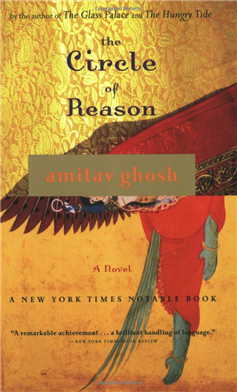 This week’s Best Book is The Circle of Reason by Amitav Ghosh!
Day 366: The Pale Blue Eye
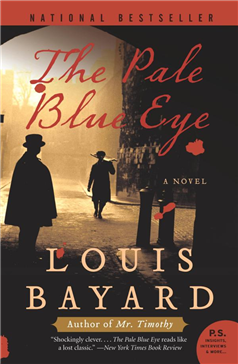 Gus Landor, a retired New York police detective, is dying, and he writes the account of his last case in The Pale Blue Eye. Gus is a lonely widower who earlier moved up to the mountains near the Hudson Valley with his wife and daughter to help improve his lungs. But his wife died within a year, and his daughter left him soon after. So, Gus lives as a veritable hermit.
On an October morning in 1830, an officer from West Point fetches him. The body of a cadet named Fry was found hanged the night before, presumably a suicide, but during the night his body was stolen and later he was found with his heart removed. Superintendent Thayer and Commander Hitchcock wish to hire Landor to find who stole the heart. Landor is quick to figure out that Fry did not commit suicide but was murdered. A mysterious message clutched in his hand seems to indicate an assignation.
Landor soon realizes that his investigations on the reservation will be sorely hampered without the assistance of an inside man. So, he asks for the help of an unusual cadet he has met who is not in good favor with the academy–Cadet Edgar Allan Poe.
This is a clever novel with a macabre mystery that would have been completely to Poe’s taste. Just when we think everything is figured out, Bayard presents us with a twist. His portrait of the young Poe, bombastic, ridiculously romantic, and fearfully intelligent, is a great pleasure.
I would only fault the novel for a slow-paced middle section, and only because Landor doesn’t seem to be doing anything. Most of the plot is driven forward by Poe’s reports, which begin to dwell on his infatuation with a lovely young woman, Lea, the daughter of the post doctor, who unfortunately suffers from the “falling sickness,” or epilepsy.
Of course, Landor is doing something–he’s deciphering Fry’s diary–but since he doesn’t relate its revelations, his investigation seems to flag, and he barely seems to look into a second death, with a second missing heart. Otherwise, the novel is well written, with well-developed and interesting characters and a surprising ending.
Day 365: Othello
 I have been reading and viewing a few of Shakespeare’s tragedies lately. Othello, in contrast to Hamlet, seems to be about very little in terms of overarching themes. Whereas Hamlet makes observations about death, revenge, the place of women in society, the relationships between fathers and their children, Othello is about what? Perhaps trusting too easily? Perhaps trusting not enough? Of course, it is about racism, jealousy, and betrayal, but what does it say about them?
The plot, of course, is that Desdemona elopes to marry the Moor, Othello, having fallen in love with him as he told the tales of all his adventures. Iago sees this marriage as an opportunity to have his revenge on both Othello, who has given the position he expected to Cassio, and on Cassio himself. He does this by making Othello think that Desdemona has betrayed him with Cassio.
To me the play is mostly about trust. Desdemona is a fool, it seems, to entrust her life to a man who would doubt her on so little evidence, actually before there is any evidence. Why is Othello so quick to trust Iago, a man he has overlooked for promotion, who has reason to hate him, and yet so quick to distrust his wife, who has never given him reason to doubt? Of course, this contrast says something about society’s view of women at the time.
Perhaps also Othello is a good excuse to write the part of a truly evil villain, Iago. For certainly Iago’s is the most important part.
Why is this a tragedy? Is Othello a great man brought down? I suppose he is great by virtue of his military adventures, but he is brought down by his own stupidity and gullibility. Desdemona is nothing but a victim, completely helpless to control her fate. This is not my favorite Shakespeare play, filling us with dread as it does from almost the beginning.
Day 364: Hell Is Empty
 This Walt Longmire novel is more like an adventure story than a mystery.
Walt and his deputy Sancho are transporting prisoners to a rendezvous with other county sheriffs and FBI agents. One of the prisoners, a sociopath named Reynaud Shade, has confessed to murdering a boy and burying him in the Bighorn Mountains. During this trip he is supposed to take the feds to the body.
After Walt drops off his prisoners and leaves the meeting, he learns that the prisoners have escaped with the help of accomplices. Finding one sheriff badly injured and a federal officer dead, Walt sends Sancho off for help and goes alone after the convicts and their two hostages into the Bighorn Mountains during a snowstorm.
This Longmire novel is notable for the mysticism that occasionally appears in the books. In this case, Walt again runs into the troubled Vietnam vet Virgil White Buffalo, who assists him in an unusual way.
The Longmire novels are not just whodunnits, but true ensemble pieces that further develop Longmire and the regular characters with each entry in the series. Wyoming is a character, too, and in this case, the mountains during a massive snowstorm make for a grueling environment.
Day 363: The Captive Crown
 At the beginning of this novel, the third in Tranter’s Stewart Trilogy, Jamie Douglas has fled to the highlands after being declared an outlaw following the disastrous battle of Homildon. That no Scot who fought in the battle would so call him is no concern to Robert Stewart, Duke of Albany and the Governor of Scotland.
Jamie is living with his family on the estate of Alexander Stewart of Badenoch, acting Justicaire of the Highlands. Although King Robert III is still alive, he has handed over the government to his brother Robert of Albany. His young son James, heir to the throne, has been captured by the English on his way to France, where his father sent him for safety after the death of his older son, David, at the time in Robert of Albany’s custody.
Jamie, who has always believed that the Duke of Albany plotted the murder of his chief, the Earl of Douglas, also believes that David Stewart was starved to death at Albany’s order. Jamie is content to stay away from the Lowlands and serve with Alexander.
The plot of this novel is a lot more difficult to describe than that of the other two, as it covers the significant events of several years in Alexander Stewart’s life, including battling the invasions of Donald of the Isles, forming an embassy to the British to treat for the release of King James after Robert III’s death, privateering against the British, and so on. This is a fault with the novel, constrained as it is by actual historical events to seem disjointed. It is definitely the weakest of the trilogy and does not make a satisfying ending for the series.

