
 I am a few days behind on my Best Book post! Last week’s Best Book was A Storm of Swords by George R. R. Martin.
Author: whatmeread
Day 206: Special Assignments: The Further Adventures of Erast Fandorin
 I have been following Boris Akunin’s Erast Fandorin series for several years. At first I liked Akunin’s shy, skinny, intellectual young hero. But then Fandorin transformed himself into a muscle-bound Putinesque superhero wannabe, so I lost most of my affection for him.
Set in Tsarist Russia, Special Assignments is actually two novelettes about Fandorin cases. The first, “Jack of Spades,” is a silly case where Fandorin is pursuing a clever con artist. It is supposed to be funny, I think, but I mostly missed the humor and found it ridiculously overcomplicated.
The second story I did not finish once I grasped where it was going. Called “The Decorator,” it is about Jack the Ripper moving his operations to Moscow. However, it becomes quickly obvious that Jack is supposed to be not only a woman but one who is murdering prostitutes because they are defiling their bodies. The whole idea was so abhorrent to me that I refused to read any more of it.
Day 205: The Journal of Mrs. Pepys
 I began reading Samuel Pepys’ famous diaries years ago, but found it difficult to understand many of the oblique references to events of the time and found many of the entries very trivial. There was also a whole lot of drinking going on. However, I thought I’d give the fictional journal of his wife a try by reading The Journal of Mrs. Pepys: Portrait of a Marriage by Sara George.
The journal follows the course of the Pepys’ marriage and their rise in prosperity. George was careful to follow closely the events related in Samuel Pepys’ diary, which somewhat hampers the plot. The novel looks at these events from the point of view of Elizabeth Pepys, particularly how she reacts to her husband’s frequent absences and philandering.
The novel provides an interesting insight into the events leading up to and during the Restoration–particularly the eagerness with which the populous welcomes Charles II to the throne and the rapidity with which they tire of the court’s profligacy and debauchery.
Also of interest are some of the customs observed. I was intrigued by how freely the Pepyses behaved with their servants, treating them as if they were friends and then getting into spats with them for taking liberties. Also of interest were some of the social behaviors, like the celebration of Valentines Day, where women picked their valentines, who then had to buy them expensive gifts. And then there were the freedoms of male friends to walk up into ladies’ bedrooms or of both sexes to share bedrooms on a trip away from home without any indication of scandal.
Written mostly in modern English, the novel manages a fine balancing act between understandability and the correct use of outdated terms or terms that have changed their meanings with time.
Although I found the novel interesting enough, by nature of the concept, it could not follow the traditional plot structure of a series of building climaxes. There is a climax at the end, but generally the novel stays fairly level.
Day 204: Unspoken
 As you have probably figured out by now if you have been following this blog, I have spent a lot of time trying mysteries written by Scandinavian authors. Unspoken by Mari Jungstedt is probably one of the less successful of them, although it has an interesting plot.
The novel is set in winter on the island of Gotland. Fourteen-year-old Fanny is missing. She seems to have no friends and only an unstable mother to care about her. She spends most of her time caring for the horses at the local racing stable.
Seemingly unconnected is the murder of an alcoholic photographer named Henry Dahlström. But Dahlström recently won a large sum of money at the race track. Inspector Anders Knutas and his team are investigating both incidents.
As I said, the plot for this novel is interesting, but the writing is so choppy as to be distracting, and the characters seem undefined. In addition, a love affair between Johan Berg, a reporter who gets involved in the investigation, and a married woman seems completely pointless, although I understand this is a continuing relationship from a previous book.
I noticed recently that there is a blog that evaluates book cover art, so I’ll just say this, sort of tongue in cheek. I was struck by how atmospheric the cover to this book was and just wish that half of that atmosphere spilled over into the novel.
Day 203: A Storm of Swords
Best Book of the Week!
My notes for A Storm of Swords, the third entry in George R. R. Martin’s A Song of Fire and Ice saga, say “This series just keeps getting better and better.” This novel picks up slightly before the end of the last one.
The evil King Joffrey Lannister has set aside his betrothal to Sansa Stark so that he can marry Lady Margaery Tyrell. Sansa is forced to marry Joffrey’s uncle Tyrion, the dwarf. Tyrion treats her gently, but she remains afraid of him. Soon, Joffrey is murdered, and Tyrion and Sansa are accused of the crime.
Jaime Lannister has made a deal with Catelyn Stark for his freedom in return for Catelyn’s daughters. He goes off firmly intending to meet his part of the bargain, escorted by the knight Brienne of Tarth.
Robb Lannister’s army has smashed the Lannister forces in the Westerlands, but Robb has ruined an important alliance with the House Frey by marrying Jeyne Westerling of the Crag instead of his intended Frey bride. He agrees to a Frey marriage for his uncle in an attempt to make amends.
Arya Stark is still wandering, trying to get home to Winterfell. The group she is traveling with encounters Sandor Clegane, The Hound, who kidnaps her.
Up at the Wall, Jon Snow has disappeared on a scouting mission with Qhorin Halfhand. Although Halfhand has commanded Jon to act as an oathbreaker so as to infiltrate the wildings, when he returns, the members of The Watch think he has betrayed them. Bran Stark and his friends Jojen and Meera Reed, having hidden in the crypts during the destruction of Winterfell, arrive at the Wall in Jon’s absence and go on farther north.
In the East, Daenerys Targaryen gives up one of her dragons to buy an army of eunuch slaves called the Unsullied. Her hatred of slavery is such that she orders the Unsullied to sack the slaver cities and frees all the slaves.
Martin shocks you at times by killing off some of your favorite characters. But are they all really dead? If you haven’t read any of these books, you’re missing an exciting series.
Day 202: The Lantern Bearers
 If you are historical fiction lover and are not familiar with Rosemary Sutcliff, I recommend that you try one of her books. She is best known for her novels about the Roman occupation of Britain and the interaction between the Romans and the various British peoples. Although many of her books are classified as children’s literature, the ones I have read are just as suitable for adults. My review today is of a Sutcliff book I read most recently, which unfortunately is the third book of her acclaimed Eagle of the Ninth trilogy, The Lantern Bearers. Although she wrote a series of eight books about the Aquila family, three are usually grouped together and sometimes can be purchased as one book. The other two are The Eagle of the Ninth and The Silver Branch.
The Lantern Bearers is about the desertion of Britain by the Romans and its subsequent inundation by marauding Saxons. Aquila is a soldier with the last battalion on Britain. He is recalled to his regiment to withdraw from Britain and leave his father and sister behind in the home they have occupied for generations.
Aquila finds that his heart is with Britain, so he deserts his regiment and returns home. However, the day after he arrives, his home is attacked by the Saxons, his father is killed, and he and his sister are enslaved.
Without giving too much away, I will say that the story eventually focuses on the rise of the British ruler Ambrosius and his adopted son Artos, from whom we get the stories of King Arthur.
I think these books are fascinating, although of the three in the trilogy, my favorite is The Eagle of the Ninth (which, by the way, was recently made into a very good movie that no one apparently went to see; I recommend it). If I had any criticism of this book, which is carefully researched, well written, and full of action, I would say that sometimes it seems as if Sutcliff thinks the Roman occupation of Britain was completely positive. I doubt if the Britains felt that way when they were conquered. However, even though her heroes are often Romans, her ideas are more nuanced than that.
If you decide to read this trilogy, I suggest you start with The Eagle of the Ninth, although the books are far enough separated in time to be read as stand-alones.
Day 201: The School of Night
 Coincidentally, this summer I read and reviewed Shadow of Night, and The School of Night by Louis Bayard is another novel that deals with the School of Night, a group of Elizabethan scholars who pursued forbidden knowledge. Its members were Sir Walter Raleigh, Thomas Harriot, and Kit Marlowe, among others. The School of Night follows events in two time periods, the present and 1603.
Ten years ago Henry Cavendish was an Elizabethan scholar with a promising future, but he was disgraced when he accepted as legitimate a forged letter supposedly by Sir Walter Raleigh and presented it at a conference. Since then, he has barely eked out a living, teaching part-time, doing editing work, and taking whatever jobs he can get. His only true friend is the eccentric Alonzo Wax, a collector and purveyor of rare books.
But Alonzo is dead, having drowned himself after trying to contact Henry, and Henry finds himself the estate executor. Shortly after the funeral, Henry is contacted by another collector, Bernard Styles, who shows him the second page of a letter by Raleigh that he alleges Alonzo stole from him. This letter makes a rare reference to the School of Night. Styles offers Henry a lot of money to find the letter in Alonzo’s papers and give it to him.
Henry also meets Clarissa Dale, who claims to have made Alonzo’s acquaintance after a lecture about the School of Night. Although she is not an academic, she has been having visions of Thomas Harriot and an assistant named Margaret and wants to find out why.
Henry has barely begun to work with Alonzo’s papers when Alonzo’s secretary, Lily Pentzler, is murdered and all of Alonzo’s books are stolen. This incident makes Henry and Clarissa wonder if Alonzo was murdered, too. Soon, Henry and Clarissa find themselves investigating the secrets of the letter.
Alternating with the present-time story is that of Thomas Harriot, the leader of the School of Night, as he explores Virginia and later works on his forbidden experiments while hidden away on the estate of the Earl of Percy. Finding that his maid servant Margaret can read, he begins to train her to assist him in his experiments.
Although I guessed one important secret early on, I found this novel deeply satisfying. It is full of twists and betrayals and has interesting characters. It treats the historical plot intelligently, and although this comment is not meant as a criticism of Shadow of Night, it deals more seriously with the School of Night than does Shadow of Night (which of course has a completely different focus).
I had not read Bayard before, but he is known for writing historical mysteries that feature such characters as a grown-up Tiny Tim (Mr. Timothy) and Edgar Allan Poe (The Pale Blue Eye). I am interested in reading more.
Special Post! Best Book of the Week
 The Best Book this week is The Secret Keeper by Kate Morton!
Day 200: Stranger in a Strange Land
 Day 200 for the blog!
First, let me preface this review of Robart A. Heinlein’s Stranger in a Strange Land by saying that I know this is a cult classic and my review may offend some die-hard Heinlein fans, if I have any readers who are die-hard Heinlein fans. So, let that be your warning.
The first sentence in my notes is “What an overrated book.” I read this novel long, long ago, and I vaguely remember thinking the first part was interesting but disliking the second part. Other than the barest outlines of the plot, that’s all I remembered. This time through, I liked the first part less and hated the second part.
Valentine Michael (Mike) Smith is the only survivor of the first manned mission to Mars. He was born on the mission to two of the astronauts and raised by Martians. Since that mission disappeared without a trace, no one knew he existed, so he is only discovered when a second mission goes to Mars. He is brought back as a young man, and political shenanigans ensue, especially when he turns out to be heir to a fortune. Besides these plot elements, the first portion of the novel deals, sometimes cleverly, with his adjustment to life on Earth. In the second part of the novel, he decides to start his own religion, which practices free love and teaches the psychic abilities he learned from the Martians.
The novel does not translate very well to the 21st century because of its blatant sexism and use of slang that I suspect was out of date when the book was published. The sexism is ironic in a way, because I believe that Heinlein would have thought his book was sexually liberating. Frankly, though, I don’t think that patting your female employees on the butt was considered liberated even in the early 1960’s.
Another criticism is that Heinlein appears to have no coherent vision of what a future world would be like. The novel reads as if he came up with a few ideas that he thought would be cool and interesting but not as if he sat down and imagined what fundamental changes might have taken place. For example, carpets are made of real grass, but he lacks the imagination to figure out that computers wouldn’t always need punch cards and we might not be using typewriters forever. As far as futuristic prescience is concerned, I would give a better grade to Jules Verne. My final point in this regard is that for a science fiction writer, he seems to know very little about science, and I mean the science that was known in his own time.
I think I could bear with these things because I generally have a rule not to judge a book on standards that are not of its own time. But the worst feature of the book for me was the hundreds of pontificating speeches made by Jubal Harshaw, a crusty author who I’m sure is meant to be Heinlein himself. Despite being presented in a conversation style, the speeches are pompous and pedantic and go on for pages and pages. Heinlein seems to be very proud of the ideas expressed and of the world Mike creates with his religion, but I think the environment in his church would give most people the creeps.
I made a good faith effort to finish the book, but I finally gave up less than 50 pages from the end. And if anyone says “grok” to me ever again, I’ll scream.
Day 199: South Riding
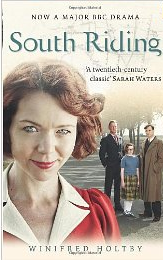 I had never heard of Winifred Holtby until I watched the excellent Masterpiece series South Riding. I enjoyed it so much that I picked up several of Holtby’s books. Holtby published 12 novels in the 1920’s and 1930’s, as well as pursuing a successful career as a journalist and nonfiction writer. She is known for regional fiction about Yorkshire and has a prize for regional fiction named after her.
Set post-World War I, South Riding is the story of the conflict between the landed gentry and social progressives in a Yorkshire town. Sarah Burton comes to town as the headmistress of a girl’s school. She has many progressive ideas and wants to improve the school and the quality of education provided to the girls. To accomplish her goals, she asks the town to invest more money in the school.
She immediately runs afoul of Robert Carne, a local landowner. He has very conservative ideas about the town and school, but he also has some heavy concerns. Previously prosperous, he has spent all his money on care for his mentally ill wife. He also has the care of a young daughter who is having her own problems.
Unlike the television series, the novel has a huge sweep and does not concentrate on Sarah, but presents the stories of about fifteen other major characters. It deals with issues like education, poverty, and governmental corruption as well as family relationships. The characters are all carefully delineated so that you feel that you know each one.
The novel is beautifully written, although it gets just a little preachy at the end. Some reviewers have compared Holtby to George Eliot because of her interest in local social issues and her breadth of scope.

