
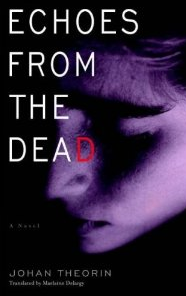
 The Best Book of this week is Echoes from the Dead by Johan Theorin!
Author: whatmeread
Day 130: Under the Lemon Trees
 In Under the Lemon Trees a high school girl tries to live her dreams while being held back by tradition and her family’s expectations.
In the beginning of the novel it is 1970’s California and Jeeto’s sister has just been hurried into marriage with a stranger. Jeeto finds out later that this happened because her sister had been pregnant by a local boy and lost the child. As a result, Jeeto’s mother is even more determined to marry her off directly after she graduates high school even though Jeeto has been offered a scholarship at Berkeley. And, in the meantime, Jeeto develops a relationship with another local boy.
Jeeto also tells the story of her uncle’s lost love when he first came to America as a Punjabi Sikh and eventually helped found the Sikh settlement in Oak Grove, California.
The plot of the novel was interesting, but I got frustrated with Jeeto. She was too ready to give up her dreams. I realize that there are cultural issues involved in the question of whether Jeeto can go to college, but what I found frustrating was not that Jeeto would give up her dreams but that she would not even fight for them.
Day 129: Mad World: Evelyn Waugh and the Secrets of Brideshead
 I found Mad World interesting, but I think it would have been very interesting if I was more familiar with Evelyn Waugh’s work. Paula Byrne’s biography seems to be mostly concerned with refuting statements and criticisms that were made about him, of which I was previously unaware.
The book traces Waugh’s life and career especially in terms of his relationship to the family who were partial models for the Flytes in Brideshead Revisited. The book describes just where the parallels lie and where they diverge.
Byrnes is at pains to refute the allegations that Waugh worshipped and toadied to the aristocracy and was ashamed of his own middle-class origins.
The book made me want to reread Brideshead. I found Waugh an interesting figure, although I couldn’t help feeling how boring and pointless the lives of many of his friends, who were hopeless drunks, seemed.
I apologize for my posts, which will be more sporadic than usual the next two weeks, as I am on vacation.
Day 128: Echoes from the Dead
 Echoes from the Dead is another terrific book by Johan Theorin. It is his first book, and reading it explained a few minor points about The Darkest Room for me.
Julia’s young son Jens disappeared on the island of Öland in 1972, but her father just received a package containing the little boy’s sandal. After Julia’s father takes his friends Ernst and John along to look into what happened to her son, Ernst is found dead.
For years the island’s inhabitants have heard rumors of the return of Nils Kant, a notorious murderer who disappeared just after World War II. We readers know that these two stories are connected, but not how. Although we also know who took Jens, we don’t understand what really happened to him until the very end of the book.
Julia returns to Oland to try to figure out what happened to Jens, if she can. After years of depression, she begins to take more of an interest in life and maybe to fall in love with Lennart, the island policeman.
This novel is not as atmospheric as The Darkest Room, but it is full of characters that you begin to know. The plot is complex, interleaved with the story of what actually happened to Nils Kant back in the past.
Day 127: Hush
 I have read a few Kate White mysteries, but this one was disappointing. The heroine of Hush, Lake Warren, is a shallow, stupid woman who is so afraid she will lose her children in a custody battle that she lies to everyone all the way through the book, even when it doesn’t seem necessary. She is so stupid that even though she has been told to be careful about her behavior while custody is in question, she can’t resist having a one-night stand with a doctor she’s been flirting with at work. Afterwards, she falls asleep on his terrace, only to return to find he’s been murdered.
Her fears about drawing attention to herself extend to the point of ridiculousness. She doesn’t report that her cat was drugged and all its hair shaved off, that she has been receiving sinister calls, or that a man attacked her with a knife. Even when she finally finds someone she can trust, she never tells him what is really going on.
In the course of investigating the murder herself, she uncovers corruption at the doctor’s fertility clinic. Even an idiot would be about five steps ahead of her all the way. I used to enjoy the TV series “Sex and the City,” but this book reminds me of that sort of vapidity that often appears in chick lit, without the great script. A predictable, even annoying novel.
Day 126: Dombey and Son
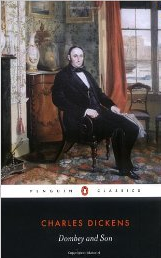 I recently re-read Dombey and Son after not having read it in so long that I could not remember its plot. The novel is Charles Dickens’s tale about Paul Dombey, a wealthy, cold, self-important man who cares only about his son, not about his wife or his gentle, loving daughter Florence. His wife dies in childbirth, and his son Paul is weak and often ill, but Paul and Florence have a loving relationship. When Florence is kidnapped as a child, she is rescued by Walter Gay, a young employee of Dombey. Dombey ships him off to Barbados to get him away from Florence, but Walter’s ship is lost and he is presumed drowned.
With Walter gone, Florence has only her brother Paul for her friend. Then Paul dies, and her father even resents Florence for the love his son had for her, which he did not give to his father.
Dombey meets a beautiful widow, Edith Granger. She is a cold, haughty but impoverished woman, and Dombey essentially “buys” her by marrying her. She despises Dombey for his pride and herself for having married him for his money. The only person she is kind to is Florence, which provides more fuel for Dombey’s dislike of his own daughter. His attempts to subdue his wife end in her disgracing him as best she is able by running away to Dijon with Mr. Carker, one of Dombey’s rivals. When Florence attempts to offer sympathy, Dombey strikes her and she leaves the house, friendless and destitute.
Although the novel is not critically accepted as one of Dickens’s major works, it is still enjoyable. It is full of vibrant characters–mostly those of good will but also some villains–and it is gripping to the end. Some critics have noticed a change in the novel that takes place with the death of the young Paul, believing that having the colorless Florence and the unlikable Dombey as the main characters is not enough to carry the story forward. The absence of Walter and his uncle through much of the book is also thought to be a problem. However, the novel has all of the Dickens hallmarks–social commentary, comic absurdity, realism, pathos, and transformation. Dombey and Sons was written before most of Dickens’s real masterpieces like Bleak House or David Copperfield, but it certainly shows the movement from his lighter, shorter works toward the qualities of his more major works.
Special Posting! Best Book of the Week!
 The Best Book of Week 25 is Gone Girl by Gillian Flynn!
Day 125: Arcadia
 After reading Lauren Groff’s first book, The Monsters of Templeton, I was expecting something totally different, something perhaps more sinister. But Arcadia is a quiet and thoughtful novel. It is the story of Bit, the first child born in a group of a couple dozen hippies who are following a charismatic musician named Handy–essentially a bunch of groupies–during the 1970s. They are also idealists who want to create a utopian commune where they can support themselves entirely from their own efforts, living off the land. The book follows the rise and fall of the commune and its aftermath.
The first part of the book takes place when Bit is a young boy. The group has settled on a large estate in upstate New York to found their commune. Bit’s father Abe is a master carpenter and his mother Hannah is a baker and the group historian. We sense that Abe is the parent more fully invested in this way of life, as Hannah does not accept or observe all of the commune’s rules.
Hannah is a golden earth mother type who is active and ebullient in the summer but falls into severe depressions in the winter. One winter, Bit sets himself a test inspired by a fairy tale book he found in the ruins of the property’s mansion house by making himself a bargain to stop speaking until she comes out of her depression. Abe is absorbed with trying to organize the renovation of the house so that everyone will have a warm place to live, since for years they all have been living out of their cars and vans and homemade shacks.
In the second part, Bit is a teenager trying to cope with the disintegration of Arcadia, which is overcrowded with runaways, junkies, and other refugees from outside and having problems with the law. He is also in love with Helle, Handy’s disturbed but beautiful daughter.
The third part takes place a few years into a dystopian future. Everyone has left Arcadia. Bit is a photography professor living in New York City, a single parent mourning the departure of his wife. It is a time of social disintegration because of the forces brought about by climate change, especially a series of pandemics.
The novel is the work of a vivid imagination, as Groff is able to fully realize what it would be like to grow up completely cut off from the world, learning mores that are different from those of society, and how that would affect the rest of a person’s life. The novel’s biggest weakness is in having too many characters to get to know them well, especially in the middle section, where Bit’s teenage friends all sort of blur into each other. I found the tale interesting but at times slow moving, somewhat meditative, which I believe is intentional.
Day 124: Whose Body?
 It has been years since I read Whose Body? by the British writer from the Golden Age of Mysteries, Dorothy L. Sayers. Unfortunately, as soon as I saw the murderer’s name, I remembered who did it, so I was not able to judge how difficult it was to guess.
Mr. Thipps finds an unidentified body in his bathtub wearing nothing but a pair of pince-nez. The body bears a resemblance to a missing financier, but it is not him. Who is the dead man and how did the body get into the tub? Where is the missing financier? Is this one case or two? Of course, the police suspect Mr. Thipps. After Mr. Thipps’s mother asks him to help, Lord Peter Wimsey gets interested in the case and decides to find the answer to these questions in his inimitable way.
As always, Sayers is fine in characterization, much better than many of her Golden Age peers. Lord Peter is his usual apparently frivolous self. He and his man Bunter are fun. Lord Peter’s mother, the Dowager Duchess, is adorably ditzy. The plot is clever. However, as with many early mystery novels, it is overcomplicated and very unlikely. For people who haven’t read any Lord Peter books, I recommend Murder Must Advertise as a better starting place.
As a total side note, the cover I’m showing is not the one for the book I read, but is just one I found on Amazon. It occurs to me, why would they show the body of a woman when the victim is a man? This disconnect in publishing is always a mystery to me. One peek at the first few pages would have told the artist the sex of the body.
Day 123: The Judgment of Paris
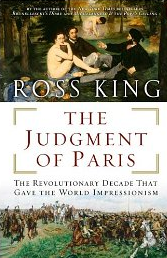 The Judgment of Paris: The Revolutionary Decade That Gave the World Impressionism is Ross King’s account of the art and politics of the decade beginning in 1863 and ending in 1874 with the first Impressionist show. The book follows the lives and careers of several significant French artists in the years leading up to the introduction of what was eventually called “Impressionism.”
At that time in France, artists were taught that the proper subjects for art were scenes from history, mythology, or the Bible. The “best” paintings observed the minutest of details, colors were muted, and the surface of the painting was smooth so that brush marks could not be distinguished.
Although the book touches upon the careers of many artists, in particular it follows the fortunes of two–Ernest Meissonier, who was considered one of the greatest artists of his time and was certainly the highest paid, and Edouard Manet, an unofficial representative for the younger painters. Meissonier progressed from painting small, very detailed scenes from the 17th or 18th Century of “goodfellows” in ordinary domestic scenes, such as playing chess or smoking, to huge historical paintings, several of events in Napoleon’s career. The younger painters were more interested in depicting scenes from modern life. At that time they were called Realists, not for their painting style but for their subject matter.
The book begins with the preparations for the Paris Salon of 1863. The Salon was the most important art show of its time, almost essential to getting an artist’s work viewed. King explains how changes in the rules affecting how the jury was selected resulted in most of the landscape painters and those with less traditional approaches being shut out of the show. So many artists were excluded and the outcry was so great that Emperor Louis-Napoleon authorized a second exhibition called the Salon des Refusés to show the paintings refused by the jury. Ross continues on from there to show how the new art moved slowly from the scorn and derision of the artistic community to acceptance and admiration. I was particularly surprised to find that the first place this new way of looking at the world was accepted was not France, but the United States.
King’s explication of the prejudices and politics surrounding the evolution of new approaches to painting is extremely interesting, as is his corollary discussion of the reign of Napoleon III, the disastrous Franco-Prussian War, and the subsequent shifts in the government of France, and how all this had its effect on the acceptance of the new art.

