Day Five: The Thousand Autumns of Jacob de Zoet

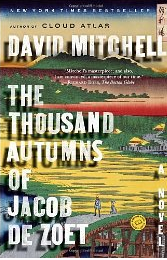
Cover for The Thousand Autumns of Jacob De ZoetTie for Best Book of Week 1!

I have read two books by David Mitchell and they were completely different. The first that I read, Cloud Atlas, was a stunningly unusual science fiction novel divided into sections, where each section was much farther in the future and was narrated by a character speaking in a patois of English that got a little harder to understand. Eventually, the sections all fitted together like a puzzle. It was fascinating. Others apparently thought so, too, because it was short-listed for six awards, including the Man Booker Prize.

But this review is for The Thousand Autumns of Jacob de Zoet, a historical novel about late 18th Century Japan. Jacob is a clerk for the Dutch East Indies company who arrives in Japan in 1799. An honest, hard-working young man, he has signed on for a six-year term so that he can earn enough money to go home and marry his sweetheart, Anna.

Jacob finds that foreigners are only allowed to live on an island called Dejima in the Nagasaki Harbor and they cannot set foot on the Japanese mainland. Only certain Japanese, some interpreters and court officials, are allowed on Dejima. But the Japanese students of a Swedish physician are allowed, and one of them is the midwife Orito Aibagawa. Jacob is fascinated by her and ends up falling in love with her.

Jacob’s boss claims to intend to clean up the rampant corruption in the company, so he sets Jacob the task of reconciling the books from the previous years, which makes him some enemies. When Jacob refuses to sign a bogus manifest, he is left on the island with only his enemies as his boss departs.

Orito’s father dies, and her stepmother sells her off to a mountaintop shrine where sinister rites are being performed.

The story was full of interesting descriptions of the customs and laws of 18th Century Japan. And this reminds me that I need to pick up another David Mitchell book soon and read it.

Day Four: The Rhetoric of Death

Cover for The Rhetoric of DeathOne of the many surprising things I learned from the historical mystery The Rhetoric of Death by Judith Rock is that an important part of the curriculum of 17th century rhetoric, as instructed by the Jesuits, was ballet. I don’t quite get the connection, but there it is. This novel, written by a historian whose dissertation is about the Louis le Grand in Paris, is full of interesting details about life in 17th century France.

Charles du Luc, a Jesuit maître of rhetoric, has had a position arranged by his cousin, the Bishop of Marseilles, at the famous Louis le Grand school. Du Luc isn’t really qualified to be employed by such an esteemed school, but the bishop wants to get him out of Provence because Charles has just finished helping smuggle his Huguenot cousin from there to Switzerland.

The school is two weeks away from its annual performance, an enormous, lengthy (some were as long as 12 hours) ballet and rhetoric production of The Labors of Hercules that will be attended by the king himself, and du Luc is assigned to assist with the dance rehearsals. On his first day, the distracted student who is to play Hercules runs off from the rehearsal and disappears. On the same day, his little brother is almost run down by a horse. Charles thinks these two events may be connected and is even more sure when the first boy is found strangled in a latrine.

At the same time Charles finds himself under suspicion from the authorities because he was the last person to see the first boy alive and was on the scene right after the second boy was almost run down. He is also facing hostility from a fellow member of the Jesuit school who takes an instant dislike to him, a member of the powerful De Guise family.

This novel does a good job of making the period come alive. Unfortunately, the mystery is not nearly as effective as the history. I figured out the motive and the person behind the murders on about page 50. Shortly thereafter I figured out who the actual murderer was. However, the test for me on a mystery, since I often figure out the solution, is whether I am still interested in reading it. In this case, I found the characters, story, and historical background interesting enough to finish.

Day Three: The Darkest Room

Cover for The Darkest RoomTie for Best Book of Week 1!

I love dark mysteries, good ghost stories, and books about family secrets. The Darkest Room by Johan Theorin, a Swedish mystery writer, is one of my discoveries from the past year. It is an excellent book, atmospheric, absorbing, part mystery and part ghost story.

Katrine and Joachim move to Öland, a large island off the coast of Sweden, with their two children. Katrine has been living on the island with the children for several months and remodeling their house while Joachim finishes up his teaching job. Katrine lived in an outbuilding of the house as a child with her artist mother.

The house itself is almost a character in this book, and the first few chapters are about its history. It was built to be the home for the families of lighthouse keepers, and two lighthouses are nearby. The walls of the house are actually built from the wood salvaged from a ship wreck, and as with any old house, many people have died there. There are local stories about the house.

Joachim has just arrived to live permanently in the house, but he needs to make one more trip to pick up a load of things from their home in an upscale neighborhood of Stockholm, a home that they had also bought and restored. On his way back to the island, he gets a confused call from the Öland police who tell him that his daughter has drowned off the pier near the house. But when he gets home, he finds it is not his daughter but Katrine who has died. The police told him the wrong name. As he tries to take care of his young children and cope with his grief, Joachim begins to think the house is haunted. And his daughter is having strange dreams about her mother.

In the meantime, a policewoman starts work at the new police post on the island. Her first investigation involves a rash of robberies of summer cottages. Another point of view is of one of the housebreakers, who is becoming dismayed by the growing violence of his partners, who have decided that they will get more by breaking into occupied houses. The atmosphere and our sense of dread builds as Joachim gets a little odder and the housebreakers become more vicious.

And let’s not forget that we don’t actually understand the circumstances of Katrine’s death.

I was especially impressed by Theorin’s skill in revealing important pieces of information naturally throughout the book instead of laying them out at the beginning. For example, early on Joachim has a few stray thoughts about a woman. He feels some guilt about her but we don’t know why or who she is. We find out later, naturally, as Joachim thinks about her, in addition to some other facts that turn out to be important to the plot. This technique doesn’t seem artificial at all, but more organic and reflective of how thoughts and memory actually work.

I’ve read one other book by Theorin, also set on Öland. I can’t wait to read more.

Day Two: The Cold Dish

Cover for The Cold DishMy intention is to review a book a day. Of course, I don’t read a book a day, but I have a book journal, so I am cribbing my reviews from that.

Today’s book is a great mystery set in present-day Wyoming, The Cold Dish by Craig Johnson. I have been loving this series, which is full of interesting characters. The setting is almost a character in itself.

The main character is Walt Longmire, the sheriff of a rural Wyoming county, who is a widower nearing retirement. (I understand that A&E will be broadcasting a series based on these books, called Longmire, sometime this year, something to look forward to.) I often tire of series mysteries, principally because of the secondary characters, who are often one-dimensional. Johnson’s characters seem more like the actual inhabitants of a smallish western town.

In The Cold Dish, Cody Pritchard is shot to death at long range by someone using an unusual rifle. Two years before, he and some other high school boys participated in a brutal rape of a young Cheyenne girl, and he and his co-defendents got off lightly. Despite his abhorrence of their crime, Walt is worried that the other boys may be at risk, so he must try to keep them safe. He is also worried about what his best friend, Henry Standing Bear, might know, since Henry is the girl’s uncle.

The book features a good mystery, some exciting action, characters that you really care about, and perhaps even the ghosts of long-dead Cheyenne warriors (although Walt doesn’t think so).

What, Me Read? Day One

Cover for The Omnivore's DilemmaHi, there.

I am a voracious reader, sometimes reading several books a week, and I have decided to use this blog to write a book review for every book I read. Maybe no one will be interested in reading this, but maybe it will be fun.

I’m going to start with The Omnivore’s Dilemma by Michael Pollan, journalist and food activist, which I read for my book club.

The book traces back four different types of meals that Pollan ends up preparing and eating, a meal from McDonald’s, one using groceries purchased at a big-box organic grocery store, one using food purchased from a small farmer, and one with food he hunted and gathered himself.

The premise is interesting, and readers familiar with Pollan will know that he goes off on philosophical side trips and provides a lot of vital information about how the American food industry is set up. With one of his other books, In Defense of Food, he did more to make me change my eating habits than anything else I have ever read.

Pollan finds his hunted and gathered meal most satisfying and surprises himself by actually enjoying shooting a wild pig. From a practical standpoint, I was more entranced by the chapters about the small family farm in Virgina, the owner of which was so clever about his use of animals to keep his land and food products healthy.

One of Pollan’s main premises is that food based on corn and soybeans—and you would be surprised how much food IS based on them—is inherently less nutritious and good for you than food based on grass. This is both because of the nutritional value of these foods and the conditions in which corn-based animals are kept versus those who are allowed to graze free.

I was startled by how misleading the labels are, even on our “organic” food. Pollan’s conclusion is that your ability to actually go to the source of your food and see especially how the animals are treated is going to be the only way to ensure that your food is healthy and the animals are humanely treated.

Pollan does some philosophical musing that I sometimes don’t have much patience for, and occasionally I felt like we were getting way off the subject. I noticed that he sometimes didn’t seem to understand how he felt about things without reading what someone else said about them, which I thought was curious.

All in all, though, I think Pollan is one of the most interesting writers about food. I would even more strongly recommend In Defense of Food, where he provides some easy-to-follow shopping rules that allow you to eat more healthily.

Kay