Review 2107: Spring

Spring is the third in Ali Smith’s seasonal quartet. Like with most of Smith’s books, there is a point where I say, “What the f— is she on about?” and a point where I say, “Oh.”

Richard Lease is an older man, a filmmaker who has done good work. He is grieving after his old friend Paddy’s death. Paddy had been his screenwriter, a woman who supported and inspired him and a good friend. He is further upset because the screenwriter assigned for his next film is trying to turn a delicate work about two famous writers who never actually met each other into a story about a hot affair.

Supposed to be at a meeting about this film in London, Richard takes a train in the opposite direction and gets off in Scotland, thinking about throwing himself under the train.

About halfway through the novel, it suddenly focuses to a seemingly unrelated story. Brittany is a security guard in a detention facility for illegal immigrants. She, like many of the other guards, has started to become callous and treat the detainees as if they were criminals.

She has heard a rumor about a little girl who walked into a facility and spoke to the director. The next day the toilets were spotlessly cleaned. Then one day on her way to work, she meets the child she thinks is that girl. The child Florence wants to know how to get to the place in Scotland shown on an old postcard she has. Suddenly, Brittany finds herself going along.

The novel is obviously about how we treat immigrants, but it makes comments about other things, like social media, on the way. There were times when its digressions got on my nerves and particularly one that I skipped once I had its measure. But somehow even when I’m frustrated by her, Smith always manages to pull me into her story and impress me with her intelligence.

Related Posts

Autumn

Winter

There but for the

Review 2106: The Mere Wife

Maria Dahvan Headley called The Mere Wife her novel about monsters in suburbia. It certainly is, but it’s also loosely based on the Old English epic poem Beowulf, only about women, not men.

Dana Mills is a U. S. Marine fighting in a desert country when she is captured and appears to be publicly executed on television. She awakens in the middle of the desert six months pregnant with no memory of what happened. Since she can’t tell the conditions under which she was impregnated, the Marines put her in prison stateside. She escapes and returns to her home town, which her family has lived in for generations, only to find it demolished with a suburb built on top of it.

Dana finds her way to caves in the mountain surrounded by the suburb. Inside the mountain is a train station from when the town was thriving. Living in the cave, she has her baby, but she is traumatized by PTSD and thinks he is a monster.

Seven years go by, during which Dana has been training her son, Gren, to survive, which she believes includes staying away from other people. But Gren sneaks out and makes friends with a boy in the nearest house, Dylan, who has been both spoiled and restricted and neglected. When Dana finds out about this friendship, she has only dread. Despite her efforts to keep him away, Gren sneaks out and attends a New Years party. Willa, Dana’s mother, has been aware that something has been in her house, a wild animal, she thinks. When Dana comes to fry to fetch Gren home, a series of overreactions on her part and that of Dylan’s parents result in catastrophe. Soon the police are hunting down Dana and her son. Enter a macho policeman named Ben Wolff.

This is really a rough read. Stylistically, it’s beautiful and poetic, but it is also harsh and cynical. The question Headley forces on you is, Who is the monster? Well, there are lots of them.

The novel features a chorus of women and a strong distaste for men as well as for hypocrisy.

Related Posts

Beowulf

Everything Under

Melmoth

Review 2105: The Royal Secret

When James Marwood and Cat Lovett, now the widowed Mrs. Hakesby, meet Mr. Van Riebeeck at the theater, Marwood has no idea that his investigation of someone selling state secrets will involve him. Cat, who has carried on her husband’s architectural business since his death two years before, has thought she would never be drawn to a man, but she is to Van Riebeeck.

When Marwood’s investigation begins to focus on Van Riebeeck, he tries to warn Cat, but she just thinks he is jealous, which he is. In the meantime, Cat is working on plans for a chicken house for the King’s sister, Madame, and is asked to take them and a model to France.

Van Riebeeck has already killed three people and proposed marriage to Cat before he disappears. But since one of the murdered is Marwood’s own footboy, he is determined to find him.

This is another excellent entry in the Marwood/Lovett series. The main characters remain interesting, and Taylor involves them in some intriguing plots. I am enjoying them.

Related Posts

The Fire Court

The King’s Evil

The Last Protector

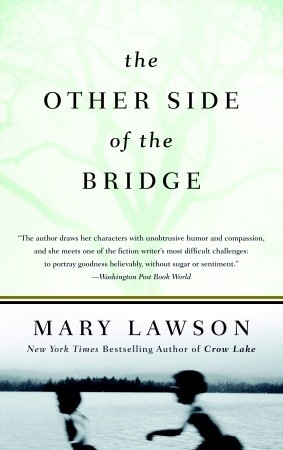
Review 2104: The Other Side of the Bridge

Mary Lawson’s milieu is the tough life in remote northern Ontario. In The Other Side of the Bridge, she examines the relationships between parents and children and between brothers.

In the late 1930s, Arthur and Jake Dunn are a farmer’s sons. Jake was born after their mother had several miscarriages, and she has been so worried about him that he has not been made to work the farm, while Arthur works hard to help his father. Jake gets by on charm and recklessness, while Arthur tries to protect his mother by lying about the various fixes Jakes gets himself into. Arthur, who is quiet, solid, and dutiful, realizes at one point that Jake is purposefully making trouble for him.

Although his mother loves only Jake, Arthur has the moral high ground until a fateful accident on a bridge.

In the 1950s, Ian Christopherson is a high school student whose mother has left him and his father. He is harboring hatred for his mother for leaving and a disinclination to become a doctor like his father just because it’s expected. He also has a crush on Laura Dunn, Arthur Dunn’s wife, and asks for a summer job on the farm just so he can sometimes be around her. The couple seems content, but their relationship is more complex than he realizes until brother Jake comes home after having been gone for 15 years.

This novel is deeply affecting, dealing with long-suppressed emotions and intricate relationships. It is written in beautifully spare prose. Another great book from Lawson, who deserves a lot more attention than she seems to be getting.

Related Posts

Crow Lake

A Town Called Solace

Family Furnishings

Review 2103: Kill Me Tender

When I asked Dean Street Press to send me books for Dean Street Press in December, I felt that a mystery starring Elvis Presley might be clever and amusing. This was despite my usual dislike for mysteries using an actual person or someone else’s character as the detective. So, I asked for the first book in the series. Unfortunately, I wasn’t able to post my review until now, so I missed the event.

Elvis is feeling strange and unfocused since he returned from his army service. He keeps an eye on his correspondence and is distressed to learn that the president of one of his fan clubs, a young girl, died of a heart attack. Also, someone has sent him a record of an Elvis impersonator singing one of his songs, only with the lyrics horribly changed. Then, he learns that another fan club president has died unexpectedly—and both girls had a red spot on their tongues. After a third death, Elvis begins to suspect that someone is killing off his fans. Elvis feels he must get to the bottom of this.

His investigation leads him to meet colorful characters—an uncredentialed doctor serving the Black community and his beautiful nurse, a whole room of Elvis impersonators, an expert on criminology, and a hippy-like jail resident who seems to be psychic.

The humor of this novel seems to be based in strange encounters and outrageous behavior, and it didn’t really work for me. Far from the witty maybe sharp novel I expected, it comes off as a fanboy tribute.

What bothered me more, though, was that while Klein obviously researched Elvis, he didn’t spend the same amount of time checking the accuracy of his memory of 1965. For example, a 14-year-old Southern girl of the time would be very unlikely to even know the language that one character uses. Elvis’s affair with a black nurse is also unlikely. But there is at least one downright anacronism—the use of the term “serial killer” ten years before it was coined.

Characterization is mostly one-dimensional in this novel except for Elvis himself. The rest of the characters are just being put through their paces.

I received this book from the publisher in exchange for a free and fair review.

Related Posts

Scot Free

Eight Perfect Murders

Insomniacs, Inc.

Review 2102: My Soul To Take

A quote on the cover of My Soul To Take says that it is chilling, but apart from its grim subject matter, it is actually surprisingly light. Conversations and the tone of the second Thóra Gudmundsdóttir novel are often quite jokey.

In 1945, a man drops a small child into a freezing coal bunker to die. From a nearby farmhouse, someone sees him.

In the present time, lawyer Thóra Gudmundsdóttir is contacted by her client Jónas Júlíusson, who has just built a New Age hotel from a remodeled farmhouse on the Snaefellsnes peninsula. He wants her to look into whether he can claim damages from the previous owners because of ghosts on the property. Thóra reluctantly agrees to come to the hotel to investigate.

Shortly after Thóra arrives there, Birna, the project’s architect, is found brutally beaten and raped on the beach. Thóra thinks that Birna was investigating something about the property. In any case, Thóra finds herself looking into her case because Jónas is a suspect. Thóra’s German friend Matthew, with whom she began a romance in the previous novel, joins her there. Just when it’s possible that the police might have believed the murder is unconnected with the hotel, another body turns up, that of the hotel aura reader.

As I said, this novel is surprisingly light in tone. Even more surprisingly is how it deals with Thóra’s children, who seem to be there only for light comic relief. Thóra’s 16-year-old son has made his girlfriend pregnant, and Thóra has left them and her younger daughter with her ex-husband. But she learns mid-case that her son, who doesn’t have a driver’s license, has left with his sister and pregnant girlfriend to drive to Thóra. On learning this, Thóra does nothing for several hours and then tells her ex where to pick them up. When, surprise, surprise, the children arrive the next day, Thóra basically ignores them. They have no apparent personalities except silliness and disobedience. It’s hard to understand why Sigurdardóttir even decided to make Thóra a mother.

One more very picky thing. At the opening of the novel, Thóra is dealing with a client who is having a dispute with the post office because the mail slot in his door is at the wrong height. The story is he bought a kit house from the States. But I’ve never seen a door for sale here with a mail slot already in it., and most people in the U. S. have mail boxes, either attached to the house or at the street. You seem to only see slots in old city neighborhoods on old doors. This just seems like an oddly wrong detail for her to have come up with.

I enjoyed the first book in this series but don’t think I’ll bother with the third.

Related Posts

Last Rituals

Gallows Rock

The Mist

Review 2101: A House in Bloomsbury

Dora Mannering is a little brat when we first meet her at 16. She and her father are tenants of a house in Bloomsbury. They are not wealthy—he is a scientist who works at a museum—and they occupy three rooms although the rooms are well-appointed. Dora has no understanding of what it means to be very poor and disdains thoughts of money.

Dora doesn’t remember her mother, and her father never speaks of her. Someone sends her a box of gifts once a year, anonymously, and he is not happy when it arrives.

Dora’s father becomes very ill, which throws Dora more into the company of others in the household. Miss Bethune is one, a wealthy Scottish spinster who lives with her maid. Dr. Roland, who believes he could treat Mr. Mannering’s illness better than the expensive society doctor called in, is another.

Then a strange lady appears, or rather, her envoy, a young man, who approaches Miss Bethune with a request that she receive the lady and invite Dora over at the same time. It’s not too hard to guess who the lady is, but the circumstances of the original separation also come out.

Miss Bethune also has a secret.

I’m not sure if this novel would have been considered a sensation novel in its time, because the secrets don’t turn out to be that shocking, but there are a few emotional scenes and two different women who are hysterical at times. However, the novel features likable characters and has a satisfying ending. The heroine grows up, and people are kind to each other.

Related Posts

Hester

Phoebe Junior

Miss Marjoribanks

Review 2100: Mistress of the Monarchy: The Life of Katherine Swynford, Duchess of Lancaster

I looked for a biography of Katherine Swynford after reading Anya Seton’s Katherine, a novel about her life. I had a suspicion that the story was greatly romanticized, and acclaimed biographer Alison Weir agrees with me.

The bare bones of Katherine Swynford’s story are dramatic. Of undistinguished foreign parentage, Swynford was married to a low-ranking knight in the army of John of Gaunt, the Duke of Lancaster and son of Edward III. John was the most wealthy and powerful noble of his time except for the King. Katherine was attached to the Duke’s household as sort of a governess for his children with his duchess, Blanche of Lancaster, to whom he was devoted. Katherine’s husband served overseas. (Weir has him dying of illness rather than being murdered by a servant faithful to the Duke.)

After Blanche’s death, John married Constance, titular Queen of Castile and tried for years to take back her country from usurpers. This marriage was not successful, and soon the Duke began an affair with Katherine that lasted for years. The couple parted then reunited, but Lancaster astounded everyone by marrying her after Constance’s death. Amazingly, Katherine was the ancestress of every king of England since 1399 and of six American presidents.

Although Katherine’s story is an intriguing one, there is so little historical information available about her that the biography is mostly about her husband and sons, with information derived from records of grants and budgets. This is the kind of research that is probably fascinating to the writer but not so interesting to the reader.

Related Posts

Katherine

Queens of the Conquest: England’s Medieval Queens

The Wars of the Roses

Review 2099: The Eustace Diamonds

The Eustace Diamonds is the third of Anthony Trollope’s Palliser series and the least political so far. In fact, although it contains a few political discussions, it is really a social commentary and satire.

The beautiful Lizzie married Florian Eustace for money, while Florian married for love. Lizzie, being mercenary, deceitful, and immoral, broke his heart, and he, being very ill, died before Lizzie was even 21, leaving her with the Eustace heir, her son.

Lizzie is left very well off, with a yearly income and Portray Castle for life. However, the Eustace’s upright solicitor, Mr. Camperdown, notices that Lizzie has not returned the Eustace family diamonds to the estate. Repeated requests for the return of the diamonds meet with no reply.

Lizzie has recently engaged herself to Lord Fawn, an engagement his family is not really happy about, because they think Lizzie is a woman of few morals—and they are right. But Lord Fawn is attracted to her beauty and is also not very well off. However, when Lord Fawn hears rumors that Lizzie is keeping family jewelry that doesn’t belong to her, he begins to back off. His position in the government doesn’t warrant any scandal.

The Fawn’s governess, whom they dearly love, is Lucy Morris, a childhood friend of Lizzie’s. Around this time, Lizzie’s cousin, Frank Greystock, proposes to Lucy despite his family’s disapproval. They have nothing against Lucy but wish Frank, for the sake of his profession, would marry a girl with some money.

When Lizzie begins having trouble about the diamonds, she turns to Frank. Although he knows on some level that she is a liar, she is able to charm him and make him sympathetic to her. She lies about the circumstances in which she received the necklace from her husband—circumstances that make a legal difference—and he begins to think Lord Fawn is a dastard for trying to back out of the engagement. Lizzie wonders if she wouldn’t rather marry Frank.

In many ways, this novel resembles Vanity Fair, as Lizzie tries to make her way in society, although with ultimately less success and less sympathy from me. Lizzie gets involved with some dubious characters and eventually there are not one but two robberies. A very interesting and unusual side plot for this age involves Lizzie’s friend Mrs. Carbuncle, who is trying to marry off her niece, Lucinda, to Sir Griffin Tewett before she completely runs out of money. Lucinda doesn’t want to marry any man at all and certainly not Sir Griffin, who appears to only want her when she is rejecting him. It’s sad that in his time the only way Trollope can resolve this plot is to have Lucinda run mad, almost but not quite like the Bride of Lammermoor, to whom there are references in the text. Still, it was interesting to me that at this period of literature, Trollope includes an attractive young woman who doesn’t want to marry as one of his characters.

Trollope skillfully engages us with lots of questions. Will Lizzie keep the diamonds? Will Frank keep his engagement? Which of eventually four men with Lizzie marry?

Related Posts

Can You Forgive Her?

Phineas Finn

Barchester Towers