Review 1792: #ThirkellBar! Before Lunch

Before Lunch is one of Thirkell’s Barsetshire Series that I have not read before. It possesses both the charm and slightly acid humor of the previous novels and a new sense of sadness.

In this novel we meet the Middletons. Jack is a trying man who often has to be soothed by his wife, Catherine. Jack’s sister Lilian Stoner, a young widow, is coming to stay in an adjacent house with her stepchildren, Denis and Daphne, who are almost as old as she is. The three have a loving relationship, all understanding that Lilian’s marriage was a difficult one.

The major focus of the plot in this novel is who will Daphne marry, for she meets two men she likes very much. Mr. Cameron is the partner of Lord Bond in their architectural firm. Although he is in his forties, Daphne thinks he’s the nicest man she knows. Cedric Bond, Lord Bond’s son and heir, also gets along with Daphne very well, but Daphne keeps hearing about another young lady named Betty in connection with him. Both men are smitten by Daphne.

Along with this plot, a lot is going on. The overbearing Lady Bond is leading a protest against the unwitting purchaser of a parcel of land called Pooker’s Piece (I love the place names in this series, particularly the oft-mentioned “Winter Overcotes”), where he plans to erect a tea shop and a garage (which rumor eventually converts to a road house). The countryside is outraged, as it is a favorite place for rambling.

The entire county is also preparing for the Agricultural Show, and Daphne talks cows with the best of them. She also takes a secretarial job with Lady Bond.

Denis takes a liking to Lord Bond, who is as kind as he is long-winded. Denis has been an invalid, but in the summer country air he begins to improve, and he is looking for backing for a ballet for which he is composing the music. He treats Lord Bond to Gilbert and Sullivan evenings when Lady Bond is away. He also has a secret of the heart.

Catherine and Lilian begin a friendship that is comforting for them both. We also briefly meet some of the characters from previous books, including Lord Pomfret, now a grieving widower, the Leslies, and Roddy Wicklow. And Thirkell does not fail to provide another irritating character (besides Lady Bond), Miss Starter, an ex-royal attendant who fusses constantly about her diet.

I think I liked this novel best so far, but I know one of my favorites, Cheerfulness Breaks In, is coming up.

The Brandons

Pomfret Towers

Summer Half

If I Gave the Award

Cover for Bring Up the Bodies

Now that I have reviewed the last shortlisted book for the 2012 Booker Prize, it’s time for my feature where I decide whether the judges got it right. This shortlist is another mixed bag of genres, two historical, two set in the 1970’s, and two contemporary. One is experimental enough to render it almost incomprehensible while another sometimes reads as if pages were taken from a textbook.

As I often do, I’ll start with the books I liked least. My least favorite of the nominees was Umbrella by Will Self. With an idea that should have been interesting, based as it is on Oliver Sacks’s Awakenings, this novel is so concerned with its devices that it is very difficult to read. It shifts point of view in mid-sentence, sometimes in mid-word, and uses stream-of-consciousness confusingly.

Narcopolis by Jeet Thayil is set in late 1970’s or early 80’s Bombay, about a young man exploring the city’s opium dens and brothels. Although I found some of the characters interesting, I was not interested in the overall subject matter, and when the novel became philosophical, it read as if it came out of a textbook.

My main objection to Swimming Home by Deborah Levy is that I found the situation unbelievable. When vacationers find a disturbed girl occupying their vacation house, they invite her to stay even though she is clearly a fangirl of the poet husband. The entire atmosphere of the novel is foreboding, and the placement in time of an initial scene is confusing.

Cover for The Garden of Evening Mists

The Lighthouse by Alison Moore is another menacing novel, about a sad, gray man who goes on a hiking trip out of nostalgia for happy times with his father. He unwittingly gets into a situation between a woman and her jealous husband. Although I didn’t like any of the characters, I found this novel oddly compelling.

I enjoyed The Garden of Evening Mists by Tan Twan Eng about post-World War II Malaya. It immersed me in the story of a Malayan judge suffering from aphasia who is revisiting her memories.

That leaves the winner of that year’s prize, Bring Up the Bodies by Hilary Mantell. This novel was the second installment of Mantell’s trilogy about Thomas Cromwell, dealing with Anne Boleyn’s frantic attempts to hold onto her throne and her life. It is an absolutely enthralling story of Tudor politics and intrigue. So, this time, yes, the judges got it right.

Review 1791: The Lighthouse

Hapless Futh is recently separated from his wife and is taking a vacation that he is ill prepared for—a walking trip in Germany when he hasn’t been hiking in decades. This holiday, like many things in his life, he has chosen because it reminds him of one of the few happy times with his father. Personally, he seldom picks up on nuances and misses many things.

After a series of odd encounters on the North Sea ferry and in the Netherlands, Futh arrives at the starting point of his walking tour—Hellhaus. There, a misunderstanding at his hotel results in his being ejected before breakfast. He has arranged his tour in a circle with his luggage being transported day by day to the next hotel, so he must return to Hellhaus.

As he proceeds on his tour, contemplating his mother, who left him and his father when Futh was a young boy, and the history of his marriage, we check in periodically with Ester, the landlady of the hotel in Hellhaus. Even though her husband is jealous, she occasionally sleeps with the guests. Years ago, she left her fiancé for his brother Bernard, but now she feels unappreciated.

These are sad, gray lives. Even so, this novel is oddly compelling, and my feeling of dread built with every step back toward Hellhaus. It is also elegantly spare in style.

I read this novel for my Booker project.

Swimming Home

Hot Milk

Umbrella

10th Anniversary Post! Top Ten Books of the Year!

Whoo hoo! It’s my 10th blogging anniversary! As is my habit, I am posting my Top Ten of the Year for this post. I make these selections from the Best of Ten lists throughout the year, and this year, some things stand out about those selections. For one thing, I had several repeat authors this year, Jess Kidd, Rumer Godden, Claire Fuller, and Maggie O’Farrell. Since I limit my Top Ten of the Year list to only one book by an author, that makes for some more difficult picking.

This year’s list is another mixed bag. Three of them are classic novels, written in the first half of the 20th century. Two are set at least partially in the future, and both of them strongly feature trees. One is a reworking of the Oedipus myth. One has a touch of the fantastic. Two are historical novels, and two are partly historical. One is a Pulitzer Prize winner. One is set in Kashmir, one partially in the Orient, one in Washington state, and one in Malaya and Australia. It was a great reading year.

Anyway, here they are, in order of when I reviewed them:

Review 1790: Mrs. Tim of the Regiment

I accidentally read Mrs. Tim Gets a Job first, but when I discovered it was third in a series, I decided to read the rest in order. Mrs. Tim of the Regiment is the first.

Hester Christie (Mrs. Tim—I didn’t discover her first name until I read this book) leads an active and happy life where her husband’s Scottish regiment is based in Southern England. However, her life is upended when her husband is temporarily transferred to Westburgh, Scotland. She must find a house, move, and then try to create a new social life. She feels especially close to her neighbor, Mrs. Loudon.

It isn’t long, though, before her husband gets his majority, which means they must move right back to where the regiment is stationed. Tim is sent back almost immediately, while Mrs. Tim prepares for the move. Before she leaves, though, she is invited to see the real Scotland by staying with Mrs. Loudon farther north.

At first, with its diary entry format, this novel was so full of little everyday events that, even though amusing, it began to seem too like the Provincial woman series. However, it eventually develops more of a plot, in particular, Hester’s attempts to help Mrs. Loudon, whose son Guthrie has fallen for an unsuitable young lady.

Although written in 1940, Mrs. Tim of the Regiment is set earlier. The exact year isn’t stated, but the soldiers all have relatively recent memories of World War I. This is a charming novel, although it does have some snobbery toward some wealthy acquaintances. However, Hester is a lively, likable heroine.

Mrs. Tim Gets a Job

Miss Buncle’s Book

Miss Buncle Married

Review 1789: The Postscript Murders

This second Harbinder Kaur novel begins with the apparently natural death of 90-year-old Peggy Smith. Peggy was a sprightly old lady with an interest in crime fiction who used to record everyone who passed her apartment.

Her carer, Natalka, thinks there might be something wrong about Peggy’s death. When she and a neighbor, Benedict, are packing up some of Peggy’s things, they notice that several mystery writers have thanked Peggy for her help. Then someone holds them up with a gun and takes a copy of an old murder mystery.

Dex Challoner is one of the writers who thanked Peggy. Natalka, Benedict, and Peggy’s friend Edwin talk Harbinder into attending a book event for Dex, and he admits that Peggy used to help him come up with interesting murders. He makes an appointment to meet with them later, but the next day he is found dead, shot in the head in his home.

This novel was certainly a page turner, so much so that I read most of it in one day. It has a light cozy feel to it, and clues galore. I found it an enjoyable read.

The Stranger Diaries

The Stone Circle

The Dark Angel

Review 1788: Miss Plum and Miss Penny

At 40, Miss Penny leads a full life in the village. She has her village activities and her two close friends, Hubert, the vicar, a timid widower with a son, and Stanley, a self-pleasing fussy man. Miss Penny always receives a birthday letter from George, the suitor her parents disapproved of, but this year it doesn’t arrive. Miss Penny is hurt and begins to wonder what her life would be if she had left with George.

On her way to the movies, Miss Penny stops a woman from drowning herself in the duck pond. When she finds out the woman has no money and nowhere to go, she takes her home and is soon nursing her through an illness. Miss Plum turns out to be a whiny neurotic who bursts into tears and complains about her hard life. She also shows a tendency to hero-worship Miss Penny.

This darkish comedy shows an insight into human character, for you needn’t make the mistake of thinking Miss Penny’s efforts are rewarded with gratitude. In fact, she is soon consumed by only one thought—how to get Miss Plum out of her house.

This fun novel is filled with eccentric characters. I enjoyed it a lot and was happy to read it for my Classics Club list.

O, The Brave Music

The Stone of Chastity

All Done By Kindness

Review 1787: The Girl from the Channel Islands

I selected this book mostly because of its setting. That it is based on a true story sounded intriguing, too.

About a hundred pages in, I began to think about not only why I wasn’t buying this novel but also why it it made me uncomfortable. Perhaps this is a politically incorrect statement these days, but for me to accept the idea of a Jewish girl having a romance with a German officer during World War II, I had to feel the love. But I wasn’t feeling it or reading about it. I was reading about sex, and I didn’t think a Jewish girl who knew what was going on in those times would risk everything for sex.

This is down to the author, I’m afraid, whose writing is merely workmanlike. I didn’t believe this story, true or not, so I stopped reading it.

Salt to the Sea

To Bed with Grand Music

Lilac Girls

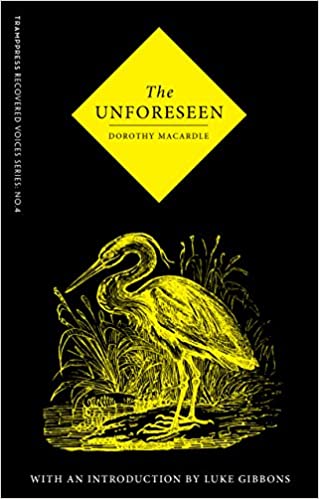
Review 1786: The Unforeseen

Although I haven’t yet read Dorothy Macardle’s The Uninvited, the movie based on it remains one of my favorites for Halloween. I didn’t realize that The Unforeseen is not a sequel to it but a follow-up and that a few of the characters make a reappearance. So, I’m reading and reviewing out of order.

Virgilia Wilde cannot afford to live in the city while she is sending her daughter Nan to art school in London, so she buys a cottage in the wilds of Wicklow. There she enjoys herself rambling the countryside and working on a children’s book about birds. However, she begins having strange experiences. First, she thinks she is seeing ghosts—a shadow in the doorway when no one is there, a telegram being delivered when one isn’t. She fears she is losing her mind so consults Dr. Franks, a psychiatrist. But he thinks there is nothing wrong with her. He consults his son Perry, who is a doctor with an interest in parapsychology, and eventually they realize that Virgilia is having visions of the future.

In the meantime, Nan has a frightening encounter with a sculptor and decides to come home for the summer while she works on illustrations for a book. Virgilia doesn’t want Nan to know about her visions, but soon she has some frightening ones.

This is a good little thriller with a supernatural angle to it. It has convincing characters and beautiful descriptions of the Irish countryside, reflecting the relative peace of Ireland during World War II.

Dark Enchantment

The Uninhabited House

The Victorian Chaise-Longue