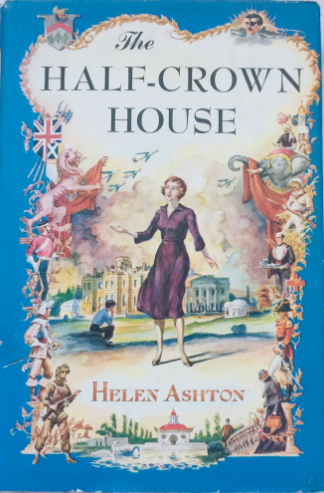
Review 1785: The Half-Crown House

The Half-Crown House is Fountain Court, a once-stately home that has fallen into disrepair after years of money and estate mismanagement and crippling death taxes. Its heir is Victor Hornbeam, a little boy who is coming to live there for the first time, his widowed mother preparing to marry. The property has been supported for years by Victor’s young aunt, Henrietta, who opens the house for viewing, and her cousin Charles, wounded during the war, who runs a market garden. They are struggling to support the estate so that they can hand over something to Victor when he comes of age. The only other family member living in the house is their grandmother, now bedridden, whose ferocious spending and mismanagement has bankrupted the family.

As the novel opens, Victor is arriving on one of the visitor’s days. Henrietta has a wealthy American suitor who wants to buy one of the valuable paintings, and she is hoping to sell it. However, that morning her grandmother tells her that it, along with many of the other paintings and jewels in the house, is a worthless copy that she had made when she needed to sell the original to pay her debts.

The household is wondering if Henrietta will marry the American, but it was apparent to me early on that her heart lay elsewhere. That only increases the little bit of suspense around this decision.

This novel is a meandering one. At times, it is much more concerned with the past elegance of the house and the events of the long-dead Hornbeams than with the living, for it goes off into little vignettes either through the memories of its inhabitants or during the descriptions of its current state. Thus, it particularizes the postwar state of the country, when many large homes were being dismantled or sold.

It’s an odd little book that reminded me a bit of Lady Rose and Mrs. Memmary and a couple of Rumer Godden novels that center around a house over the generations.


Lady Rose and Mrs. Memmary

China Court

A Harp in Lowndes Square

Review 1784: Death in Oslo

I began reading this Norwegian series after watching the Swedish TV show Modus that is based on it. I mentioned that connection before, but while reading this novel, I thought about it a lot.

Helen Bentley, the American president, disappears from her hotel room during a state visit to Norway. Adam Stubo isn’t involved in the case at first, but then FBI agent Warren Seifford requests Adam as a liaison. When Adam’s wife, Johanne Vik, hears this, she demands that he refuse to work with Warren even though she won’t explain why. Then she leaves home with her baby when Adam reports to work.

Perhaps it’s because I watched the Modus version of this book first, which made significant changes, but I found it much less plausible than I have Holt’s other books in the series. I have already noticed, though, that her character Johanne Vik tends to be a little hysterical at times, unlike the calm counterpart in the TV series.

First, I felt that Holt had little grasp of the way politics between the Norwegians and the Americans would play out. Most of the time, she just shows them spinning their wheels in power plays. She, or perhaps the translator, also gets things wrong about American speech. The mistake I can think of offhand has an American on the news call gas “petrol.” Americans don’t use that word. I would think the book was simply translated for a British audience except the word was used in a supposedly verbatim news report from the States. I also noticed a similar error when Warren’s thoughts are revealed.

The TV program has the President stashed in the closet of an abandoned building, but in the novel she is in an apartment basement and just happens to be found by the servant of the woman Johanne Vik goes to stay with. That coincidence is bad enough, but that they don’t immediately call the police is wholly unbelievable.

Finally, there’s the big climax. I don’t want to give too much away, but I have to say that since the person the president thinks is guilty isn’t, what happened to the danger that she was supposedly in? They handled this much better in Modus by having there be actual danger.

So, a bit disappointed here. I’m ahead of the series on the next book, so we’ll see if that makes a difference.

Punishment

The Final Murder

The Water’s Edge

Review 1783: Himself

Best of Ten!

Mahony has been raised to believe that his mother abandoned him on the steps of an orphanage. However, when Sister Veronica, who hated him, dies, he finds out that he was left with a note telling him his true name, his mother’s name, and “she was the curse of the town, so they took her from you.” So, he travels to Mulderrig, County Mayo, to find out what happened to Orla Sweeney.

Mahony is an attractive young man, and at first he is warmly received despite his mid-70’s hippie rig. Soon, though, the word is out, and most of the townspeople want him gone. Orla was wild, a thief and a prostitute, and she just up and left. But he finds a few supporters who believe she was murdered: Mrs. Cauley, an impressive old actress; Bridget Doosey, the slatternly housekeeper for the nasty local priest; and Shawna Blake, who takes care of Mrs. Cauley.

And, although they can’t really help him, Mahony can see the dead. When he was a child he saw them, but they faded until he set foot in the town. There’s only one dead person he can’t see—Orla.

This is a peculiar, dark story. I loved it. I first read Kidd about six months ago, and she hasn’t disappointed.

The Hoarder (Mr. Flood’s Last Resort)

Things in Jars

The Haunting of L.

Review 1782: The Toll-Gate

I was rereading some Georgette Heyer novels last winter as I replaced some of my ratty old 70’s copies, and I remembered The Toll-Gate as one of my least favorite of her romances. I was confused, however, for the novel was amusing and had a fun adventure plot.

Back the second time from the Napoleonic Wars, Captain Jack Staple has been intending to settle down. His mother and sister have accordingly presented a string of attractive, eligible girls, but Jack hasn’t been interested. He says he doesn’t want to get married until he receives “a leveller.”

On going to visit a friend, he loses his way and comes to a toll-gate that is manned at night by a terrified young boy. The boy tells Jack that his father told him to mind the toll-gate for an hour, and he hasn’t been back. The boy is terrified of a man his father sometimes meets during the night. Jack decides to stay with the boy until his father returns. Then the next morning, he receives his leveller, in the person of Nell Stornaway.

This novel is just delightful, and I don’t understand how I misremembered it so badly.

The Talisman Ring

Sprig Muslin

Faro’s Daughter

Review 1781: Good Evening, Mrs. Craven: The Wartime Stories of Mollie Panter-Downes

A woman feels as if some evacuees have taken over her home. The Red Cross sewing party is enlivened by arguments between the good-natured Mrs. Peters and the bloodthirsty Mrs. Twistle. A woman bravely faces her husband’s deployment and then is devastated to find he hasn’t left yet and she has to face it all over again. A couple finally gets rid of their evacuees only to have an acquaintance ask for room in their house. A man who has been working in a ministry feels guilty about not joining up.

These are a few of the stories about ordinary people during World War II that Mollie Panter-Downes published in the New Yorker. They are slice-of-life stories, although most of them have an upper-class perspective, of changing social conditions, of changes in everyday life, of people keeping a stiff upper lip.

I was surprised to learn from the Afterword that Panter-Downes, a prolific British journalist, short story writer, and novelist, was much better known in the United States than in Britain because she published almost everything in the New Yorker. So, even though she wrote hundreds of short stories, her legacy was almost lost in her native country.

Ordered by when they were written, this collection provides an insightful look, beautifully written, at the lives of ordinary people during the war.

One Fine Day

My Husband Simon

To Bed with Grand Music

Reading Thirkell’s Barsetshire Series in Order: #8 Before Lunch + #7 The Brandons Wrap-Up

I know it was tough to participate this month with the holidays and read The Brandons. Thanks, then for the comments by

  • Christine of All the Vintage Ladies
  • Liz Dexter of Adventures in Reading
  • Penelope Gough (a real trooper!)
  • Historical Fiction Is Fiction
  • Yvonne of A Darn Good Read

The next book in the series is Before Lunch, which I will be reviewing on Monday, January 31, 2022. I hope some more people will jump on board for this one.

And here’s our little badge.

Review 1780: Dead Point

Things haven’t been going well at the track for Jack Irish, Harry, and Cam. They just had to shoot a horse, which broke his leg just as he was winning a race. But that’s not the worst. The men’s friend Cynthia was returning from the track with the winnings for a syndicate they put together when she was robbed and brutally beaten. There are no leads, but they soon hear of another similar incident.

Jack’s involvement in these activities has been leading him to neglect a job for Cyril. One of Cyril’s clients wants him to find a man named Robbie Colbourne, who works as a bartender. Jack has barely started looking for him when he reads that the man was found dead of a drug overdose. However, the client asks to see Jack. He turns out to be an eminent judge who had an affair with Robbie, during which Robbie stole a compromising photo album. He hires Jack to find the album.

Peter Temple has written another great thriller, but he has also invented a rich life for his character, who surrounds himself with interesting people. He’s taking the “youth club,” a bunch of octogenarians, to the football, he’s installing a library, he’s advising his ex-partner on his love life, he might be getting back together with Linda. Temple likes his characters and makes working-class Melbourne come to life.

Bad Debts

Black Tide

Without Fail

Review 1779: Sudden Traveler

I enjoyed Sarah Hall’s The Wolf Border, so I was looking forward to reading her Sudden Traveler for my James Tait Black project. I sometimes have an uneasy relationship with short stories, though.

This thin book is a collection of seven stories. Some of them are slices of life, but others are more fantastic.

In “M,” a woman who was raped as a child transforms into a powerful creature that disposes of men who prey on the helpless.

In “The Woman the Book Read,” a man spots a woman he knew as a little girl on the beach in Turkey. He remembers how much he cared for her when he was engaged to her mother.

In “The Grotesques,” Dilly witnesses the humiliation of a local drunk.

“Who Pays” is quite mystical. Set in the Middle East, it is about village women who figure out a way to circumvent another war.

In “Orton,” a woman decides to disable her pacemaker in the town of her childhood.

“Sudden Traveler” is about a young mother burying her own mother.

I found some of the stories perplexing and “Live That You May Live” is one of them. It’s about a mother telling a terrifying story to her little girl.

The Wolf Border

Slipping

Nocturnes

Review 1778: #ThirkellBar! The Brandons

Although I know the season is busy, I hope some others of you joined me in reading The Brandons for Reading Thirkell’s Barsetshire Series in Order.

Mrs. Brandon attributes her good temper and blooming if languid looks to having been many years a widow. She also likes to imply that she was unhappily married even though she had just started to be bored by her husband when he died. Whatever the reason, she is charming and captivating enough to make men fall devotedly in love with her, including the vicar, Mr. Miller, and his pupil, Mr. Grant, who is the same age as her son Francis.

Mrs. Brandon’s elderly aunt by marriage, Miss Brandon, has been holding the bequest of her money and hideous house over Francis’s head for years, hinting when she is displeased—which is almost always—that she will leave it to someone else. Francis doesn’t want it, but when she summons them all to her house, Mrs. Brandon feels that they must go. There she finds that Miss Brandon has been ill and is actively mistreating her companion, Miss Morris.

At her house they also find Mr. Grant, who it turns out is a cousin in the same situation as Francis, alternately promised and denied a legacy that he doesn’t want. Part of the novel deals with what happens when Miss Brandon dies.

Thirkell is brilliant at describing the silliness of infatuations, and here she does not spare Mrs. Brandon’s admirers. A delight of this book is its conversations, especially those involving such eccentric characters as Mrs. Grant, Mr. Grant’s mother, who patronizes others about her life in Italy and constantly embarrasses her son with her lack of manners and clanking jewelry. Some favorites reappear in this novel, including Mrs. Morland and Tony, Lydia Keith, and Noel Morton.

Thirkell continues to entertain us with her witty and charming novels.

Pomfret Towers

Summer Half

August Folly