Review 2613: The Bloater

I was so taken by Rosemary Tonks’ The Halt During the Chase that I looked for more by her. I found The Bloater.

Min is a married sound engineer whose husband is seldom home. She occupies herself with witty, frivolous conversations with her girlfriends and flirtations with her admirers. She has one admirer she finds disturbing, though, a large opera singer whom she finds disgusting and attractive at the same time. She talks endlessly with her other friends about whether she wants an affair with him, whom she refers to as the Bloater.

This novella is crammed with witty, sometimes cruel dialogue. It moves along very quickly and is beautifully written. At times, I wondered if Min really wanted to have an affair with anyone—or maybe she does.

When I was reading about this book, I learned that Tonks gave up a successful career and retreated into isolation. You would hardly believe this of the creator of such witty, vibrant characters.

Related Posts

The Halt During the Chase

Sing Me Who You Are

Sally on the Rocks

Review 2612: Across the Common

Louise has left her husband Max for reasons that are not clear to her and gone to stay at The Hollies with her elderly aunts. Part of the problem is that she still considers The Hollies home and bears some guilt for how she left it. Maybe she resents some of the attention Max gives to his students or maybe that he realized his limitations as an artist but is happy as a teacher. (When we finally meet Max, he seems perfect, so it must be for some other reason.) In any case, she eventually realizes, she needs to grow up.

At first, she is happy to be home with her formidable Aunt Rosa and her fey-like Aunt Seraphina, although not so pleased to hear that Aunt Cissie, who has broken her hip, is coming to recuperate. And then there’s Gibby, the cook and housekeeper, who is more like family. But very soon, she learns something disturbing—that her grandfather committed suicide years ago. No one will talk about it, so she doesn’t know why.

As she listens to her aunts talk about their past, Louise begins considering what happened to all the men in the family—they all left or died. Her own father was a sort of invalid, and both he and her mother died there from the flu. Neither of her sisters ever married.

Soon, Louise begins to discover secrets in her family history and instead of retreating to her childhood, as she does at first, learns to become her own person.

I liked this book very much. The writing is gorgeous, and Berridge manages to tell the story without falling into clichés. Rooms, scenes, and emotions are minutely observed, as are perceptions about human relationships.

Related Posts

Old Filth

Heat Lightning

Family Ties

Review 2611: Romantic Comedy

For some reason, I thought I had read at least one book by Curtis Sittenfeld. It turns out, though, that I was confusing her with someone else. (Correction: I just looked, and I have read one other book by her. I thought I looked that up before I wrote this.)

Romances are not usually my genre, but I can sometimes enjoy them. Romantic Comedy was so popular that I decided to give it a try.

Sally is a comedy writer for a TV program called The Night Owls, a thinly disguised Saturday Night Live. She loves her job but after an embarrassing incident with a co-worker, has given up on romance.

Her spots usually have something to do with feminism, and for the week in question, she is working on one sketch called “The Danny Hurst Rule,” named after her office mate and friend, who is engaged to a famous, beautiful actress. The idea is that beautiful celebrity women might date average-looking men, but the reverse never happens.

For that show, the guest host and musical guest is Noah Brewster, a popular musician. Sally finds herself terrifically attracted to Noah as she helps him write a sketch, but since she considers her looks average, she can’t believe he would be interested in her. He obviously is, but at the after party she makes a crack that drives him away.

Two years later during quarantine from Covid, Noah sends her an email. This starts a chain of correspondence.

I think Sittenfeld was attempting to write a smart, witty romantic novel. I have realized I am out of step with modern humor (proved by the fact that I haven’t considered SNL funny since the 80s, and I’m waiting for younger folks to realize that fart jokes are not funny), and I did find some of the lines witty, but I found the rest of the novel only moderately interesting and was a bit bored by the string of long, heart-felt texts.

The most interesting to me was the research Sittenfeld put into the operation of SNL, the preparation and behind-the-scenes stuff. Otherwise, I was kind of meh. Although I did find both main characters sympathetic, Sally is so hung up on her preconceptions that she creates a lot of problems, and Noah is too perfect.

Also, I have an objection. Why do most modern romances involve a woman ending up with someone wealthy? Although there is certainly a long history of that, it used to be that sometimes two ordinary people could make a romance.

Related Posts

Eligible

Beautiful Ruins

Wonder Cruise

WWW Wednesday!

It’s the first Wednesday of the month, so it’s time for WWW Wednesday, an idea I borrowed from David Chazan, The Chocolate Lady, who borrowed it from someone else. For this feature, I report

  • What I am reading now
  • What I just finished reading
  • What I intend to read next

This is something you can participate in, too, if you want, by leaving comments about what you’ve been reading or plan to read.

What I am reading now

Right now, I’m reading the second book in the Department Q series: The Absent One by Jussi Adler-Olsen. It’s pretty grim so far, but that doesn’t usually bother me with crime novels. The second season of Department Q is supposed to be uploaded to Britbox this month, so I’m right on time. FictionFan pointed out to me that the TV series has inexplicably moved the mysteries to Scotland. I didn’t even notice that! Maybe it’s because I saw the TV series first.

What I just finished reading

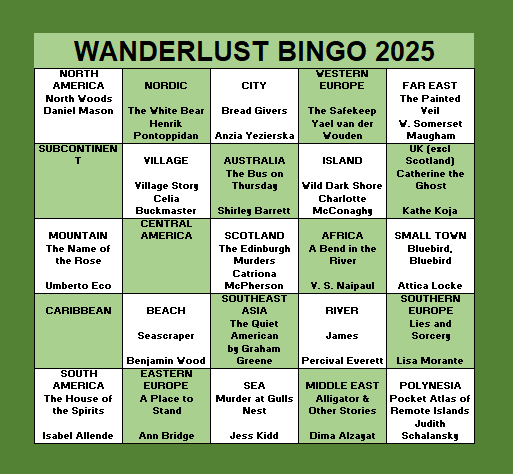
I have to thank Nonfiction November for this one, because I have seldom enjoyed a nonfiction book as much. It’s the beautiful Pocket Atlas of Remote Islands by Judith Schalansky. If you like maps and stories about remote places, even if you don’t have an affinity for islands like I do, you’ll find this one fascinating.

What I will read next

I think it’s going to be The Darlings of the Asylum by Noel O’Reilly. I have no idea how this book got on my list or what it’s about, but it’s almost time to find out!

How about you? What have you been reading?

Review 2610: Orbital

Orbital, the winner of last year’s Booker Prize, is unlike any novel I’ve ever read. I’m not even sure I would call it a novel.

It takes place over 24 hours in the International Space Station. It doesn’t have much of a plot or much characterization. It is mostly contemplative, examining the ideas Harvey imagines the astronauts might consider and making observations of her own.

There are six astronauts onboard—two Russian men, an English woman, a Japanese woman, an American man, and an Italian man. Two significant events are taking place that day outside the space station—a ship is headed to the moon and a super-typhoon is headed for the Philippines.

Pietro, the Italian astronaut, is worried about a Filipino family he and his wife befriended. Chie, the Japanese astronaut, has just heard that her mother died unexpectedly. Nell, the English astronaut, is worried about the growing distance between her own life and her husband’s in Ireland. Anton, one of the Russians, has realized he no longer loves his wife. But being so removed from the Earth simultaneously brings a love for the planet and a remove from it. The novel is about contemplation.

It is almost entirely descriptive, with very little dialogue. It is beautifully written, as it indulges in passages about the beauties of the earth.

For me, not a contemplative person, I could appreciate its qualities without being that engaged in it. That may be because I am interested in people. Miles up may be way too high for me.

Related Posts

The Western Wind

Dear Thief

Packing for Mars: The Curious Science of Life in the Void

Review 2609: The Keeper of Lost Causes

My husband and I were recently transfixed by the Department Q TV series, so I set out to find the books it was based on. They are by the Danish writer, Jussi Adler-Olsen.

The mystery in the first book was the same one as in the first series, but lucky for me, the TV series changed it enough so that it wasn’t totally predictable. They also changed the personality of Merete Lynggard and the motive for the crime, which was even more senseless than in the TV series.

Following a shooting incident which wounded Carl Mørck, paralyzed his partner Hardy, and killed Officer Anker, the department doesn’t quite know what to do with Carl. The media has been out to get him, claiming that he hid behind Hardy when in actuality Hardy fell on top of him, and he is difficult and not liked by most of his colleagues. Then his boss is told to set up a special department to investigate cold cases and given a large budget to fund it. So, the boss takes most of the money for the homicide department and sticks Carl in a basement with only one assistant, a Syrian refuge named Assad, charged with cold cases.

At first, Carl is totally apathetic. He spends his days playing games on his phone and visiting Hardy in the hospital. When they finally get some files, it is Assad who reads them and encourages him to pick the case of Merete Lynggard.

Merete was a rising political star when she disappeared without a trace from a ferry on vacation with her disabled brother Uffe. The investigators eventually decided she had fallen overboard. But we readers know she is alive and being held captive, because occasionally the novel flashes back to events five years before, when she was taken, and to her situation in the present.

Despite my knowledge of many of the plot points, I found this novel intriguing. The characters are interesting—Carl is actually a tad more sympathetic than in the TV series (although probably not as handsome)—and the mystery is a good one, with a suspenseful climax and a touching ending. Now I just need to read the second book before the next series comes out.

Related Posts

The Tenant

Borkmann’s Point

Roseanna

Review 2608: The Night Ocean

At first, I thought this novel was going to be about H. P. Lovecraft. Then, I thought it was a sort of homage to 30s and 40s science fiction and horror writers. But having finished it, I don’t know quite how to describe it.

Marina Willett’s husband Charlie is missing or dead. A writer of insightful profiles, Charlie began working on one of H. P. Lovecraft. During his research, he became interested in the story of a book purportedly written by Lovecraft’s much-younger deceased friend Robert Barlow that alleged a homosexual affair. This book was debunked as a fraud perpetrated by Lovecraft fan L. C. Spinks. However, Charlie becomes convinced after visiting Spinks that he is actually Barlow, having faked his own death and taken Spinks’ identity. He publishes a book telling this story and immediately becomes a literary celebrity.

But then, evidence comes out about facts that are incorrect, and Charlie himself is believed to have perpetrated a fraud. After checking himself into a mental hospital, he disappears, his clothes found next to a lake.

Marina is not satisfied. She decides to revisit the research that Charlie conducted, in the hopes of figuring out what happened. Since the last thing he did before checking into the hospital was revisit Spinks, Marina goes to see him.

Most of the rest of the novel becomes a series of stories beginning with Spinks’ first interview with Charlie. These stories name-drop 30s and 40s science fiction and horror writers and other prominent figures like crazy. This technique of the strange tale is one familiar to horror readers and a nod to Lovecraft.

If I were a bigger Lovecraft fan, I’d probably recognize more allusions besides the obvious ones—his fanboy-cum-writers themselves dropping his made-up words into their conversations, for example.

I think that Lovecraft fans will appreciate this novel more than I did, but the novel leaves Lovecraft behind about halfway through, and becomes more about Barlow. Myself, I got a little tired of the structure of story after story.

The novel is ultimately about identity, search for community, and reinvention.

Related Posts

The Annotated H. P. Lovecraft: Beyond Arkham

The Dark Fantastic

Melmoth

Review 2607: Girls in Their Married Bliss

Girls in Their Married Bliss is the third book in O’Brien’s Country Girls trilogy. It is unusual in that the book is narrated partially by Baba instead of only by Kate (once Caithleen). Baba is much more cynical, and she lets us know right away that neither of them is happy.

At the end of the last book, Kate seemed to give up on her older married boyfriend Eugene and moved to England with Baba. However, she was pregnant, so, in the interim between the last book and this one, she and Eugene eventually married. But Kate felt ignored in their marriage except for Eugene’s myriad of rules, so she began a romantic relationship with another man. They have just broken up at the beginning of this novel when Eugene discovers his love letters. He turns cruel and nasty and threatens to take away Kate’s little boy.

Baba has married a rich, crude builder for his money. After she has an unsatisfying encounter with a drummer, she becomes pregnant. Despite her knowing attitude, neither she nor Kate have any idea what to do, and they must do something, as Baba’s husband is not big on sex.

This is an affecting trilogy, but I thought this book was the most affecting. I don’t want to say any more about what happens, though.

Related Posts

The Country Girls

The Lonely Girl

Wild Decembers

Review 2606: The Episode at Toledo

I have read two books before by Ann Bridge, and although the second was more action-oriented, they were both about women discovering themselves. When I looked for another book by Bridge, I wasn’t aware that she had a series of books around the character of Julia Probyn. This is one of them, about the sixth or seventh in the series, but Julia is a fairly minor character.

Although not necessary, it might have helped me to have read the series in order. I say this mostly because of the beginning and ending of this book, where Julia is ensconced in Scotland among a throng of characters who are briefly introduced but who I couldn’t keep straight.

Julia receives a guarded letter from her Hungarian friend, Hetty, who has married Richard Atherley, British Counsellor in Madrid. Hetta has asked that Julia send either her husband or another friend in Intelligence out to Madrid but doesn’t explain why. However, her friends speculate that it might have to do with a visiting admiral from the U. S. Understand that this is definitely a Cold War novel, and that in an earlier novel Hetta was kidnapped and drugged by Hungarian Communists.

Hetta is worried because she thinks she has recognized the American ambassador’s chauffeur as a Hungarian Communist who years ago closed down the Catholic school that Hetta attended and took delight in harassing the nuns. However, when Hetta’s friends check into it, they find he has been vetted by American security, so they dismiss her fears.

Of course, he is a bad guy, so Hetta does her best to keep the American admiral out of the ambassador’s car. On a tour to Toledo, Hetta suffers a broken arm after she delays the car, which has an accident trying to get to a rendezvous in time to be blown up.

After that, Hetta’s husband arranges for her to go to Portugal to stay with friends, as she is pregnant. But danger follows her.

For a suspense novel, there is a lot more inactivity than activity. Somehow the balance wasn’t right. There is also a lot of repetition as one group after another discusses the same incidents. Frankly, the last 20 pages or so, in which Hetta’s husband arranges for her to return to Scotland and she does, seem to have no relevance except to return to Julia and her confusing pack of relatives and friends. I would estimate that 50-75 pages of this novel are unnecessary.

Was Bridge tired of writing this series? She seems to have been trying to replicate the kind of books Mary Stewart wrote, combining suspense with lovely descriptions of the country. But Stewart did it better. This book also reminds me of the Cold War books of Helen MacInnes, only they have more romance.

To really evaluate this series, I think I would have to start with the first one, which I plan to do. In the meantime, I prefer her other books.

Related Posts

Illyrian Spring

A Place to Stand

Station Wagon in Spain