
 The Best Book for this period is The Greenlanders by Jane Smiley!
Review 1380: Literary Wives! Ties
 Today is another review for the Literary Wives blogging club, in which we discuss the depiction of wives in fiction. If you have read the book, please participate by leaving comments on any of our blogs. Be sure to read the reviews and comments of the other wives!
We are sorry that Emily of The Bookshelf of Emily J. has left our group because of her many commitments. We’re going to miss her!
Eva of Paperback Princess
Lynn of Smoke and Mirrors
Naomi of Consumed By Ink
* * *
Ties is a very short novel divided into three parts. It is about a marriage, but moreso, it is about how a period of infidelity in that marriage affects everyone in this small family. Part I consists of letters written by the wife, Vanda, after her husband leaves her. Part II is narrated by the husband 40 years after they reconcile. Part III is from the point of view of their two children.
Initially, I was sympathetic to Vanda. After all, her husband leaves her with almost no warning and then neglects her and her children for several years, refusing to discuss their situation and too busy being happy with his girlfriend. His explanations for the affair are laden with sophism. Where did this idea come from, repeated twice, that it’s bad to resist impulses? It’s the 70’s, but come on. However, Vanda’s tone in the letters is too insistent, too strident.
An old man, Aldo is forced to revisit this period in their lives after a break-in. Cleaning up, he finds Vanda’s letters and reads them again. He sees his old affair with Lidia as a bid for freedom that was defeated out of guilt. After he and his wife reunited, she used his unhappiness to beat him and make him submissive. Worse, from the children’s point of view, she removed his role of father from the family.
This book was obviously written by a man.
Throughout the book are themes of boxes or being boxed in versus freedom and themes of cheating or being cheated.
What does this book say about wives or about the experience of being a wife?
We understand that Vanda and Aldo were happy and content for some years, although for a few years before the breakup, they were less so. But in this book we only see Vanda as a shrew. Of course, there is reason for her to be unhappy when her husband leaves her and the children with nothing and then avoids them for years. Still, she carries her reactions to an extreme, especially after they reunite.
For his part, Aldo seems to see her and their children as a trap. Interesting, how some men seem to forget they actually participated in having children. Once he has left them, he prefers to think only of Lidia. Later in life, he’s been downtrodden for so long, yet he sees Lidia once a year and secretly keeps photos of her in a box.
Jhumpa Lahiri, in her introduction, says the novel is about creating and destroying. To me, it is just about destroying. Aldo was happy with Lidia but didn’t have the courage to stay with her. At the same time, he destroyed what seemed to be a happy marriage with Vanda in the worst possible way, by deserting his family. When he comes back out of guilt, the two of them create an even worse mess.
Crime Spree
Embolded by a post by Simon of Stuck in a Book, who wrote about some books he received from publishers, I requested books from three of my favorite reprint publishers: Poisoned Pen Press, which publishes the British Library Crime Classics; Dean Street Press, which publishes Furrowed Middlebrow; and Persephone Press. I received positive responses from all of them with promises to send some of their new books. I had a few contacts with publishers before I retired, but I lost those contacts when I moved and had occasionally been requesting eBooks from Netgalley. But I really don’t like reading books online.
 Yesterday, I received my first shipment, four British Library Crime Classics! I can’t wait to dig in, which I will do after I finish the current nonfiction book I’m reading about the medieval English queens. The books are Murder in the Mill-Race by E. C. R. Lorac, Death Has Deep Roots by Michael Gilbert, and two volumes of mystery short stories: Deep Waters and The Christmas Card Crime and Other Stories.
Review 1379: The Nightingale
 I wasn’t impressed by the only other Kristin Hannah novel I read, but my brother recommended The Nightingale so strongly that I decided to give her another chance. I know I’m probably in the minority.
The novel begins with an old lady living in Oregon in 1995 who is moving into a retirement home and is sorting through old papers with her son. Her son finds the identity papers of Juliette Gervaise, a person he’s never heard of. This launches most of the rest of the novel, set in France during World War II.
The two Rossignol sisters are very different women. Vianne is a mother, wife, and schoolteacher. When the Nazis arrive in the village, she is careful to follow orders and try to stay out of trouble. Isabella, however, is a rebellious teenager who runs away from school and immediately begins distributing fliers for the Resistance.
As Vianne fights to survive and protect her daughter, Sophie, she eventually finds that she can’t always follow the rules. In the meantime, Isabella’s involvement with the Resistance becomes more dangerous. Obviously, one of hooks of the novel is to find out which sister becomes the little old lady in Oregon.
It took quite a while, but I did become involved in this novel. It’s an interesting story, based on a real one. I still, however, consider the writing mediocre and trite and the characterization flat except for a few characters. I found the novel affecting, though.
Related Posts
Review 1378: Widdershins
 Widdershins presumably takes place in the 17th century, when Puritan elements began to go after the local wise women and midwives and accuse them of witchcraft. The novel follows two characters, John, who was raised by his mother’s midwife after her death, and Jane, whose mother is a midwife.
When John is a boy, he is sent to live with his uncle, a woman-hating Puritan. He casts off his affection for his foster mother and begins to imbibe his uncle’s beliefs. As Jane approaches womanhood, she is being taught midwifery and the use of herbs by her midwife mother and Mag, a wandering wise woman. She also falls in love with her best friend, Tom.
It’s clear from the beginning that these two characters are on a collision course. However, for me, it was taking too long to get there. I’m not a reader who requires a lot of action from a novel, but I do require something. I didn’t find these characters particularly compelling, and when I reached the halfway point, I decided to stop.
Related Posts
Review 1377: Lincoln in the Bardo
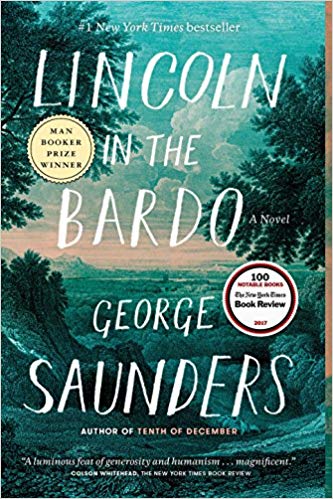 The title Lincoln in the Bardo is the first tip-off that this book is unusual, for it refers to a Tibetan concept of immediate life after death. The novel is set in a graveyard after the death of Abraham Lincoln’s son, Willy, and is narrated by a host of ghosts who don’t know they are dead and are clinging to their worldly concerns. It is also moved along by quotations, some real, some fictitious, by accounts of the time, letters, and historical accounts.
The ghosts in the graveyard are grotesqueries who physically manifest the obsessions they had in life. The two most important ghosts in the novel, for example, are Hans Vollman, who sports an enormous erect penis because he died before he could consummate his marriage; and Roger Bevins III, whose sensual nature is indicated by his multiple eyes, noses, and hands. Okay, this can be comic. It is certainly an amusing idea. But after a while, I began to miss the subtle humor that seems to have deserted us in recent years.
The thrust of the plot is that children aren’t meant to linger in the Bardo or terrible things happen to them. However, Lincoln arrives early in the novel to visit his son in his grief, and he says he will return. Vollman, Bevins, and their friend, the Reverend Everly Thomas, become determined to help Willy leave, and to do so they must get Lincoln to return to the tomb and release him.
This novel is wildly original. Aside from the characteristics I’ve mentioned, it is written more like a screenplay than a novel. It also resonates deeply in its themes of grief, Lincoln’s worries about the war, and the concerns of life affecting the afterlife. Still, I was repelled by how crude and crass it is at times. I also felt that the novel was much longer than it needed to be. You get the idea about the ghosts fairly quickly, but the supernatural chatter becomes boring after a while.
I read this for my Booker Prize project.
Related Posts
Review 1376: A Harp in Lowndes Square
 In a lonely attic, a neglected child sits and makes clothing for her doll out of old clothes. Everyone is out, surely, but she hears voices on the stairs. These voices belong to her two children, twenty years in the future.
Those children are twins, Vere and James, who have been taught by their mother that all time is simultaneous. The two do indeed experience flashes of visions and sounds from other times, events that occurred in the room years before.
Vere and James’s happy growing up, along with their sister, Lalage, is interrupted by the death of their father. The family is left in financial difficulties and must move from their suburban home to a small house in London. This brings their mother, Anne, back into the orbit of her own mother, the formidable Lady Vallant.
It is clear that, when she returns from visits to her mother, Anne appears to be more worn than usual. Anne’s children know that the two don’t get along and suspect that Lady Vallant harasses Anne. However, a chance remark reveals to them an aunt they didn’t know existed, Myra, who died when she was young.
Vere and James receive impressions of serious events that are not talked about. They begin trying to find out the secrets in their family’s past.
This novel is a ghost story but not in the sense of one meant to scare. It reflects Ferguson’s interest in houses and her sense that actions taken in a room stay in that room’s atmosphere. This idea also occupied A Footman for a Peacock, which I found considerably less likely than this novel, which is set during World War I.
I like a ghost story, but this novel has more going on than that. It’s a story of how family events can affect the lives of others who weren’t even alive when they happened. It’s a good character study of Vere, who cares deeply about a few people but is meticulous and reticent in nature. It is also about a chaste love affair with an older man—and his wife. I didn’t really understand the charms of that relationship, but I very much enjoyed this novel.
Related Posts
Review 1375: Melmoth
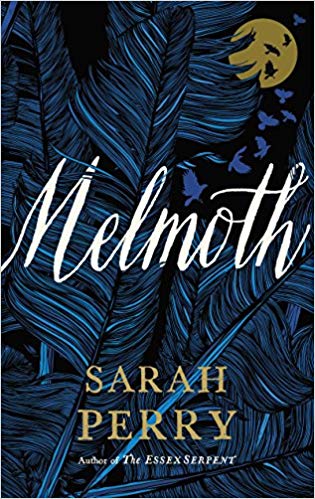 Helen Franklin is an Englishwoman living in Prague who leads a willfully colorless and drab existence. She dresses and behaves as if she wants no one to notice her and makes a living translating brochures. In nine years in Prague, she has made only two friends, Karel and Thea, a couple.
Helen encounters Karel one night, looking ill. Thea was recently stricken by multiple sclerosis, and Helen assumes he is worried about her. He tells her the story of a manuscript he’s been given that documents sightings of Melmoth. In the legend of the novel, Melmoth (who seems in actuality to be based on a male character in an Irish Gothic novel) witnessed Christ arisen from the grave but denied it. In this novel, Melmoth is an evocatively described woman, a suggestion of tattered sheer silks, who is fated to witness man’s inhumanity. She appears to those who have entered the depths of despair and asks them to keep her company.
Through the manuscripts, we learn the stories of several people who have caused the sufferings of others and who have met Melmoth. Both Karel and Helen are immediately obsessed with this vision and imagine Melmoth stalking them.
The novel is tied together by the gradual exposure of Helen’s own crime, but the themes of the novel center around the history of man’s inhumanity and the importance and difficulty of witness.
This novel was certainly a departure from Perry’s The Essex Serpent, and I wasn’t sure how much I liked it. It has a deeply Gothic atmosphere, suitable for its setting in Prague, but I didn’t understand its characters’ fascination with Melmoth. Also, I had little sympathy for most of the characters whose crimes are related in the manuscript, even though I was sympathetic to Helen. Although this novel has more serious intentions, I have to say I preferred The Essex Serpent.
Related Posts
If I Gave the Award
 Having posted my review of The Sellout by Paul Beatty, I see it is time for my feature where I give my opinion of the winners for a specific award. The Sellout was shortlisted for the 2016 Man Booker Prize. It was the winner that year. If you read my review, you know that I disliked this book intensely because of its style, which reminded me of a long stand-up comedy routine, and also because of its over-the-top plot. In fact, I did not finish reading it. So, obviously, I would not have picked it for the award.
Another book that did not impress me was All That Man Is by David Szalay. It depicts in barely related short stories (why is it called a novel when nothing but the theme overlaps from story to story?) a series of incidents featuring despicable male characters who at best do nothing and at worst are very bad indeed.
Eileen by Otessa Moshfegh, on the other hand, is a portrait of a despicable woman. Although I thought this novel presented a masterful characterization, it was not my favorite.
 I liked Hot Milk by Deborah Levy more, but I thought some of its events were unlikely. And it was confusing at times, written in an almost hallucinogenic style.
Although I occasionally found its style irritating, since it has a fairy tale-like quality to it, I found Do Not Say We Have Nothing by Madeleine Thien heart-rending. In addition, it informed me about events I knew nothing about.
My selection for the winner, however, would have been His Bloody Project by Graeme Macrae Burnet. I found it absolutely fascinating as it followed a crime as well as depicting the lives of crofters in the 19th century.
Review 1374: The Sellout
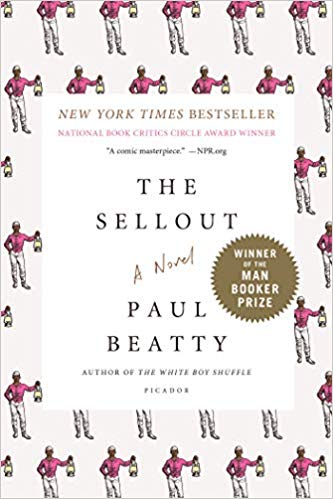 Really? This book won the Booker Prize? I know my sense of humor is getting to be out of date, and when I read on the blurb that the book was “biting satire,” I just sighed. There’s no subtlety in humor anymore, and this novel is a prime example. Its writing style is broad and hectic, like a really long stand-up comedy routine. I’m guessing you either love it or hate it.
The narrator, a black man whose name is Me, starts out the novel at the Supreme Court, where he is being tried as a slave owner and is getting a lot of hatred because of his race. He proceeds to tell the story of how he got there, spending lots of time getting to the crux of the story.
The beginning of the book, where he satirizes his upbringing as a subject of his father’s childhood development experiments, is over the top but amusing. When he introduces the character of Hominy Jenkins, the last surviving Little Rascal, his all-on employment of racial stereotypes (to make fun of them, of course) was too much for me. I quit about halfway, after he reluctantly made Hominy his slave.
Be warned that this novel makes extensive use of the N word. I’m not sure, but Beatty’s intent may be to desensitize us to it. If so, it didn’t work.
 What? Me Read?