Time for Another Classics Club Spin

Classics Club announced its 17th spin on Thursday. If you want to participate, you must post a list of 20 books from your Classics Club list by March 9. The spin will select a number corresponding to one of those books, which they challenge you to read and post a review by the end of April. Here is my list of 20 books:

  1. The Tenant of Wildfell Hall by Anne Brontë
  2. August Folly by Angela Thirkell
  3. La Morte D’arthur by Thomas Malory
  4. The Duchess of Malfi by John Webster
  5. Mansfield Park by Jane Austen
  6. I Go by Land, I Go by Sea by P. L. Travers
  7. Oroonoko by Aphra Behn
  8. Aurora Floyd by Mary Elizabeth Braddon
  9. Kenilworth by Sir Walter Scott
  10. The Good Soldier by Ford Madox Ford
  11. Owls Do Cry by Janet Frame
  12. The Haunted Hotel by Wilkie Collins
  13. Mary Lavelle by Kate O’Brien
  14. The Expedition of Humphrey Clinker by Tobias Smollet
  15. Three Weeks by Elinor Glyn
  16. This Side of Paradise by F. Scott Fitzgerald
  17. Madame de Treymes by Edith Wharton
  18. My Mortal Enemy by Willa Cather
  19. The Viscounte de Bragelonne by Alexandre Dumas
  20. The Heir of Redclyff by Charlotte M. Yonge

There are lots of books on this list that I know nothing about, and only three that I have read before, so it should be an exciting spin.


Day 1184: The Garden of Evening Mists

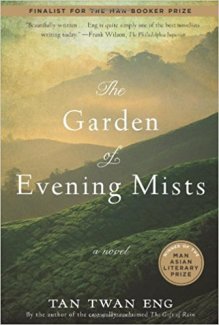
Cover for The Garden of Evening MistsBest of Five!
Yun Ling Teoh, a Malayan federal judge of Chinese descent, has decided to retire early. She has been diagnosed with a neurological ailment that will cause more and more frequent episodes of aphasia and will eventually destroy her language abilities. She decides to return to Yugiri, a Japanese garden in Malaya that she inherited from its creator, Aritomo.

On the advice of her friend Frederik, the owner of a nearby tea plantation, Yun Ling decides to record her memories. She begins in 1951, when she went to Aritomo to ask him to design a garden in memory of her sister, Yun Hong, who died in a Japanese labor camp during World War II. Yun Ling also was in the camp, and her hatred of the Japanese makes it difficult for her to ask for Aritomo’s help. But her sister loved Japanese gardens.

Aritomo refuses her request but makes her a different offer. If she will take on the job of apprentice, he will teach her enough to design her own garden. She decides to accept the offer, having quit her job as prosecutor.

It is a difficult time in Malaya. No sooner did the war end than the government began fighting Communist guerillas, who were attempted to take over the country. And Akitomo has his secrets. He came to Malaya before the war, having resigned as the Japanese emperor’s gardener, but Yun Ling occasionally hears that he played a role for Japan during the war. He had some kind of influence, because he saved his neighbors from the Japanese labor camps. Yun Ling, we find, has her own secrets.

The Garden of Evening Mists is the best kind of historical fiction, immersing me in its time and place while informing me of events I was formerly unaware of. I found it deeply interesting and affecting. The descriptions are delicate and evocative, and the characters feel real yet mysterious. This novel was part of both my Walter Scott Prize and Man Booker Prize projects, as well as the winner of the Man Asian Literary Prize. It is a powerful novel.

Related Posts

The Glass Palace

The Narrow Road to the Deep North

The Ten Thousand Things

Day 1183: The Widow’s House

Cover for The Widow's HouseI haven’t read a creepy book in a while, and The Widow’s House is a good one. It is also a complex story where nothing is what it seems.

When she went away to college, Clare Martin moved away from her home in the Hudson Valley and hoped she would never return. She and her husband, Jess, moved to New York with aspirations to be writers, and ten years ago, Jess wrote a critically acclaimed novel. However, another one was not forthcoming, and for the past three years, Clare has been supporting them by taking editing work. They are badly in debt.

Jess suggests they move back into the country with the money from selling their loft apartment, leaving both of them time to write. He has a fancy to live in the same area where Clare grew up. When they go to look at houses, however, most of them are out of their price range.

Their realtor, Katrine Vanderberg, has an idea. Another writer is looking for a couple to occupy the caretaker’s house on his property. The rent would be free in exchange for some help around the property. The main house is River House, a beautiful but neglected octagonal mansion that is said to be haunted. The owner is Alden Montague, or Monty, the writer, who just happens to be the Martins’ old writing professor, and he is glad to have them.

Shortly before the move, Clare finds out that Jess turned down a teaching job at a college near their apartment, an opportunity that would have allowed them to stay in New York, without even discussing it with her. She is so upset by that, and what she thinks is his philandering, that she prepares to leave him soon after the move. But his behavior makes her change her mind.

The main house is supposedly haunted by a woman who had a child by the owner of the house. One stormy night she left the child on the doorstep of the house and drowned herself in the pond. The child was found dead. Clare was fascinated enough by this local story to have written about it in college, and now she decides to write a novel about it.

But almost upon her arrival in the house, she sees the woman standing near the pond and hears a baby crying at night. Clare has a history of psychic experiences and decides the house is haunted. When the caretaker’s cottage is destroyed in a flood, she and Jess move in with Monty.

Early in the novel I suspected gaslighting. I won’t say if I was right, but there are layers upon layers to this novel. It is a well written, suspenseful, spook fest. I had to keep reading it until late in the night once I got started.

Related Posts

Arcadia Falls

The Poison Tree

The Darkest Room

Day 1182: Suzanne

Cover for SuzanneSometimes you read a book that makes you want to consider it. Maybe you feel ambivalent about its subject matter or its approach. Maybe you want to ponder the choices made by its characters. Maybe the fact that you want to think about it marks it as good. I had all these thoughts about Suzanne.

This novel was given to me to read by my French-Canadian sister-in-law. It is an imagining of the life of the author’s grandmother, a poet and painter who abandoned her family when her daughter was three.

The novel is written originally in French and translated by Rhonda Mullins. It is written in the second person in short excerpts. Suzanne Meloche was always rebellious, it seems, and when she had to choose, she chose herself. After a difficult, poverty-stricken childhood in rural Ottawa, she struck out for Montréal. There, she almost immediately was taken up by a movement of artists and writers, called Automatism, led by Paul-Émile Borduas. Many of the people she associated with became well-known Quebecois painters. Eventually, she married Marcel Barbeau, an artist.

This novel makes compelling reading, as it explores the question of how far you should go to pursue your own goals. Suzanne is an interesting character who leads a rich life, although I don’t like her very much. In fact, I think her granddaughter is a little too understanding of her foibles. Perhaps her interpretation of Suzanne’s thoughts and feelings is correct—Suzanne did after all keep the pictures of her grandchildren that her daughter sent her. To balance that, though, is the harm she did her children by abandoning them and her reception of her daughter and granddaughter the one time they went to visit her.

As a work of authorship, it’s brilliantly written and compelling. Will you like it? I suppose it depends on how you feel about the subject.

Related Posts

The Blazing World

How to Be Both

The View from Castle Rock

If I Gave the Award

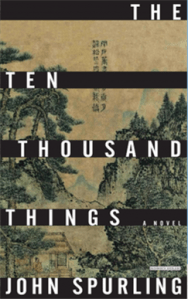
Cover for The Ten Thousand ThingsLast week I posted my last review of the shortlisted books for the 2015 Walter Scott Historical Fiction Prize. That means it’s time for this feature, where I give my opinion about whether the judges got it right.

The shortlist for 2015 is a tough one to like. There were seven books on the shortlist, but for various reasons, four of them just didn’t float my boat at all: Zone of Interest by Martin Amis, In the Wolf’s Mouth by Adam Foulds, Arctic Summer by Damon Galgut, and A God in Every Stone by Kamila Shamsie.

Cover for Viper WineOf the other three nominations, Viper Wine by Hermione Eyre is the most inventive in approach and is well grounded in its historical background. Looking back at my review, I think I enjoyed it more than I remembered. The Ten Thousand Things, that year’s winner by John Spurling, is probably the book that most qualifies as literary fiction, and it certainly conveys both a historical context and a sense of time and place. It had such a detached viewpoint, however, that I was never fully engaged with it. For me, The Lie by Helen Dunmore was the most engaging, but of these three, it conveyed the least about its historical time. So, for this year’s prize, taking into consideration both how involving the book was and its reflection of its time and place, I guess I would have picked Viper Wine, with a plus for its wildly inventive approach.

Day 1181: The Zone of Interest

Cover for The Zone of InterestIn Martin Amis’s The Zone of Interest, the Zone is a Nazi factory and concentration camp in Poland. Interestingly, Amis makes this setting a source of some very black humor.

The novel is written from the points of view of several characters, mostly Nazis, but it is mainly from that of Thomsen, an officer in charge of production at the rubber factory. He is a womanizer, but he begins to have feelings for Hannah Doll, the commandant’s wife.

Doll himself is a vile human being. He has his rival for Hannah imprisoned and uses threats against inmates’ relatives to force them to do things.

In fact, most of the characters are vile. And that’s the difficulty with this novel. First, is the Holocaust fodder for humor? I’m not sure it is in general, but it isn’t for me. Also, even though Thomsen is the least criminal of the characters because he’s working subtly against the war effort, these are people busily explaining away their own terrible actions.

Amis’s goal, I think, is to give some insight into the behavior of these people. Whether you want to read a novel on this subject probably depends on whether you’re interested in that insight. It made me a little queasy. This is one of the books I read for my Walter Scott Prize project that I didn’t really enjoy.

Related Posts

Maus I

Great House

The History of Love

Day 1180: Travels with a Donkey in the Cévennes

Cover for Travels with a DonkeyMary Stewart’s My Brother Michael is the first place I heard of Robert Louis Stevenson’s Travels with a Donkey. It is a short travelogue of a journey Stevenson took in 1878 in the remote Cévennes area of southern France with only a donkey for company.

This book is full of descriptions of the people and scenery and relates with some humor the author’s struggles with Modestine, the donkey. It also tells some of the legends and history of the area, which was the site of a religious revolt by the Camisards, a sect of the Huguenots, in the 17th century.

Although this history is interesting, for my tastes Stevenson spent too much time discussing religion, particularly as he asserts at one point in the book that he does not believe in God. Yet, he makes comments that sound like he does believe. He has several discussions about religion with people he meets on the trip, and he muses on the subject.

It seems natural to compare this work with that of Patrick Leigh Fermor, particularly the trip he made as a youngster through Europe. But Fermor’s work is at once more sparkling, witty, and erudite, although the type of content is the same. I felt that this book was only of moderate interest.

Related Posts

Treasure Island

A Time of Gifts

Under the Wide and Starry Sky

Day 1179: In the Wolf’s Mouth

Cover for In the Wolf's MouthAnother book for my Walter Scott Prize project, In the Wolf’s Mouth is very different from the last novel I read by Adam Foulds. It is about the incompetent “liberation” of Sicily by the Allies during World War II, from the point of view of two characters. Will is a British field security officer who is ambitious to accomplish something. Ray is an Italian-American soldier who gets accidentally detached from his unit.

Although the plot of this novel is disjointed, it hinges upon the use by the American army of Sicilian exiles in its capture of Sicily. Unfortunately, some of these exiles are mafioso who fled the island 20 years before under threat from the Fascists. Ciró Albanese is one of these men, and under the auspices of the American army, he begins taking charge of his old activities. He considers Angilú one of his enemies, as the ex-shepherd took over his job and his house after he was kicked out. He also wants his wife back, even though she has remarried after thinking him dead. Eventually, Will gets wind of his activities.

Although this story is coherent enough, Ray’s story has very little to do with it. His is one of a soldier suffering from too much exposure to violence. His story is loosely connected by place and a link to the Princess, daughter of Angilú’s employer. This looseness gives the novel a disjointed feeling. After enduring a certain amount of tension through the problems of Angilú, we end with a fizzle, with Ray.

Finally, none of the characters are very knowable. We only really see one or two facets of their personalities. The sense of place depends on a few descriptions and a general aura of confusion. Although the novel kept my interest, I felt frustrated by it.

Related Posts

The Quickening Maze

The Information Officer

Siracusa

Day 1178: Do Not Say We Have Nothing

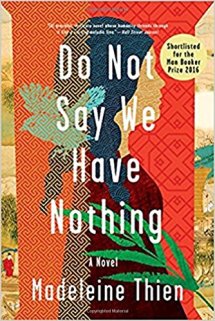
Cover for Do Not Say We Have NothingBest of Five!
When Balzac and the Little Chinese Seamstress was so popular, I was not a fan. I disliked how the two male college students patronized and abused the girl, even though she won through in the end. I also vaguely felt that the events of the Chinese Cultural Revolution were being trivialized, even though I was not really sure about the facts. Reading Do Not Say We Have Nothing confirmed that I was right.

Marie is a young immigrant Chinese girl living in Vancouver, British Columbia, in 1991. She and her mother are confused and grieved, because after the family escaped from China, her father, Jiang Kai, first deserted them to move to Hong Kong and later committed suicide.

Marie’s mother receives a call from China, from Ling, the wife of Jiang Kai’s beloved teacher, Sparrow. Ling says that her daughter, Ai-Ming, has had to leave China because of involvement in the Tiananmen Square protests, but she has missed the amnesty offered by the U.S. Ling asks that they give Ai-Ming a home.

Ai-Ming becomes an older sister to Marie. She tells her stories about her family—her great uncle, Wen the Dreamer, who courted her aunt Swirl with chapters from a forbidden book called the Book of Records; her grandparents, Big Mother Knife and Ba Lute, wandering musicians; and her father Sparrow, a composer of music. Ai-Ming tells of the days of her father, her cousin Jhuli, and Marie’s father, Jiang Kai, at the Shanghai Conservatory. Shadowing all their lives is the Cultural Revolution and its horrible excesses—murder and exile of intellectuals, forced denunciations of relatives, ransacked homes, humiliation and ruining of the innocent.

At first, I was irritated by the style of Ai-Ming’s story, which feels a little like a fairy tale, but it was not long before I was completely absorbed in it. The novel is a heart-rending tale about identity, music, love, and political destructiveness. This was another excellent book that I read for my Man Booker Prize project.

Related Posts

Red Sorghum

The Kitchen God’s Wife

Shanghai Girls