Day 700: Some Luck

Cover for Some LuckSome Luck begins in 1920, five months after the birth of Frankie, Walter and Rosanna Langdon’s first child. They have only been settled on their own farm a short while.

This novel is the first of a trilogy about the Langdons, an Iowa farm family. It covers a turbulent 33 years, during which occur the Great Depression, the long drought, and the Second World War.

Most of the novel concentrates on the Langdon children. Frankie is active and always into trouble. He teases his younger brother Joey unmercifully. Joey is gentle and good with animals, dutiful and obedient. Lilian is angelic looking and well behaved, good at taking care of the younger children but a bit prissy. Henry is self-contained and spends as much time reading as possible.

It is hard to describe this novel. It moves constantly from character to character in viewpoint and has no main character, but is more like an ensemble piece. The action that takes place is mostly that of everyday living, although there are births, deaths, and weddings. Rosanna goes through a religious phase after one child’s death and drags the family to a fundamentalist church for several years and then stops.

Smiley’s characters are very human, with faults and foibles. So far, this trilogy is developing slowly, but the family’s lives make interesting reading.

Related Posts

A Thousand Acres

The All-True Travels and Adventures of Lidie Newton

Gilead

Day 699: Rustication

Cover for RusticationBest Book of the Week!
I was captured by this dark, twisty novel from the moment I started reading it. I only feared it may eventually disappoint, but it does not.

In winter 1863, Richard Shenstone, 17, appears without warning at his mother’s new home, a large dilapidated house on the southern coast of England. He has been rusticated, sent down from Cambridge for reasons not immediately explained.

Having received word of his father’s death too late for the funeral, he is surprised to find his mother and sister living in apparent poverty. Furthermore, although he doesn’t at first tell them he’s been sent down, his arrival is met by a surprising lack of welcome, indeed hostility on the part of his sister Effie.

There is some mystery about his father’s death, that is clear. His father’s pension has been denied to the family, and Richard’s mother is suing for her father’s estate as well. Effie is also up to something, for he twice sees her out accompanied only by a tall man, not proper behavior for a lady.

Richard is not a pleasant person, obsessed as he is by desire for every girl or young woman he meets and also addicted to opium. The novel is told as excerpts from his journal, interrupted by copies of a series of hateful letters that soon begin arriving at the homes of various people in the district. It is also clear from the beginning that some crime has been committed and the journal is a look back into the past. It is not clear to readers, however, how reliable a narrator Richard is or what’s going on when he roams the countryside at night in his opiated state. Soon the letter writer begins leaving corpses of mutilated sheep behind him.

This novel is atmospheric in the extreme and completely absorbing. As Richard begins trying to figure out who the letter writer is, he finds the finger pointed toward himself. He takes unwarranted leaps of logic that cause him to make many mistakes and ignores some clues that he has. Still, exasperating and unlikable as the main character is, you are urged along to the end of the novel.

Related Posts

Stone’s Fall

The Séance

The Darkest Room

Day 698: The Namesake

Cover for The NamesakeIn 1968, Ashima Ganguli gives birth to her first child. She has travelled from Calcutta to Cambridge, Massachusetts, to live with her husband, whom she barely knows, and is missing her family in India. When she has a boy, she and her husband Ashoke run into difficulty because they are waiting for a name to arrive from her grandmother. But the American hospital needs to put a name on the birth certificate. Finally, Ashoke picks Gogol, after Nikolai Gogol, a favorite author whom he credits with saving his life after a horrendous train accident when he was a young man.

Gogol grows up embarrassed by his name and rejecting the traditions of his Bengali parents. He is bored through the endless Saturdays spent with his parents’ Bengali friends and the biennial trips to India where they do almost nothing but visit family. His mother, on the other hand, has never stopped missing India. His parents want him to observe the customs of his homeland, while he just wants to be American.

This novel insightfully explores the stresses for Indian immigrants adjusting to American ways and the tensions between the traditional and the present for their first-generation American children. Lahiri’s prose is full of minutely observed details as well as empathy for both generations.

Related Posts

The Lowland

Unaccustomed Earth

Under the Lemon Trees


Day 697: The Life and Death of Sophie Stark

Cover for Sophie StarkThe Life and Death of Sophie Stark is the striking portrait of an unusual person, a young filmmaker, from the viewpoints of various lovers, acquaintances, relatives, and movie reviewers. The various chapters are possibly interviews for the documentary about her.

The first story about Sophie is one of betrayal. Allison meets Sophie at a storytelling event where Allison decides to tell a story. She makes up a tale about a murder, but later Sophie is able to get her to tell the real story, about how the boy who she’d made the murderer in her story actually raped her. Sophie is a beginning film maker, and she asks Allison to be in her movie. They also begin a torrid affair.

But Sophie uses her knowledge of the rape to manipulate Allison into giving a better performance in the horror movie. The movie, Marianne, becomes a cult classic as explained in the humorously egotistical review by R. Martin.

Gradually, we see how Sophie was mistreated or ignored in school. But Robbie, Sophie’s brother, understands her a little better than others do. He tells about Sophie’s beginning as a filmmaker, when she started following a popular basketball player named Daniel around her college campus with a camera. This episode ends with Cece, Daniel’s girlfriend, getting friends to shave off all of Sophie’s hair. Sophie uses that event to interesting effect in her movie, too.

link to NetgalleyGradually, a picture builds of a woman struggling to express herself. She doesn’t understand people, she says, but she knows how she wants things to look. She can’t explain her feelings even to her brother. She does what she must, destroying relationships in the process. I imagine someone on some part of the autism spectrum.

We never hear from Sophie herself, but her story is oddly powerful. This is the second book for North, whose America Pacifica is a young adult dystopian novel.

Related Posts

Tell the Wolves I’m Home

Mountains of the Moon

Black & White


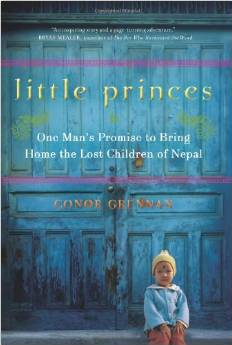
Day 696: Little Princes: One Man’s Promise to Bring Home the Lost Children of Nepal

Cover for Little PrincesAlthough I wrote this review several weeks ago, with the earthquake in Nepal, it is more timely now. I am happy to report that the children in the orphanages mentioned in this book are all well.

* * *

After the scandal of Three Cups of Tea, I wasn’t sure how much I wanted to read what seemed to be a similar book, but Little Princes was chosen by my book club. It’s the story of a man who volunteers for a Nepalese orphanage from fairly selfish motives but finds himself drawn in because of his affection for the children to do more.

Conor Grennan explains that he volunteered to work in the Little Princes orphanage in Nepal so that his decision to take a year off from work to travel wouldn’t look so selfish to others. This reasoning is an odd thing to admit and made me puzzle about his character. Still, once in place, he enjoyed work with the children enough to promise to come back.

It is right after he returned to Nepal that he met seven children from a remote province called Humla. Like many of the children, he learned, they were sent away by their parents from the district for their safety during civil war. What the parents didn’t know was that they were paying human traffickers, who got the children to Kathmandu and then sold them or abandoned them. Most of the children thought their parents were dead, and most of the parents had had no news of their children for years.

This was all to come out after Conor found the seven children from Humla in the custody of the wife of one of the traffickers. Just before he left the country again, he struggled to find a home that would take them in. A charity called the Umbrella Foundation, which had several orphanages, agreed. But after Conor returned home again, he learned that the trafficker had found out what was going on and removed the children before the Umbrella Foundation could fetch them.

Conor then decided to create his own foundation to work against child trafficking in Nepal. His first goal was to find those seven children. But after discovering that the mother of two of the children was alive and had not known of her children’s plight, he also decided to travel to Maoist Humla and try to find the parents of the seven children, as well as those of the children in Little Princes.

Conor does not do this all by himself. He has help from Gyan, a child welfare official; his coworker Farid, who founds an orphanage with him; the Nepalese men who go with him to Humla as guides and interpreters; and various European aid workers. Conor and the others eventually find the seven children and locate many parents in Humla, some of whom arrive to take their children back. The book also tells us how Conor met the woman he is now married to.

This book is interesting and makes you think about how much good can be done in poor countries with a small amount of money. The efforts of Grennan’s foundation and its results seem to be legitimate and worthy. What wasn’t entirely clear was how closely Grennan remains involved in the work now that he lives in Connecticut with his wife and child.

Related Posts

The Zookeeper’s Wife: A War Story

Conversations with Myself

My Father’s Eyes

Day 695: The Assassination of Margaret Thatcher

Cover for The Assassination of Margaret ThatcherThe Assassination of Margaret Thatcher is a collection of short stories that reveal an unusual sensibility. Some of the stories echo other of Hilary Mantel’s writings.

For example, the first story, “Sorry to Disturb,” seems as if it could be a chapter from Mantel’s Eight Months on Ghazzah Street. It is about an English woman living in Saudi Arabia who has troubles with a Pakistani man she befriends. Several other stories refer to physical ailments that she talks about in her memoir Giving Up the Ghost. Another story, “Terminus,” is about seeing the ghost of her father on the subway. But of course, many writers’ fiction has an element of the autobiographical.

The title story has more than a hint of the absurd. In the story, an apartment owner is held hostage by a sniper who is waiting for Margaret Thatcher to emerge from the hospital below her window. The hostage, who doesn’t like Thatcher either, begins helping with the planned attack and escape.

All of these stories are impeccably written, some are haunting, and all reflect the workings of an unusual mind.

Related Posts

Giving Up the Ghost

Beyond Black

The Stone Mattress

Day 694: The Paying Guests

Cover for The Paying GuestsSarah Waters builds on some of her themes from Affinity in the post-World War I novel The Paying Guests. Frances Wray lives with her mother in the family home, a large house that is getting a little seedy. Since the death of Frances’ father, they have had to dispense with servants, and Frances does all the housework herself. Now they have been forced to take in “paying guests,” giving up most of the top floor of their house to be their lodgers’ apartment. The lodgers are a young couple, Leonard and Lilian Barber.

Frances did not see her life like this. Not so long ago, she was in love with a friend, Christina, and they planned to make a home for themselves. But after the death of her father, Frances discovered he had lost all his money, leaving her mother nearly destitute, and she decided to stay to help her mother. Now she feels as if Christina and her new friend Stevie are leading the life she and Christina planned.

Class is an important issue in this novel and comes up constantly. Frances and Mrs. Wray feel they’ve been deceived when they take stock of their new guests, who are considerably less genteel than they thought. Frances often refers to them as being in the clerk class, but Lilian’s family is considerably more common. On the other end of the class scale, Frances has to wait to do her housework when her mother is out, because it appalls her so to see her daughter doing physical work. Her mother herself does none.

Different classes or not, Frances and Lilian tentatively develop a friendship. Soon, though, their relationship becomes a love affair. Frances wants them to run away to lead their own lives, but Lilian thinks she is fantasizing. Soon, their plans put them into peril.

This novel creates a fully realized time and place, with reference to many of Britain’s post-war issues. Unemployed soldiers on the streets are a problem as well as a growing sense of a less-ordered society.

I found Frances to be an interesting character but was less interested in Lilian, who seems more formless. I found the story compelling, though, wondering how the women would get through a difficult situation.

Related Posts

Affinity

Practical Magic

Trick of the Dark

Day 693: Fallout

Cover for FalloutMost of Fallout is told as a flashback, but the opening section is very short, so we can say we really encounter Luke Kanowski in 1961, when he is 14. He has busted his mother out of the mental asylum where she’s lived since he was five to take her to visit the art museum in London. The expedition is not a success, but while they are being questioned by a security guard, Nina Hollings notices them.

Nina is with her mother Marianne, a selfish woman who hands her off to her sister Mat when Nina is in her way but reclaims her before she can gain any stability. Later, she does other things to sabotage Nina’s self-confidence. Marianne works sporadically as an actress.

Luke is a young adult when he meets Paul Driscoll and Leigh Radley. He has been working at a mill, but shortly after he meets the two, he decides his life is harmful to him. Luke feels immediate friendship for Leigh and Paul and has soon moved to London. There the three of them work together with a few others to open a new theater.

Leigh has fallen immediately in love with Luke, but Luke is busy seducing practically every woman he meets, so Leigh becomes Paul’s girlfriend. Leigh’s father was unfaithful to her mother, so Leigh decides to stick with the man she feels is safe.

Then Luke meets Nina, who her mother has essentially pimped out to Tony Moore, a theatrical producer. Tony and Nina are soon married, Nina naively not realizing that Tony is using her as his beard. That is, she doesn’t realize until she finds him with two waiters during a party.

Luke’s first play is being produced as he and Nina begin an affair. This affair and the things Luke is willing to do to try to “save” Nina have repercussions for several people.

This novel is completely different from Jones’ The Uninvited Guests, which I enjoyed more. Although I was compelled to read the novel, I really don’t enjoy fiction where men betray themselves for a woman, or vice versa. Usually, the woman in these novels is bad. Nina isn’t, but she is weak and selfish and eventually asks Luke to betray his friends and his art.

Finally, I feel as if the ending of the novel is unrealistically hopeful and pat, when I think of the wreckage that has gone before. The background of the theater and play production with a bit about the politics of theatre is very interesting, though.

Related Posts

The Uninvited Guests

A Visit from the Goon Squad

The Cuckoo’s Calling

Day 692: The Devil in the Marshalsea

Cover for The Devil in the MarshalseaTom Hawkins has been leading a dissolute life ever since his ordination ceremony was sabotaged by his stepbrother’s reports of his behavior at school. In a desperate attempt to save himself from debtor’s prison, he goes out gambling with his disapproving friend Charles and manages to win enough money to save himself. But on the way home, he is attacked and robbed of everything. Soon, he is on his way to the Marshalsea.

In 1727, the Marshalsea is not the place Dickens described in Little DorritAlthough Dickens’ prison was a place of lost hope, in the early 18th century, the Marshalsea is a hell-hole run by a venal and vicious governor, Mr. Acton. Hawkins is astounded to find that it costs more to live in the Marshalsea than it does outside, and if you can’t pay your lodging you will be banished to the horrors of the Common Side, from which bodies are brought out daily. Hawkins has no money at all except what he gets for pawning his mother’s cross and a bit of money from Charles.

To support himself, Hawkins takes on the job of investigating the death of another debtor, Captain Roberts. Although Roberts’ death was deemed a suicide, it was almost certainly a murder, and his ghost is reported as roaming the prison.

Hawkins has taken Roberts’ room, so his roommate is Samuel Fleet, whom all of the prison inhabitants fear. Fleet claims to have been asleep when Roberts’ body was dragged from the room that night. But Hawkins soon observes that Fleet never sleeps.

This novel is terrific. It is thoroughly researched and richly imagined so that both the setting and characters come to life. Hodgson explains at the back of the book that many of the characters are based on actual historical figures. This is Hodgson’s first book, and I’ll be looking for more.

Related Posts

Jack Maggs

Great Expectations

The Solitary House