
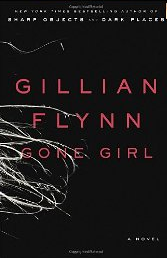
 The Best Book of Week 25 is Gone Girl by Gillian Flynn!
Day 125: Arcadia
 After reading Lauren Groff’s first book, The Monsters of Templeton, I was expecting something totally different, something perhaps more sinister. But Arcadia is a quiet and thoughtful novel. It is the story of Bit, the first child born in a group of a couple dozen hippies who are following a charismatic musician named Handy–essentially a bunch of groupies–during the 1970s. They are also idealists who want to create a utopian commune where they can support themselves entirely from their own efforts, living off the land. The book follows the rise and fall of the commune and its aftermath.
The first part of the book takes place when Bit is a young boy. The group has settled on a large estate in upstate New York to found their commune. Bit’s father Abe is a master carpenter and his mother Hannah is a baker and the group historian. We sense that Abe is the parent more fully invested in this way of life, as Hannah does not accept or observe all of the commune’s rules.
Hannah is a golden earth mother type who is active and ebullient in the summer but falls into severe depressions in the winter. One winter, Bit sets himself a test inspired by a fairy tale book he found in the ruins of the property’s mansion house by making himself a bargain to stop speaking until she comes out of her depression. Abe is absorbed with trying to organize the renovation of the house so that everyone will have a warm place to live, since for years they all have been living out of their cars and vans and homemade shacks.
In the second part, Bit is a teenager trying to cope with the disintegration of Arcadia, which is overcrowded with runaways, junkies, and other refugees from outside and having problems with the law. He is also in love with Helle, Handy’s disturbed but beautiful daughter.
The third part takes place a few years into a dystopian future. Everyone has left Arcadia. Bit is a photography professor living in New York City, a single parent mourning the departure of his wife. It is a time of social disintegration because of the forces brought about by climate change, especially a series of pandemics.
The novel is the work of a vivid imagination, as Groff is able to fully realize what it would be like to grow up completely cut off from the world, learning mores that are different from those of society, and how that would affect the rest of a person’s life. The novel’s biggest weakness is in having too many characters to get to know them well, especially in the middle section, where Bit’s teenage friends all sort of blur into each other. I found the tale interesting but at times slow moving, somewhat meditative, which I believe is intentional.
Day 124: Whose Body?
 It has been years since I read Whose Body? by the British writer from the Golden Age of Mysteries, Dorothy L. Sayers. Unfortunately, as soon as I saw the murderer’s name, I remembered who did it, so I was not able to judge how difficult it was to guess.
Mr. Thipps finds an unidentified body in his bathtub wearing nothing but a pair of pince-nez. The body bears a resemblance to a missing financier, but it is not him. Who is the dead man and how did the body get into the tub? Where is the missing financier? Is this one case or two? Of course, the police suspect Mr. Thipps. After Mr. Thipps’s mother asks him to help, Lord Peter Wimsey gets interested in the case and decides to find the answer to these questions in his inimitable way.
As always, Sayers is fine in characterization, much better than many of her Golden Age peers. Lord Peter is his usual apparently frivolous self. He and his man Bunter are fun. Lord Peter’s mother, the Dowager Duchess, is adorably ditzy. The plot is clever. However, as with many early mystery novels, it is overcomplicated and very unlikely. For people who haven’t read any Lord Peter books, I recommend Murder Must Advertise as a better starting place.
As a total side note, the cover I’m showing is not the one for the book I read, but is just one I found on Amazon. It occurs to me, why would they show the body of a woman when the victim is a man? This disconnect in publishing is always a mystery to me. One peek at the first few pages would have told the artist the sex of the body.
Day 123: The Judgment of Paris
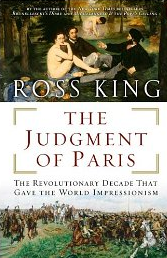 The Judgment of Paris: The Revolutionary Decade That Gave the World Impressionism is Ross King’s account of the art and politics of the decade beginning in 1863 and ending in 1874 with the first Impressionist show. The book follows the lives and careers of several significant French artists in the years leading up to the introduction of what was eventually called “Impressionism.”
At that time in France, artists were taught that the proper subjects for art were scenes from history, mythology, or the Bible. The “best” paintings observed the minutest of details, colors were muted, and the surface of the painting was smooth so that brush marks could not be distinguished.
Although the book touches upon the careers of many artists, in particular it follows the fortunes of two–Ernest Meissonier, who was considered one of the greatest artists of his time and was certainly the highest paid, and Edouard Manet, an unofficial representative for the younger painters. Meissonier progressed from painting small, very detailed scenes from the 17th or 18th Century of “goodfellows” in ordinary domestic scenes, such as playing chess or smoking, to huge historical paintings, several of events in Napoleon’s career. The younger painters were more interested in depicting scenes from modern life. At that time they were called Realists, not for their painting style but for their subject matter.
The book begins with the preparations for the Paris Salon of 1863. The Salon was the most important art show of its time, almost essential to getting an artist’s work viewed. King explains how changes in the rules affecting how the jury was selected resulted in most of the landscape painters and those with less traditional approaches being shut out of the show. So many artists were excluded and the outcry was so great that Emperor Louis-Napoleon authorized a second exhibition called the Salon des Refusés to show the paintings refused by the jury. Ross continues on from there to show how the new art moved slowly from the scorn and derision of the artistic community to acceptance and admiration. I was particularly surprised to find that the first place this new way of looking at the world was accepted was not France, but the United States.
King’s explication of the prejudices and politics surrounding the evolution of new approaches to painting is extremely interesting, as is his corollary discussion of the reign of Napoleon III, the disastrous Franco-Prussian War, and the subsequent shifts in the government of France, and how all this had its effect on the acceptance of the new art.
Day 122: The Tudor Secret
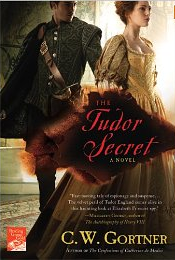 I have heard about C. W. Gortner before, but The Tudor Secret is the first book of his I have read. My overall impression is that the book reflects some knowledge of Tudor times and some research, but is generally on the light side, with a fairly predictable plot.
Brendan Prescott is a servant of the powerful Dudley family, a foundling who has been mistreated by the Dudleys all of his life. He is surprised when he is removed from the stables and given training as a body servant. He is dismayed when he is sent to court to wait on the cruel Robert Dudley.
He is almost immediately thrust into dangerous circumstances as he tries to help the Princess Elizabeth see her dying brother, King Edward. Edward’s regent Northumberland, Robert’s father, is trying to keep everyone away from the king.
Elizabeth is in contention for the throne against her half-sister Mary. But Northumberland is trying to manipulate his daughter-in-law, Lady Jane Grey, and his son Lord Guildford Dudley, onto the throne. Soon, Brendan finds himself spying for William Cecil to help Princess Elizabeth.
Although the Tudor era was a turbulent time, involving much intrigue and a lot of paranoia, I felt that some of the plots suggested in the book were absurd, such as Northumberland poisoning Edward so that he can put himself on the throne. I understand from reading one of the reviews on Amazon that this was an early book by Gortner and not up to his usual level, so perhaps I will try another.
Day 121: Gone Girl
 Best Book of the Week!
A lot of people are reading Gone Girl by Gillian Flynn, and no wonder! Usually, I would wait awhile to present another Flynn book after just having reviewed one last week, but I couldn’t wait to do this one! If you like dark, twisted plots, and great psychological thrillers with a smidgen of evil humor, this is the book for you.
Nick and Amy Dunne are having some marriage problems. When they met, they were both cool young Manhattanites. He was a magazine journalist and she a quiz writer and the model for a series of Amazing Amy children’s books written by her psychologist parents. Five years later, they have both lost their jobs and moved to a dying small town in Missouri to help his mother take care of his ailing father. With the rest of Amy’s money, Nick has bought a bar to keep himself and his twin sister Go busy. Their relationship has been deteriorating ever since.
On their fifth wedding anniversary, Amy disappears, leaving evidence of violence. Of course, Nick is the police’s prime suspect, and it doesn’t help that he hasn’t been altogether truthful with them. The public, galvanized by the Amazing Amy connection, almost immediately turns against him. The investigation turns up money problems and worse. Secrets are flushed out.
Most of the first part of the novel is narrated alternately by Nick and by diary entries written by Amy. Amy seems disingenuous and appealing, almost giddy, reminding me sometimes of Bridget Jones. Nick commits many lies of omission. Here’s a hint. Both Nick and Amy are liars.
Just when we think we know what’s next, the plot twists. The book is completely engrossing and very darkly funny, suspenseful and chilling. Think psychopath, but guessing who that person may be is just one of the book’s pleasures. In the reviews, I’ve seen several comparisons to Patricia Highsmith, and I think that’s about right.
Special Post! Best Book of the Week!
 The Best Book for Week 24 is The Solitary House by Lynn Shepherd!
Day 120: Tigana
 I decided to try a book by Guy Gavriel Kay because I read somewhere that he is a great historical novelist who disguises his books as fantasy. I read another book a long time ago but more recently picked up Tigana. Each of his books seems to have the setting and atmosphere of a different medieval European country, although they are set on other worlds. In this case, the country is Italy.
On a peninsula made up of nine provinces, the provinces have been conquered and divided up between two tyrant sorcerors, Brandin of Ygrath and Alberico of Barbadior. During one of the last battles, Brandin’s son was killed by Tiganian soldiers. As revenge, Brandin had the Tiganian prince’s family killed and cast a spell so that no one except those born in Tigana can remember its name. That is, I think, an interesting and original idea that has far-reaching effects.
Years later, a young singer named Devin falls in with a group of wandering musicians and learns from them that he is from Tigana, although he cannot remember, as his father took him away as a child. The group, lead by Alessan, the last prince of Tigana’s royal house, has been waging psychological warfare to free the province from both tyrants and revive the name of Tigana.
These novels are well written and rich in detail. Unlike Kay’s most famous work, The Fionavar Tapestry, which seems immature at times, it is more fully realized and mature.
Day 119: Daphne Du Maurier: The Secret Life of the Renowned Storyteller
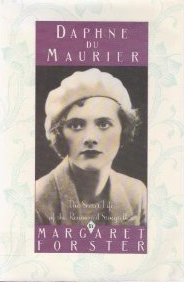 I have enjoyed reading Daphne Du Maurier’s books for many years, so I was interested to come across this biography by Margaret Forster. The main revelation of the biography is that Du Maurier struggled with bisexual and homosexual feelings all her life and always thought she was putting on a show of a normal life. She explained to others that she was two people, one with a female side–wife and mother–and the other with a male side–lover–that was the fuel for her creative energy.
The book examines Du Maurier’s life and works in terms of these feelings and how they conflicted with her roles as a wife and a mother. In fact, she seemed at times extremely self-obsessed and stunningly unkind to her children when they were young, as she was cold and immersed in her work. She was also unkind to her husband when he returned from service in World War II. By that time, she was living in the home in Cornwall that she never wanted to leave. Her husband “Tommy” Browning was asked to serve the royal family, which he had to do from London. He was obviously lonely, but she refused to move there or even visit. Instead, he made the trip out there every weekend for years after his strenuous, lonely weeks working for the royals. Until he didn’t. She eventually divorced him and later remarried.
The book also tells about Du Maurier’s long-time affair with the actress Gertrude Lawrence and her attraction to Ellen Doubleday, the wife of her American publisher.
Du Maurier tended to hide herself in her Cornwell home while she was writing. Although she became more sociable as she aged and many people remembered her as a warm and funny hostess, she eventually ended up almost a recluse who was devoted to her own daily routines.
The biography is interesting and well written.
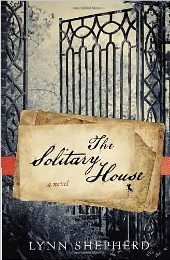
Day 118: The Solitary House
 Best Book of the Week!
I had an ambivalent reaction to The Solitary House, which is sort of a riff on Bleak House. It is not exactly a retelling of Dickens’s book. Although some story lines are re-interpreted, most of the Dickens characters appear in the background of the novel. My ambivalence is because Bleak House is one of my favorite Dickens novels, and I have not been happy with some of the retellings of classics that have appeared lately, particularly those that seem to miss the point of the original works. I am also a little dismayed by what Shepherd has done to some of my favorite Dickens characters. However, I find I have to admire the masterful way Shepherd has worked the threads of Dickens’s novel into such a different story. On the whole, almost despite myself, I am giving this novel a big recommendation for its originality.
Charles Maddox is a former detective for the London police force who left under undesirable circumstances. He is hired by Edward Tulkinghorn, a mysterious solicitor who has an evil reputation. A client of Tulkinghorn’s has been receiving threatening letters, and Maddox’s assignment is to find out who is sending them. Charles descends into the squalor of London to discover the author of the notes, but when he turns the information over to Tulkinghorn, the author of the notes is brutally murdered.
Thinking that this is not a coincidence, Charles begins investigating Tulkinghorn himself, as well as his client, Julius Cremorne. In doing so, he comes upon evidence of a serial killer. He also runs up against Inspector Bucket, his former police supervisor.
Charles’s story is written in a jokey third-person omniscient narration that often addresses the reader directly and is interlarded with many references to Dickens and some quotes from Shakespeare. Imagine a style that is like a postmodern Dickens. This narration is interleaved with the first-person narrative of Hester, seemingly the same quiet, loving, capable Esther Somerset of Bleak House. It is not until the end of the novel that these two stories merge horribly together.
Ultimately, I am coming down on the side of strong admiration for this book. It is completely absorbing and inventive, well written and literate, and actually convincing as a twisted alternate vision of Bleak House minus the case of Jarndyce vs. Jarndyce. It made me want to return to Bleak House, which I have not read recently, and dig out all the references. It is a gothic novel that becomes a serious creepfest, and you know how I love those.
I see that Shepherd has also riffed on Mansfield Park. As much as I am dreading what she will do to my beloved Jane Austen, I think I’m going to have to read it.
 What? Me Read?