12th Anniversary! Top Ten Books of the Year!

Today I’ve been blogging for twelve years, which means it’s time for my anniversary post, where I list my top 10 books of this year of blogging. This year I found it much more difficult to pick this list than in previous years. Working from my Best of Ten list, I had several cases of more than one book by the same author that I had to choose between. I also didn’t have as many books that I was absolutely sure would end up in my top ten for the year as I usually do. (When I’m sure, I mark them in purple on my list.)

Of the books I’ve chosen, six are historical novels, three are vague as to time, and only one is clearly contemporary, but harks back to the 1970s (which some of us can remember). Eight are by women. This is an international group of novels. I’ve chosen books set in far northern Canada, islands off the coast of Denmark and in the Moluccas, France, Iceland, Michigan, Texas, and Ireland. My choices are by Canadian, Danish, American, Icelandic, Indo-European, French, and Irish authors. Seven of the books were written relatively recently, while three are older books. This year, all are novels.

So, in the order in which they appeared on my blog, here are my top ten books of the year:

  1. The Other Side of the Bridge by Mary Lawson
  2. The Unseen by Roy Jacobsen
  3. The Flight Portfolio by Julie Orringer
  4. Miss Iceland by Auður Ava Ólafsdóttir
  5. The Ten Thousand Things by Maria Dermoût
  6. News of the World by Paulette Jiles
  7. We Have Always Lived in the Castle by Shirley Jackson
  8. Tom Lake by Ann Patchett
  9. The Child and the River by Henri Bosco
  10. Foster by Claire Keegan

Review 2303: Alice

Margaret admires her best friend, Alice, even from their days at school. She thinks Alice is beautiful and elegant and envies her her siblings. However, Alice’s sister Sonia disillusions Alice early by leaving home with a man and turning up at school to demand Alice give her her monthly allowance.

As the two naïve and protected girls emerge into womanhood, Margaret comes to understand that Alice is afraid of life and has no confidence in its success. After Sonia steals the boy that’s been courting Alice, she tries to commit suicide and then incautiously marries Cassius, the man who saves her, when she hardly knows him.

Although the marriage is clearly ill-advised, to Margaret Alice lives a much more exciting life than her own. Still, Margaret notices how suggestible Alice is to those giving bad advice, even people she used to avoid.

Although this novel, about young women in the upper echelons of society, works as a social satire, it also has a serious message about what happens to unprepared young women thrown into society, especially in the years between the wars, when mores where changing.

Related Posts

Sally on the Rocks

Beneath the Visiting Moon

Love in a Cold Climate

Review 2302: Trespasses

I read somewhere that Kennedy inserted the romance into Trespasses to make the political and social environment of her childhood palatable to readers. If that is so, I personally found the political and social parts more interesting, although the romance seems to take over the novel. However, the addition of the romance helped create the extremely touching ending.

Cushla is a Catholic schoolteacher who helps out at her brother’s pub in 1970’s Northern Ireland. One day Michael Agnew comes into the pub. He is nearly twice as old as she is, a Protestant, married, and a lawyer. She is immediately attracted to him even after she finds out he’s known as a womanizer. Soon he invites her to teach a group of his friends Irish, which leads to an affair.

At school, the children pick on one of her students, an eight-year-old named Davy McGeown, who is poor and who has a Catholic father and a Protestant mother. The family is threatened at home, and soon after Davy’s father finally gets a job, he is beaten mercilessly and left a cripple. Even the principal of the school treats Davy and the family badly, and there are hints of potential child abuse in the attentions toward Davy from the local priest. Cushla begins trying to help out Davy and his family, including his sullen older brother, Tommy.

Although Cushla’s family has successfully stayed out of the internecine conflict and serves people of both religions at the pub, things begin to change for them.

For quite a while that I was reading this novel, I was only mildly interested in the main story line but fascinated with the other things that were going on. However, towards the end, I was completely drawn in and found the ending particularly touching.

Related Posts

Milkman

The Last September

Troubles

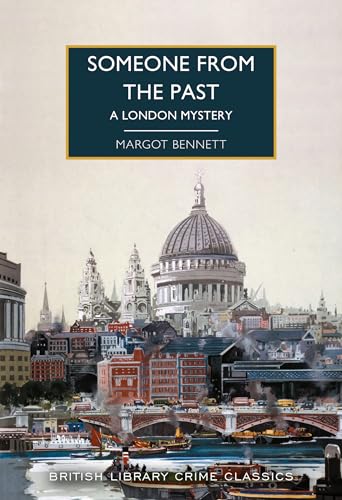
Review 2301: Someone from the Past

I found Someone from the Past to be the best of the British Library Crime Classics I’ve read so far. It has a smart, feisty, occasionally indiscreet heroine, is fast moving, sometimes exciting, and presents an interesting, character-based mystery.

Nancy is at a restaurant about to receive a proposal from her boyfriend Donald when her estranged friend Sarah approaches the table. This approach creates some awkward moments, because Donald was the last in a string of Sarah’s lovers and didn’t take her departure well. Finally, he leaves the table so the women can talk.

Sarah tells Nancy she is about to marry a wealthy man, Charles. Then she says that someone has been writing her letters threatening her life. As Nancy is a reporter and knows all the suspects—Sarah’s discarded boyfriends—Sarah asks her to try to find out who is writing the letters. She says she’ll send her one of them in the morning.

Nancy’s evening ends poorly, with Donald stomping off. But the next morning, he arrives at her flat, confused and frightened. He tells her he went to see Sarah in the early hours of the morning and ended up falling asleep in the sitting room. When he awakened shortly after eight, he found Sarah murdered in her bed. He is sure the police will think he did it.

To protect Donald, Nancy lets herself into Sarah’s apartment and tries to remove all traces of his visit. In doing so, she notices some odd things about the scene. Unfortunately, when the cleaning lady arrives, Nancy puts the chain on the latch instead of hiding or going out another way so it was obvious someone was in the flat.

Shortly after she arrives home, the police are at her door. They think she killed Sarah, partly because she left her own fingerprint in the apartment and because the cleaning lady recognized her when Nancy met one of Sarah’s other lovers in a pub before going home. Nancy thinks the only way to clear herself and Donald is to figure out who did it herself. The list of suspects consists of Sarah’s last four lovers, including Donald.

Nancy finds she isn’t very good at lying to the police, keeping secrets, or fleeing the country, but she is good at figuring out clues. I’m not so sure she’s that good at picking future husbands, though.

I received this book from the publishers in exchange for a free and fair review.

Related Posts

In a Lonely Place

Excellent Intentions

Water Weed

Classics Club Spin #36!

It’s time for another Classics Club Spin. What’s it all about? Members of the Classics Club select 20 books from their Classics Club lists (here’s mine) and list them by number on their blogs before Sunday, January 21. On that day, a spin number is selected by the club, and that number determines which book on the list the member will read by the spin deadline, which is Sunday, March 3. I am always ready to play, so here is my list:

  1. The Return of the Native by Thomas Hardy
  2. Cecilia, Memoirs of an Heiress by Frances Burney
  3. The Prophet’s Mantle by E. Nesbit
  4. The Passenger by Ulrich Alexander Boschwitz
  5. The Methods of Lady Walderhurst by Frances Hodgson Burnett
  6. The Tavern Knight by Rafael Sabatini
  7. The Book of Dede Korkut by Anonymous
  8. Weatherley Parade by Richmal Crompton
  9. The Princess of Cleves by Madame de La Fayette
  10. Incidents in the Life of a Slave Girl by Harriet Jacobs
  11. The Book of Lamentations by Rosario Castellanos
  12. Love’s Labour’s Lost by William Shakespeare
  13. The Three Musketeers by Alexandre Dumas
  14. Merkland, A Story of Scottish Life by Margaret Oliphant
  15. The Deepening Stream by Dorothy Canfield Fisher
  16. Tis Pity She’s a Whore by John Ford
  17. Our Mutual Friend by Charles Dickens
  18. Hero and Leander by Christopher Marlowe
  19. Les Misérables by Victor Hugo (1862)
  20. Weatherley Parade by Richmal Crompton

Review 2300: So Late in the Day

So Late in the Day is a collection of three of Claire Keegan’s short stories. Unfortunately for me, I had already read one of them, “Antarctica,” in her collection Antarctica. All three stories focus on relationships between men and women.

In “So Late in the Day,” we get to know Cathal. We follow him in the course of what was to be an important day for him, as he considers his relationship with his fiancée, referred to only as “she.”

In “The Long and Painful Death,” an unnamed writer starts a residency in the home once owned by a revered Nobel-Prize-winning author. On her first day, however, she has to deal with a visit from a man who claims he has permission to view the house but turns out to have a different agenda.

The story “Antarctica” was a reread for me. It’s about what happens when a married woman decides one time to have a fling.

As always with Keegan, the stories are written in lucid, precise prose. They reflect a good deal of cynicism about relations between the sexes.

Related Posts

Antarctica

Foster

Small Things Like These

Review 2299: The Salt Path

The Salt Path is Raynor Winn’s memoir of walking with her husband the 600+-mile Salt Path from Wales around the tip of Cornwall and back to Devon. This may not sound extraordinary or appealing to everyone, but the circumstances that initiated the walk were difficult.

It must have been the worst few days of their lives to date. For years, Raynor Winn and her husband Moth had been fighting a lawsuit that, through no fault of their own, threatened their home and livelihood. They went to court having found a document that proved they owed nothing, but because they didn’t follow the proper procedures, they were not allowed to admit it as evidence. They lost the farm they built up from nothing and were homeless.

As if that weren’t enough, a few days later some pain Moth had in his arm for years was diagnosed as a terminal illness that would result in the degeneration of his muscles and end with him choking to death.

The Winn’s reaction to these circumstances was unusual. With a very small income and almost no ready cash, they decided to walk the Salt Path. And although Raynor wanted to walk it the easy way, from the southeast westward, because the best guidebook went the other way, they went that way.

This book is compulsively readable, as the couple deal with grief, bad weather, physical problems, lack of food and water, poor equipment, difficulty finding camp sites, and general bad treatment of the homeless. It is vividly written and although I tripped over some misplaced modifiers, impels you along with them on their journey.

Related Posts

Notes from a Small Island

Vanishing Cornwall

Wild

Review 2298: Libertie

Libertie is an African-American girl growing up in pre-Civil War Brooklyn. Her mother, Mrs. Sampson, practices as a homeopath and has been training Libertie in the use of plants. Her great desire is for Libertie to study medicine and become the first African-American woman doctor.

But Libertie seems to be a person who only knows what she doesn’t want. She doesn’t want to study medicine, but her mother arranges a course of study for her at a college in Ohio for African-American students, without consulting her. She is the only girl in the science department. There she decides to punish her mother for sending her away by neglecting her studies. She spends her time trying to figure out how to fit in with one group or another and finally settles on girls nicknamed the Graces, two women with beautiful singing voices.

The novel is mostly concerned with the relationship between the two women—the mother constantly pushing, disapproving, eaten up with ambition for her daughter but with no regard for what her daughter wants, the daughter seeking approval but rebelling at the same time, with no ambitions for her own life. This relationship becomes even more difficult when Libertie comes home after a year at college, lying about her results, and meets Emmanuel Chase, her mother’s protégé from Haiti.

I was uncomfortable with this book, I think, partly because of its first-person point of view. I don’t like historical fiction that makes its heroines modern, and there is nothing 19th century about Libertie’s narrative, especially when it comes to sex. But even more than that, it didn’t help that neither Libertie nor her mother is a particularly appealing character or that all of Libertie’s life decisions are poor ones. A 21st century young person might fritter away the opportunity that her mother is struggling to provide her, for example, but I can’t imagine a 19th century one, with her knowledge of what her people have been through, would. Libertie behaves more like a spoiled 21st century child than someone who in the 19th century would be considered a young woman.

Finally, Greenidge says this novel was inspired by the first African-American woman doctor in the States, but I kept wondering who it was meant to be. Mrs. Sampson herself is not a qualified doctor, and Libertie purposefully sabotages her opportunity in pre-med.

I read this novel for my James Tait Black project.

Related Posts

The Underground Railroad

Beloved

Washington Black

Review 2297: Killingly

Killingly is loosely based on the true story of a student’s disappearance from Mount Holyoke College in 1847.

Bertha Mallish has vanished, but the readers realize that her best friend Agnes Sullivan seems to know something about it. The river has been dragged, but no trace of Bertha can be found.

Bertha and Agnes are the campus misfits. They are hard workers who don’t socialize and are from poor families. However, the last few months they have become very close.

Dr. Hammond, who had been courting Bertha, has arrived at the college with Reverend Mallish, Bertha’s elderly grandfather, and Florence, her much older sister. Florence and Agnes don’t like Dr. Hammond, who quickly develops an obsession about the case, hires a private detective, and behaves as though he’s in charge of the investigation. He becomes suspicious of Agnes.

Beutner is very skillful in how she slowly unfolds the story and reveals what happened to Bertha. She draws you in to a story that is sometimes affecting, sometimes suspenseful. The novel is involving, and I look forward to reading more by Beutner.

Related Posts

Alias Grace

Stone’s Fall

The Shape of Darkness