Review 2034: The Year of the Runaways

The Year of the Runaways is another book I read for my Booker Prize project. It follows the fortunes of a group of young Indian men who are living illegally in England looking for work.

Tochi is a young man from a low-caste family who in India had been finally getting his head above water since he had bargained for an auto so that he could work as a taxi driver. But after an election where one party rabbled-roused on the slogan of “racial purity,” his entire family was murdered. He travels illegally to England to start again.

Alvar’s father’s shawl business isn’t doing well and his younger brother will soon have school fees to pay. He also wants to marry Lakhpreet, his friend Randeep’s sister. He is able to get a student visa for England with no intention of studying, because he has had to borrow money from a moneylender for his fare.

Randeep comes from a wealthier family, but his father, a government official, loses his job after a mental breakdown. Randeep is kicked out of college in India and attacked for sexually assaulting a girl because he is constantly misreading people’s reactions. To get to London, he enters into a visa marriage with Narinder, a devout Sikh.

All of these young men travel to England with completely unrealistic ideas of how much money they can make or how easy it will be to even find work. They end up living together in a house packed with illegal immigrants working for low wages at menial work, most often employed by their own countrymen. Those with families receive constant demands from them for more money. And things get worse.

This novel is a throw-back to the 19th century social realism genre. The story is compellingly told and illuminates the dilemma of the illegal immigrant. I didn’t feel particularly attached to any of the characters, but I felt sorry for all of them.

Related Posts

The Lives of Others

Nectar in a Sieve

The Lowland

Review 2033: Astonish Me

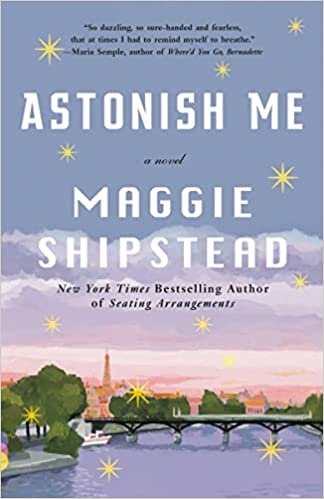
I enjoyed Maggie Shipstead’s Great Circle, although maybe I thought it was a little overhyped. However, I liked it well enough to look for something else by her and found Astonish Me.

When ballet dancer Joan sees Arslan Rusakov dance, she falls madly in love with him. A brief encounter leads to a correspondence, and a few years later, in 1975, Joan helps him defect from the USSR. Arslan is not faithful to her, however, and once he finds that she is not a good enough dancer to dance with him, he seems to lose interest.

Joan finds she is pregnant and decides to leave the dance life. She seduces her lifelong friend, Jacob, and marries him. They settle in to a suburban life in California.

Their son Harry develops the same kind of friendship with his neighbor Chloe that Jacob had with Joan—he worships her while she seems often embarrassed by him, yet appreciates his friendship. But as they reach their teens with both turning to ballet, it becomes obvious that Harry will be a great dancer while the jury is still out on Chloe.

At first, I was turned off by Joan’s decision to deceive Jacob. I felt it was particularly unlikely for that time. However, as the novel digs deeper into the fascinating world of dance, I found it more and more compelling. I liked, too, that Shipstead’s characters have their faults. They’re human, not perfect. If anything, I liked this novel better than Great Circle.

Related Posts

Great Circle

Pippa Passes

Ballet Shoes

Review 2032: The Edinburgh Mystery and Other Tales of Scottish Crime

The Edinburgh Mystery and Other Tales of Scottish Crime is the latest British Library collection of crime short stories, edited by Martin Edwards. These stories are either set in Scotland or written by Scottish writers, like the first, “Markheim,” by Robert Louis Stevenson. They are arranged in chronological order by publication date, ranging from 1885 to 1974.

Some of the stories, like “The Field Bazaar” by Sir Arthur Conan Doyle, are simple puzzles. In this one, Sherlock Holmes explains to Watson how he knows what is in the letter he just received. Others, like “The Running of the Deer” by P. M. Hubbard, are about the supposition of crime. “Madame Ville d’Aubier” by Josephine Tey tells the story of the heavy atmosphere emanating from a woman at a bakery and how later this woman murdered her sons and husband. In “Footsteps” by Anthony Wynne, a man figures out the connection between apparently ghostly footsteps and an attempted murder.

I liked some of the stories more than others, but they altogether make an enjoyable collection for an escapist evening.

I received this book from the publisher in exchange for a free and fair review.

Related Posts

Murder at the Manor

Deep Waters

The Tuesday Club Murders

If I Gave the Award

Having posted my review of the last shortlisted book for the 2018 James Tait Black Fiction Prize, I think it’s time for my feature where I discuss whether the judges got it right. The four entries for this year are disparate and for each of them, I have both positive and negative reactions. In fact, this is so much the case that I hardly know which book to start with or to pick. I’ll just work my way toward the winner.

I guess I’ll start with First Love by Gwendolyn Riley, because I’m still not sure what Riley meant by the title. The novel depicts the main character’s two abusive relationships, one with her older, ill husband and the other with her first boyfriend. Although these depictions are realistic, the theme doesn’t give the reader much to like.

American War by Omar Al Akkad was not my genre, being a dystopian novel about the results of climate change and about how young people are radicalized for war. However, I found it completely engrossing, despite disliking its themes.

White Tears by Hari Kunzru is about a relationship between two young men in college who form a friendship and a company based on a mutual fascination with sound. However, it turns out that that neither the narrator nor the reader understands what is going on, and the novel gradually moves from complete realism to having a strong supernatural bent. Although this novel flagged for me at times, its ending was so unexpected that Kunzru was the only author of these four from whom I wanted to look for more to read. (Although this reminds me that I have not yet done that.)

The winner of the award that year was Attrib. and Other Stories by Eley Williams. I can understand the judges’ choice, because this collection is so playful with language. Still, I only had a strong reaction to a couple of the stories and felt that its playfulness was beyond me at times. Also, I often struggle with short fiction.

So, which book did I think should get the award? I had the biggest reaction to White Tears, but didn’t think I should give the honor to a book that flagged for me at times. American War was the only one I called engrossing, but it was also really not the kind of thing I like to read. Attrib. and Other Stories was way above my head at times, but at other times it was funny and endearing. I think for this shortlist, I’ll recommend that, if you want to read one, pick the one that sounds most interesting to you. That’s right. I am totally copping out.

Review 2031: Attrib. and Other Stories

I found Attrib. and Other Stories, which I read for my James Tait Black prize project, a little intimidating, as I find reading poetry. That’s because, although I enjoy language, I use and understand it more straightforwardly.

Williams, on the other hand, clearly loves to play with language while also understanding the moments when it fails you. Two of the stories demonstrate this: “Alphabet,” in which a sufferer from aphasia is forgetting her words along with her lover, and “Spins,” where the narrator contemplates her inability to find the right word as her lover stomps out the door.

“Smote,” subtitled “(or when I find I cannot Kiss You in Front of a Print by Bridget Riley)” was a bit much for me in the verbal gymnastics department, but then its ending was so simple. The most straightforward story and the one that affected me most was “Spines,” about a family on vacation that can’t be bothered to remove a drowning hedgehog from the swimming pool.

Williams is playful and imaginative in her writing. Most of the stories (all except “Spines”) are written in the first person and feel very personal.

Related Posts

Not the End of the World

Thunderstruck and Other Stories

Sudden Traveler

Classics Club Spin #31

It’s time for another Classics Club Spin. Members who want to participate post a numbered list of 20 of the books from their Classics Club list by this Sunday, September 18. The club takes a spin, and the number selected determines which book from my list I’ll read next.

So, here’s my list:

  1. We by Yevgeny Zemyatin
  2. Grand Hotel by Vicki Baum
  3. Love’s Labour Lost by William Shakespeare
  4. The Fair Jilt by Aphra Behn
  5. Castle Rackrent by Maria Edgeworth
  6. Sleeping Murder by Agatha Christie
  7. Miss Mole by E. H. Young
  8. Cecilia, Memoirs of an Heiress by Fanny Burney
  9. Tis Pity She’s a Whore by John Ford
  10. The Three Musketeers by Alexandre Dumas
  11. The Saga of Gosta Berling by Selma Lagerloff
  12. The Book of Dede Korkut by Anonymous
  13. Our Mutual Friend by Charles Dickens
  14. The Prophet’s Mantle by E. Nesbitt
  15. The Methods of Lady Walderhurst by Frances Hodgson Burnett
  16. A Double Life by Karolina Pavlova
  17. Dust Tracks on a Road by Zora Neale Hurston
  18. The Tree of Heaven by May Sinclaire
  19. Merkland, a Story of Scottish Life by Mrs. Oliphant
  20. The Return of the Native by Thomas Hardy

I’ll be waiting to see which one I got. Did you join the spin? What book would you like to get?

Review 2030: Down Below

Leonora Carrington was a Surrealist artist who for years had an affair with the much-older Max Ernst. During World War II, Ernst kept being imprisoned as an enemy alien in France, and the resultant tribulations broke Carrington’s mental health. As she and some friends traveled to Spain to escape the German invasion, she became disassociated from reality. Down Below is her recollection of her state of mind and thoughts during her break from reality.

Reading this very short work is an odd experience, as Carrington’s delusions seem as surrealistic as any artwork. It also feels elliptical, reticent about the events that brought on her insanity and really about anything personal except her state of mind. It would have been almost impossible to understand without the background provided in the Introduction to my NYRB edition.

It’s pretty crazy. Unfortunately, this breakdown made her a heroine of Surrealism, which must have been personally difficult for her.

Just as a coincidence, shortly after I read this book, I read Julie Orringer’s The Flight Portfolio, about Varian Fry, the man who helped many writers and artists, including Ernst, I think, escape the Nazis. Review coming in a few months.

Related Posts

Suite Française

Grand Days

Warlight

Review 2029: Long Summer Day

R. F. Delderfield is known for his ability to capture slices of English life, and he certainly does that in this long volume, the first book of A Horseman Riding By.

Paul Craddock is just recovering from being seriously wounded in the Boer War when he learns that his father has died, leaving him a great deal of money and a half share in a scrap metal business. Paul wants nothing to do with scrap metal but thinks he’d like to buy a farm. However, Franz Zorndorff, his father’s business partner, sends him to the West Country to look at Shallowford, a large estate that’s for sale. Although it is much bigger than he had in mind, he ends up buying it.

At first people tend to treat Paul as a dabbler, but he begins to win over the regard of the people in the dale by making improvements to his tenant’s property and by his commitment to his new life. He makes friends with Claire Derwent, and people expect them to marry, but on his original trip to look over the property, he was struck by Grace Lovell.

This novel covers the first nine years of Paul’s Westcountry life, beginning with the accession to the throne of Edward VII in 1902 and ending with the accession of George V. Of course, by then, the First World War is approaching, but not many of the characters in the novel seem to be aware of it. The novel gets somewhat involved in the politics of the time and in the suffragette movement, but it mostly centers on life in the valley.

There is a strong awareness of the dale with many descriptions of it. The novel itself is slow moving with only a few major events, mostly to do with the private lives of the inhabitants—marriages, births, and deaths among them. One thing I found surprising was that there was so little emphasis on actual farming issues. It’s like the estate just runs itself.

There was much of interest about this novel, but for me some of it was hampered by Delderfield’s writing style. He likes long, involved sentences that verge on being and sometimes are run-ons. He also has the odd habit of leaving out the comma in a compound sentence, which many times forced me to reread. Even with the modern tendency to use fewer commas, I’ve never seen anyone else do that and am surprised his editors didn’t add in a bunch of commas.

Am I ready to read the second book? I don’t think so. The novel has a lot to recommend it, but at 800+ pages, this first book in the series indicates that it will be very lengthy.

Related Posts

Ross Poldark

The Children’s Book

A Place Called Winter

Review 2028: Seven Graves One Winter

Before winter in the small Greenland village of Inussuk, the gravediggers dig seven graves and hope that will be enough. One is about to be filled when a man throws a young woman overboard a boat and then runs over her.

Constable David Maratse is nearly ready to be released from the hospital, where he has been recuperating from torture. He has been given early retirement because of his injuries and plans to retire in Inussuk. Once there, though, he and his friend Karl pull up the body of a young woman while fishing.

It’s pretty obvious who she is. First Minister Nivi Winthur’s daughter Tinka has gone missing. It soon seems clear that the murder was political. Although Nivi’s opponent in the coming election, Malik Uutaaq, is running on a platform of Greenland for Greenlanders, not Danes, he prefers his sex partners to be half Danish and very young. Tinka was the most recent. But would Malik actually murder her?

When Nivi meets Maratse, she asks him to help find her daughter’s killer.

Although after two revealing conversations, I didn’t find it hard to guess the murderer, I liked this novel for other reasons, mostly its exotic setting and descriptions of life in Greenland. (How many mysteries have sled dogs in them?) It is described as Arctic Noir on the cover, but except for the crime and the suspenseful ending, it was more of a cozy mystery.

Related Posts

Free Falling, As If in a Dream

Last Rituals

The Water’s Edge