Nonfiction November 25! Week Two: Choosing Nonfiction

For week two of Nonfiction November, the host is Frances at Volatile Rune. The prompt is Choosing Nonfiction: There are many topics to choose from when looking for a nonfiction book.  For example:  Biography, Autobiography, Memoire, Travel, Health, Politics, History, Religion and Spirituality, Science, Art, Medicine, Gardening, Food, Business, Education, Music.  Maybe use this week to  challenge yourself to pick a genre you wouldn’t normally read?  Or stick to what you usually like is also fine.  If you are a nonfiction genre newbie, did your choice encourage you to read more?

I’m not actively reading nonfiction this month unless something comes up in my pile. I usually use this month to read other people’s entries and get ideas for books to read in the future. I put a bunch of books on my To Read list last year, but so far, I have only managed to read a few of them. That doesn’t mean I don’t intend to read them.

As far as genres, although I tend to read mostly history and biography, particularly of literary figures, and a bit of true crime, I will read any topic if it seems interesting, even science, which in general I don’t have much interest in. About the only topics I won’t read are self-help and health, because I’m really uninterested in those topics. But psychology, for example, which is related, I find interesting. (I also won’t read business books, especially the “Ten Traits” type, because they are based on very little research and are generally stupidly thought through—and thank goodness, I’m no longer working.)

I thought I’d use this week to talk about some of the more unusual, for me, nonfiction books I read during the year. Unfortunately, I have only posted reviews of one of them so far.

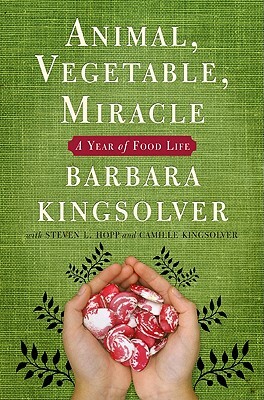
Although I don’t tend to read about health, this year I read Animal, Vegetable, Miracle: A Year of Food Life by Barbara Kingsolver. Now, granted, this book is partially memoir, but it also has lots of information on food topics and the importance of eating fresh food. I actually read this book because it filled a hole in my A Century of Books project that I was trying to get done last year. (It came over into this year by four months!) That’s because, although I tend to like Kingsolver and think she has written wonderful books, she can also be preachy. And she is, a bit, in this book. But it also has lots of information about food topics I hadn’t thought about, includes a bit of memoir, and has tasty sounding recipes!

Now, I like books about maps and mapmaking. I don’t often see one, but I think books about mapmaking and the related subjects, geography and geology, can be interesting. I haven’t reviewed it on my blog yet, but one of my best books, whenever it comes up (it may not make it until next year) will be Pocket Atlas of Remote Islands: Fifty Islands I Have Not Visited and Never Will by Judith Schalansky. This is a lovely book that I read about on someone else’s blog. I’d like to give them credit, but I can’t remember who they are. (I did a quick search hoping a familiar blog name would pop up, but it didn’t, although I saw lots of copies for sale on eBay, surprisingly.) This book is interesting not just because of the islands Schalanksy chooses to talk about but also because of the things she chooses to tell about them, including a topographical map, one story about each place, and the distance from other locations. This is probably the most unusual book about maps I have ever read.

Finally, another as yet unreviewed book for me is Fenwomen: A Portrait of Women in an English Village by Mary Chamberlain. This is a sociology study from the 1970s, when feminism was just starting to make inroads in academia, but it was also the very first book published by Virago, and its reception was fairly astonishing, at least it would probably seem so to people nowadays. It simply interviews as many women in a small village in the fens as it can about their lives, their work, and so on. The updated version that I got includes an Introduction from 2010 that talks about what happened when it was published and includes about twenty pages of beautiful photos at the end.

I’m looking forward to getting new ideas for nonfiction this year.

Review 2645: #RIP XX! Uncle Paul

Why have I never heard of Celia Fremlin before? This book is great! When I first read a review of it last year, I could only find an expensive used copy, but another blogger this year (sorry, I don’t remember who) set me looking again, and I found an inexpensive set of three novels, including this one.

Meg gets an urgent message from her older sister Isabel asking her to drop everything and come see her at a vacation caravan site on the seaside. The telegram simply tells her that Mildred, their much older half-sister, is in trouble.

After talking it over with her friend, Freddy, Meg travels to the run-down caravan park to learn that Mildred’s problems have to do with Uncle Paul. Fifteen years ago, when Meg was a child, Mildred married Uncle Paul, and they spent their honeymoon in a cottage just a few miles away. It turned out, however, that Uncle Paul was not only already married but he was wanted for attempted murder of his wife for her money, and Mildred was also wealthy.

Now it is the end of Uncle Paul’s 15-year sentence. Mildred seems to think he will be coming to get his revenge, but she has perversely rented their old holiday cottage.

Both of Meg’s sisters seem permanently distressed. Isabel worries constantly about her husband Philip’s reaction to everything, while Mildred is often alarmed enough to scream. Meg talks Mildred into returning to town and looking for different lodging, which she finds for her at a comfortable hotel. She also finds Freddy there.

Her sisters’ alarm seems to be contagious, though. When she arrived at the cottage, she found Mildred all aquiver because she had been hearing footsteps—Uncle Paul’s footsteps. Isabel is hardly less nervous. And Meg learns that she may also be in danger, because she was the one who recognized Uncle Paul in an old newspaper.

Fremlin manages to work a good deal of suspense from what seems like trivial incidents, and from fears that Uncle Paul could be any of several men around. But just when I was deciding that everything was in their heads, things got going.

This book reminded me of a lot of Mary Stewart’s combinations of suspense and a bit of romance that I’ve always loved. The writing style is sprightly, the dialogue is witty, and the characters are vivid. Finally, Meg is an engaging, intelligent heroine.

Related Posts

The Unforgotten

Touch Not the Cat

The Lace Reader

Review 2644: RIPXX! The Absent One

This book is the second in Adler-Olsen’s Department Q series. It’s Danish super noir.

Someone has put a file on Carl Morck’s desk. It’s the case of two murdered teens, brother and sister, from 20 years ago. The only thing is, it’s been solved. Nine years after the murders, Bjarne Thøgerson confessed. He was part of a group of students who were originally suspected of the crime—Ditlev Pram, now the owner of several hospitals; Torsten Florin, a famous designer; Ulrik Dybbal, a stock market analyst; and the deceased shipping magnate, Kristian Wolf. The other member of this group was Kirsten-Marie Lassen, who has disappeared. Of the group, only Bjarne did not come from wealth.

So, Carl wonders, was Bjarne innocent of the crime, or did he take the fall for the others? He has become wealthy in prison, which might indicate the answer.

In the meantime we learn that the above-mentioned group of powerful men—who prove to be vile human beings—are searching for Kirsten-Marie Lassen, whom they call Kimmie. That’s because she has proof that they committed not just the double murder but scores of beatings of random strangers and some other murders. Kimmie is now a homeless person who is hiding from them.

As Carl and Assad investigate, they are blocked by their boss because the case is closed but also because someone is bringing pressure from above. There is a spy in the force, and Carl is being personally threatened.

This is really a grim entry into the series, not because of the investigation but because of the activities of the super-rich, soulless bad guys. Also, FictionFan mentioned to me that she quit reading the series because it made Assad into a figure of fun. I’m not quite seeing that yet, but the Danish characters seem to be quite bigoted, even Carl at times.

Related Posts

The Keeper of Lost Causes

Roseanna

The Tenant

Review 2643: #RIPXX! The House of Silence

Marble knights walking in the night, a man coming back from the dead, a man who acquires a sweetheart in the graveyard, a haunted picture frame, killer vines, such are the fodder of E. Nesbit’s collection of 18 ghost stories. None of these stories are truly terrifying, but some of them are at least original.

There are a few that turn out not to really be ghost stories—for example, a salesman who uses a ghost story to get a better room—and I liked those better than most of the ones involving the supernatural, although I do like a nice, chilling story.

Several of the stories are about thwarted love affairs or unscrupulous rivals for a girl’s affections. Some have sad endings, but in others people get what they deserve.

This book is about on par with the volume of Victorian ghost stories I reviewed a few years ago, but uniformly better written and sometimes more subtle.

Related Posts

The Oxford Book of Victorian Ghost Stories

Tales of Mystery and the Macabre

The Casebook of Carnaki the Ghost Finder

Review 2642: #RIPXX! Bats in the Belfry

Bruce Attleton is a once-successful novelist married to the actress Sybilla Attleton. He has planned to meet up with his friend Neil Rockingham in Paris, but he doesn’t show up. When Rockingham finds that no one knows where Attleton is, he thinks of going to the police.

In the meantime, Robert Grenville, a journalist who wants to marry Attleton’s ward, Elizabeth Leigh, learns that a strange man with a beard named DeBrett might be blackmailing Attleton. He traces DeBrett to a weird studio with a tower, breaks in, and finds Attleton’s briefcase in the coal cellar.

Grenville goes to the police, and eventually they find a body plastered into what had been a niche in the wall. But the body has no head or hands, so is it Attleton or DeBrett, since both seem to be missing?

There’s no love lost between the Attletons, and both were unfaithful, so is that a motive for murder? Or has Attleton faked his own death? Did Grenville kill him since he was denying permission for him to marry Elizabeth? Or does it have something to do with his cousin, who recently died?

If this doesn’t sound complicated enough, the mystery gets more so as it continues. I guessed the motive, but the murderer was just one of many guesses.

I think I like Lorac’s rural mysteries better because of their atmosphere, although the studio is certainly creepy. Of course, Inspector Macdonald is going to solve the crime.

Related Posts

Checkmate to Murder

Murder by Matchlight

Post After Post-Mortem

Nonfiction November 2025! Week One: My Year in Nonfiction

Hi, all, it’s November, so it’s time for Nonfiction November, which I participated in the last two years. This year, it is hosted by the following bloggers:

Each week, the host posts a prompt for discussion and a linkup where you can link your posts. For this first week, the host is Heather at Based on a True Story, and the prompt is Your Year in Nonfiction. For more information about the prompt, see Heather’s blog. And here we go for mine.

What Did I Read?

Since November 2024, I read 16 books. I think this means that I have increased my nonfiction reading in number by one each year that I participated until now, when I went up by four (but I am not sure if I included the two books I read in November 2024 in my count last year—probably not). Last year I didn’t list them all, just totaled them by category, but sixteen isn’t so many, so I may as well, in the order that I read them. If I have reviewed them yet (I am behind posting), there’s a link to the review.

As far as categorizing them, here goes:

  • Biography/Memoir: 10
  • Art and Language: 3
  • History: 4
  • Sociology: 1
  • Sports: 1
  • Food: 1
  • Science: 1
  • True Crime: 1
  • Maps: 1

Clearly, some of these fit into more than one category. The hardest to categorize are Animal, Vegetable, Miracle, which I have put under memoir but is as much about the importance of good food, and Shakespeare: The Man Who Pays the Rent, which I have not put under memoir, even though it includes lots of anecdotes, but under art and language, because it’s mostly about interpreting Shakespeare’s plays (which sounds dull, but it is not).

Just as a side note, when I look at my record of nonfiction reading from the past year, I see that I seriously went into it in the spring, reading half a dozen books between February and April, then sort of fell off for the summer, and picked up the pace a bit in the fall.

What Were My Favorites?

If I go by my ratings, my favorites were Life Among the Qallunaat, The Pocket Atlas of Remote Islands, and Shakespeare: The Man Who Pays the Rent. However, hands down, the one that made the most impression on me was Pocket Atlas of Remote Islands. I’m sorry, therefore, that I haven’t reviewed it yet. (It’s going to be a Best of Ten, which I tend to save up so as not to have too many in a given period, so I may not get to my review this year, because there are a bunch ahead of it.) I believe I read about it during last year’s Nonfiction November. Other books I read about last year were Cultish and Mad Madge (I think).

What Were My Favorite Topics?

Well, obviously and always, I like reading about people and history. I didn’t read anything this year that I wanted to follow up on, although I like to read about indigenous people, so probably will.

What Am I Hoping to Get Out of Nonfiction November?

Since I’m not a big nonfiction reader and don’t tend to read many blogs that focus on it, I hope to add a few more interesting books to my To Read list.

Review 2641: #1925 Club! #HYH25! Bread Givers

The last book I selected for the 1925 Club is Bread Givers. It is the mostly autobiographical novel about poor Jewish immigrants living in New York.

The novel opens with the Smolinsky family not having enough money for the rent. Reb Smolinsky spends all of his time studying the Torah and depends on his wife and daughters to support him. Bessie, the oldest daughter, earns the most and willingly hands over every penny to her family, but she is getting a little old to attract a husband. Mashah, the beautiful next sister, takes all her money to spend on finery, buying a new trinket when her family doesn’t have enough money to eat. Fania, the third sister, is still fairly young. Sara, the narrator, is only ten, but she goes out to buy some herring and then sells it on the street for twice as much, coming back with the rent and enough for some food. The father, of course, gets all the good parts of the food and any meat. After this incident, the family takes in lodgers and begins to do better.

Sara begins to form her own opinion of her father and their lives through the experiences of her mother and sisters. Her father takes any extra money for his charities and clubs, so her mother never has anything nice.

Bessie gets a boyfriend. Berel Bernstein is a hard-working tailor who plans to open his own shop and wants to marry Bessie because she is a hard worker and will make a good wife. So, he is willing to overlook the absence of a dowry. But their father tells Berel he wants money from him to make up for losing Bessie’s wages. He says he must have new clothes for the wedding, never mentioning a dress for Bessie. Berel doesn’t accept this or their father’s hostile attitude and leaves angrily. Weeks later, Bessie hears he is engaged to another girl. The light goes out of her.

Then Mashah begins to behave in a less selfish way. It turns out she is in love, with concert pianist Jacob Novak. Jacob is supported by a wealthy father, and when Mr. Novak comes to meet the family, it’s clear that he views them like dirt under his feet. Jacob doesn’t have the courage to stand up to him. He eventually returns, but Mashah has lost her faith in him and in love, so she sends him away.

Then Fania falls in love with Morris Lipkin, a journalist and poet. But the holy Reb Smolinsky thinks Lipkin isn’t good enough. After a big argument with his family about how he’s been driving off his daughters’ suitors, he claims he can find them better husbands. He brings home a flashy diamond merchant on the night Lipkin comes to ask for Fania in marriage and ignores Lipkin, who then leaves.

Like everything her father does, his matches end in unhappiness for his daughters. Sara begins to hate him and decides her life will not depend on a man. She is working in a box factory, but she decides she is going to college to become a teacher. And at every step she has to navigate a different foreign culture.

Written in the vernacular, this novel is a personal story of struggle against poverty and ignorance. Of course, Sara’s family think that education isn’t for women, but only submission to a husband is. I found this work really gripping. I read it in one day. My Persea Books edition is illustrated by photos from a film based on Yezierska’s short stories.

Related Posts

Brooklyn

Americanah

The Weight of Ink

Review 2640: #1925Club! #HYH25! The Painted Veil

At the beginning of The Painted Veil, Kitty Fane is a beautiful but shallow woman. At 25, she had turned down some opportunities for marriage and finally realized she must do it soon. She actually accepted Walter Fane because he had to return to Hong Kong, so she was able to miss her younger sister’s more suitable wedding.

And in fact, the book begins with her affair with a married man, Charlie Townsend, being discovered by Walter when they’ve been married less than a year. She is infatuated by Townsend, who is handsome, polished, popular, everything that Walter is not.

Walter doesn’t say anything at first. Then he gives her a choice—either come with him into the interior of China to an area rife with cholera or if Townsend’s wife will give him a divorce, he will let Kitty go. Kitty is sure that Townsend will divorce and marry her, but it is clear he won’t and that he isn’t the man she thought he was.

Kitty is convinced she will die, but she sets off with Walter for the interior where, as a doctor and bacteriologist, he thinks he can help. On this journey, Kitty begins to grow up. She finds that Walter is highly regarded because of his untiring work with the ill, and she herself begins helping out by working in an orphanage run by French nuns.

Although I disliked Kitty at the beginning of this novel, as she becomes more aware and empathetic, I began to like her. At first heartbroken, she begins to see both men for what they are—Townsend selfish and irresponsible, Walter much more estimable. I ended up liking the novel quite a bit.

Related Posts

The Constant Wife

Cakes and Ale

The House of Doors

Review 2639: #1925Club! #RIPXX! #HYH25! The Secret of Chimneys

My second book for the 1925 Club is The Secret of Chimneys. I usually don’t enjoy Christie’s political mysteries as much, but this one is a romp. It’s got everything—a missing jewel, impersonations and secret identities, secret passages, an arch-criminal, Italian gangsters, kidnapping, and Balkan assassinations.

In Zimbabwe, Anthony Cade is leading a bunch of old ladies on a guided tour when he runs into Jimmy McGrath, an old friend. Jimmy is about to depart on a gold-mining expedition, so he asks Anthony to do two favors for him. Jimmy once saved the life of Count Stylptitch, prime minister of Herzoslavakia, and the Count had his memoirs shipped to Jimmy after his death with a promise of £1000 if he gets them to the publisher before a specific date. Jimmy offers Anthony a cut if he will take them to England for him. Jimmy also came by a collection of letters that someone has kept with the idea of blackmailing the writer. He wants to return them so that the writer, Virginia Revel, addressing the letter from Chimneys, will feel safe. Anthony takes on both tasks and returns to England, traveling under Jimmy’s name.

It turns out that lots of parties want the memoirs. England is about to help the heir to the throne of Herzoslavakia, Prince Michael, ascend to the throne after a period of anarchy. As a friend to the monarchy, England will get an important oil concession. But perhaps the memoirs say something embarrassing about Prince Michael. Anthony is approached by Baron Lolopretjzyl asking to buy them. Anthony refuses. Then he hands them on to a man who says he’s a representative of the publisher.

Next thing he knows, the Italian waiter at his hotel has stolen the packet of letters, along with the newspaper clipping he found about Virginia Revel. He goes to see her and gets to her house just after she discovers the body of the Italian waiter in her study. She explains that he had come the day before and even though she knew the letters weren’t hers, she gave him some money just to see what it would feel like and told him to come back the next day. She is due at Chimneys, so Anthony disposes of the body for her and follows her.

The reluctant Lord Caterham and his daughter Bundle, who also appear in The Seven Dials Mystery, are entertaining important political guests at Chimneys—Prince Michael and Count Lolopretjzyl; the millionaire Herman Isaacstein, who is involved in the oil deal; Mr. Fish, an American collector of books; and Virginia. Anthony arrives late at night and approaches the house only to hear a gun shot. The next morning, Prince Michael is found dead. Inspector Battle has been summoned, and Anthony recognizes the prince as the man he handed the manuscript to. Anthony’s boot prints have been found outside, so he has some explaining to do.

And in all this, I forgot about the jewel, the Koh-i-noor, which King Nicholas last had at Chimneys and hid somewhere before he returned to Herzoslavakia and was killed.

The novel has two engaging protagonists in Anthony and Virginia and is lots of fun. There are several characters in disguise, and although I guessed the identity of one of them as soon as I heard of that person, the others fooled me. I also didn’t guess at all who killed Prince Michael.

This is a ridiculously unlikely but entertaining early book by Christie. Note, though, that there are several anti-Semitic comments as unfortunately isn’t unusual for the time.

Related Posts

The Seven Dials Mystery

The Secret Adversary

Destination Unknown