Day 502: The Poisoned Crown

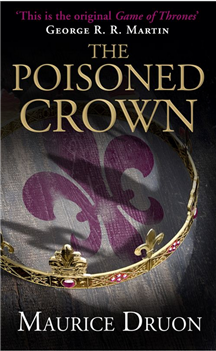
The PoCover for The Poisoned Crownisoned Crown begins with the beautiful and devout Clémence of Hungary on her way into a pit of vipers, the court of Louis X of France, and marriage with the king. Louis has managed to rid himself of his inconvenient first wife. His attention span is short, however, so by the time Clémence arrives after a horrendous journey he is more involved with an ill-conceived siege against the Count of Flanders than with arrangements for the wedding. Still, the new queen is soon esteemed for her gentleness and generosity, even by her horrible husband.

During Louis’ short reign, France has already descended from relative prosperity to famine, and the progressive steps taken by his father have all been rescinded. Robert of Artois, always trying to cause trouble for his aunt Mahaut, has provoked her barons to rise up against her in Artois. The cardinals have still not settled on a new pope. In short, France is in chaos. Louis’ younger brother Philip of Poitiers has striven to dissuade his brother from his poorer decisions, but Louis sends him off to the papal conclave.

Another character who has served in previous books as almost comic relief will soon become more important. This is Guccio Baglioni, the very young nephew of a rich Lombardi merchant. He has fallen in love with the daughter of impoverished nobility, Marie Cressay, and hopes to marry her, without understanding how much beneath them her family considers him. He has just helped escort Clémence of Hungary to France when he is badly injured.

The curse against the Capet kings of France continues in this third book of Druon’s excellent series The Accursed Kings. Those who are following it will not be surprised to learn how short Louis X’s reign will be.

Day 483: Reread: The Strangled Queen

Cover for The Strangled QueenThis article is a repeat review of the second book in Maurice Druon’s excellent Accursed Kings series. I wrote my initial reviews years after I read the books, from memory. This review is from a recent reread in preparation for my first review of the third book in the series.

The name of Philip the Fair would glow down the centuries only by the flicker of the faggots he had lighted beneath his enemies and the glitter of gold he had seized. It would be quickly forgotten that he had curbed the powerful, maintained peace in so far as it was possible, reformed the law, constructed fortresses that the land might be cultivated in their shelter, united provinces, convoked assemblies of the middle class so that it might speak its mind, and watched unremittingly over the independence of France.

So says Druon in his prologue to The Strangled Queen about Philip IV of France (Philip the Fair), whose death in 1314 begins the action of the novel.

Marguerite of Burgundy has not heard of Philip’s death. She and her sister-in-law Blanche, Philip’s daughters-in-law, are imprisoned in the Château-Gaillard for adultery, and she does not know that her husband has become the king of France, Louis X. When her cousin Robert of Artois comes to tell her, she naïvely believes he wants to help her, unaware how he has assisted in her downfall. What he actually wants is for her to agree to an annulment, as now she poses a big problem to the succession.

But Marguerite doubts when she should not. Although she would gladly exchange her harsh prison for a convent, she is afraid that once she signs, those in charge of her will leave her where she is. She also does not want to declare her daughter a bastard, the other requirement of her release.

Louis X soon sets his sights on marrying Cleménce of Hungary. To do so, he must get a pope installed who will agree to give him an annulment. However, the cardinals have been arguing ever since the death of Pope Clement V, who with Philip the Fair was a victim of the curse of the Grand Master of the Knights Templar (whose death by burning at the stake is referred to in the quote at the beginning of this review).

The weak and stupid Louis is faced with a battle between the forces of order and progress, represented by Enguerrand Marigny, his father’s coadjutor, and the old ways of feudalism, represented by his uncle, Charles of Valois. Whoever can get Louis a pope or his marriage with Cleménce will ultimately win, but in the meantime he begins stripping away all of the governmental reforms instituted by his father.

Bitingly told, about a fascinating period of French history, these novels introduce us to a world of complicated alliances, treachery, and politics, as well as murder and mayhem. Lately the novels are being marketed as the original Game of Thrones. There are certainly strong similarities.

Day 470: Reread—The Iron King

Cover for The Iron KingI already reviewed The Iron King during my first year of blogging, but that review was based on my memory of the novel, having read it several years before. I recently re-read it and would just like to mention it again, as it is so good and easier to find now that the first three volumes of the series have been republished.

The Accursed Kings series concerns the history of the last Capet kings of France. The first in the series, The Iron King, begins with some fateful acts that eventually affect the future of the kingdom.

The novel begins in England with Queen Isabella plotting with her cousin, Robert of Artois, against her three sisters-in-law. Queen Isabella, the daughter of Philip IV of France (known as the Philip the Fair or the Iron King), is unhappily married to Edward II of England, who disdains her and lends the power of his throne to the Despensers, the family of his male favorite. Isabella is disposed to make trouble. Her cousin has brought her his conviction that at least two of her three sisters-in-law are being unfaithful to their husbands, her brothers, the princes of France. Isabella and Robert hatch a plot to expose them.

Robert of Artois has his own reasons for the plot, for his father’s property was awarded to his aunt Mahaut instead of to him so that it would pass into the hands of King Philip the Fair’s two younger sons when they married Jeanne and Blanche, Mahaut’s daughters. Robert is only too happy to ruin Marguerite, Queen of Navarre and wife of Philip’s oldest son, along with the two other girls, as she is Mahaut’s cousin.

Awaiting their own fates are the last four members who are not in hiding of the once wealthy and powerful Knights Templar. Years before they had refused to admit Philip the Fair as a member, as it was against the rules of their order to admit royalty. Since then, Philip has plotted their ruin, assisted by Pope Clement, who covets the riches of the order. Now they have been condemned of heresy, largely on trumped up charges.

Early in the book, Jacques de Molay, Grand Master of the Knights Templar, is burned at the stake. During his burning, he curses the King, Pope Clement, and Guillaume de Nogaret, Secretary-General of the Kingdom, to their thirteenth generation. The Pope is dead within 40 days, de Nogaret soon after. Thus the name of Druon’s fantastic series, The Accursed Kings, for you can be sure that Philip the Fair will be dead by the end of the novel.

This series is being marketed as the original Game of Thrones. Perhaps there are some similarities. The court is a nest of vipers—those in power are constantly engaged in political machinations and those not in power in other kinds of plots. The world Druon presents is fascinating, depicted with cynicism and wry observations. The novel is extremely well written, about an extraordinary time in French history.

Day 347: The Strangled Queen

Cover for The Strangled QueenBest Book of the Week!

The Strangled Queen is the second in Maurice Druon’s The Accursed Kings series. In The Iron King, King Philippe IV and his progeny were cursed at the stake by the Grand Master of the Knights Templar for conniving with the pope to destroy the knights for their wealth. Now, after the pope and one of the king’s advisors dies, Philippe begins to believe in the curse and dies shortly thereafter, within a year, just as foretold.

His death leaves Philippe’s eldest son, Louis X, on the throne. Louis needs an heir, but his wife, Marguerite of Burgundy, was imprisoned in the Chateau Gaillard for adultery along with her sister-in-law Blanche. He is unable to get a divorce because a new pope has not yet been chosen. He sends Robert of Artois to coerce Marguerite into signing a letter claiming that their marriage was not consummated and their daughter is illegitimate.

In the meantime, Louis is involved in a power struggle against his uncle Charles of Valois. Louis does not know that Robert of Artois has taken his uncle’s side as part of his scheme to reclaim his inheritance, stolen by his aunt Mahaut.

Druon’s historical fiction is powerfully written, elegant and ironic. His novels do not take the point of view of one fictional character, as do most historical novels. All of the characters are actual historical figures, and few of them are sympathetic. The plots are driven forward by the power of the events they relate.

Several years ago, I had a hard time finding this series of books so that I could read it, but I felt that the result was worth the effort. Now, luckily for readers who are interested in the series, a new version of these books is available in paperback.

Day 318: Cathedral of the Sea

Cover for Cathedral of the SeaCathedral of the Sea was written to relate some of the history of Barcelona and of the Church of Santa Maria de la Mar. Unfortunately for Ildefonso Falcones’ readers, even though there is some fascinating material here, this purpose is all too obvious.

The novel begins with Bernat Estanyol’s wedding. Because of his father’s foresight in making a will, Bernat is allowed to keep his father’s property on his death. Otherwise, it would be forfeit to his lord, as Bernat is a serf. Left relatively prosperous, Bernat decides to marry a shy girl named Francesca. However, on the night of the wedding, his lord chooses to exercise his droit de seigneur, his right to deflower the bride. He follows this act up by forcing Bernat to rape her, too.

This horrible start to their marriage shows no sign of improving after Bernat’s son Arnau is born, and more atrocities follow. Eventually, to save his son’s life, Bernat flees the land, making for Barcelona, where, if he can live for a year and a day without being recaptured, he can become a free man of the city.

The growing Arnau soon becomes the novel’s main character, and he has many hardships to overcome. Missing a mother, he becomes fascinated with the image of Mary at the Santa Maria de la Mar, which is just being built as a cathedral for the common people. The novel follows Arnau’s life and the building of the cathedral together.

Well, sort of. The book’s jacket compares this novel to Ken Follett’s Pillars of the Earth, but there is really very little comparison. The cathedral is only brought into the plot periodically when needed or when Falcones wants to tell us something about it.

And that’s the problem with the entire book. Although the novel deals with the themes of the medieval caste system and the problem of justice for common men, and also treats of the special rights of the area, everything is driven by the plot. Even with a third-person omniscient narration, we seldom learn what anyone is thinking unless it is important to the plot. Characters are not so much developed as given things to say and do.

The plot itself has no focus. When I read at the end of the novel that Falcones followed the Crónica written by King Pedro the Third, that explained a lot. To show this history, Falcones must put his main character through some contortions. Beginning as a bastaixo, one of the men who unload ships and carry their cargo into town on their backs, Arnau runs off to war and later becomes a money lender, an extremely unlikely sequence of careers.

Characters appear as needed, disappear, and then pop up again when they’re needed. This might make sense for some characters but not for all of them. Women are uniformly raped, die from the plague, become prostitutes, or are otherwise mistreated, as if Falcones doesn’t know what to do with them except have something terrible happen to them.

One of the worst instances of this treatment is of Maria, Arnau’s cardboard wife. (The rest of this paragraph is a spoiler.) During all the first years of their marriage, Arnau is involved in a torrid affair with another woman. Arnau wants to leave this woman, but she threatens to tell his guild, which will expel him for immoral conduct, so that he has no work. Arnau goes to war to get rid of her, and when he finally sheds his mistress, do we have scenes of everyday married life? No. We immediately jump five years, and within two pages Maria dies of the plague.

Finally, we come to Joan, Arnau’s adopted brother. Treated with nothing but kindness and love by Bernat and Arnau despite a rocky start in life, he becomes a priest, after which he disappears for years. When he returns, he has suddenly become a hard, self-righteous right hand of the Inquisition.

My conclusion? Falcones is clearly not an able enough storyteller to skillfully handle a complex plot and many characters.

Day 311: Lords of Misrule

Cover for The Stewart TrilogyNigel Tranter was a historian and a prolific historical fiction writer whose work can be uneven. During the 1950’s through 1990’s he wrote more than 60 historical novels, some of which employ dialogue and characterization only to drive the plot forward. Such is not the case, however with Lords of Misrule, the first book in his Stewart Trilogy, a novel that is fully realized.

Jamie Douglas is a young esquire to the Earl of Douglas, the most powerful man in 14th century Scotland, certainly more powerful than the King, Robert II, a sorry descendent of Robert the Bruce and doddering old man who just wants to be left alone. The King has spawned a clutch of squabbling Stewarts who are waiting to see what happens when he dies. Unfortunately, his oldest son, John, seems unsuited to power, and his second son, Robert, is ambitious and dangerous.

When Jamie’s lord is foully stabbed in the back by his own armorer during battle, Jamie fears that any of several powerful men may have had enough to gain in the subsequent power vacuum among the Douglasses to have suborned the armorer. But when Robert Stewart, acting as his father’s Governor, appoints his good friend Archie Douglas to take the position of Earl, Jamie’s suspicions point to Robert.

Jamie and some other men lie in wait outside the armorer’s home after they figure out where he is hiding, in hopes they can capture him and question him about who paid him to murder the Earl. Their plans go awry, however, ultimately sending Jamie Douglas north in pursuit of another man, to the Highland territories of the dreaded Alexander Stewart, Earl of Buchan, known as the Wolf of Badenoch.

This novel provides a fascinating glimpse into the rivalries and political in-fighting among the early Stewarts. It has an appealing protagonist, although Jamie is a bit too honest and outspoken for his own good. It also includes a romance, as Jamie is drawn to two different Stewart women while serving a third, his Earl’s widow. Having learned most of my Scottish history from the excellent historical novels of Dorothy Dunnett, I am not accustomed to thinking of Douglasses as heroes, but Jamie makes a good one.

Day 88: The Iron King

Cover for The Iron KingBest Book of the Week!

The Iron King is the first of seven books in the “Accursed Kings” series by the French novelist Maurice Druon. Unlike many historical novels, this series does not follow a fictional hero or heroine but is an interpretation of actual events in French history with all historical figures. This series was popular in its time (it was written in the 1950’s), but may be difficult to find now. If you are lucky, your local library may have it.

It is 1307 in France. The kingdom is broke, and King Philippe IV, known as the Iron King, is looking for sources of money. The Knights Templar, one of the wealthiest organizations in the world, seems like a good place to get it, but they refuse France a loan. Some charges of heresy, obscene rituals, and other abominations have been laid against them by a defrocked knight. Everyone knows they are false, but with the collusion of Pope Clement, who fears the knights’ power, Philippe orders the members to be arrested all on the same night, and seizes their assets.

In the meantime, Robert of Artois has been cheated out of his inheritance by his aunt, Mahaut.  He decides to get his revenge by bringing down her daughters, who are married to the King’s sons.

Druon’s writing is elegant and ironic, his novels thoroughly researched. He doesn’t over-explain; instead, the novel is compelled forward solely by the events in the plot. Few of the characters are sympathetic; nevertheless, it is a fascinating series. I have often read opinions that Druon is one of the best historical novelists ever.