
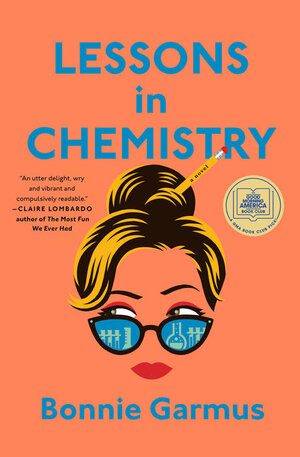
Today is another review for the Literary Wives blogging club, in which we discuss the depiction of wives in fiction. If you have read the book, please participate by leaving comments on any of our blogs.
Be sure to read the reviews and comments of the other wives!
- Kate of booksaremyfavoriteandbest
- Naomi of Consumed By Ink
- Rebecca of Bookish Beck
My Review
I finally got to read Lessons in Chemistry. It’s been sitting in my pile for more than a year waiting its turn for the club.
Elizabeth Zott is a chemist in the 1950s, when any career for a woman besides secretary, teacher, or nurse is unusual. She was accepted as a Ph.D. candidate at her university when her advisor sexually assaulted her, so she stabbed him with a pencil. Although he had a reputation, she was accused of cheating and expelled. So, she has no doctorate.
She gets a job at Hastings Laboratories in a town in California, but she is treated like a secretary. However, she meets Calvin Evans, a scientific genius with no social skills, and after a misunderstanding, she interests him in the work she is doing on abiogenesis. Soon, they fall in love. The people at their workplace interpret their synergy to Zott’s ambition to succeed. The couple acquires a dog, which they name Six Thirty (a great, if slightly unlikely, character). Zott is determined not to be married because she knows any breakthroughs she makes will be attributed to Calvin, but Calvin determines to ask her to marry him. We never find out how this will work out, because he is killed in a freak accident.
I may seem to be giving a lot away, but there’s a lot more to this story. For one thing, Garmus has created a unique character in Elizabeth Zott. She is straightforward, forthright, and determined to be treated equally with men. She doesn’t understand the meaning of compromise or of hidden messages.
I know I’m not conveying what this book is like, though. Despite the many obstacles and injustices that Elizabeth encounters, the tone of this novel is light and often funny, as Elizabeth misunderstands the other characters, and they misunderstand her. Yet, the novel has a strong message of feminism, and if younger readers think the misogyny in it is exaggerated, I can tell you it isn’t. (I remember talking to my father, who was a vice president of a large corporation, about a job interview at his company—for which, by the way, he gave me no assistance because he thought it would be unethical. I complained that the first thing they wanted to do was give me a typing test. He told me that was how to get started. I asked him if he had to pass a typing test when he first went to work. He didn’t understand my point.)
As someone who wanted to be a boy when I was a child, because boys got to do things, I really related to Elizabeth Zott. She’s a great character, and I loved this book.
What does this book say about wives or about the experience of being a wife?
The marriage examined in this book is more of an implied one about everyone else, since Elizabeth and Calvin aren’t married. The problems that Elizabeth has are rooted in the attitudes about marriage at the time, the clichés that Elizabeth doesn’t want to have anything to do with—that the wife is the homemaker and mother, and the husband earns the bread, that women don’t have careers, that the women who work are basically there to be sex toys for their bosses, that women are subservient to their husbands and probably not even intelligent, that in terms of science, findings would be attributed to the husband.
Elizabeth and Calvin, the main relationship in the book, are not married, and they have an intellectual synergy that is above these notions. But the implications of the notions have all their coworkers buzzing that Elizabeth is sleeping her way to the top, rather than that she is contributing to the work intellectually.
The point of the novel is to break all these stereotypes and show what Elizabeth is able to do despite all the setbacks. And have fun reading about it.


I like your take, Kay. I do think the author means it to be a fun way to get a message across. I also liked the dog!
I had forgotten that there were rumours about Elizabeth sleeping her way to the top. Whether she married Calvin or not, she couldn’t win!
That’s right. But she did, in a way.
This sounds like an entertaining way to discuss some serious points. I’m upset that Calvin died though! Still, at least it wasn’t the dog…
Some people in our group didn’t like the dog, but I did!
They didn’t think it was likely that he would know almost 1000 words, but there are dogs who do. There’s that one who can go get his toys by name if asked, and he has almost 1000 words.
Yeah, even average dogs are pretty good at recognising specific words. My childhood dog didn’t know a thousand, but he knew us all by name, knew all kinds of words like walk, treat, out, etc. In fact we used to spell words to try to fool him, but he soon learned that O-U-T spelled out and C-H-O-C meant chocolate! As for ‘collar’ and ‘lead’, he’d retreat out of reach as soon as they were mentioned… ;)
Those little scoundrels! I’m guessing my dog knows more words than I think he does. He seems to know what’s going on most of the time.
Thanks for this, Kay. Same as you, I lived through that time of misogyny where a woman was only worth half of a man, if at all.
I only read this now and therefore, only reviewed it today. (See here.)
Thanks, Marianne!