Day 765: Mistress Malapert

Cover for Mistress MalapertMistress Malapert was my favorite of Sally Watson’s books years ago, the rediscovery of which I discussed in my review of Lark. The only thing that might keep it from still being my favorite is its attempt at Elizabethan English, not entirely convincing although not horrible, even used sometimes in the narrative parts of the book. Watson in her updated notes at the end of the book says she wishes she hadn’t used so much of it but that she was inexperienced as it was her second book. Still, as a young reader, it clearly didn’t bother me. I’m not even sure I noticed it.

Valerie Leigh has been raised for years by her wealthy, childless aunt and uncle, who have given her everything she asks for. Now she is back with her own family, and they don’t know what to do with her. At fourteen, she has a nasty temper that appears whenever she doesn’t get what she wants. Her temper is over quickly and she always sincerely apologizes, but that doesn’t stop her from behaving in a truly outrageous manner when she is angry.

When Valerie’s parents are dispatched by her mother’s distant cousin, Queen Elizabeth, on a foreign embassy, they leave Valerie and her sister Audrey in the care of their stern Uncle Gil, who is determined to tame Valerie. Of course, she isn’t going to put up with much of this.

At a fair, she is fascinated by a troupe of players, especially the boy who plays the part of the princess. She decides it is unfair that girls aren’t allowed to act. Later, when Uncle Gil punishes her for fighting, she decides to run away. She disguises herself as a boy and runs off to join the traveling players, a plot straight from Shakespeare.

Val finds she has a talent for the stage, but her adventures on the stage aren’t all this novel is about. Slowly, she learns some lessons about her responsibilities to the other players and about the kind of person she really wants to be. To be that person, she must learn to control her temper and think of others.

I found this book quite enjoyable and think that many preteens and young teens might like it as well. Val has the opportunity to meet Shakespeare and even Queen Elizabeth by the end of the novel, and although I am not generally fond of historical novels where the main, invented character somehow meets lots of famous people, in this novel it seemed perfectly reasonable. And by the way, I recently criticized the depiction by another writer of Shakespeare’s dialogue in her book for its lack of playfulness. When Val meets Shakespeare, his response is a little clumsy, but much more what I would expect:

Here be a valiant Val to have with us for a valediction. Be you a valid Valentine? Can ye play a valet? Put down your valise, valiant Val, and be you proved valuable, we’ll keep you till you be valanced with a white beard.

Don’t worry, it’s not all like this.

Related Posts

Lark

Witch of the Glens

The Secret Life of William Shakespeare


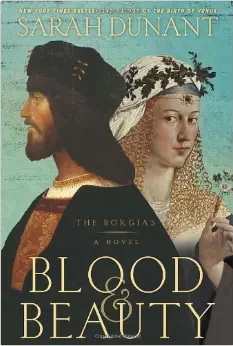
Day 753: Blood & Beauty

Cover for Blood & BeautyBest Book of the Week!
Blood & Beauty is a historical novel about the Borgia family that shows meticulous research, examining in light of modern findings the legends that have surrounded the family for centuries. It also powerfully evokes the period.

The novel begins with the election of Rodrigo Borgia as Pope Alexander VI. He is clever and ruthless but sentimental about his four illegitimate children. Although historically there is some debate about the birth order of the oldest two sons, Dunant firmly places Cesare as the oldest, followed by Juan, Lucrezia, and Jofrè.

Although the pope loves his children, especially Juan and Lucrezia, their value is largely in the alliances he can make through their marriages. Cesare’s value, on the other hand, is to back up his father on the religious front. He begins as a cardinal, although he is unsuited to his religious profession and eventually throws it off to become a commander of armies.

Juan’s marriage is first, but the novel is mostly concerned with the relationship among Pope Alexander, Cesare, and Lucrezia. It is much more complex than and different from what you may have heard. It is Lucrezia’s misfortune to be married into families that become enemies of the Borgias because of shifting alliances. This is particularly true of her second marriage to Alfonso of Aragon, whom she loves.

Dunant remarks in the afterward that the Borgias have not deserved their evil reputation. Certainly they were rapacious and ruthless—and more interested in the good of the Borgias than anything else—but so too were most of the great families of Italy at that time. In this novel, alliances are made and discarded at will by most of the great families.

This novel is historical fiction at its best. None of the characters are invented or romanticized, and we become immersed in the world of Renaissance Italy.

Related Posts

The Malice of Fortune

A Folly of Princes

Worldly Goods: A New History of the Renaissance

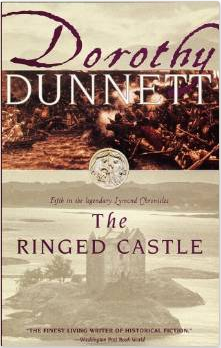
Day 701: The Ringed Castle

Cover for The Ringed CastleBest Book of the Week!
In this fifth book of the Lymond Chronicles, Francis Crawford of Lymond goes on a journey to an uncivilized land. He has already traveled and battled his way over Europe, North Africa, and Asia Minor, but this time he takes his small band of mercenaries to Russia. In an attempt to avoid the consequences he fears from a prophecy by the Dame of Doubtance, he feels he must stay away from his home in Scotland. So, he decides to go to Russia and offer to fight for Ivan IV (Ivan the Terrible) against the Ottoman Turks.

With Lymond and his mercenaries goes the mysterious Guzel, a beautiful, cultured former mistress of the Ottoman admiral Dragut Rais. She wants to make Lymond a powerful ruler. Lymond sees Russia as an undeveloped country full of opportunity for an intelligent leader, a place that will allow him the scope to create something great. Since Russia has no modern army in the sense of those of 16th century France and England, he offers to build one for the tsar.

Lymond’s struggles to work with the erratic tsar are complicated by his relationship with Dmitri Vishnevetsky, or Baida, the volatile Hetman of the Ukrainian Cossacks and a man of legend who has pledged his help to the tsar. Baida sees Lymond as a possible companion but also as a threat to his own power, and he desires Guzel for himself.

Back in England, Philippa Somerville has made a debut at the court of Mary Tudor that is surprising to even her mother, because her sojourn in the sultan’s harem has changed her from a scruffy teenager to a beautiful, polished, and sophisticated young woman. The treacherous Margaret Lennox and the queen’s sister Lady Elizabeth seem to be interested in involving her in their various schemes, but Philippa is tactful and cautious.

This novel, like the others, involves plenty of political maneuvering, adventure, danger, and battles, but also features winter sledge races and the burning of Moscow. Lymond, as usual, is arrogant, frightfully intelligent, and always ready with a blistering comment. Still, we find him irresistible. I cannot tell more for fear of spoilers, but if you decide to read this series, you will not regret it.

Related Posts

Pawn in Frankincense

The Disorderly Knights

Queen’s Play

Game of Kings


Day 651: Literary Wives! The Last Wife of Henry VIII

Cover for The Last Wife of Henry VIIIAgain, we have a group book review with Literary Wives, where a group of bloggers get together and review the same book about wives on the same day. If you have read this month’s book and would like to participate, leave comments on any of our blogs. Be sure to read the reviews and comments of the other wives!

***

In considering The Last Wife of Henry VIII, I come smack up against the issue I’ve mentioned in the reviews of several historical novels based on the lives of actual people. That is, how an author can make the subject interesting while staying faithful to the events of the person’s life and to the person’s character.

In this novel, Erickson has a fairly clean slate to work with, because Catherine Parr’s life has not been covered as exhaustively as that of other Tudors. Yet it is one thing in historical fiction to invent the details of ordinary life and another to present readers with questionable events. The most obvious of these is to have Parr’s love affair with Thomas Seymour begin while she was still married to John Neville, when to all indications it began after Neville’s death, when she was left a relatively wealthy widow. And, might I add, the unlikelihood that they continued their physical relationship (if they had one) while she was married to Henry VIII. Not in that court and atmosphere, with that history, I’m guessing.

But this is aside from the point that with all this inventing, Erickson still fails to make Catherine Parr an interesting character or her story compelling—despite the fact that it probably was compelling. The actual Catherine was much more capable and influential than Erickson’s character, in fact.

Literary Wives logoWhat does this book say about wives or the experience of being a wife?

First, for the Tudors wives were bargaining chips. The novel depicts Catherine as taking control of her own fate in some of her marriages, but only within limits. That is, in both instances if she hadn’t had another suitor, she would have had to marry the person chosen for her. Within the marriages, the limits to her spheres of action are chosen by her husband unless, as in her marriage to Seymour, she has her own money, which gives her leverage. In three of her marriages, her husband’s activities or relations with her husband’s relatives make her position insecure, so much so in her first marriage that she is left a poor and unprotected widow, at least according to Erickson. I would submit that in actuality, what left her insecure after the death of Henry VIII was more likely her marriage to Thomas Seymour than anything else.

In what way does this woman define “wife”—or in what way is she defined by wife?

Catherine usually tries to do her duty by her husband, whether she loves him or not. The exception is her affair with Thomas Seymour while she was married to John Neville (which I don’t believe actually happened). In the terms of the novel, this is probably supposed to make it more romantic (it doesn’t), but it makes her character less consistent. I would say that for Parr, a wife is dutiful, affectionate, and tries to do the right thing. Her marriage to Henry VIII also shows her as compassionate, capable, and politically astute. Her marriage to Thomas Seymour, on the other hand, shows her as fatuous and besotted, unfortunately the reputation that has survived her. If I can sneak in a comment about stepmothers here, I believe her actual relationship with Henry’s children was much warmer than depicted in the novel.

Related Posts

The Tudor Secret

Bring Up the Bodies

The Marriage Game

Day 646: The Marriage Game

Cover for The Marriage GameAlthough I have read several of Alison Weir’s meticulously researched histories and historical biographies, I feel her gifts are more for nonfiction than fiction. In her novel The Marriage Game, she concentrates on the struggles and power plays around the issue of Queen Elizabeth I’s marriage during the first years of her reign. Unfortunately, Weir focuses on this subject so much to the exclusion of others that you would think it was the only item of concern in the realm. For example, Elizabeth sends Cecil away to broker a peace with Scotland, which is almost the only mention of a war.

The novel begins right after Elizabeth hears of her sister’s death and takes the throne. Her advisor William Cecil almost immediately raises the issue of her marriage. Elizabeth, determined not to lose her hard-won power to a husband, finds her repeated statements that she will not marry either not believed or met with the opinion that her remaining unmarried would not be good for the kingdom. Elizabeth takes a flirtatious stance, refusing to be pinned down to a decision but forever pretending she’s considering a suitor.

Confusing the issue is Lord Robert Dudley, for whom she has a decided preference. But he is already married. Still, she heeds no one’s warnings about her reputation. She keeps him with her even when his wife is dying, and at least in this novel, their physical relationship includes everything except actual penetration. Just whether the Virgin Queen was a virgin is a subject of debate, and this seems to be Weir’s (perhaps unlikely) compromise. The mystery of what happened to Dudley’s wife seems much less important than it actually was at the time.

http://www.netgalley.comWeir has not chosen to make this story romantic or even depict the two main characters sympathetically. Neither is fully formed, but both are selfish, ambitious, demanding, and conniving. Although the novel is well written and should be interesting, it eventually devolves into repetitious arguments, with Dudley’s ambitions thwarted and Elizabeth incensed because he has overstepped his bounds. If there is an arc to the plot, I couldn’t discern it. I couldn’t help thinking that a novel about Elizabeth that was a little broader in scope would be more interesting. After reading most of the novel, I finally decided I was finding it tedious and quit reading it. Very disappointing, especially considering Weir’s excellent biography of Mary Boleyn.

Related Posts

Mary Boleyn

The Wars of the Roses

Wolf Hall


Day 635: The Secret Life of William Shakespeare

Cover for The Secret Life of William ShakespeareAs I am interested in Shakespeare and recently enjoyed a Regency romance by Jude Morgan, I wanted to enjoy this novel a lot more than I did. There is of course a risk in making a historical figure a main character in a novel, and that is that no author truly knows the mind of the real person. The truly successful novel of this type bravely forges a persona. Morgan’s solution, however, is to make Shakespeare, about whom little is known, truly amorphous in character.

The novel centers mostly on the relationship between Shakespeare and his wife, Anne Hathaway, an interesting choice, since we know they lived apart for much of their marriage. Morgan explains the marriage between Shakespeare and his bride, almost ten years older, as a love match, which is perhaps more unlikely than many different explanations for it (although of course not impossible). He has Anne reluctantly agree to Will’s eventual decision to join a group of players only on the condition that he is never unfaithful to her. Anne does not understand Will’s fascination with the theatre and views it with jealousy.

To go along with the amorphous nature of Will’s character, the details of his London life are murky. Morgan hardly ever shows him at his work or refers to any of the events of his life. Instead, he has him in conversation with various players and writers, particularly Christopher Marlowe and Ben Jonson. The introduction of Jonson into the novel is particularly confusing, as often we side track to examine his life and career as a playwright. In fact, he is a much more definite character than Shakespeare is.

It felt to me as though, in being perhaps reluctant to misinterpret Shakespeare’s personality, Morgan just doesn’t interpret it at all. Wife and friends find him equally unknowable. I had a hard time reconciling my knowledge of the plays with this reticent character. In particular, it seemed as though a man who was so fascinated with language would play with it more in his speech, as he does in Anthony Burgess’s much more adventuresome book Nothing Like the Sun. I did not buy Morgan’s idea of Shakespeare’s personality at all.

Day 595: Turn of the Tide

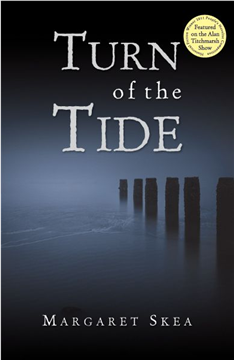
Cover for Turn of the TideTurn of the Tide is a historical novel set in the 16th century that centers around a long-running feud between two Scottish families, the Cunninghames and the Montgomeries. The feud and some of the events are factual, although the main character and his family are not.

The novel begins when the Cunninghames summon Munro. Not a Cunninghame himself, he is a minor laird who owes them allegiance. But he is not happy when he finds the plan is to massacre a bunch of Montgomeries on their way to meet with the king.

Although Munro’s wife Kate is angry when she finds he took part, she is even more angry when she finds out later that he has befriended some of the Montgomeries. This apparent change of loyalties could cause even more problems for their small family. King James has forced the two families to make peace, but it is an awkward one, with both families jockeying for position in court.

Munro is most wary of his uneasy relationship with William Cunninghame, the Earl of Glencairn’s heir and a brute. As Munro becomes closer to the Montgomeries and William’s eye alights on Sybilla Boyd, the fiancée of Munro’s brother Archie, the relationship between Munro and William becomes dangerous.

This novel never quite gets off the ground for me. Although I don’t demand action from every book, this one has very little going on for much of the time. Skea does so little to differentiate some of the characters that I kept getting confused about who they were. The novel begins with the massacre and ends with some action that is not really satisfactory. In between it concerns itself with grown men literally jostling for position with King James, the form of which seems silly, although probably exactly what went on.

The novel is also about Munro’s family life, mildly interesting but not compelling. It is nicely written with some Scots dialect. It just isn’t very tightly plotted.

Day 558: La Reine Margot

Cover for La Reine MargotIf you’ve been following my reviews of Maurice Druon’s Accursed Kings series about medieval France, you’ve probably seen me use the phrase “nest of vipers.” La Reine Margot, set a couple of centuries later, is just as full of intrigues, infidelities, betrayals, and even poisonings.

It is 1572, and the French court is celebrating the inexplicable marriage of Marguerite of Valois (Margot) to Henry of Navarre. France is at the height of the wars between Catholic and Huguenot, and Charles IX has proposed the union between his sister and the leader of the Huguenots purportedly to further peace.

Soon, though, we find out that the wedding is a trap for the leading Huguenots planned by Charles and his evil mother Catherine de Medicis. (Note that throughout I spell names as they were in the book.) For that evening of St. Bartholomew’s Day, troops are sent out all over Paris to massacre the Huguenots, who are in town for the wedding.

Thinking to rid himself of an enemy in Henry of Navarre, Charles has not considered his sister. Even though she and Henry are not romantically attached, the two have sworn to support each other. When Henry is trapped in the Louvre with the royal family, a combination of Margot’s support and his recanting saves his life. Margot has also rescued a young wounded Huguenot, La Mole, from the slaughter, providing a romantic subplot for the novel.

So begins the novel about how Henry of Navarre, aided by Margot, survives the machinations of the Valois family. The rumor is that Catherine recently murdered Henry’s mother by poisoning her, and Catherine also works in charms and horoscopes. Charles IX is unstable, first mistrusting Henry and then treating him like a brother. Henry d’Anjou, Charles’ brother, detests Henry of Navarre and thinks he is a threat to d’Anjou’s own right to the throne after his brother. François d’Alençon, the other brother, wavers in his decision to ally with Navarre.

Dumas was a writer of the Romantic movement, which de-emphasized rationality and emphasized emotion. The romantic plot involves the love affair between Margot and the naive and gallant La Mole, who is drawn into danger because of his love and religion.

My Oxford World Classics edition was fortified with copious notes, including information about which events were true and which were invented. Dumas is prone to using real people in his historical romances, and it was just a little off-putting to discover, for example, that the real La Mole was not a gallant Huguenot but a fundamentalist Catholic who was responsible for many murders during the massacre. Still, I found the real stories as fascinating as the novel.

If you like a fast-moving adventure that also involves political maneuvering, this is a good book for you. I was more interested in the nerve and political agility of Navarre than I was in the romance, but I still enjoyed the novel.

One caution—an abbreviated version of this novel is available as Marguerite of Valois. I have not read it, but if you want the more complete novel, look for La Reine Margot. (Yes, it is in English but also in French, so be careful if you order it online.)

Just a side note. I have written much about Dorothy Dunnett’s excellent historical novels. One of her Crawford of Lymond novels, Queen’s Play, is also partially concerned with the massacre.

Day 354: Worldly Goods: A New History of the Renaissance

Cover for Worldly GoodsWorldly Goods promises a new look at the European Renaissance from a different point of view. Lisa Jardine, a professor of English at the University of London, proposes an interpretation of the period in terms of the growth of commerce and a new consumerism and multiculturalism.

However, the information offered does not seem new. Rulers and wealthy men have always been conspicuous consumers. Jardine attempts, for example, to turn around our view of the flowering of art as merely a series of demonstrations of the wealth of patrons who commissioned the works, a sort of competition to show who is most wealthy or powerful. But simply providing examples of patrons who specified expensive materials or the inclusion of their goods in pictures doesn’t prove this point.

Jardine does a better job of showing how the development of printing made the exchange of ideas easier, thus affecting the advances in many different fields, including the arts and the sciences. However, her argument that the policy decisions of the period were all driven by the dictates of commerce is taking things too far, I think.

The book is well written and lively. It does not back up its assertions with footnotes or a bibliography, however, indicating that it is written for the general public but frustrating those who would like to look further. At some point, I felt that the examples were becoming too repetitive and no new points were being made. For example, Chapter Three is about the proliferation of books and printing, but Jardine continues to make the same points about printing and the sharing of scientific and technical information repeatedly throughout the rest of the book.

Although the history provides an interesting discussion of commerce during the Renaissance, it is oversold as a complete history of the period.

Day 345: The Chalice

Cover for The ChaliceI am not sure why I found this novel so irritating. Possibly it is because it is a sequel, but nowhere on the cover is that indicated, and this novel is definitely one that requires knowledge of the previous book, which I have not read.

Joanna Stafford is a former Dominican novice after the dissolution of the monasteries by Henry VIII. At the beginning of the novel she is in Canterbury with some ex-monks about to commit some serious act, but then the action turns back several months.

Joanna is living in Dartford with her young cousin and her friends Brother Edmund and Sister Winifred, a former monk and nun who are sister and brother. Some of the townspeople are suspicious of the former residents of the priory, but Joanna has plans to continue there and set up a loom to weave tapestries.

Soon, however, her cousins Gertrude and Henry Courtenay arrive to invite her and her cousin Arthur for a visit. Little does Joanna know that Gertrude is aware that Joanna is the subject of a prophecy, which a group of Catholics believe will save Catholicism in England. Apparently, in the previous novel she received a prophecy and was told she would learn it in full after she received three prophecies. Since her family was destroyed as the result of a prophecy, however, she has promised never to dabble in it again. She is soon subject to immense pressure from Gertrude Courtenay and others, including the Lady Mary Tudor and the Spanish ambassador Chapuys, to see a seer.

The novel does not seem very coherent. Joanna is told she must hear the prophecies of her own free will, yet all kinds of pressures and threats are applied to make her hear them. She is refusing to hear the prophecy, then she isn’t. Then we go through the same thing with the next prophecy. Some of her decisions seem completely unlikely for a person who is extremely religious and was previously a novice. At one point in the book she throws herself at two different men within the space of weeks.

It takes an incredibly long time to feel certain that we’ve learned of everything revealed in the first book–new facts keep popping up until nearly halfway through the volume. This is not a stand-alone novel by any means. Whether it would be more satisfying for someone who has read the first book I cannot answer.