Day 77: Wolf Hall

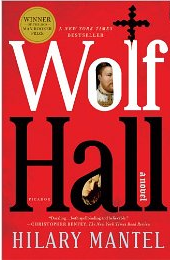
Cover for Wolf HallBest Book of Week 16!

This is a good time to write about Wolf Hall, because I was thrilled to learn that Hilary Mantel’s sequel to it has just come out. My copy is arriving soon. Mantel is always an interesting writer whose work does not occupy any one genre, although her last few books have been historical fiction. Wolf Hall won the Man Booker Prize and was one the best books I read in 2010.

The novel looks at the political and religious machinations of Henry VIII through the eyes of Thomas Cromwell, who rose from low origins to become Henry’s chief minister. Although Cromwell has traditionally been viewed as Henry’s “heavy,” recent historians have looked at his career more kindly, showing that his work as chief minister brought England into more modern statehood and that his changes created more order for government functions that were less controlled by the whims of nobility.

Mantel depicts Cromwell as a loyal man who cares for his dependents and works to reform England. He builds up a great household as he moves from the position of secretary to Cardinal Wolsey to work for the king. Later, after the Cardinal’s downfall, he slowly, almost imperceptibly, works to bring down those who furthered their own interests by destroying the Cardinal, including the rapacious Boleyns.

Cromwell is loving to his family and friends, completely faithful to the Cardinal and then to Henry, intelligent, able in many spheres of work, and decent. Mantel paints a charming pictures of his home life. In contrast, she turns the tables on Thomas More, venerated for centuries, showing him as a sadistic torturer of Protestants who is in love with his own martyrdom.

Cromwell meets Jane Seymour when she is a young, lonely lady’s maid to the queen, teased and neglected by the rest of the court, and feels pity for her. Later, after he is long widowed, he falls in love with her. The title of the book is the name of her ancestral home, Wolf Hall.

Mantel’s approach is understated, leaving the reader sometimes to connect the ideas. The details in this novel seem completely authentic, and Mantel handles the period brilliantly. She somehow manages to generate tension and suspense even about things we know all about, like what will happen to Anne Boleyn.

Day 61: The Game of Kings

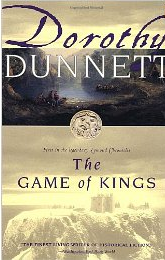
Cover for Game of KingsBest Book of Week 13!

If you love an authentic, well-researched, exciting historical novel that makes you almost feel like you are in the period, then I can’t recommend a better author than Dorothy Dunnett.  I have been trying to get people to read her for years with the caveat that her books are challenging, not for the reader of light romantic history.

Lady Dunnett is described on her Wikipedia page as a “leading light in the Scottish arts world and a renaissance woman.” Her books are loaded with detail about medieval customs, dress, politics, religion, food, and literature, and have labyrinthine plots full of action. She is most renowned for two series, the Lymond Chronicles, written in the 1960’s and 70’s and set in 16th Century Europe and Africa, and the House of Niccolò, written in the 1980’s and 90’s and set in 15th Century Europe, Asia, and Africa. Dunnett died shortly after finishing the last book in this series.

Game of Kings is the first book in my favorite series, the Lymond Chronicles. Francis Crawford of Lymond makes a rollicking and disruptive re-entrance into his home country of Scotland despite the charge of treason hanging over his head. He forms a band of outlaws and begins roaming around the countryside, sneaking across the border to play tricks on the British and harassing his own family. For quite some time, you don’t know whether he is a hero or a villain. He never explains himself, so it is left up to the reader (and the other characters) to figure out his motives for sometimes seemingly wrongful acts. His enemies think he is responsible for the explosion that killed his sister and is trying to murder his older brother Richard so he can inherit the estate. His friends are absolutely devoted to him but suffer doubts when he misbehaves, as he often does. His brother doesn’t know what to think, and his mother, Sybilla, is silent.

Francis is a mimic and a rogue, a musician and a polyglot, a poet and a swordsman, as swashbuckling a character as you will ever meet with in a novel. In among the action of cattle raids, impersonations, intrigues, duels, and archery contests, you actually learn a lot about Scottish history and politics.

Game of Kings is Dunnett’s first book, and my only criticism of it is that Lymond is a bit too fond of quoting poetry in antique languages. Most of it is incomprehensible unless you are a medieval scholar, but skipping over it does not hurt your understanding of the novel. Dunnett does this much less in the other books in the series. If you read this book and continue with the series, by the second book you won’t be able to stop.

Day Nine: Mary Boleyn

Cover for Mary BoleynIn the introduction to Mary Boleyn, biographer Alison Weir talks about the many misconceptions we have about Anne Boleyn’s less famous sister, which were not only derived from such popular fictions as The Tudors (wildly inaccurate, but I still loved it!) and The Other Boleyn Girl (ditto), but also from biographers and historians over the centuries. Weir calls her book both a biography and a historiography, because she tackles many published statements about Mary’s life and attempts to show the extent of their truth or even likelihood.

Because most of Mary’s life was spent in the background of her glittering, ambitious family, not many actual records or letters that mention her exist, and only a couple of her own letters survive. Even the exact date of her birth is unknown, so that there has been been debate about whether Mary is the older or younger of the two sisters. (Weir makes a good case for older.)

Weir examines Mary’s life from as early as it is known and explores such subjects as whether she had an affair with the King of France (yes, probably a short one), whether she came from that with a ruined reputation, as has been alleged (no, but her family may have sent her away from court), whether she had an affair with Henry VIII (yes, but possibly reluctantly), whether she was then labeled a “famous whore” as has also been alleged (no, hardly anyone knew about it), whether she was married off to an unworthy but complaisant husband as a result (no, she married before the affair to William Carey, a wealthy and influential courtier who was one of Henry VIII’s trusted friends), and so on.

The picture Weir paints is of a woman who has repeatedly been smeared over the centuries. She certainly did not seem to be ambitious, like the rest of her family, because she got very little from her royal lovers. She was almost certainly also not well regarded by her family, probably because she had taken these lovers without gaining an advantage. After her first husband died, she eventually remarried for love, William Stafford, a relatively poor man much lower in status who was 12 years her junior. After she was cut off from her family and court as a result, she described the time of her widowhood as “bondage” and stated in a letter to Thomas Cromwell that no one in the world cared for her except Stafford.

Mary seems to have been slighted by her family for much of her adult life and was finally exiled from them because of her second marriage. This separation may be the only reason she survived her sister and brother.

Weir makes a strong case for Mary’s first child, Katherine Carey, being the unacknowledged daughter of Henry VIII. An appendix relates what happened to Mary’s descendants. Weir remarks that Henry VIII’s line is believed to have died out with Elizabeth I, but assuming she is correct about Katherine’s birth, she provides a fascinating list of some of the famous British people who can trace their lineage back to Mary’s daugher—and so to Henry—including Winston Churchill, Charles Darwin, Lord Nelson, Vita Sackville-West, Ralph Vaughn Williams, Princess Diana, Camilla Parker-Bowles, and Queen Elizabeth II herself.