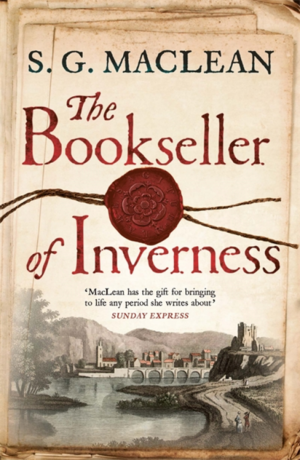
Review 2635: #RIPXX: The Bookseller of Inverness

Iain MacGillivray was badly injured at Culloden and shipped off to work in indentured servitude in the Americas. In 1752, six years later, he is back and running a bookshop in Inverness. The town is full of British soldiers.

One evening he sees a grubby man who looks vaguely familiar looking through some books that came from Lord Lovat’s estate. It’s closing time, so he forces him out.

Iain hasn’t seen his father, Hector MacGillivray, for years. Hector has been serving King James in France and Italy. He is proscribed, but Iain has believed his father is dead. Now he finds he is in town.

Hector is searching for a book that has been rumored to exist, one that contains a list of traitors to the Jacobite cause. King James is planning another attempt to take back the throne from the Hanoverian king, and they want to make sure they know it’s not going to be betrayed.

By looking through the remaining books from Lord Lovat, they figure out which book it was. Hearing that there is a copy, Iain goes to Lovat’s castle, now occupied by British soldiers, on the pretext of buying some of the books. There he has an unpleasant encounter with the cruel Captain Dunne, who burns part of the book, but Iain is able to get away with the rest.

Hector starts trying to decode the text for names, but before he figures out each of six names, that person is murdered. The killer could be someone getting revenge, or it could be a traitor trying to cover his back.

I found this to be an interesting, fast-moving adventure that seems well researched and steeped in its time. I enjoyed it quite a bit.

Related Posts

Kidnapped

Corrag

Waverley

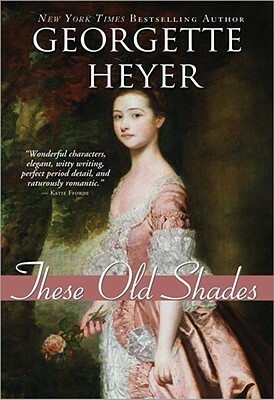
Review 2482: These Old Shades

In trying to fill some of the holes in my Century of Books project, I noticed that These Old Shades, which I haven’t read for many years, would help. This novel is Heyer’s first, and it is also the first of four about the Alastair/Audley family. (The others are The Devil’s Cub, Regency Buck, and An Infamous Army.)

Late on a mid-18th century night, His Grace of Avon Justin Alastair is walking through a Paris slum when a boy collides with him. The boy is fleeing his brutish brother. On impulse, the Duke buys the boy, but it is clear he is up to something. He takes the boy home and makes him his page.

The boy, Léon, has fiery red hair and dark eyebrows. The Duke has noticed this resemblance to his enemy, the Comte Saint-Vire, and takes Léon around to embarrass him. However, he begins to have other thoughts about the resemblance because of Saint-Vire’s reaction.

Soon, though, it is revealed that Léon is really Léonie, disguised as a boy since she was 12. The Duke takes her to England and leaves her with his sister while he arranges a chaperone, announcing that he intends to adopt her as his ward. Léonie is starting to enjoy being a girl when she is kidnapped by Saint-Vire.

This is an adventurous, amusing romantic novel. The Duke is enigmatic and Léonie is charming and feisty. Although the Duke has a bad reputation and is known as Satanas, as his relationship with Léonie develops, he becomes more human. Some of the interviews between Saint-Vire and Avon struck me this time as a little unsubtle, but overall, it is a great start to Heyer’s career and I enjoyed it very much.

Related Posts

Regency Buck

An Infamous Army

The Nonesuch

Review 2474: North Woods

In early colonial days, a couple flees one of the colonies into the wilderness of Massachusetts. There, they settle in a valley.

A settler with a baby is kidnapped by natives. When she becomes ill with fever, they leave her with an old white woman, who cares for her. But when white men come after her and plan to kill the natives—the old woman’s friends—she murders them. Before this happens, one of the men gives the captured woman an apple, and she drops the seeds on the ground.

An apple tree grows.

After the French and Indian Wars, Major Charles Osgood gives up his uniform and decides to grow apples. His friends think he has lost his mind. He searches all over until a child leads him to an apple tree near a ruined cabin in the wilderness. The apple is marvelous. He builds a house and takes cuttings from the tree to make an orchard, producing an apple called Osgood’s Wonder.

So Daniel Mason goes on relating the history of this plot of ground, from one owner to another. People die, are murdered, are conned, become ghosts, run mad, the wilderness recedes and then returns, the house is ruined and rebuilt, added to, ruined, rebuilt. Each section is linked to others by characters, coincidences, and place. Some of the incidents are funny, some fates are sad, some characters get what they deserve. Tales are punctuated by songs written from the grave.

I can’t really convey how much I enjoyed reading this unusual novel. It’s steeped in the beauty of the forest. It somehow manages to involve you despite some quite short (some longer) stories of its characters. You get worried about the fates of apple and chestnut trees! I loved this one. It did exactly what a book is supposed to do, pulled me into a different world and made me reluctant to leave it.

Related Posts

The Overstory

The Orchardist

Ulverton

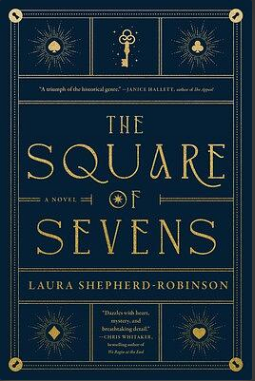
Review 2453: The Square of Sevens

Now, this is the kind of historical novel I like. The time period seems to be well-researched, the flawed heroine is still likable, and the plot is twisty and interesting.

Red tells us about her life in 1730, when she was seven. She has been traveling all her life with her father, a Cornish cunningman named John Jory Jago. But he believes his life is in danger so is using an assumed name. He has taught her to read fortunes using the square of sevens, a technique passed down in her family. She knows nothing of her mother except she is dead.

They meet Robert Antrobus at an inn. He is an antiquarian who is interested in the square of sevens. Her father tries to get him to take Red, but he refuses. Red’s father dies, and Antrobus returns to take her home to Bath and adopt her.

Now named Rachel Antrobus, Red begins as a young woman to try to find out about her family. The pack of cards she has always used has a Latin slogan on it that is the motto of the rich and powerful De Lacey family. That family is engaged in a legal battle over the estate between most of the De Laceys and Lady Seabourne, a sister of Julius De Lacey who is estranged from the family. The dispute is about a codicil that Nicholas De Lacey left, leaving the bulk of his estate to his first grandchild. Lady Seabourne’s son is that grandchild, but the rest of the family claims that Nicholas burned the codicil.

Red learns enough about the family to believe that she is the daughter of a runaway marriage between John Jory Jago and Patience De Lacey. Then she finds the codicil in the tube that contained the document explaining the square of sevens and realizes she is the first grandchild.

Fairly early on, we see another point of view. Lazarus Darke is working for Lady Seabourne trying to find the codicil.

Someone breaks into the house, killing the housekeeper, Mrs. Fremantle, obviously looking for something. Then Mr. Antrobus dies. Red has reason to believe that her new guardian, Henry Antrobus, has stolen her inheritance from Mr. Antrobus, and then he sells the codicil. Red runs away from home to London.

Red finds herself a job telling fortunes at a show, an illegal activity. The show was once a joint enterprise between John Jory Jago and Morgan Trevthick. Red, who has thought her mother dead, finds out that Patience De Lacey is Lady Seabourne. She presents herself to her, but Lady Seabourne throws her out. So, Red decides to infiltrate the De Laceys as a fortune teller for Mirabel Tremaine, who she believes is her grandmother. But can she find the codicil? And how will she prove that she and John Jory Jago lived instead of both going over a cliff when she was a baby, as everyone believes?

Soon, Red realizes she has entered a nest of vipers. But are they all or only some of them vipers? It seems as if I have told a lot of the story, but there is much more to come.

Related Posts

The House of Fortune

The Last Confession of Thomas Hawkins

The Clockwork Girl

Review 2310: Jane Austen at Home

Although I read Claire Tomalin’s biography of Jane Austen years ago and thought it was very good, I feel that historian Lucy Worsley’s book provides a more personal look at Austen with more detail about her everyday life. Although some references are drawn from Worsley’s knowledge of Georgian society, she doesn’t hesitate to draw inferences from Austen’s novels and letters. Further, I think she has a better sense than some biographers of when in Austen’s letters she is joking

Worsley points out how important a settled home is in Austen’s fiction. Certainly, from the time of her father’s retirement from Steventon, that is something she and her sister and mother did not have that provoked much anxiety.

It was Tomalin’s suggestion that Austen was unable to write when she was unsettled, but Worsley suggests that Austen was working on novels all along but not doing much to market them. She also pointed out some subversive ideas in Austen’s fiction that I never noticed despite how many times I’ve read the novels. In any case, she does a good job of showing how revolutionary Austen’s fiction was for her time.

Related Posts

Jane Austen: A Life

Charles Dickens: A Life

The Life of Sir Walter Scott

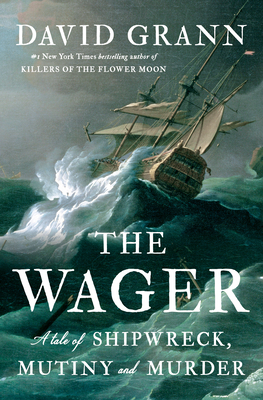
Review 2290: The Wager: A Tale of Shipwreck, Mutiny, and Murder

In 1740, a small fleet of ships set out from Portsmouth on a mission to try to capture Spanish ships laden with treasure in the Pacific Ocean. This poorly conceived and executed mission was part of the War of Jenkin’s Ear, essentially an excuse to try to gain wealth by pillaging Spanish ships.

Because of delays in refurbishing and equipping the ships, they left late. They were trying to round Cape Horn during the southern hemisphere’s summer, which they thought was the calmest time to venture through those dangerous waters. By the time they got to the Horn, the Wager, the smallest ship, had already experienced a bout of typhus and another of scurvy. The loss of officers to illness had given them a new leader, newly promoted Captain David Cheap. They made it around the Horn but lost contact with the other ships and then were shipwrecked.

Nearly a year after they were last sighted at the tip of South America, a few of the sailors made it back to England. Six months after that, a few more appeared, including Captain Cheap, accusing the first group of mutiny and other crimes. Two more appeared even later, accusing the first group of abandoning them on the coast of Patagonia.

Using the widely varying accounts in the journals and memoirs of some of the survivors, David Grann has attempted to reconstruct a fair account of what happened. One of these survivors was the sixteen-year-old midshipman, John Byron, who became the grandfather of the poet, Lord Byron. It’s a fascinating account, with some of the thrills of fictional naval adventure. Yet its all true.

Related Posts

Killers of the Flower Moon: The Osage Murders and the Birth of the FBI

The Lost City of Z

Fatal Journey: The Final Expedition of Henry Hudson

Review 2275: The Books of Jacob

The Swedish Academy that awarded Olga Tokarczuk the Nobel Prize for Literature called The Books of Jacob her magnum opus. It is certainly a stupendous novel at almost 1000 pages, carefully researched, minute in detail, taking on such subjects as the nature of religion, forgiveness, the interconnectedness of things. It is a dense historical novel about a real figure in history, Jacob Frank, the head of an odd religion, a Jewish heresy.

Frank emerges from another Jewish heresy, a group called the Shabbatians, who believe the Messiah has already come and therefore according to teachings, the Mosaic law is broken. The new law, according to Frank, is whatever he says to do. This story is told from multiple perspectives, notably that of Nahman, one of his earlier followers, who attempts to document his life and beliefs.

The movement, which begins in the mid-18th century, is formed mostly of Shabbatians, some of whom are merchants but others of whom are very poor. Frank’s teachings seem to consist mostly of story telling, but as with other cult leaders, one big feature is the sexual exploitation of women, first by all of them sucking a woman’s breast and later by Jacob assigning men partners even from the unmarried girls. You can guess that Frank is charismatic.

This fantastic story follows this group of people, which gets larger and larger, first from southeastern Poland down to Turkey, where Jacob briefly converts to Islam, then back to Lwow in Poland. There, they are attacked by the Talmudic Jews until from revenge they tell the authorities that it’s true that Jews use Christian blood in their rites, a lie that ends in the execution of 14 Jews, including rabbis.

After fleeing Poland again, Jacob decides that their route lies with conversion to Christianity, an act that he can justify with teachings but that also has the end goal of the members being allowed to own land and gain other honors denied them as Jews. Although the path is not always smooth and a lot more traveling ensues, the upward mobility of the group after that decision is phenomenal. Ultimately, Jacob becomes an intimate of the King of the Habsburg Empire.

The research that this novel reflects is phenomenal. As a reader, I was often enthralled but reluctantly had to put up with some deep philosophical discussions, including deeply confusing ones about numbers, since some of the members are kabbalists. The most difficult part of it, though, was the sheer number of characters, especially Frank’s followers. I was keeping up okay until they converted and all changed their names. Then I was usually lost.

I wouldn’t recommend this book as the first you read by Tokarczuk, and it’s certainly not an easy read, but it’s a fascinating story.

Related Posts

Drive Your Plow over the Bones of the Dead

Flights

Zealot: The Life and Times of Jesus of Nazareth

Review 2238: Castle Rackrent

Castle Rackrent is a novel I picked for my Classics Club list. Published in 1800 although set before 1782, it is an early example of the use of an unreliable narrator.

That narrator is Thady Quirk, a servant to the ancient Irish Rackrent family, but the novel is also annotated by a scholarly character called the Editor. Thady informs us in the first paragraph that he’s known as “Honest Thady,” a phrase that puts us on the alert.

Thady quickly runs through the older history of the family and then tells in greater detail the story of the last three owners of the Castle, Sir Murtagh, Sir Kit, and Sir Condy. These are satirical tales of mismanagement either by penny pinching and bleeding the tenants or by wasteful consumption. Thady is vehement in his avowals of support for the family and in this role makes some astonishing assertions, such as, about Sir Kit who married a woman for her money and then locked her away for seven years because she refused to give him her jewels, “He was never cured of his gaming tricks, but that was the only fault he had, God bless him.”

This novel is a light commentary on the class system and its abuses, as the series of barons get up to all manner of hijinks while the servants (particularly Thady and his son) arrange to purchase assets at low prices. It is moderately funny but is considered by critics to be an astonishing first novel by a woman at this period.

Related Posts

Evelina

A Double Life

The Good People

Review 2195: Catriona

I was unaware until recently that there is a sequel to Robert Louis Stevenson’s Kidnapped, but there is, Catriona, and it begins right where the previous novel left off. (Note that apparently this novel is sometimes called David Balfour.) David Balfour has been confirmed in his estate and is ready to learn to be a gentleman, but first, he has some old business to take care of. He must arrange a ship to take his friend Alan Breck Stewart to France, and he must appear as a witness in the Appin murder case, for which he himself is wanted, to free James More, who is innocent.

The problem with this second plan, he finds when he visits the Lord Advocate’s office in Edinburgh, is that no one wants James More, who may not be guilty of Appin’s murder but is guilty of a lot else, to go free. David’s challenges are further complicated when, in the approach to the Lord Advocate’s house, he meets Catriona Macgregor, James More’s daughter, and falls instantly in love with her.

Conscientious David will not agree to any of the compromises proposed by the various lawyers as alternatives to his testimony, so David finds himself kidnapped again in an attempt to prevent him from testifying. So begins another set of adventures for our hero as well as for the innocent but feisty Catriona.

Kidnapped has long been my favorite Stevenson adventure but I liked Catriona very much.

Related Posts

Kidnapped

Treasure Island

Waverly

Review 2141: The Foundling

As a young woman, Bess Bright, a shrimp seller, has a first sexual encounter with Daniel Callard, a merchant. He disappears, leaving her with only a keepsake, half a whalebone heart, and a pregnancy. In 1748 London, she and her father, who already support her lay-about brother, cannot afford to keep the baby, so she takes her newborn daughter to a lottery at a foundling hospital, and she is accepted. She leaves the half heart as an identifier, so she reclaim her daughter.

Six years later, Bess believes she has saved enough money to redeem her daughter. But when she returns to the foundling hospital, she is told that she herself redeemed her daughter one day after leaving her, even identifying the keepsake.

Bess has discovered that Daniel died a few months after their encounter and that he was married. When she goes to consult Dr. Mead of the foundling hospital, he takes her to chapel, where she sees Mrs. Callard. With her is a six-year-old girl that Bess knows immediately is her daughter.

With unwitting help from Doctor Mead, Bess gets a position as a nursemaid with Mrs. Callard. There, she finds a strange household, where no one leaves the house except for the weekly chapel visit. Here the point of view shifts to that of Alexandra Callard, a woman full of fears and given to ritual.

I thought I had read a book by Stacey Halls before, but I was mistaken. I was at first disturbed by the first person narration, because it sounds nothing like a woman of Bess’s time and lack of education. Also, the first person narrative taken up later by Alexandra doesn’t sound like a different person. Hall could have easily avoided this problem by employing limited third person instead.

I got accustomed to the narrative style eventually and was pulled along by the story. However, without saying what it was, I found the ending spectacularly unlikely, especially the sudden change in Alexandra.

Related Posts

Birdcage Walk

The Mermaid and Mrs. Hancock

The Bass Rock