Review 1407: Murder at the Vicarage – #1930Club

I decided to reread Murder at the Vicarage for the 1930 Club, but it also applies to Readers Imbibing Peril. It is the first Miss Marple book, and for much of it she seems like a minor character.

The novel is narrated by Len Clement, the vicar of St. Mary Meade. He is called away one evening by what proves to be a false call for help. He arrives home late for a meeting with Mr. Protheroe, a wealthy man who is disliked by many. In his study he finds Protheroe dead, shot in the head.

Of course, there are lots of suspects and red herrings. Mr. Hawes, the curate, is behaving oddly. Mrs. Protheroe had just decided to part from Lawrence Redding, who is in love with her. Lettice Protheroe has inconsistencies in her alibi. Rumor reports that a local poacher has a grudge. A team exploring the local barrow seems to be up to something besides archaeology.

No sooner does Inspector Slack appear on the scene when first Lawrence Redding then Anne Protheroe make confessions of guilt. Miss Marple lives next to the vicarage so has some testimony to offer about its comings and goings. And she also has some interesting ideas about who may be guilty.

Related Posts

4:50 from Paddington

At Bertram’s Hotel

A Caribbean Mystery

Review 1406: Strong Poison – #1930Club

There are those who feel that Dorothy L. Sayers ruined her Lord Peter Wimsey series with the introduction of the character Harriet Vane. I am on the fence about this. On the one hand, I don’t really enjoy Peter’s sappiness as he courts and marries Harriet. On the other hand, I like Gaudy Night, the mystery that Harriet solves herself.

I also enjoyed Strong Poison, the novel in which Harriet is introduced. Harriet, a mystery writer, is accused of poisoning her ex-lover, Philip Boyes, with arsenic. In 1930, when the book was published, no one quite understands why Harriet broke off with Philip. Philip convinced her, against her principles, to live with him without marriage, stating that he did not believe in it. Then he turned around and asked her to marry him, which Harriet views as his having tried her out. Her resulting anger seems to be the police’s motive. Lord Peter doesn’t believe it for a moment. He thinks Harriet is innocent and wants to marry her himself. Luckily, there’s a hung jury, so Peter has a month to investigate.

At first, Peter can’t get anywhere, because he can find no motive. Yet he is struck by the precautions Philip’s host at dinner took when Philip was taken ill to preserve the food. Peter is even more struck by the precautions he took not to be left alone with Philip or give him medicine when he was ill. But this host, Mr. Urquhart, Boyes’s cousin, had no opportunity to administer the poison, and Harriet did. Moreover, Harriet purchased arsenic as research for her book.

About halfway through, this mystery becomes more a puzzle about motive and opportunity than the identity of the killer. It skillfully unwinds, however, and does not cheat by hiding information from the reader.

I reread this novel for the 1930 Club and Readers Imbibing Peril, and was glad I did. I had forgotten the witty dialogue and the deft characterization.

Related Posts

Busman’s Honeymoon

Whose Body?

Unnatural Death


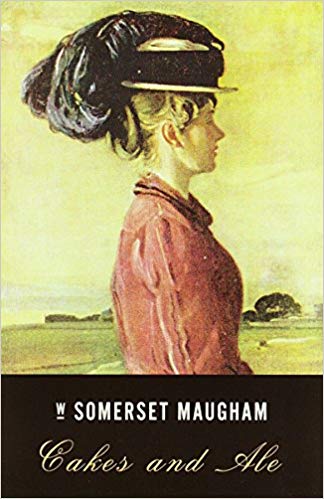
Review 1405: Cakes and Ale – #1930Club

I previously read only one book by Somerset Maugham, The Razor’s Edge. Frankly, I did not enjoy that book about two frightful people tormenting each other.

That was a long time ago, though. So, when I saw Cakes and Ale listed under books published in 1930, I thought, Why not give the guy and another chance and read it for the 1930 Club?

Another book I have already reviewed for 1930 is As I Lay Dying by William Faulkner.

* * *

William Ashenden, a moderately successful writer, unexpectedly hears from Roy Kear, another writer. Although Kear is a perfectly pleasant fellow, Ashenden knows he wouldn’t be hearing from him unless he wanted something. But Kear doesn’t come directly to the point.

Around the same time, Ashenden receives an invitation from Mrs. Driffield, the widow of Ted Driffield, widely considered Britain’s most important late Victorian novelist. He ignores this summons as he doesn’t know Mrs. Driffield. Finally, Kear admits he wants to pick Ashenden’s brain. He is writing an authorized biography of Driffield, and Ashenden knew Driffield and his first wife, Rosie, when Ashenden was a young man. Rosie was a beautiful, vibrant force of nature who was massively unfaithful to Driffield. The second Mrs. Driffield has dragged Ted into respectability and is concerned for his legacy. She wants Kear to leave Rosie out of the biography even though Driffield’s most important work was written during their marriage.

This novel about class snobbery is also a character study of an unusual woman. Because of Rosie’s promiscuity, the novel was highly controversial in its time. I wondered whether Ted Driffield was supposed to be Thomas Hardy and found out that others had supposed that at the time, although Maugham denied it. He did admit that Kear was modeled after Horace Walpole, however.

I enjoyed this novel and am willing to give Maugham another trial. The movie of The Painted Veil that came out a few years ago was beautiful, so I may try it next.

Related Posts

Tess of the D’Urbervilles

Consequences

Someone At a Distance