Day 1206: The Good People

Cover for The Good PeopleBest of Five!
Hannah Kent seems to be fascinated with historical true crime cases. Her Burial Rites was about a woman found guilty of murder in Iceland. The Good People is about the inhabitants of a poor, superstitious valley in Ireland in 1825.

Nóra Leahy has had a year of misfortune. Not long ago, her son-in-law arrived to tell her and her husband, Martin, that their only daughter had died. He brought with him their grandson, Micheál, to care for.

Unfortunately, Micheál at four is not the bright, babbling toddler he was the only other time they saw him. He does not seem to be able to use his limbs and does not talk. Instead, he screams all the time to be fed.

Martin cares for Micheál and gives him affection, but Nóra hides him away from the neighbors. Then Martin dies, falling down suddenly at a crossroads.

The manner of Martin’s death provokes comment but so does the hidden child.

Even after Nóra brings home a hired girl to help with the work of caring for the child, Micheál seems an unbearable burden. Nóra begins to believe that her grandson was “swept away” by the fairies, the Good People, and that she has a fairy child in his place. She consults Nance Roche, an old wise woman who treats the villagers’ ailments.

Nance herself has enemies in the valley. In particular is Kate Lynch, because Nance refuses to help her with a piseóg, or curse, against Kate’s husband, who beats her. Although Nance refuses to deal in curses, Kate leads others to talk of strange dealings when things begin to go wrong for the valley. Also, the new priest, Father Healy, has begun speaking against Nance at mass.

All of this builds a feeling of dread. Kent has beautifully evoked the way that superstition plays a part in the people’s everyday lives. We know something bad will happen; we’re just not sure what.

Although I would have read The Good People anyway, it is a novel for my Walter Scott Prize project. I found it mesmerizing.

Related Posts

Burial Rites

The Wonder

Harvest

Day 1199: Salt Creek

Cover for Salt CreekBest of Five!
Ten years after she left Australia in 1862, Hester Finch recollects the seven years her family spent in the Coorong, at Salt Creek, southeast of Adelaide. Her father brought the family there after all of his other business ventures had failed.

Originally from genteel stock, Mrs. Finch is appalled by the rusticity of the station, as are her children. Mrs. Finch, who moved to Australia for the sake of her husband, is depressed and apathetic, so Hester, the oldest girl, must take her place doing the housework and educating the younger children. Mr. Finch considers himself a godly man who must do his duty by bringing the natives to Christianity, so they take in a mixed race boy named Tully.

Life is difficult, and it slowly gets worse. Although Hester falls in love with Charles, a young artist doing a survey of the area with his father, she decides that she will never allow her fate to be determined by another.

As Hester tries to figure out a way to leave Salt Creek without abandoning her younger brothers and sisters, events occur that make the family understand the kind of man their father is.

Some readers may need patience for the beginning of this novel, as it is mostly setting the stage for events to come. I found the plaintive tone of the novel at first a little depressing. However, just before the halfway point, events get going, and the novel becomes absolutely gripping.

Although Treloar states that the novel is based very loosely on her family’s beginnings, the characters in the novel are completely fictional except for four of them. Those characters make up a subplot that involves an actual murder.

I felt the novel lacked descriptions that would give ideas of the appearance of the place (references are made to its beauty, but I was unable to form a mental picture), but the daily existence of the characters is fully realized. This is at times a harrowing read for my Walter Scott Prize project, but it is certainly worth it.

Related Posts

The Orchardist

Rush, Oh!

All the Birds, Singing

Day 1195: The Long Song

Cover for The Long SongSeveral years ago, I greatly enjoyed Andrea Levy’s Small Island. So, I was happy when I saw that The Long Song was in both my Walter Scott Prize and Man Booker Prize projects.

July is fathered upon her slave mother, Miss Kitty, by the overseer on Amity, a Jamaican sugar plantation. It is early in the 19th century, so July is a slave, too.

July and Miss Kitty are field slaves, but when July is nine years old, the master’s sister, Caroline Mortimer, takes a fancy to her. She takes July away from Miss Kitty to train her as a house slave and calls her Marguerite. The novel is written as July’s memoir, as she recalls the final days of slavery on the island and its transition to freedom.

At first the tone of this novel bothered me. It seemed too sprightly and playful for subject matter that is sometimes appalling. It really tears into its white characters, too, who are portrayed at best as hypocrites but more often much worse. Eventually, though, its sly sense of humor got to me, and I laughed out loud. Still, I did not feel as involved by this novel as I did with Small Island.

Related Posts

Beloved

Jade

The Quality of Mercy

Day 1170: The Black Opal

Cover for The Black OpalWhen I was a teenager, I enjoyed Victoria Holt’s gothic historical romance novels. At some point, however, I felt that she was just churning books out, so I quit reading them. When I ran across The Black Opal in a used book sale, I decided to see what I think of her now.

Carmel was found as a baby under an azalea bush at Commonwood House, owned by the Marlines. She is believed to be a gypsy child. Although Mrs. Marline wanted to send her to a foundling home, Dr. Marline insisted on keeping her. So, she stayed in the nursery with the Marline children, although she was not treated like the others.

Mrs. Marline’s brother, Toby, captain of a sailing vessel, is one of the few people who are nice to Carmel. Another is Miss Carson, the governess. Things begin to improve for Carmel when she meets Lucian and the other children at the Grange, a neighboring estate.

But Mrs. Marline dies, and Carmel is thrilled to learn she is going on a voyage with Uncle Toby to Australia. On the voyage, she learns something about her parentage. When they arrive there, they get news that the Marline household is broken up. There is nowhere for Carmel to return to, so she stays with Uncle Toby’s wife.

Ten years later, Carmel returns to England. There she finds that more was involved in Mrs. Marline’s death than she knew. There was a tragedy, and Carmel believes an injustice was done. She decides to find out what really happened.

I remember Holt’s books as being fairly tightly plotted, but that was not the case with this novel. It is all over the place. Although the earlier scenes when Carmel is a child are necessary to the story, the scenes in Australia seem unnecessary, as if they are needed for padding. Characters are poorly developed, and some characters seem to fill no particular function.

Maybe some of Holt’s earlier novels are better. It’s hard for me to say at this distance of years. But there are better gothic romance novels around. This one seemed to be about 100 pages of novel expanded out to nearly 400.

Related Posts

The Vanishing

An Inquiry into Love and Death

Castle Dor

Day 1169: A Treacherous Curse

Cover for A Treacherous CurseA Treacherous Curse is the third Veronica Speedwell novel by Deanna Raybourn. I don’t think much is lost in reading the novel out of order. Background information is provided as you go.

Veronica Speedwell is apparently a woman well ahead of her time. She is a scientist and a feminist who believes in free sex. She wears trousers and picks locks. She is also the illegitimate daughter of the Prince of Wales. Is she a very likely character for 1888? Not so much.

Veronica and her professional partner, Stoker, are working with a collection of artifacts when they begin hearing about a curse on the Tiverton expedition to Egypt. Soon, the news of the expedition affects Stoker, whose wife deserted him for John de Morgan, a member of the expedition. De Morgan and his wife left the expedition, apparently with the diadem, one of its most important finds. His wife has returned to her parents, but de Morgan is nowhere to be found.

The police want to question Stoker about de Morgan, because their enmity is well known. The story has reopened all the rumors of Stoker’s disastrous expedition to the Amazon, where he was left for dead by his wife and de Morgan, and the lies they told about his relations with his wife. So, Stoker decides he must find de Morgan to clear his name. Any notion that he is going to do this without Veronica’s assistance, he must speedily dismiss.

Concerned parties are the Tivertons and their assistant, Mr. Fairbrother, and Caroline de Morgan. Stoker and Veronica begin looking into the incident, but they can find no trace of de Morgan beyond his landing in Dover. Oddly, though, apparitions of the god Anubis, which haunted the Tiverton expedition, have now relocated to London.

For some time, I followed Deanna Raybourn’s Lady Julia Grey series, a mashup of the mystery and romance genres. I tired of the series because of the cliché of the couple always arguing about the wife taking part in the investigation. Apparently, Raybourn has decided to hold the couple of Stoker and Veronica apart indefinitely, maybe hoping to avoid this problem.

link to NetgalleyBut I don’t like Veronica nearly as well as I did Lady Julia, and there is something about the breezy, sometimes slightly racy narration that I find irritating. Too many young men are stripping to the waist for no apparent reason, for one thing, in a time that was much more modest than our own. As I mentioned before, I find Veronica not very believable for the time period.

Related Posts

The Dark Enquiry

The Dark Road to Darjeeling

Twelfth Night

Day 1163: The Shuttle

Cover for The ShuttleAt first, I wasn’t sure I would like The Shuttle, despite my enjoyment of Frances Hodgson Burnett’s other novels. That is because it begins with an extended metaphor, rather cumbersome, about the shuttle of fate weaving together east and west. I wasn’t altogether sure which east and west she was talking about and had wild thoughts about China. But we weren’t leaving the Occident. By west she meant America, more precisely the United States. By east, England. But this introduction lasts only a couple of pages, and then we get into the action.

The novel begins with Rosalie Vanderpoel, the gentle, naive daughter of a New York millionaire. It is the early days of the migration of young, titled Englishmen to New York looking to marry money, and the relatively innocent New Yorkers don’t understand that most of these men are fortune hunters. Rosalie becomes engaged to Sir Nigel Anstruthers. Although Reuben Vanderpoel, Rosalie’s father, does not like Nigel, only nine-year-old Bettina sees him for the vicious bully that he is.

But Nigel hasn’t done his homework. He doesn’t realize that American girls don’t come with dowries nor that Rosalie won’t expect to hand her money over to her husband for handling, as an Englishwoman might. Once he realizes his mistake, he blames it on Rosalie.

Rosalie goes to live in dilapidated Stornham Court, where she is mistreated and bullied by her husband and his mother. Thinking that no man would take money from a woman, Rosalie doesn’t offer any, and it takes a while before she realizes that’s what he wants. But he doesn’t want money for the estate, just to support his vicious habits. He cuts her off from her family to make her miserable and keep control.

Rosalie isn’t the heroine of the novel, however. That honor belongs to Bettina, or Betty, who vows at the age of nine to go sometime and rescue Rosalie. And so she does, 15 years later.

This novel isn’t one of great surprises. When Betty finds Rosalie and her son alone and works to buck them up and get them ready to leave, the tension builds from the expectation of a showdown with Nigel. When Nigel finally arrives, he uses all his cleverness to foil Betty. We know who will win—we just don’t know how.

I don’t think Burnett’s adult novels were considered sensation fiction, but this one certainly deals with those kinds of topics and is very melodramatic. Still, it was a fun book to read. Betty is clever and determined. You know she will win at love and defeat Sir Nigel.

Related Posts

The Making of a Marchioness

That Lass o’Lowrie’s

Diana Tempest

Day 1162: Classics Club Spin! Letters from Egypt

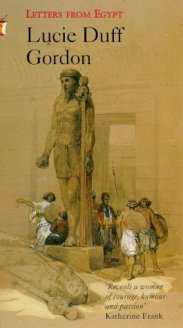
Cover for Letters from EgyptLetters from Egypt is the book I drew for the latest Classics Club spin! A book like this one is hard for me to evaluate. Lucie Duff Gordon was an English gentlewoman suffering from consumption who spent the last seven years of her life in Egypt, hoping the climate would help her. The book of her letters is heralded as a first to deal with the Egyptian people rather than the scenery and monuments. She was by all accounts beloved by the people she lived among in Luxor from 1862 to 1869.

I try to judge books as best I can by the standards of their own time, but sometimes with this book that was a struggle for me. Duff Gordon is known for being kind to the people she met, particularly the Arab fellaheen, who by all accounts were the despised of Egypt. Certainly, she was loved by them and is careful to follow their customs, but she does patronize them in just about every word of her letters. She also takes pleasure in telling stories about how much they love her and what courtesies they exchanged. She adopts their customs and learns to speak Arabic, all very laudable. However, it seems to me that she takes their part to the point of perversity, for example, sprinkling Arabic words into her letters to friends and so participating in their customs that she speaks casually of such things as buying slaves (for herself), always for their own good, thirty years after England outlawed slavery. Further, she favors the Arabs by putting down other groups, like the Copts, the Jews (even though she meets hardly any), and some of the Turks but not all, even though the Turks would seem to be to blame for the dire state of the country.

If you are feeling politically correct, you may not appreciate her frequent use of the N word, and her constant mention of the color of the various people she meets, although that is clearly a difference in the standards of the time.

The book does have descriptions of various ceremonies and customs, which are interesting. And Duff Gordon’s behavior toward the people was clearly better than that of most “Franks.” Another slight issue is that she tends to use Arabic and Egyptian words without always explaining what they mean, which can be confusing.

I want to compare this book to West with the Night, which was written 90 years later. Beryl Markham was raised with Masai playmates in what was British East Africa. Never does she treat her native friends condescendingly. Not only that, but her book provides a better sense of the landscape and society of Africa, although admittedly more oriented toward the European. Another contrast is Tales from the Queen of the Desert, in which Gertrude Bell ventures into even more remote corners of the Arab world while not once patronizing anyone.

Related Posts

Tales from the Queen of the Desert

The Cruelest Journey: Six Hundred Miles to Timbuktu

A Time of Gifts

Day 1158: Mrs. Engels

Cover for Mrs. EngelsBest of Five!
Lately, I’ve realized that the novels I enjoy most have a strong narrative voice or sense of character. Mrs. Engels, the debut novel of Irish writer Gavin McCrea, is one of these. I had the fortune to read it as part of my Walter Scott Prize Project.

Lizzie Burns is the Irish mistress of Frederick Engels, long accepted as Mrs. Engels. She has a lot to put up with. Although Engels supports Karl Marx’s entire household, liberally, so that Marx can work on his book, he is very careful about what is spent on his own household. Further, Lizzy suspects him of yearning for her sister, Mary, who was his mistress before she died. And Lizzy is aware that Frederick is not faithful. Finally, he is completely devoted to a Communist revolution, so he often opens the house to his comrades or sends Lizzy on errands for the cause.

Mrs. Engels is a vivid imagining of Lizzy’s life, beginning in 1870 and looking backward to the past. A poor worker in Engels’s cloth mill, she leads a penurious life until Mary takes up with Frederick Engels. She becomes involved with the Fenian movement through her lover, Moss Óg. All in all, she’s a strong presence, funny and putting up with no nonsense. As she becomes more involved with the Marx family after she and Engels move to London, she begins to learn more about Frederick and what he will do for the cause, which to him means Marx.

This novel is beguiling, drawing me, at least, into a topic that I wasn’t much interested in. It tells Lizzy’s story with wit and creates a wonderfully realized setting and character.

Related Posts

Shirley

Z: A Novel of Zelda Fitzgerald

Charlotte and Emily

Day 1153: Bleak House

Cover for Bleak HouseBest of Five!
I just love Bleak House. I hadn’t read it for years, so I was happy to pick it up as one of the last books on my first Classics Club list. Note: with this book, I have finally posted my last review for my first Classics Club list. I will soon have my second list posted at the link above.

At first, the novel appears to follow two distinct stories, that of the orphan Esther Summerson and that of the household of Lord and Lady Dedlock, but we find that these stories are entwined. Peopling the novel are countless other unforgettable characters.

Esther has had a sad childhood, but her life begins to improve when an unknown benefactor first takes her education in hand by sending her to school and then employs her to be the companion of Ada Clare. Ada, with her cousin Richard Carstone, is another orphan, and both are parties to the famous lawsuit of Jarndyce and Jarndyce. As they are wards of the court, a distant cousin, Mr. John Jarndyce, has agreed to be their guardian.

Dickens was famous as a social activist, and one of his targets here is the Courts of Chancery, where wills are proven. Jarndyce and Jarndyce is a famous case in Chancery that has been going on for years and has driven countless possible legatees to ruin. Mr. Jarndyce refuses to deal in this case and hopes to encourage Richard and Ada to leave it alone.

Esther makes a happy home for herself and Richard, Ada, and Mr. Jarndyce at Bleak House, Mr. Jarndyce’s home. But as Richard grows older, he fails to settle to a profession and devotes more and more time to the lawsuit. He is sucked in. And that is more a shame because Ada, whom Esther calls her darling, is in love with Richard.

At the Dedlock’s, a mystery begins that eventually takes up much of the novel. Lady Dedlock is beautiful and stately but deeply bored. However, one day when the Dedlock lawyer, Mr. Tulkinghorn, comes with papers to sign, Lady Dedlock glimpses some handwriting and promptly faints. Lady Dedlock has a secret, and Mr. Tulkinghorn is determined to find it out. Mr. Tulkinghorn is inexorable.

As with any Dickens novel, Bleak House is filled with entertaining characters. There is Mrs. Jellyby, who is so taken up by a charity for Africans that her children are neglected and her house is a disaster. Her unfortunate daughter, Caddy, covered in ink when we first meet her, becomes an important secondary character. One of Mr. Jarndyce’s friends is Harold Skimpole, who professes himself a mere child in worldly ways and proceeds to leech off his friends. There are many other notable characters, but one of the most interesting is the detective, Mr. Bucket. At first he seems rather sinister, but we soon change our minds about him.

Above all, there is Dickens’ style, which carries you along with the story. He makes you laugh, he makes you cry, and as always, he shows sympathy for the unfortunate, especially for children. It is easy to see from Bleak House, which many consider his masterpiece, why he was the most popular writer of his time.

Related Posts

David Copperfield

Great Expectations

Oliver Twist

Day 1150: Snowdrift and Other Stories

Cover for Snowdrift and Other StoriesI keep saying I love Georgette Heyer, so of course when a volume of her short stories appeared on Netgalley, I requested it. Originally, the story collection was released as Pistols for Two, so I’m sure I read it years before but did not remember the stories.

Each of these stories is a romance in miniature. They involve some of Heyer’s hallmarks—cases of mistaken identity, elopements gone wrong, accidental encounters, and a couple of duels. Appealing heroines meet attractive men usually while they are engaged in some mistaken folly.

link to NetgalleyThese are delightful, light stories, perfect for a rainy day and a cup of tea. This is a very short review, but if you like a charming romance laced with humor, you can’t go wrong with Georgette Heyer.

Related Posts

Sylvester, or the Wicked Uncle

Black Sheep

Cotillion