Review 2166: In Place of Fear

It’s 1948 Edinburgh, and it’s Helen Downie’s first day in her job as almoner for the brand new National Health Service. Her bosses are young Dr. Strasser and Dr. Deuchar—previously the partner of Dr. Strasser’s father—who share a house and a practice. Although Dr. Deuchar is friendly and humorous, Dr. Strasser is abrupt and sometimes rude. However, Dr. Strasser unexpectedly gives Helen and her husband Sandy a place to live—a flat in a house that was used as a fever hospital during the war. That’s good, because just that morning Helen’s quarrelsome mother threw them out.

Helen completes her first busy day and is delighted with the upstairs flat, which is clean, bright, and has an inside bathroom. When she and Sandy are trying to pull together a few odds and ends to make the flat minimally habitable, Helen finds the body of a young woman out back in the Anderson shelter. She thinks the woman is Fiona Sinclair, the daughter of her benefactor, Mrs. Sinclair.

After she alerts the police, Dr. Deuchar says the woman died from poisoning herself. He and Helen go to notify Mrs. Sinclair, but Fiona is okay. Then Helen thinks the body might be her other daughter, Caroline. She and Dr. Deuchar try to find the misidentified body but are told it was sent to Glasgow because it was the body of a notorious Glasgow criminal. However, on a second visit to the morgue, Helen learns that the girl was hanged, not poisoned, and a famous criminal by the name she was given is unknown in Glasgow.

Persistent Helen begins to uncover widespread corruption involving leading citizens in the city. Something is going on very close to home.

It wasn’t clear to me whether this book marks the start to another series by McPherson, but it has hallmarks of it. Helen is a feisty and likable heroine, and although I thought she was blind to the identity of the killer, what was actually going on in the city was harder to figure out. If this is a series, I’m looking forward to seeing more of Helen.

Related Posts

The Turning Tide

Strangers at the Gate

The Mirror Dance

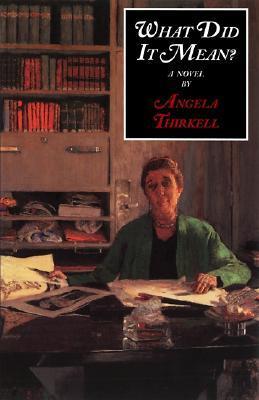
Review 2165: #ThirkellBar! What Did It Mean?

The focus of What Did It Mean? is on Queen Elizabeth II’s coronation. The novel deals principally with Lydia Merton, who has been asked to chair the committee for the Northbridge coronation pageant. This gives Thirkell the opportunity to poke fun at village committee meetings, during which very little seems to get done.

Lydia also gets acquainted with the Earl and Lady Pomfret and takes an interest in their oldest son, Lord Mellings, who at 16 is too tall for his strength, sensitive, and shy. Lydia arranges for him to meet the actress Jessica Dean and her husband Aubrey Clover, the playwright, and they enlist him in a part for their short play for the coronation, which promises to do much for his confidence.

For a while when reading this book, I thought Thirkell was starting to phone it in or that she needed a better editor. For example, there is a scene in which Lydia telephones to the Clovers to ask them to participate in the pageant. Then immediately following that, she takes Lord Mellings to the Deans to ask the Clovers the same question. Similarly, she reminds us several times of the little romance that took place between Noel Merton and Mrs. Arbuthnot when Lydia became so sick. There are also too many meetings described and no apparent romance until quite late in the novel.

However, the novel picked up as it went on, and the romance, once it emerged, was understated and touching. I finally ended up liking this one almost as well as the others.

Related Posts

Jutland Cottage

Happy Returns

The Duke’s Daughter

Review 2162: Shrines of Gaiety

It’s 1926. Ma Coker is being released from jail, and it’s like a circus in front of the prison. Nellie Coker is the head of a crime family in London, the owner of five clubs that Frobisher, the new broom at the police station, thinks are responsible for the disappearance of quite a few girls.

Miss Gwendolyn Kelling has unexpectedly inherited some money, so she quits her job in York as a librarian and decides to search for her friend’s sister, Florence Ingram, and Freda Murgatroyd, both 14, who have gone to London to make their fortunes, Freda being positive that she is going to be a star. When she goes to the police station, Frobisher asks her to visit one of the Coker clubs to report what she can observe.

Niven Coker, Nellie’s oldest son, by coincidence comes upon Miss Kelling on the street after she has been mugged. He gives her a ride to her ladies hotel, and afterwards she receives her purse.

Frobisher has been asking at the office for Maddox, one of the inspectors, but he has been on sick leave. Frobisher is sure Maddox is corrupt, but what he doesn’t know is that Maddox is putting the final pieces in place to take over Nellie Coker’s clubs. To start with, there is arson.

Maddox isn’t the only one after the Coker empire. There’s also Mr. Azzopardi, who begins by trying to exploit the weaknesses of Nellie’s youngest son, Ramsey.

There are some dark deeds in this novel, but it is written with a lightness that conveys more the fevered fun seeking of the time. For a crime family, the Cokers are curiously benign, and Nellie Coker seems to be three steps ahead of everyone else. The novel is more of an ensemble piece and doesn’t have a main character, although we admire Miss Kelling and also the plucky but naïve Freda. Although ostensibly a crime novel, I found it more a portrait of a particular period and enjoyed it very much. Atkinson has based some of it on the life of Kate Mayrick, the owner of clubs in Soho.

Related Posts

Big Sky

Transcription

A God in Ruins

Review 2161: The Lost Book of Eleanor Dare

After the death of her father toward the end of World War II, Alice Young finds out that Evertell, the farm that has been in her family for generations, was not sold as she thought but is waiting for her to decide what to do with it. She has not been there since her mother died under painful circumstances, and she doesn’t want to keep it. However, her thirteen-year-old daughter Penn has been depressed since her own father’s death three years before, and she hopes the trip to evaluate the farm will perk her up. She also hopes the money will help pay for Penn to attend the private school she expressed interest in several years ago.

When Alice and Penn arrive at the large but dilapidated farm, Penn is enchanted. She is also enchanted by the stories Alice tells her about the family’s descent from Eleanor Dare, an original settler of the doomed Roanoke colony. Unfortunately, it was the theft of a stone, said to be engraved by Eleanor Dare to explain where the survivors of the colony went, that finally drove Alice’s mother over the edge of sanity. Penn is also fascinated by the commonplace book, written in by the female descendants of Eleanor over the centuries.

As Alice tries to improve her relationship with Penn, she is forced to face memories of her mother’s death and find the truth of family secrets.

It’s interesting to learn that this book was inspired by Brock’s fascination with the stone alleged to be engraved by Eleanor Dare, because the story of Dare, as imagined by Alice’s mother, was the least interesting part of this novel. Possibly, this is because of the matter-of-fact way it is told, with few details. The more modern story is told in alternating chapters from Alice’s or Penn’s point of view, and I found it extremely interesting and engaging. Brock proves to be an effective storyteller. I only thought it took Alice a long time to make the decision that seemed obvious from the beginning.

Related Posts

Beheld

The Physick Book of Deliverance Dane

The Last Painting of Sarah de Vos

Review 2149: #ThirkellBar! Jutland Cottage

Jutland Cottage, published in 1953, begins with John and Mary Leslie, whom we have seen little of since Wild Strawberries. However, the purpose of this first chapter is to describe the death of George VI, or rather the characters’ reactions to it.

Then we go to Greshamsbury, where Father Fewling, now a canon, is the new rector and is moving into the rectory. Canon Fewling becomes aware of the plight of the Phelps’s. Admiral Phelps is ill and his wife not much better, both cared for by their daughter Margot, who is 40. Since they mix little in society, no one knows them, but it is Rose Fairweather who realizes that Margot needs help. She has been doing all the work around the house, including gardening and caring for chickens, and her parents are too ill to be left alone. She is tired, stressed, poorly dressed, with no amusements. She is also worried that if her father dies first, the navy pension will be too small for her mother to live on. As it is, they are very poor.

Rose makes a plan with her friends and neighbors to stop by to visit the Phelps’s frequently and to at least once a week get Margot out of the house while someone is visiting her parents. Rose goes further by giving Margot a length of tweed and taking her shopping. A great deal of attention is spent on her undergarments, particularly her “belt,” which is apparently a corset or girdle. (Thank goodness we don’t wear those anymore.) And she gets her hair cut.

While all this kindness is going on, Margot gains confidence and eventually draws the attention of some of the older bachelors.

In the meantime, Swan, who you may remember was in love with Grace Grantly until he realized her heart lay elsewhere, has found someone else to care for. But one of the things I like about Thirkell is her subtle romances, which are so downplayed that it’s often not clear who might end up with whom.

I don’t care what people say about Thirkell’s post-war novels, I am finding them just as interesting as ever, perhaps because I’ve come to know so many characters and want to know what happens to them.

Related Posts

Wild Strawberries

Happy Returns

The Duke’s Daughter

Review 2140: Postern of Fate

Postern of Fate is the last of Christie’s Tommy and Tuppence novels. In reading them in order, I chose not to revisit By the Pricking of My Thumbs because I had posted its review several years ago. Since Christie aged these characters along with the years, in 1973, when this book was written, we find Tommy and Tuppence in their 70’s.

The Beresfords have sold their London apartment and bought a house in a small village. This activity has resulted in renovations and clearings out, as apparently the previous occupants made no effort to remove everything. Tuppence finds a lot of old children’s books, and as she’s sorting them, she naturally begins dipping into them. In Stevenson’s The Black Arrow she finds a basic code made from reading only the first letters of some underlined words. It says, “Mary Jordan did not die naturally. It was one of us.” By asking around the village about the history of the house, she finds that Mary Jordan worked for the Parkinsons before World War I. She was thought to be a German spy. Tuppence also finds the gravestone of Alexander Parkinson, the boy who owned the book, who died at fourteen.

Tommy in the meantime has met with some old contacts and found that Mary Jordan was indeed a spy but for the British side, sent to infiltrate a nest of Nazis. It’s believed that papers are still hidden in the house that would affect some people now high in the government.

Although this book has an intriguing premise, I don’t think it was one of Christie’s best. For one thing, early on Tuppence finds an object that is later referenced several times before she figures out the connection. To me, it was all too obvious just from the first reference, but it takes Tuppence another 100 pages or so.

However, Tommy and Tuppence are still a pleasing pair, and there is even some danger. Tommy and Tuppence save the day with the help of their dog, Hannibal, who was himself an entertaining character.

Related Posts

N or M?

By the Pricking of My Thumbs

Partners in Crime

Review 2129: #ThirkellBar! Happy Returns

Cover for Happy Returns

When I originally reviewed Happy Returns, I remarked that I thought it would be easier to keep track of its many characters if you had read the series from the beginning. That certainly proved to be the case when I revisited the novel this time. I provided an adequate summary in my original review, so I’ll use this post to write about my observations second time around.

I didn’t mention that much of the point of view of this novel is from Eric Swan, whom we met way back when he was a school friend of Tony Morland’s and used to infuriate Philip Winter, then his schoolmaster, by looking at him through his glasses. (I believe this was in Summer Half.) Swan is now working for Philip, and at thirty, has not found the woman for him. However, he is immediately struck by Grace Grantly.

Much of the novel concerns whether the engagement of Clarissa Graham and Charles Belton will actually end in marriage, but I was also interested in the growing friendship between the older Lady Lufton and her very nice tenant, Mr. Macfayden. Lady Lufton was exceedingly irritating in the preceding book because of her helplessness after her husband’s death, but in this one a few choice words from a friend make her pull herself together. This takes some of the pressure off the burdened young Lord Lufton, her son. He has been attracted to Clarissa, but another instance of rudeness toward Charles breaks the spell. Unfortunately, he also notices Grace Grantly.

I enjoyed this novel in its context within the series much more than I did as a stand-alone. I knew most of the characters already, although I sometimes wish I had drawn up tables for each character when I read the first book and continued with it as I went on.

I haven’t commented on this before, but I also enjoy the references to Trollope’s Palliser and Barsetshire series. I have probably missed some, but I am noticing them more often because lately I’ve been reading the Palliser series.

Related Posts

Summer Half

The Duke’s Daughter

County Chronicle

Review 2126: The Flight Portfolio

As soon as I finished reading Julie Orringer’s The Invisible Bridge, I looked to see what else she had written, and that’s how I found The Flight Portfolio. This novel is based on true events with real historical characters except for Elliott Grant and some main invented characters.

It’s 1940, and American journalist Varian Fry is working in Marseille as the head of a charitable organization. Its mission is to help as many European artists, writers, and other intellectuals as it can to leave Europe and escape the Nazis. This mission is supposed to be legal but of course Fry has to use illegal means to evacuate people sought by the Nazis or by the Vichy government. The book begins with him trying to persuade the Chagalls to leave, but they think they are unassailable.

Into the chaos of the office work, including the eviction of the charity, comes a request for a meeting. It is from Varian’s old schoolmate at Harvard, in fact his ex-lover, Elliott Grant, who disappeared when Varian decided to pursue marriage and a normal life. Grant has come to ask Varian’s help in finding the son of his own lover, Professor Gregor Katznelson, a brilliant nuclear physicist who is somewhere in Europe trying to evade the Nazis.

While Varian works hard trying to get exit papers and arrange routes of escape, his relationship with Grant rekindles. He is forced to face his old decision and determine whether he wants to continue hiding his real self. His office faces searches and arrests, closures of escape routes, arrangements made only for clients to refuse to leave, blockages by government officials, and other obstacles.

The novel is riveting. Orringer is not only an excellent writer but a great story teller. I love it when I discover someone who is this good.

Related Posts

The Invisible Bridge

Down Below

Dark Palace

Review 2119: The House of Footsteps

Simon Christie, in his brand new role as an art cataloger, takes his first job for a well-known auction house. He is supposed to evaluate the famous Mortlake collection, rumored to perhaps have even a Da Vinci.

When he arrives at the small village near the Mortlake house, Thistlecrook, he hears rumors about the unpredictable owner, Victor Mortlake, and about a history of violence on the property and deaths in the lake.

Victor Mortlake is unpredictable and the famous art collection is horrifying—images of ghastly acts of violence. Still, because of Simon’s ingratiating behavior, Mortlake seems to believe Simon understands something that he doesn’t.

Then Simon meets Amy in the library, an unexplained and unacknowledged presence in the house. Who is she? And of course he hears footsteps in the house at night.

This novel, set in the mid-1920s, seemed much like a Victorian gothic. I thought it would be the perfect book for me, but it was slow moving and hard to stick with. It is written mostly with description rather than dialogue, much like a Victorian novel. Further, by the end of the novel I still wasn’t quite sure what was going on.

Related Posts

Wylding Hall

The House of Whispers

The Uninvited

Review 2118: Afterlives

An interview I heard with Nobel Prize winner Abdulrazak Gurnah made me interested in reading his latest novel, Afterlives. This novel is set in what once was German East Africa, from the early 1900s to the 1950s.

At first, the novel seems rambling, beginning with one character then moving to another, reminding me a bit of Indian writer Amitav Ghosh, but Gurnah eventually returns to the characters he started with. This novel begins with Khalifa. In Gurnah’s fashion, we first hear all about Khalifa’s family and education before getting down to the story of how he goes to work for the merchant Amur Bi-ashara. They become close, and Khalifa marries Amur’s niece, Asha. Asha’s father was ruined before he died, and Amur bought the house they live in, but he promised the house to Asha. However, he dies before giving it to them, and his son, Nassor Bi-ashara, keeps it. Although Khalifa continues to work for Nassor, resentment is there.

The story moves to Ilyas, who arrives in town for work and befriends Khalifa. Ilyas was stolen away from his family as a child, and so after he is settled, he returns to his village to look for his family. His family is gone except for a much younger sister he didn’t know he had, Afujah, who is living with her uncle and being treated like a slave. Ilyas brings Afujah back to town to live with him for a year, but then he decides to join the askaris in the German army, so he takes her back to her uncle. There she is mistreated until she sends a message to Khalifa, who comes and takes her back to town.

We meet Hamza when he is serving as an askari just before and during World War I. This is the story in which the theme of colonialism really gets going. Hamza eventually meets Khalifa, but much else happens first.

Gurnah employs a detached tale-telling style, which I noticed bothered some Goodreads readers, but he is a true storyteller. The ending seemed a bit of an anticlimax but wrapped up all the story threads.

Related Posts

Sea of Poppies

In the Shadow of 10,000 Hills

A Sin of Omission