Review 2029: Long Summer Day

R. F. Delderfield is known for his ability to capture slices of English life, and he certainly does that in this long volume, the first book of A Horseman Riding By.

Paul Craddock is just recovering from being seriously wounded in the Boer War when he learns that his father has died, leaving him a great deal of money and a half share in a scrap metal business. Paul wants nothing to do with scrap metal but thinks he’d like to buy a farm. However, Franz Zorndorff, his father’s business partner, sends him to the West Country to look at Shallowford, a large estate that’s for sale. Although it is much bigger than he had in mind, he ends up buying it.

At first people tend to treat Paul as a dabbler, but he begins to win over the regard of the people in the dale by making improvements to his tenant’s property and by his commitment to his new life. He makes friends with Claire Derwent, and people expect them to marry, but on his original trip to look over the property, he was struck by Grace Lovell.

This novel covers the first nine years of Paul’s Westcountry life, beginning with the accession to the throne of Edward VII in 1902 and ending with the accession of George V. Of course, by then, the First World War is approaching, but not many of the characters in the novel seem to be aware of it. The novel gets somewhat involved in the politics of the time and in the suffragette movement, but it mostly centers on life in the valley.

There is a strong awareness of the dale with many descriptions of it. The novel itself is slow moving with only a few major events, mostly to do with the private lives of the inhabitants—marriages, births, and deaths among them. One thing I found surprising was that there was so little emphasis on actual farming issues. It’s like the estate just runs itself.

There was much of interest about this novel, but for me some of it was hampered by Delderfield’s writing style. He likes long, involved sentences that verge on being and sometimes are run-ons. He also has the odd habit of leaving out the comma in a compound sentence, which many times forced me to reread. Even with the modern tendency to use fewer commas, I’ve never seen anyone else do that and am surprised his editors didn’t add in a bunch of commas.

Am I ready to read the second book? I don’t think so. The novel has a lot to recommend it, but at 800+ pages, this first book in the series indicates that it will be very lengthy.

Related Posts

Ross Poldark

The Children’s Book

A Place Called Winter

Review 2021: A House in the Country

All during the war, Ruth, her husband, four friends, and the Adam children have been stuffed into an uncomfortable house in London, suffering privations of every sort. As early as 1941, they all began dreaming of taking a house in the country together, where they could have space, good food, and plenty of fresh air for the children. At the end of the war, Ruth finds an ad for a large house in Kent, 33 rooms. They go to see it and fall in love.

They figure that with their combined incomes, they can barely afford it. Ruth will do the housekeeping. The house comes with Howard, a handyman/gardener who has lived there most of his life and whose assistance proves invaluable.

Adam lets us know right away that this plan doesn’t work, but the descriptions of the beauties of the landscape and garden sometimes made me forget this. Written with a deadpan humor, the autobiographical novel tracks the ups and downs of this experience, through employment issues, attempts at agriculture, paying guests, house sharing. But as Adam repeatedly states, the house was built to be served, not to serve.

The story of the hapless occupants is funny and touching. I found it fascinating.

Related Posts

The Half-Crown House

Merry Hall

Greengates

Review 2020: #ThirkellBar! Peace Breaks Out

Although Peace Breaks Out begins by returning to Anne Fielding, now almost 19, who was Miss Bunting’s student in the last book, it spends a lot of time with the Leslie family, whom we have encountered in several of the books. Anne has just met Sylvia Halliday, a beautiful, golden girl a few years older, and shortly thereafter, both girls come to the attention of David Leslie.

At 37, David should have toned down his tricks, but he hasn’t, so Anne is smitten while the older Sylvia’s reaction is a bit harder to ascertain. Anne’s being smitten puts her friend Robin Dale in a funk, which is good because he was tending to take her for granted. And David seems to be almost seriously considering her as a wife.

For the first time, we get a true sense of how tired the British are with the living conditions of the war. This is expressed by being upset about the peace, which makes conditions even worse.

In this novel, readers meet or hear of almost all of the main characters from the previous novels. Rose Fairweather, in all her beautiful idiocy, reappears from America, and more importantly, Rose Bingham, a Leslie cousin who we saw a bit of on the occasion of the other Rose’s wedding, returns from the continent.

It’s really been useful for me to have begun reading these novels in order. I only wish I had started out making charts of characters’ relationships, what books they appeared in, and some notes about each one.

Related Posts

Miss Bunting

The Headmistress

Growing Up

Review 2013: Touch Not the Nettle

Touch Not the Nettle is not necessarily a sequel to Molly Clavering’s Susan Settles Down, but it features the same locations and some of the same characters. The Armstrongs get a call from Jed’s cousin asking if her daughter, Amanda Carmichael, can come to stay. Amanda’s husband, Cocky, an explorer, has been lost in Brazil, and Amanda is being driven crazy by her selfish mother, who is demanding that she behave like a widow when they don’t know if he is dead. Although Amanda, rather brittle from her struggles in an unhappy marriage, doesn’t really want to go stay with strangers, she soon finds herself happy to be with Jed and Susan and loving the beauty of the borderlands of Southern Scotland.

Like Susan Settles Down, Touch Not the Nettle contains many descriptions of the lovely landscape and many of the same delightful or irritating characters. It is darker, however, and I’m not sure (spoilers!) how happy I am with the love interest for Amanda, Larry with the angry temperament and drinking problem. The couple’s problems are also too magically cleared up.

Perhaps this is a deeper novel than Susan Settles Down, but it is also more facile, and I didn’t like it quite as much.

Related Posts

Susan Settles Down

Music in the Hills

Winter and Rough Weather

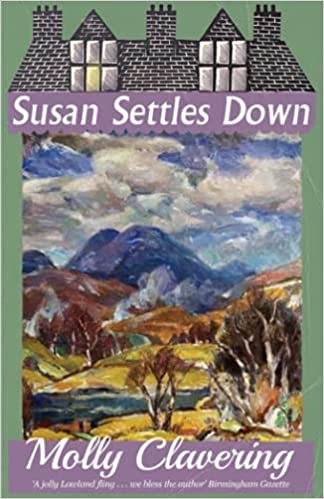
Review 2006: Susan Settles Down

Susan Parsons has been leading a wandering life keeping house for her naval officer brother Oliver, but Oliver was badly injured in a fall months before and has left the Navy, still suffering a limp and not his old self. Then Oliver inherits a small estate in Southern Scotland. It’s not in good condition and the Parsons haven’t much money, but Oliver decides to make it their home.

While Susan struggles to get some help in the kitchen and repair the worst problems of the house, Oliver begins supervising the farm work and almost immediately meets Jed Armstrong, the farmer next door. Although they immediately become friends, Susan finds Jed rude and uncouth.

Soon, the two siblings become involved in village activities. Susan befriends Peggy Cunningham, the parson’s young daughter, who has been receiving unwelcome attentions from the organist. The Parsons become fast friends with the Cunninghams, and all try to avoid the Pringle sisters, three mischievous gossips.

This novel is a lovely tale of village life in pre-World War II rural Scotland, featuring two romances. The descriptions of the landscape are beautiful, the characters are attractive, and I enjoyed it very much. However, I continued to find problems with Furrowed Middlebrow blurbs. Twice now the main character’s name has been misspelled, and this time the blurb places the novel in the Highlands.

Related Posts

Apricot Sky

Music in the Hills

Five Windows

Review 2003: The Museum Guard

I have been a big fan so far of Howard Norman’s quirky novels. However, I had a slightly more mixed reaction to The Museum Guard.

DeFoe Russet has lived in the Lord Nelson Hotel in Halifax ever since his parents died in a freak Zeppelin accident when he was eight. As a boy, he was cared for by his uncle Edward, if you can call it that. Edward is an irresponsible, gambling, drinking womanizer with a lot of opinions.

DeFoe works as a museum guard in the small Glace Hotel, where his uncle also works when he bothers to show up. DeFoe is very much in love with Imogen Linny, the caretaker for the local Jewish cemetery. However, although they are lovers, Imogen is difficult and seems often to tolerate DeFoe.

DeFoe doesn’t seem to realize how stuck he is in his life. He has no plans except to continue working as a museum guard and to persist with Imogen. He is interested in listening to the tours of the museum given by Miss Dello, a local professor, and likes to think about the paintings.

Edward has been making himself obnoxious about DeFoe’s relationship with Imogen, whom DeFoe has kept from meeting Edward. But Imogen has recently become fascinated by a painting in the museum, Jewess on a Street in Amsterdam by Joop Heijman. Then there is a fateful meeting between Imogen and Edward in the museum. Imogen essentially dumps DeFoe and begins spending a lot of time with Edward, who without permission lets her into the museum at night to be with the painting. Soon, the novel takes a bizarre turn as Imogen begins to believe she is the woman in the painting.

The novel is set mostly in 1938 and 1939 against the background of what is happening in Nazi Germany. DeFoe tells us on the first page that he steals the painting for Imogen, and the novel is about what causes him to do that and what happens afterwards.

I guess this novel is about stepping out of ordinary life. However, a lot of time is spent on DeFoe’s obsession with Imogen, maybe a bit too much, and the novel just gets weirder as it goes along. I’m not saying I disliked it, just that it wasn’t one of my favorites of Norman’s novels.

Related Posts

The Bird Artist

The Haunting of L.

The Northern Lights

Review 2000: #ThirkellBar! Miss Bunting

Miss Bunting is another re-read for me. I’ve looked over my original review, which seems fine, so use the link for the plot synopsis. One thing I notice is that because of reading the books in order and thereby getting to know the characters better, I found the ending of this novel more affecting than I did the first time.

So, here are my observations from this time through. First, I noticed the subtleties of the class distinctions. Although I mentioned in my first review that Thirkell’s usual upper-class characters are flustered at having the wealthy and vulgar Mr. Hill thrust his way in amongst them (and thrust he does, appearing several times uninvited), Jane Gresham is shocked when he implies that he considers himself better than his landlady Mrs. Merivale, who is educated and middle class and whose daughters have better marriage prospects than Heather Hill does. Of course, Heather’s ambitions are different than Mrs. Merivale’s. I myself was surprised to find the Middletons, who seemed fully accepted in Before Lunch, being considered socially inferior (mostly by Lady Fielding, who’s a real snob). Toward the end of the novel, Lady Fielding reflects that men like Mr. Hill have taken over, and there won’t be room for people like them. Lord Fielding reassures her, but she’s not far wrong.

This novel is sad in more ways than one, but particularly affecting is Jane’s situation, not knowing whether her husband is dead or alive. I won’t give the other reason away.

Related Posts

Marling Hall

The Headmistress

Before Lunch

Review 1999: Edith Trilogy Read-Along: Dark Palace

The Edith Trilogy Read-Along calls for the second book to be read during July. This second book, Dark Palace follows Edith and the fate of the League of Nations from 1931 through the end of World War II. Although most of it is set in Geneva, Edith also visits Australia and the United States.

This novel begins roughly one year after the close of Grand Days. Edith and Robert have been married about a year, but Edith feels she has misunderstood Robert’s character. For one thing, he is not really dedicated to the success of the League, and she sometimes finds him crass. She takes the opportunity of Ambrose Westwood’s return to Geneva and Robert’s departure to cover the Spanish Civil War to rekindle her unusual affair with Ambrose.

At the League, she is considered an expert on protocol but still does not have an official title. At the beginning of the novel, she and other League officers are excitedly preparing for the conference on disarmament they are hosting.

This novel, like many middle novels in a trilogy, has a less focused plot than the first. Edith, at one point, considers moving back to Australia and visits the newly founded Canberra to fish for a job. But Canberra barely exists, and her fellow Australians don’t seem impressed by her accomplishments. The novel skips in an episodic way through several events during the war.

There are times in the novel when Edith’s didacticism is really annoying. What the novel does have, however, is a deeply affecting conclusion.

Related Posts

Grand Days

A Town Like Alice

All the Light We Cannot See

Review 1895: The Magician

Although I’ve only read one work by Thomas Mann, I still found The Magician, based on Mann’s life and writings, interesting. Although Mann himself often seems inert in this novel, he lived in interesting times, during both world wars.

The novel covers Mann’s life from a young man who is dispossessed by his father to his relocation from California to Switzerland in his 70’s. It examines the thinking behind his greatest works and although fairly meditative in tone, has some excitement during the Mann’s flight from Nazi Germany.

In some ways The Magician is reminiscent of The Master, Tóibín’s novel about Henry James, with Mann fantasizing about young men but never acting on those fantasies after a couple of abortive encounters. The difference is that James seemed almost unaware of his own proclivities. Mann still managed to have a long, successful marriage with his wife Katia.

Tóibín’s biographical fiction always seems intuitive and thoughtful to me. I enjoyed this one despite my lack of knowledge about its subject. I read this novel for my Walter Scott Prize project.

Related Posts

The Master

Nora Webster

Lady Gregory’s Toothbrush

Review 1891: Keeping Up Appearances

I’m not sure if it was because I was on vacation while reading Keeping Up Appearances, but it took me much longer to read it than usual for a novel its size. I did notice I occasionally had a hard time paying attention to it while at other times felt I was reading a script for I Love Lucy.

Daphne and Daisy are opposites in personality, but they’re constantly together. Daphne is confident, witty, and brave, perhaps a higher class than Daisy, while Daisy is shy, unsure, and not always swift on the uptake. Daisy is ashamed of her class origins and the circumstances of her birth, even though she has been raised by higher class family members. Daphne could care less about all that.

At the opening of the novel, both young women are vacationing with the Folyot family on an island in the Mediterranean. Mrs. Folyot works against tyranny and reminds me of Mrs. Jellyby. She is obsessed by her causes and so later has a hilarious scene of talking at cross-purposes with Daisy’s mother.

Both girls care for Raymond, the Folyot’s oldest son, a biologist. Although Daisy doesn’t like to look at the little animals Raymond shows her as much as Daphne does, Daisy fears she cares for Raymond more than Daphne does, but he likes Daphne more than her. Unfortunately, an incident with a wild boar makes Daisy too embarrassed to stay, and Daphne goes, too.

Daisy doesn’t think the Folyots would approve of her profession. Not only is she a successful author of middlebrow novels, but she takes assignments from a newspaper to write silly articles about women that the paper assigns her. Daisy is a snob, and she is proud of neither activity even though we suspect she is a better novelist than she thinks.

Macaulay obviously had fun skewering the newspapers, because the ideas for articles are ridiculous and sexist, as is clearly the attitude toward Daisy’s novels.

Although this novel satirizes the publishing industry, it is really about identity and self-image. Most of the characters are not quite likable except Daisy’s mother, who is a hoot.

I received this novel from the publisher in exchange for a free and fair review.

Related Posts

Dangerous Ages

The World My Wilderness

The Towers of Trebizond