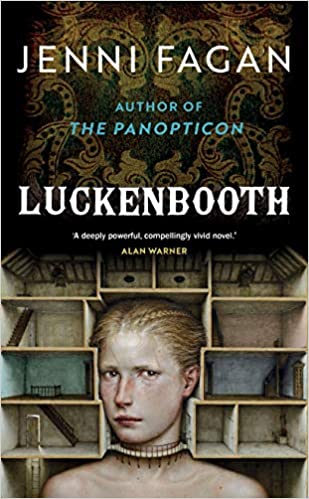
Review 1860: Luckenbooth

I just loved Jenni Fagan’s other books, so I was expecting a lot from Luckenbooth. Unfortunately, it didn’t quite deliver.

The devil’s daughter launches herself off the island where she was born, using her own coffin for a boat. She arrives at a tenement in Edinburgh to take on the function her father has sold her for, to be the surrogate mother for Mr. Uldam’s child with his fiancée Elise.

This is the first of nine story threads that proceed up the nine floors of 10 Luckenbooth Close, a building of secrets and horrors. The novel has a specific structure. It is split into thirds, with each third featuring the tales of residents on three floors of the building, and each thread advancing a decade in time, beginning in 1910. On the second floor, a transgender woman attends a transgressive party in 1928. On the third floor, a black Southern American works in the bone library of a veterinary school in 1939, and so on. The building hides some horrors that are finally revealed in 1999, when Dot, who is squatting in the derelict building, rips out the walls of the lower floors. But these secrets are no big surprise.

The stories are written in modern vernacular, which I suppose is a stylistic choice, but found it grating, especially for Levi’s letters to his brother. He’s the black American from Louisiana, and besides not sounding 1939ish, he doesn’t sound American, he doesn’t sound black, and he definitely doesn’t sound Southern. In fact, the more I think about it, I feel this choice to use modern vernacular indicates a general attitude of laziness. As an example, Levi chooses to explain things to his brother that his brother would know—like the building being called tenement, as if the U. S. hasn’t had tenements for hundreds of years. In fact, Levi is unbelievably naïve for a black man from the American South. The rich get everything while the poor get nothing? What a surprise!

Another example is that for a gothic novel that is supposed to convey the dark history of Edinburgh, there is an amazing lack of a sense of place (except for in the building) until 1999. Does this suggest that the author thus evaded any research into the appearance of Edinburgh in the past?

I can go on about this, but I just want to bring up a few more things. One is the polemic passages in the novel. There are long passages of ranting about such subjects as the treatment of the poor or women. I would have thought these ideas could have been worked in differently.

Next, I don’t know anything about William S. Burroughs, for example, whether he believed what Fagan has him say. All I know is, after the first few paragraphs when he started talking, I started flipping pages.

Finally, there is a gangster standoff in 1977 where what is said is so unlikely that I could barely stand it. It seems like it might have been a juvenile idea of a “cool” scene.

Related Posts

The Panopticon

The Sunlight Pilgrims

Wylding Hall

Review 1849: Much Dithering

Jocelyn Renshawe is a young widow who has always done what is expected of her, that expectation arising from two older ladies, Mrs. Pallfrey, her aunt, and the Honourable August Renshawe, her mother-in-law. She leads a quiet life, mostly doing good works. At the beginning of the novel, she is about to suffer a visit from her mother, Ermyntrude.

Ermyntrude is the most selfish being in this novel, which is full of them. She finds her daughter a bore, and her only reason for visiting her is because she is what Lambert calls a “baby-stealer” and what we would call a cougar. She is interested in cementing her affair with Adrian Murchison-Bellaby, whose parents have just taken a house near the village of Much Dithering, where Jocelyn lives. Ermyntrude wants to show Adrian’s parents how suitable she would be as a wife. However, when Adrian meets Jocelyn, Ermytrude is unable to see that he falls in love with her daughter.

In a thunderstorm on the way back from one of her good deeds, Jocelyn accepts a ride from a stranger who is having trouble finding Much Dithering. He is Gervase Blyth, who has unexplained business in the area.

Soon, Jocelyn unaccountably has three men in love with her. But the one she prefers is most likely to force her out of her protective shell.

It’s not very hard to guess the outcomes of this entertaining light novel, but that doesn’t make it any less fun to read. Its characters’ foibles are all too human, but still funny. This was a perfect light read for me from my Classics Club list.

Related Posts

Rhododendron Pie

The Blue Sapphire

Wild Strawberries

Review 1845: The Nickel Boys

The Prologue of The Nickel Boys is chilling in and of itself. The novel is based on investigations into the Dozier School for Boys in Florida, which turned up evidence of mistreatment, torture, and even murder of young boys.

Set mostly in the early 60s, the novel follows Elwood Curtis, a black boy who has been taught to do what is right and who has been inspired by the speeches of Martin Luther King, Jr. His attitude seems to be working. He is doing well in high school, he has a job with a good boss, and his presence at some demonstrations for equality has earned him an invitation to take college courses.

He is on his way to college for the first night of classes when he accepts a ride from a stranger. Next thing he knows, the car has been pulled over as stolen and he’s been sentenced to the Nickel Academy for Boys.

On his second day, still trying to make sense of things, Elwood steps in to stop some bullying and ends up being beaten senseless by the Director. He spends some time in the infirmary, where the doctor only prescribes aspirin no matter what the problem is.

When he gets out, Elwood is befriended by Turner, who tries to show him how to get by. Turner gets him on Community Service detail, where Elwood observes all the food for the school being sold to restaurants, boys being sent to homes of the board members to do yard work and painting, and other signs of graft and corruption. Elwood writes them all down.

This novel is a searing record of the recent racial history of our country as well as being a story of friendship. It’s a powerful book. It makes me wonder why I haven’t read any Whitehead before.

Related Posts

NW

The Cold Millions

The Goldfinch

Review 1839: #1954 Club! Go Tell It on the Mountain

Reading Go Tell It on the Mountain checked off some boxes for me. Not only does it qualify for the 1954 Club, but it is on my Classics Club list. In addition, it’s been a long time since I’ve read anything by Baldwin.

Fourteen-year-old John Grimes is in rebellion. His stepfather, Gabriel, is a deacon in a Black Pentacostal church. Gabriel is a man who believes himself bound for heaven, but John sees his faults. He is self-righteous and treats John harshly while he is kinder to his own scapegrace son. He is cruel to John’s mother, Elizabeth, because she had John out of wedlock. He has other faults that John doesn’t know about but Gabriel’s sister Florence does. John sees his hypocrisy and that of the “saints,” as the novel calls the church faithful, and stands aloof from the frenzied religious services.

The novel is divided into three sections. The first explores John’s frame of mind. The second is divided into thirds, which explore the thoughts of Florence, Gabriel, and Elizabeth. Finally, in the third section, John is forced to confront his feelings in a service at church.

This novel is powerful, and its language is masterful. As I am an atheist, it’s hard for me to conceive of the characters’ mindset, in which everything is about the acceptance or rejection of God and all others are sinners. I thought it was interesting to explore this world, but I found especially the last, hallucinogenic section, and the resolution of John’s dilemma, to be a bit too much.

Related Posts

Gilead

Religion and the Decline of Magic

The Brothers Karamazov

Review 1831: The Tolstoy Estate

Paul Bauer, an army surgeon during the World War II German invasion of Russia, finds himself stationed at Yasnaya Polyana, the ancestral estate of Leo Tolstoy. It is set up as a field hospital.

The men are startled to find a woman on the estate—Katerina Trubetzkaya, the Head Custodian. She and the estate workers refuse to leave. Bauer, who speaks a little Russian and is an admirer of Tolstoy, finds himself almost immediately falling in love with her.

This novel details the six weeks of the German army’s occupation of Yasnaya Polyana. Toward the middle, the book jumps ahead in the form of letters to tell what happened to the characters.

I enjoyed this novel. I thought that the descriptions of the field hospital and the characters’ activities seemed convincing. Particularly convincing seemed the descriptions of the cold. Conte does a good job of humanizing the German soldiers while still including some inflexible and dogmatic soldiers and some true Fascists. For example, the commander, Julius Metz, is slowly becoming unhinged from treatments of amphetimines.

Despite the novel being described in grandiose terms on the cover, I felt there was something slight about it. The love affair it was centered on wasn’t very convincing, for one thing, and I didn’t like how the letters broke the forward action of the plot and somehow seemed to trivialize the story. They certainly destroyed any suspense about whether the main characters would survive.

Since Tolstoy seems to be important to Conte, perhaps he could have found some way to sustain this importance. He says in the acknowledgements that both the Soviet and German soldiers were “acutely conscious of the site’s cultural, ideological, and even metaphysical significance,” but in the novel, of the Germans only Bauer and Metz, in his weird way, seem to be. I read this for my Walter Scott prize project.

Related Posts

The Girl from the Channel Islands

Abigail

The Zone of Interest

Review 1828: #ThirkellBar! Northbridge Rectory

Cover for Northbridge Rectory

Northbridge Rectory is the tenth book in Angela Thirkell’s Barsetshire series and another reread for me, so I won’t repeat my review but simply provide the link to it. Instead I’ll comment on what I noticed this time through.

Everyone is much more actively involved in the war in this one, so it seems closer. Yet it seems far away, too, as we busy ourselves with the emotional lives of several characters.

I’m starting to notice Thirkell’s tropes, and one is for the infatuation of a young man for an older woman. In this case, it’s the young officer Mr. Holden for Mrs. Villars, the rector’s wife. Sometimes, these infatuations are handled sympathetically and in one case a few books ago, it was a mutual regard that added a bit of pathos to the plot. In this case, it is more comic, with Mrs. Villars not noticing at first or making herself respond in a practical way after feeling in herself a tendency to want to imitate the fragile flower that he thinks he worships. However, his comments about how tired she looks make her more and more irritated.

The other very touching story is the restrained love triangle of the two penniless scholars, the terrifying Miss Pemberton and the timid Mr. Downing, and the comfortable and warm Mrs. Turner. Miss Pemberton, who seems at first a grim bully with Mr. Downing under her thumb, turns out to have a much more sympathetic side.

I loved the depiction of Mrs. Turner’s nieces, Betty and “the other girl,” and their swains, Captain Topham and Mr. Grieves. And I don’t know how Thirkell does it, but even though Betty has as many verbal tics as the voluble Mrs. Spender, Betty seems delightful while Mrs. Spender is just plain irritating.

Not only am I finding these novels just as delightful as I go on, but I’m also finding them deeper (in a light way) and more touching. We get just a sentence about the (backwards spoiler for Cheerfulness Breaks In) survival of Lydia Merton’s husband at Dunkirk, since Thirkell with this book is dealing with other characters, but it cheered me right up.

Related Posts

Cheerfulness Breaks In

Before Lunch

The Brandons

Review 1814: Temptation

From before his birth in a Hungarian village in 1912, Béla is unwanted. His mother, away working in Budapest, pays Rozi to care for him. But when his mother can’t pay, Rozi doesn’t feed him. So, at age seven, he begins stealing to feed himself.

Rozi also makes him work instead of going to school, that is until he, thirsting for knowledge, goes to the schoolteacher. At school, he begins finding success, until an incident results in him being shipped off to Budapest to live with his mother.

Béla must forget about schooling in Budapest, because his mother has found him a job in a fancy hotel. Unfortunately, as an apprentice he is not paid, and he and his mother are barely scraping by, scrambling to pay rent and eating seldom.

At work, Béla meets Elamér, who begins instructing him in Socialism. Although the Democratic Socialist party is legal, the right-wing government behaves as if it is not. Then Béla is distracted by his infatuation with Her Excellency, a beautiful member of the nobility who uses the boys in the hotel for sex.

Within a background of a country sliding toward chaos and Fascism, we follow Béla in his enthralling journey toward political self-awareness. This picaresque novel is vital and exciting. What a great story!

Jamrach’s Menagerie

American War

The Spoilt City

Review 1811: The Blue Sapphire

Julia Harburn is sitting on a bench in Kensington Gardens waiting for her fiancé when a young man sits down beside her and tells her he is on a business trip from South Africa and doesn’t know anyone in London. He is perfectly polite and friendly, but when the fiancé, Morland Beverley, arrives, Julia can tell Morland isn’t pleased.

Julia is taken aback, then, when she comes home one day to find the man, Stephen Brett, having tea with her stepmother. But this isn’t a tale of a stalker—it’s the story of how Julia finds herself.

Julia was close to her mother, who died when she was younger. She has never felt that her father paid attention to her. In fact, he’s always been quiet and depressed. Since he remarried, she has felt in the way, and her stepmother encourages her to move out and find a job. Julia finally finds a room with an eccentric but friendly landlady, who gets her a job in a hat shop. Morland isn’t very happy with her decision, but he has been delaying their wedding until he gets a partnership in his father’s firm, and anyway he is in Scotland golfing.

Julia’s parents are away in Greece when she gets a letter from Scotland from an uncle she didn’t know she had—her father’s brother. He says he is ill and wants to see her, so she goes, even though Morland is very much against her doing so. Thus begins an even greater adventure for her.

This novel is just what you expect from D. E. Stevenson: a heroine who didn’t know she had it in her, some light romance, some self-discovery, and some entertaining characters. Even though I could foresee the result of the romantic angle from the first pages, it didn’t make reading any less enjoyable.

I received a copy of this book from the publishers in exchange for a free and fair review.

Five Windows

Winter and Rough Weather

Vittoria Cottage

Review 1806: Harlequin House

When Mr. Partridge decides he needs a holiday, he just walks off from the Peters Lending Library, leaving it closed. He may be an older man with a shape like an egg, but he is lawless. Wandering around the seaside town of Dormouth Bay, he spots Lisbeth Campion and follows her. Lisbeth is the type of girl that men are always following. He not only follows her, he has tea with her and her aunt.

Later that night, he sees Lisbeth getting into a car with a man. He gets in the back. Finding they have landed in London at midnight, he learns that Lisbeth has been looking for her brother, Ronnie, who through a misunderstanding, of course, has been in prison for delivering cocaine and is just out. Ronnie claims he thought it was baking powder.

Although Lisbeth is engaged to a fine, upstanding captain in the army, Captain Brocard wants to ship Ronnie to Canada with a small pension, as he has never successfully kept a job. Lisbeth has other plans, though: to rehabilitate Ronnie so that the captain returns to find him an upstanding citizen with a job.

Using Mr. Partridge’s five pounds, the three find a modest lodging in Paddington and set out to find jobs. And they find very odd ones.

Harlequin House is a charming, silly comedy. It made me laugh.

Cluny Brown

The Stone of Chastity

Our Spoons Came from Woolworths

Review 1803: Five Windows

In Five Windows, D. E. Stevenson uses the metaphor of windows to reflect her main character’s growth, or change in mental outlook.

David Kirke (his last name again misspelled on the back cover of my Furrowed Middlebrow edition) begins his story as a young boy during World War II, the son of a rector of a small Scottish village. He comes from a happy home and loves rambling the countryside with his friend Malcolm, a shepherd, or Freda, a girl from a nearby farm.

David grows up a bit naïve, even after he goes to live with his uncle Matt in Edinburgh so that he can attend a better school. His eyes are opened to a less salubrious life when he moves to a London boarding house while he works as a clerk in a law office. That’s when he begins to learn that people aren’t always trustworthy or likable.

Five Windows follows David from childhood until just before he is married. It is pleasant, light reading about a likeable hero.

I received this book from the publishers in exchange for a free and fair review.

Winter and Rough Weather

Vittoria Cottage

The Baker’s Daughter