Review 2486: A Chelsea Concerto

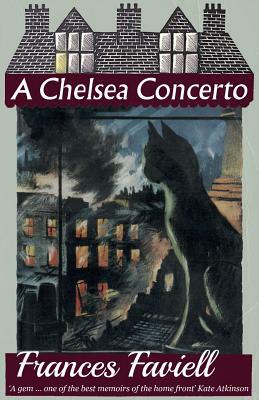
A Chelsea Concerto is Frances Faviell’s memoir of the Blitz. Although I have now read several memoirs and novels set during this time, this one is remarkable for its integration of war news and its detailed descriptions of air attacks and their results. Faviell lived in Chelsea during the Blitz—an area that was very hard hit—and the book ends with a massive bombing of the area.

The book begins before the official war, with Faviell getting involved with working with Belgian refugees because of her ability to speak several languages. It continues to follow events of the war and the Blitz. It’s so detailed as to indicate that Faviell must have notes or diaries to refer to, as the memoir was not published until 1959. The descriptions of damage caused by the bombings is very vivid.

Unfortunately, Faviell often assumes knowledge on the part of readers that they may not have, either because it was common knowledge at the time or that it was so familiar to her that she didn’t think it needed explaining. This problem includes unexplained abbreviations, people identified only by name with little context, and at the end of the book, a mysterious reference to some event three years after the events of the memoir.

Also, there are lots of people mentioned in the book but characterization of only a few of them. This led me sometimes to be confused about who they were.

Related Posts

Table Two

The House Opposite

Spam Tomorrow

Review 2478: Village Story

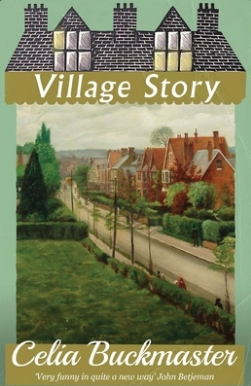
Like Buckmaster’s Family Ties, Village Story presents us with lots of characters and we begin slowly to sort them out and differentiate them. Buckmaster, who frequently speaks directly to the reader, states that Mrs. Ethelburger is her heroine, but Mr. Noyce gets more attention.

The novel begins with the Darlingtons because they have the nicest garden in the village, but it’s only their daughter Linda who has a minor role in the story. Linda, we’re told, having been pronounced “gifted” in school, has been spoiled. Hoping to keep her out of trouble, Mrs. Darlington takes her up to the big house in the village, the Noyce’s house, and gets her a job as a housemaid. There, she proceeds to make trouble by telling everyone that Mr. Noyce has been making love to her in the drying cupboard. This is a lie. In fact, Mr. Noyce is hardly even polite to her. But from a 21st century viewpoint, this minor plot is troubling on lots of levels, not least of which is the author’s attitude toward girls’ education. We must try to view it in the context of its time, where these views were not unusual.

Next, we briefly meet Mr. Noyce, who led a cosmopolitan life before settling down in the village on the family estate after his father died. Mrs. Noyce is an artist, one whom Mr. Noyce believes could become great, so he encourages her to keep painting. Even though that’s what she wants to do, her relationship with Mr. Noyce is on edge, and she seems to be rude to everyone. Of course, the village thinks she shirks her household duties.

Mrs. Ethelburger isn’t much interested in household duties, either, and since she has several small children, her house shows it. We’re told she and Mr. Ethelburger love each other, but he isn’t much of a character in the novel, and she is just breaking off an affair with Mr. Browning, a young businessman who lives with his mother. Mrs. Ethelburger used to visit old Mr. Noyce, so one day she wanders onto the property—now much more private—and strikes up a friendship with Mr. Noyce.

Also in the village are the Sparks, the rector and his wife, an elderly couple. He tends to be studious while she has decided to become a Communist without really understanding anything about Communism.

The novel only has the suggestion of a plot, mostly about the party the Noyces decide to have and the fate of the Noyce’s marriage. But somehow Buckmaster ties it all in with the fate of the village itself. I was interested in the story but sometimes couldn’t remember who all the characters (many more than I described) were and wondered where it was going.

Related Posts

Family Ties

A House in the Country

Near Neighbors

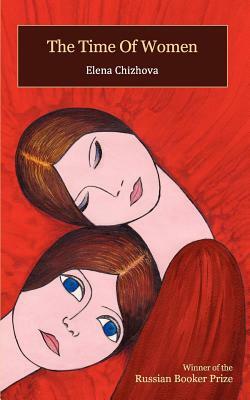
Review 2477: The Time of Women

In 1950s Soviet Union, Antonina has a child out of wedlock. She is lucky to be allotted a room in a house with three old ladies, making a deal with them to cook and clean if they’ll take care of the baby while she’s at work at the factory. The deal becomes even more important when they realize Suzanna isn’t talking at the right time. They all become terrified that the girl will be institutionalized or at least that Antonina will be forced to take her from one doctor to another.

So, Suzanna stays out of school and the grannies teach her to read and write and even to understand French. She imbibes Russian fairy tales as well as some strange beliefs and superstitions, and the grannies sneak her to church to have her baptized.

All goes well until a man at work, Nicholai, starts paying attention to Antonina. Although they have done nothing but have tea, the union people at work assume they are having an affair and begin pressuring them to get married.

Then the situation turns serious. Antonina has cancer. How will the grannies be able to arrange to keep Suzanna after Antonina dies?

This novel effectively depicts the poor living conditions and the uncertainty of life in Soviet Russia, where the state can become involved in the details of anyone’s private life. The narration moves from person to person, and a lot of action is conveyed in somewhat elliptical dialogue, so I wasn’t always sure what was going on. Dreams and stories are also given a lot of importance.

I found the ending, which is another story, fairly unsatisfying, though.

Related Posts

A Mountain of Crumbs

A Train to Moscow

Sofia Petrovna

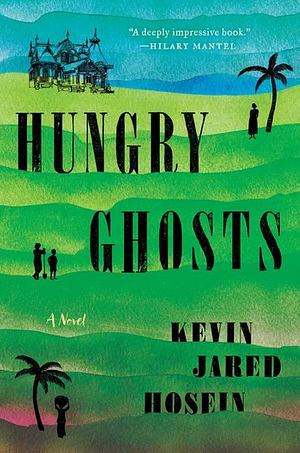
Review 2476: Hungry Ghosts

I feel safe in saying that if I wasn’t reading Hungry Ghosts for my Walter Scott project, I wouldn’t have read it at all. It is absolutely brutal.

In 1940s Trinidad, Krishna lives with his family in the Barracks, run-down ex-military barracks that are leaky and filthy, where five families live in each building, one to a room. Krishna’s father Hans has aspirations for better and insists that Krishna attend school in the village, but there he is mercilessly teased and bullied by other students as well as teachers. Krishna and his cousin Tarak have begun to hang with two twin brothers, Rudra and Rustrum, who have a bad reputation because their father was a murderer.

Hans works for Dalton Changon, a prosperous man. Changon’s wife Marlee has recently noticed some disturbing changes in his behavior—a heightened paranoia and a tendency to hallucinate. Then he disappears during a night when there’s a terrible storm.

Marlee receives a threatening note, so she offers Hans a large amount of money to stay on the property overnight as a guard. He accepts, thinking to save a down payment on a house. However, soon he is involved in a torrid affair with Marlee, not even returning to his home when his wife, Shiveta, is hospitalized for an infected foot.

Meanwhile, Krishna, defending himself from some village boys who try to drown Tarak’s dog, injures Dylan Badree. Because Dylan’s father is a policeman, Krishna is put in jail and is only released after Marlee’s intervention. But the boys’ feud begins to go in evermore dangerous directions.

This book contains graphic descriptions of drowned dogs and murdered dogs and the killing of a rabbit. Everyone in it who seems like a good person either becomes bad or is victimized. The language of the book is impressive, but sometimes Hosein uses such obscure words that it seems pretentious. Hosein certainly describes a vivid world, but it’s not a place I wanted to be in.

Related Posts

Fortune

A Brief History of Seven Killings

The Cold Millions

Review 2474: North Woods

In early colonial days, a couple flees one of the colonies into the wilderness of Massachusetts. There, they settle in a valley.

A settler with a baby is kidnapped by natives. When she becomes ill with fever, they leave her with an old white woman, who cares for her. But when white men come after her and plan to kill the natives—the old woman’s friends—she murders them. Before this happens, one of the men gives the captured woman an apple, and she drops the seeds on the ground.

An apple tree grows.

After the French and Indian Wars, Major Charles Osgood gives up his uniform and decides to grow apples. His friends think he has lost his mind. He searches all over until a child leads him to an apple tree near a ruined cabin in the wilderness. The apple is marvelous. He builds a house and takes cuttings from the tree to make an orchard, producing an apple called Osgood’s Wonder.

So Daniel Mason goes on relating the history of this plot of ground, from one owner to another. People die, are murdered, are conned, become ghosts, run mad, the wilderness recedes and then returns, the house is ruined and rebuilt, added to, ruined, rebuilt. Each section is linked to others by characters, coincidences, and place. Some of the incidents are funny, some fates are sad, some characters get what they deserve. Tales are punctuated by songs written from the grave.

I can’t really convey how much I enjoyed reading this unusual novel. It’s steeped in the beauty of the forest. It somehow manages to involve you despite some quite short (some longer) stories of its characters. You get worried about the fates of apple and chestnut trees! I loved this one. It did exactly what a book is supposed to do, pulled me into a different world and made me reluctant to leave it.

Related Posts

The Overstory

The Orchardist

Ulverton

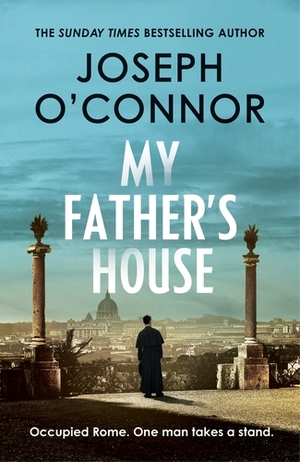
Review 2473: My Father’s House

Helen of She Read Novels has posted a note about Readers Imbibing Peril (RIP XIX), which I always forget about but usually participate in. As somewhat of a suspense novel, My Father’s House qualifies, so let this be the start of my participation this year. Most of the action is on Instagram at @PerilReaders, but I am not a great user of that.

My Father’s House is a book I read for my Walter Scott project, and it is also the first in O’Connor’s Roman Escape Line trilogy. It is based on the true story of the Escape Line, a group of people who helped captured soldiers and others escape from the Nazi occupation of Rome. In particular, it focuses on Monsignor Hugh O’Flaherty, one of the group’s founders.

After Rome is overrun by the Nazis, the Vatican gives Monsignor O’Flaherty a duty of ministering to British soldiers in Nazi captivity. Being an Irishman, he isn’t eager to do this duty. However, when he sees the condition of the men and the ease with which the Nazis break the Geneva Conventions, his manner to the Germans is such that he is removed from the duty. In this way, he comes to the attention of Obersturmbannführer Paul Hauptmann.

O’Flaherty then decides to form a group to help soldiers escape from the Nazis. The group becomes successful enough that Hauptmann begins receiving threatening communications from Himmler.

Much of the novel centers around a Rendimento, as the Choir, the central group that runs the Escape Line, calls their missions. The group has planned its mission for Christmas Eve (1943), thinking that Hauptmann won’t expect it, but in the last few days, Sam Derry, an escaped British major who would normally run it, is incapacitated. They begin training Enzo Angelucci instead.

The main focus of the novel is whether the mission will be successful, but the narration travels around in time and person via transcripts of interviews of several of the participants. In some respects, this structure is interesting, helping you get to know the other characters, but they didn’t all have distinct voices, and you didn’t get to know them well. There is also the disadvantage that the approach tends to interrupt the building suspense.

I thought the novel was very interesting in its subject matter. I’d never heard of the Escape Line. However, as the first of a trilogy, I’m not sure how much more there is to say, even though no doubt there are many adventures to recount. I didn’t feel as if I got to know most of the characters in the novel, not even the Monsignor.

Related Posts

Ghost Light

Shadowplay

Munich

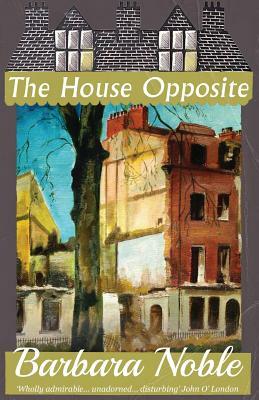
Review 2463: The House Opposite

I didn’t like the main character of The House Opposite at first. Elizabeth is having an affair with her boss, a married man with two children, and she sees his wife and children only as people who get in the way of her happiness. She’s dating a young serviceman, Bob, simply to hide her affair. She apparently referred to the boy across the street as a “pansy” in his hearing, and the remark has made him doubt his sexuality.

Nevertheless, she’s friendly to her coworkers and as she begins to help with the war—working as a warden and helping in the hospital—she begins to grow on me. As warden, she is partnered with Owen, that same boy she insulted, and it is the developing friendship between the two that is a focus of the novel—that and her own self-evolution.

One of the interests of this novel is the detailed descriptions of what it was like to live through the Blitz in London. Although other novels recount an incident or two, most of the characters in this novel have chosen to stay in London and sustain many attacks, most of them even staying in their homes and feeling a little superior to those who seek shelter.

Although Elizabeth takes a long time to recognize that her lover is a stinker, she otherwise shows herself to be quite likable. There are a lot of themes, involving Owen growing up, Elizabeth humanizing her lover’s wife and children, Owen’s father’s involvement in the black market, and so on.

Related Posts

The Midnight News

Company in the Evening

Spam Tomorrow

Review 2462: Weyward

Bookish Beck has a meme called “book serendipity” where she finds things in common between books she’s read recently, and I have a doozy. Not to give too much away, but this is the second book I’ve read in two weeks where women decide that the only way to deal with their abusive husbands is to murder them.

This novel is set in three time frames. In 1619, Altha is being tried for witchcraft. In 2019, Kate has discovered she is pregnant, so she has decided she must leave her abusive boyfriend, Simon. She has inherited a cottage from her Aunt Violet that he doesn’t know about and she has quietly saved some money, so she goes. In 1942, Violet has grown up isolated, not even allowed to go to the village and never told anything about her mother. At 16, she is jealous of her brother Graham, who is allowed to study interesting topics while she is forced into a traditional feminine role. She wants to travel the world and study bugs, but her father has apparently already chosen a husband for her.

Back at the cottage, Kate begins looking into her family history, into the women who called themselves the Weywards and have an unusual connection to animals.

This is an interesting novel with supernatural overtones that are fairly slight. I was interested in all three stories, although I found the outcomes of Altha’s and Kate’s stories fairly easy to guess. In this novel, I wasn’t as disturbed by the husband murder as I was in the other novel, in which I thought the wife could have easily gotten away. In any case, almost all the men in this novel are rotten to the core. So yes, I liked this novel fairly well.

Related Posts

Recipe for a Perfect Wife

The Harpy

The Family Upstairs

Review 2461: Agatha Christie: An Elusive Woman

I usually take much longer to read a work of nonfiction vs. fiction—up to a week as opposed to two or three days—but such was the power and readability of historian Lucy Worsley’s prose that I was astonished to finish this book one day after I started it. Of course, many people may want to know about the days Christie was missing, and she deals with that, but there is much more.

Christie lived an interesting life, and Worsley tells us about it, from the pampered, loved child of wealthy parents, to the loss of her father and the family fortune when she was 11, the World War I nursing and dispensary work, the ill-planned marriage to Archie Christie, and so on. Worsley’s main message is that Christie understood people to hide their actual selves and she presented her own masks, as well as evolved during her life into different personas. That was why she presented as shy when she had a lot of self-confidence, why she said little about her disappearance, why she told everyone she was a housewife rather than an author, and so on.

I’m fairly sure I have already read a biography of Christie, but this one was much more interesting. It is written in a lively style but looks thoughtfully at some of the problems posed by other writer’s remarks, and is thoroughly documented.

Related Posts

Agatha: The Real Life of Agatha Christie

Jane Austen at Home

The Secret Rooms

Review 2458: Miss Granby’s Secret or the Bastard of Pinsk

I was thrilled to learn that Dean Street Press was continuing its Furrowed Middlebrow imprint. This novel is an entertaining entry in that line.

In 1912, Pamela receives a bequest from her great-aunt Addie Granby of a house and a box of keepsakes and papers. Aunt Addie had been a well-known romance writer, but her modern great niece doubts that her spinster aunt ever understood the facts of life. Pamela finds hints that Addie had a romance when she was 16 with someone named Stanislaw. She also wrote her first novel.

The entirety of the novel, entitled The Bastard of Pinsk, is included within this novel. It begins with a conscientious list of terms that some polite young man has given her definitions for. As an example, “bastard” is given as “a very noble Hero of Royal Blood.”

The novel within the novel is made funny by the naïveté of its author, who writes in a Romantic, florid style and flings about words she doesn’t know the meaning or connotations of. Her Romantic upbringing and reading in the Gothic tradition are manifest in the ridiculous plot. If I have any criticism, it’s that it’s a bit too long. However, it picks up as it goes along.

Twenty years later Pamela learns that her friend Adey has been nursing an old man—her Aunt Addie’s Stanislaw! Now, she thinks, is her opportunity to find out about Aunt Addie’s past.

I received this book from the publisher in exchange for a free and fair review.

Related Posts

Beneath the Visiting Moon

Anne of Green Gables

My Brilliant Career