Day 785: All Aunt Hagar’s Children

Cover for All Aunt Hagar's ChildrenAs in his wonderful novel, The Known World, Edward P. Jones attempts to depict an entire community in the short stories included in All Aunt Hagar’s Children. This goal is more difficult to accomplish, because the community is a much larger one—the African-American citizens of Washington, D.C.—and the stories take place over much of the 20th century.

Several of the stories have to do with the migration of the characters from the rural South to the city. In “In the Blink of God’s Eye,” Ruth and Aubrey Patterson are a hopeful young couple from across the river in Virginia at the turn of the 20th century. Ruth, though, is homesick, and when she finds a baby boy in a tree one night, Aubrey becomes jealous. This story is first in the collection, but the last story echoes it. Anne Perry, of rural Mississippi, meets George Carter, a sleeping car porter, and moves with him to Washington. In the story “Tapestry,” Jones uses a technique he also employed in The Known World where he breaks off to tell Anne’s entire life. But he twice tells what her life might have been had she married a different man.

The emphasis on rural roots is also important in “Root Worker.” Dr. Glynnis Holloway’s mother has been treated for mental illness for years until her care worker, Maddie Williams, talks the reluctant doctor into consulting a root worker, a wise woman. In the rural North Carolina setting under the care of Dr. Imogene, her mother improves, and Dr. Holloway surprises herself by apprenticing herself to Dr. Imogene.

Another strong theme is that of moving into the middle class. It pervades many of the stories but particularly “Bad Neighbors.” When Sharon is in high school, her family has made it to the middle class, but they are disturbed when the Staggs move in across the street, for they are not considered respectable enough. Sharon’s father is responsible for encouraging the neighbors to club together to buy the Staggs’ house so they can evict the family. Years later, Sharon realizes some truths when she is saved by Terrance Stagg.

Perhaps the thread I least identified with was the presence of folk lore as if it were real, a sort of magical realism. For example, in “The Devil Swims Across the Anacostia River,” Laverne spends a lively afternoon at the grocery store fending off the devil. Years ago, her grandmother got away from him by wading into the Atlantic Ocean to go to heaven.

Although overall, the stories are not as effective as the novel The Known World, they are compassionate to even the lowest of their characters. I particularly found touching “Adam Robinson Acquires Grandparents and a Little Sister,” about Noah Robinson, whose grandson Adam was lost after his drug addict parents abandoned him. The little boy is found, illiterate and frightened, and Noah faces a future of raising his grandchildren instead of the carefree retirement he envisioned.

Related Posts

The Known World

Family Furnishings

Unaccustomed Earth

Day 781: Dandy Gilver and A Deadly Measure of Brimstone

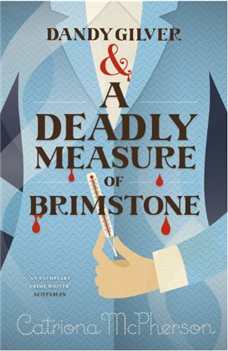
Cover for A Deadly Measure of BrimstoneThings have been fairly stressful in the Gilver household. Dandy’s husband Hugh and both boys, Donald and Teddy, are recovering from a serious illness. Just as they begin to improve, Pallister, the butler, and Mrs. Tilling, the cook, are also felled. Dandy and her partner, Alec Osborne, haven’t had a case in months, and when Alec announces it’s time he looked for a wife, Dandy is afraid their detecting days will soon be over. Then, she has a letter from Mr. Addie and Mrs. Bowie, asking them to make an inquiry.

The job turns out to be helpful for all parties. Mr. Addie and Mrs. Bowie are upset about their mother, who died recently on a visit to a spa in Moffat. She reportedly died of a heart attack, but her children insist she had no heart trouble. Dandy thinks everyone will be served by renting a house in Moffat and enrolling the invalids at the spa. Alec goes early, pretending to have a bad back.

Once they begin investigating Mrs. Addie’s death, something seems suspicious. The police sergeant says she was scared by a ghost. He also says that although Dr. Laidlaw was there at the spa, they called in Dr. Ramsay from the village to sign the death certificate. That Dr. Laidlaw apparently refused to sign the death certificate seems suspicious to Dandy, and when she questions Dr. Ramsay, he proves to be an idiot who says that everyone dies of a heart attack. Dr. Laidlaw herself has a violent reaction to mentions of Mrs. Addie.

On her investigations of the spa, Dandy finds the attendant who prepared Mrs. Addie for burial. She says that Mrs. Addie was dirty, even under her fingernails, so Dandy begins to think she may have died outside. In the meantime Alec determines that Mrs. Addie did not believe in ghosts so would be unlikely to have been scared to death by one. Mr. Laidlaw, Dr. Laidlaw’s brother, also seems a shifty sort of person. Dandy is a little worried, because Alec seems protective of Dr. Laidlaw, a scattered young woman.

Dandy and Alec soon believe something odd is going on at the spa. For one thing, Hugh has stopped being grumpy! The arrival of a bunch of mediums makes everything even stranger.

Dandy Gilver mysteries, set in post-World War I Scotland, are light-hearted, funny, and entertaining. I am always happy to see another one coming out.

Related Posts

Dandy Gilver and a Bothersome Number of Corpses

The Child Garden

Sidney Chambers and the Shadow of Death


Day 776: Patrick Leigh Fermor: An Adventure

Cover for Patrick Leigh FermorWhile reading Patrick Leigh Fermor’s retrospective trilogy about the journey he made in his teens, walking from Holland to Istanbul and then Greece, I was struck by the references to what seemed to be an exciting and unusual subsequent life. So, I soon looked for a biography and found this one, by British writer Artemis Cooper, the granddaughter of Leigh Fermor’s good friends and a woman who knew him from when she was a child.

Cooper goes into a little more detail than Leigh Fermor (known by his friends as Paddy) about his childhood, making clear there was a split between his parents and a good deal of neglect from both. Still, he had a happy childhood growing up in a rural setting, and his problems only began with the regimentation of school. Having failed in an academic setting and with the army, Paddy got the idea to go on his fabled walk.

Cooper summarizes the route of this walk, only she reveals the true names of the people he met (he used pseudonyms) and tells us when the stories are invented or conflated. When I read the trilogy I wasn’t aware that any events were invented or conflated, but I should have known that the level of scholarship reflected in the writing was not that of an eighteen-year-old. (Well, I did know, but he wrote the books much later in his life.)

picture of Princess Balasha
Princess Balasha

After his journey, Paddy settled in Athens and then Rumania with Princess Balasha Cantacuzene, a fascinating older woman separated from her husband. However, after World War II broke out, he hurried back to England, not realizing how long it would be until he saw her again.

Paddy spent most of the war in Crete working with the resistance. He is famous for kidnapping a German general and removing him to Egypt, an act meant to improve Cretan morale. (A movie, Ill Met by Moonlight starring Dirk Bogarde as Paddy, was made about this feat, but Paddy was unhappy with how far it drifted from the facts.) For the rest of his life, despite the unfortunate political differences that evolved between England and Greece after the war, Paddy was beloved in Crete.

picture of Joan Fermor
Joan

After the war, Paddy lived a gadabout life with many famous friends, only settling down in Greece with his wife Joan in his late middle age. He and Joan had been together 27 years before they married and for many of those years, had an open relationship.

Paddy chose the profession of writer and wrote several books about his travels and adventures. He was a raconteur who demonstrated an impressive range of knowledge and was interested in everything. Apparently very charming and loved by many people, he was not always sensitive to the feelings of others.

This biography is a well written, fascinating, and occasionally funny portrait of a remarkable man. At times, the sheer number of people mentioned made me unsure of who they all were, and there was certainly an assumption that readers would know who was meant. I didn’t always, which made the book a little more difficult to follow, but that was only on occasion.

Related Posts

A Time of Gifts: On Foot to Constantinople: From the Hook of Holland to the Middle Danube

Between the Woods and the Water: On Foot to Constantinople: From the Middle Danube to the Iron Gates

The Broken Road: From the Iron Gates to Mount Athos

Day 772: The Haunting of Maddy Clare

Cover for The Haunting of Maddy ClareBest Book of the Week!
The Haunting of Maddy Clare has been on my reading list for a while. I’ve finally read it, and my first reaction is to immediately look for another book by Simone St. James. It’s not often I encounter a good ghost story. This one is really good.

It’s just after World War I, and Sarah Piper has been living a safe but impoverished and lonely life in London taking temporary secretarial jobs, when her agency sends her to Alastair Gellis. Gellis has an unusual request. He is a wealthy young man who can afford to turn his interests into employment, and his interest is in ghosts.

Alastair’s regular assistant is away, and he has been summoned to the site of a haunting. Sarah’s job is to assist him in recording evidence of a ghost.

Maddy and Alastair travel to Falmouth House and an interview with Mrs. Clare, an elderly woman. She explains that Maddy came to her doorstep years ago as a child. She had been beaten and was barely dressed and covered with mud. She could hardly speak. The Clares took her in and tried to find her people, with no success. She was obviously of the servant class, so they employed her as a maid. She was with them for several years, always frightened and never leaving the house. Then one day she hanged herself in the barn.

Maddy haunts the barn, and Mrs. Clare wants Alastair to get her to leave. She already tried an exorcism, with terrible results. But Mrs. Clare says that Maddy hated men, which is why she asked Alastair to bring a woman.

Sarah learns she is expected to go into the barn accompanied only by a wire recorder and a camera. She finds the experience terrifying. Although she does not see Maddy, Maddy plants images in her mind and asks Sarah to find someone. What she wants is not clear, but Sarah decides to continue.

Shortly thereafter, Alastair’s partner Matthew Ryder arrives. Although he is badly scarred from the war, Sarah is immediately attracted to him. Matthew, on the other hand, thinks Sarah is too fragile for the work and should be dismissed. In the meantime, Sarah has sensed a threatening presence in the village.

This novel drags you in from its first sentences. It also tells a deliciously creepy yet heart-rending story about why Maddy is haunting the barn. If you like ghost stories and enjoy some romance in  your historical fiction as well, you’ll like this novel.

Related Posts

This House Is Haunted

The Uninvited Guests

The Greatcoat


Day 769: Dandy Gilver and a Bothersome Number of Corpses

Cover for Dandy GilverDandy Gilver has only the fondest memories of a summer spent with the Lipscotts when she was a girl, especially of the winsome, creative youngest, whom they all called Darling Fleur. Dandy only met Fleur once as an adult and she had changed. She was then a flirty, noisy, but beautiful flapper.

Dandy is surprised to be contacted by Pearl Lipscott, asking her for help with Fleur. Pearl says Fleur has been teaching at a girls’ school and she’s afraid all is not well. She hints at breakdowns in the past and tells Dandy that she and her sister Aurora are not welcome at the school. She wants Dandy and her partner Alec Osborne to go to the school to see if Fleur is all right.

Alec isn’t pleased to be visiting a girls’ school as it limits his own participation in the investigation, but almost as soon as they arrive in Portpatrick, he finds himself another client, an Italian fish and chips shop owner named Joe Aldo. His wife has left with a lover, and he wants to find her and make sure she’s okay.

When Dandy arrives at St. Columba’s, she is mistaken for the replacement for the French teacher, who has left without notice. Dandy goes along, feeling she can learn more from inside the school. But when she sees Fleur, she is shocked. The beautiful, vibrant girl has been replaced by a pale, beige woman. Moreover, when Fleur recognizes Dandy, she flees. Dandy is only able to get her to say that she’s killed four people before she runs away.

The next day the police arrive because a woman’s body was found on the beach and they want someone to see if it is Jean Beauclerc, the French teacher. Fleur volunteers to go but only if Dandy comes with her. At the dreadful sight of the drowned body, Fleur says it is not Miss Beauclerc but then utters the word “five” and runs away again.

Dandy soon realizes Fleur is missing but also that something odd is going on at the school. Even after Dandy is shown up as a fraud by the arrival of the actual French teacher, the headmistress Miss Shank takes her on as an English mistress. In fact, it turns out that Miss Shank was the housekeeper before she took over as headmistress upon the original headmistress’s death, a situation that is odd in itself. The girls seem to spend a lot of time lolling around, with short school hours and little work, while the teachers work feverishly. Five teachers have either died or left the school, and Dandy wonders if these are the five Fleur mentioned.

Joe has been to see the body and says it is not his wife. A witness saw his wife with a man on a cliff the night she disappeared. So, Dandy and Alec are left with three missing women, a mention of five murders, and some kind of wrong-doing at the school.

The Dandy Gilver series set in post-World War I Scotland is always fun. The dialogue is lively, and Dandy is always ready to leave her dull husband and farm to detect with Alec. In this case I thought it takes Dandy and Alec far too long to figure out what Fleur’s comment means, but there is still plenty I didn’t figure out.

Related Posts

The Child Garden

The Return of Captain John Emmett

As Chimney Sweepers Come to Dust

Day 766: Miss Bunting

Cover for Miss BuntingMiss Bunting, an elderly governess, has left her usual home at Marling Hall to live with young Anne Fielding in Hallbury. Anne’s health is considered too delicate for her to live with her parents in Barchester, so Miss Bunting has agreed to take her on, with an eye to improving her health, her poise, and her education.

Miss Bunting is an old-school type of governess, a force in herself, whose presence makes others sit up straight. Still, she is fond of her pupils, too many of whom are being killed in World War II.

Jane Gresham has been having a particularly tough war. Her husband Francis is on an island in the Pacific, and he hasn’t been heard of for three years. She has been living with her father, Admiral Palliser, and doing her best to raise her eight-year-old son Frankie.

Robin Dale, son of the rector Dr. Dale, is feeling a bit adrift. He lost his foot in combat. Although his old school has asked him to return to a job as master, he feels he must keep his elderly father company. So, he’s been running a small school for boys preparing for public school.

Jane does a favor for the admiral, going to view housing for Mr. Adams and his daughter. Mr. Adams is a wealthy factory owner looking for a place for the summer, and the admiral is on his board.

This novel is about a disappearing way of life for the British upper class, as personified by Miss Bunting. Class is an important issue in the novel, as the upper levels of Hallbury society are taken aback when Mr. Adams and Heather breach their ranks. Thirkell tells this story with liveliness and wit. Although her tone is sometimes one of asperity, none of her characters are bad, or even ill-meaning, people. Thirkell shows their foibles while still making you like them very much. I’m happy to be rediscovering these novels.

Related Posts

Happy Returns

The Warden

Some Luck

Day 764: Sweet Caress

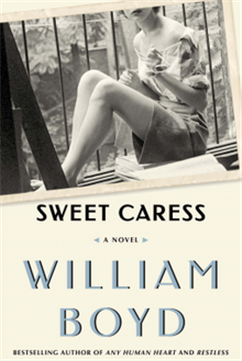
Cover for Sweet CaressAlthough I have by no means read everything by William Boyd, Sweet Caress reminds me most of his Any Human Heart, perhaps because it’s the story of one person’s life. This novel is about Amory Clay, a photographer born in 1908. Boyd creates the impression that Amory is a real person (so much so that I googled her twice) by interjecting photos of her life into the novel.

Amory leads an unusual life almost from the start of the novel. Although her father suffers from depression and other problems as a result of World War I, she is so content with her home life that she is upset when her parents send her away to school. Her parents are not well off, but Amory learns later that a legacy from an aunt is dedicated to her education.

Her mother wants her to attend university, but she decides early that she doesn’t want to go. Her favorite uncle, Greville, gave her a camera on her 10th birthday, and she wants to be a professional photographer.

Then a violent incident brings her home. Her father arrives at school unexpectedly to take her to tea. But his intention is to commit suicide, and he doesn’t want to go alone. Amory survives the drive into the lake and even saves her father, who is committed to an institution for a long time.

Soon after, Amory becomes Uncle Greville’s assistant. He is a society photographer, and although Amory does not enjoy this type of work, she must start somewhere. But she takes a risk with an unusual betrothal photo, and its reception ruins her chances. Soon Amory is off to capture the decadent night life of Berlin.

Amory leads an extraordinary life that contains many sorrows and triumphs. She is a war correspondent for both World War II and the Vietnam War, she is attacked by fascists rioting in London, she travels with lesbians to Mexico, she encounters a Charles Manson-like figure in 1960’s California. She almost unwittingly marries a lord and has a family. These are just some of the events of her life, its story punctuated with paragraphs from the “present time” of 1978, when Amory is an old woman.

link to NetgalleyI found this novel involving, although not as much as I did Any Human Heart. For one thing, I wasn’t always convinced I was hearing a woman’s voice, and in no way was this because of Amory’s adventurous life. Also, Amory’s voice is a reserved one, with certain exceptions. Still, it is a fascinating story that manages to cover a great deal of modern history.

Related Posts

The All-True Travels and Adventures of Lidie Newton

The Signature of All Things

The Lacuna

Day 763: The Vet’s Daughter

Cover for The Vet's DaughterIt was several days before the doctor came. It was my father who sent for him. Even he noticed something was wrong with Mother. When he saw her all doubled up over the dining room sideboard, he suddenly bellowed, “For Christ’s sake, woman, send for the doctor, and if he can’t put you right, keep out of my sight!”

Best Book of the Week!
Alice and her mother live in terror of her father, the vet, in this novel written in 1959. He ignores Alice and treats his wife with brutality and contempt. Alice is in her teens, living in a dreary house in a London suburb with only one friend, a deaf girl, when her mother becomes ill. The one bright light for Alice is it brings vulgar but kindly Mrs. Churchill to help.

Mrs. Churchill continues to come after Alice’s mother dies, but within weeks Alice’s father has brought his lover home to live there, so Mrs. Churchill leaves. Rosa Fisher moves into Alice’s mother’s room and stays until she tries to pimp Alice out to an acquaintance.

Alice occasionally seems to have what first appears to be some kind of fits. But they are actually the slow development of an uncanny ability.

As with Sisters by a River, the simple, innocent manner in which this novel is narrated gives it a distinctive tone. Alice is a naive and unsophisticated girl whose isolation from society means she doesn’t always understand very common things. The plot is impossible to predict, as it takes us to some unusual places. The Vet’s Daughter is another strange and vivid novel from Barbara Comyns.

Related Posts

Sisters by a River

The Lace Reader

The Death of Bees


Day 757: Thirteen Guests

Cover for Thirteen GuestsJohn Foss is a young man running away from London at the end of a failed love affair when he injures his foot jumping off the train at a small station. Guests bound for the house of Lord Aveling take him to the doctor’s house only to find that the doctor is away treating Mrs. Morris, Lord Aveling’s mother-in-law. Nadine Leveridge, a beautiful widow, insists on bringing John along to Lord Aveling’s, the unwitting thirteenth guest at a house party.

Lord Aveling’s guests feature a cricket player, an actress, a member of Parliament, a society painter, a gossip columnist, and a novelist, but there are also some more unusual guests, a vulgar sausage king and his family and a shady couple, the Chaters. Some odd things happen almost immediately. Someone throws paint on Leicester Pratt’s painting of Lord Aveling’s daughter Anne, and an odd confrontation takes place between Zena Wilding, the actress, and a strange man at the train station. Mr. Chater seems to be around sticking his nose into everything.

After John’s foot is treated, he is parked on a sofa in an anteroom. Late that night, he hears a dog barking outside, several exchanges in the hallway, and some glass breaking. The next morning it is obvious that someone broke out of the studio that Pratt locked after he discovered his ruined painting, and the dog has been stabbed to death. Later, the strange man from the station is discovered dead at the bottom of a nearby quarry.

Of course, when Detective-Inspector Kendall arrives, he finds that many of the house’s inhabitants have something to hide. And the man no one seems to know is not the only one to die.

link to NetgalleyAlthough this Golden Age mystery involves time tables, the solution is fairly straightforward but hard to guess. Agatha Christie was a great admirer of Farjeon, who I think gives a good sense of his characters, enough to help me distinguish one from the other when there were so many of them.

Related Posts

Antidote to Venom

The Hog’s Back Mystery

Behold, Here’s Poison

Day 756: Z: A Novel of Zelda Fitzgerald

Cover for ZTo write a novel about Zelda Fitzgerald, Therese Anne Fowler had to make many decisions between competing sources. Historians and biographers are sharply divided between those who think Zelda ruined Scott’s life and those who think Scott ruined Zelda’s life. Fowler ends up coming in pretty firmly on Zelda’s side. Ernest Hemingway’s A Moveable Feast said nasty things about both of them, but many of those things have been found to be exaggerations or outright lies. In any case, I’ve always thought Hemingway was a jerk.

This novel begins when Zelda, fresh out of high school and a popular debutante, meets Fitzgerald, at that time in the army and due to ship out to Europe and World War I. It ends shortly after Fitzgerald’s death. It paints a vivid portrait of Zelda, a woman trying to find a purpose in her life beyond being a wife.

If Fowler has made the right choices, the novel creates a devastating idea of Fitzgerald, insecure, unfaithful, controlling, and alcoholic. He undercuts Zelda in every way possible, publishing her stories under his own name, taking control of her published novel in the editing stage and butchering it, being generally nasty, and threatening to take away her daughter Scottie when she wanted to accept a solo role in the ballet in Naples. His friendship with Hemingway especially drove them apart, as Hemingway was relentless in accusing her of being selfish and ruining Scott’s career, and Scott began to believe it. Note that Hemingway is the same person who did all he could to halt his own wife’s career as a war correspondent.

I was completely absorbed by the novel, which strongly characterizes Zelda and to a lesser extent, Scott. My only criticism, besides a few too many descriptions of clothes, is that most of the other characters are only sketchily drawn. A great many characters appear in these pages, and I can’t say that I had much of an impression about any of them, to the point where I couldn’t remember whether some were friends or relatives. With such vivid personalities as Cole Porter, Gertrude Stein, H. L. Mencken, and Hemingway appearing in the novel, more could have been done with them.

Related Posts

Circling the Sun

The Happy Foreigner

The Other Daughter