Day 166: We, The Drowned

Cover for We, The DrownedBest Book of the Week!

We, The Drowned is an unusual novel by Danish writer Carsten Jensen that has become an international best seller. It relates the history of the author’s home town, the port of Marstal, Denmark, from 1848 to 1945. Although it picks principal characters to follow during these times, large portions of the novel are written in the first person plural, as though the entire town is the Greek chorus in a play. The novel follows the fate of the town as it rises to become a major shipping port to its near demise just before and during World War II.

The narrative style of the novel feels like a series of seafaring tales. Ships sink, sailors are never seen again, but the townsmen of Marstal continue to be lured out to sea. We follow them as the Danes go to war with Germany in the mid-19th century and the men of Marstal wonder why they are fighting men they traded with the week before. In this conflict, Laurids Madsen is shot upward from an exploding ship and lands again on his feet, unharmed, creating a legend about his boots.

Years later, his son Albert travels the South Pacific looking for his father, who went to sea when Albert was four and never returned. He finds him with a second family in Samoa.

As an old man retired from a prosperous career as a sea captain, Albert befriends a young boy, Knut Erik Friis, whose widowed young mother does everything she can to keep her son from going to sea. When she gains some economic power in the community, she undercuts the town’s shipping industry in an attempt to keep all the young men home.

These stories and many more, ending with Knut Erik’s experiences during World War II, tell the rich tales of the lives in this seafaring town. Although I was initially a little put off by the narrative style, I found myself barely able to put down this book.

Day 156: Winter Garden

Cover for Winter GardenI want to start out this review by saying that I usually avoid reading tearjerker fiction (by the way, that’s different from being brought to tears by emotion that is evoked honestly in fiction) and I don’t like things that are too heartfelt, if that makes any sense. Having misgivings, I read Winter Garden by Kristin Hannah upon the recommendation of a friend because I have always been interested in Russia. This decision was a mistake for me because I found this novel too corny, contrived, and predictable.

Meredith is a caregiver. She takes care of her father’s business and tries to take care of everything else for everyone. She has also tried to love her cold, withdrawn mother all her life, but her mother remains unknowable. Meredith’s sister Nina, on the other hand, is a photojournalist who seems unreliable to Meredith and hardly ever comes home. This, Meredith resents.

Their father has a heart attack, which brings Nina home. During his illness, he insists that the girls force their mother to tell them a fairy tale she used to tell them as children, only this time, she is to finish it. Then he dies, and Nina returns for the funeral.

It is obvious from the beginning, even before we hear a word of the tale, that it isn’t a fairy tale but a true story about their mother’s difficult life in Stalinist Russia. Of course, you immediately know that by listening to the story, the women will grow to love and understand their mother. By the way, they will also figure out how to reconcile their relationships with each other and solve their other life problems. A review I read says “Although this book starts off fairly maudlin, it evolves into a gripping read.” I have to disagree. I think it starts out maudlin and stays that way.

Day 155: In the Garden of Beasts: Love, Terror, and an American Family in Hitler’s Berlin

Cover for In the Garden of BeastsBest Book of the Week!

In the Garden of Beasts is the latest of Erik Larson’s extremely interesting histories. In a couple of his books, he takes the approach of  juxtaposing two seemingly different subjects and showing how they are related, for example, in Thunderstruck, where he tells the story of Marconi and the invention of radio and how that affected the capture of the famous British murderer, Crippen. In other books, though, he has managed to make historical events more personal by relating them from the point of view or one or two people. Such is the case with In the Garden of Beasts, which follows William E. Dodd’s years as the American ambassador to Germany during the build-up of Nazi power before World War II (1933-1937).

The book is about the experiences of Dodd and his family as they witnessed the events of those times. It focuses mostly on Dodd and his daughter Martha, based upon their letters and memoirs.

Dodd was in many ways an uncomfortable fit for the position of ambassador. He was an academic–a historian whose previous position was chairman of the history department at the University of Chicago. He had worked his way up from extreme poverty and believed that he had not risen as far as he would have if he had come from a more privileged background.

Dodd was a personal acquaintance of Franklin D. Roosevelt, and he requested a position as an ambassador of a small country from FDR, hoping both to add to his prestige and to be able to devote more time to writing his history of the South. In an ironic twist, though, he was offered Berlin, a much more demanding situation than he wanted and no sinecure, after several other candidates turned it down.

He saw his role as that of a reformer. He intended to live modestly on his salary and provide the other employees in the diplomatic service with an example of good stewardship of public funds, never understanding that his frugality was more likely to be misunderstood by his colleagues from more privileged backgrounds, who were the more usual occupants of such a position and who viewed him with disdain. In fact, some of them circulated a malicious and untrue rumor that FDR had made a mistake with the phone book and offered the job to the wrong Dodd.

The family was at first inclined to believe that the stories of attacks on foreigners and Jews by the SA (German Stormtroopers) were exaggerated. Frankly, they were also somewhat anti-Semitic. Martha admired the vigorous blond young men who were excited by the rise of Hitler, and she socialized with men in the Nazi leadership. In fact, she was quite the party girl, in every sense of the term. Dodd naively thought that he would have more impact on German policies if he maintained friendly relations with the country’s leaders, no matter what he thought of them personally.

It took Dodd an inordinately long time to recognize the truth about the kind of people he was dealing with, especially considering all his sources of information. However, when he did, he was at times heroically unflinching about standing up to the Nazi high command.

The genius of this book is that it relates history from the point of view of naive onlookers whose understanding of the situation and sense of danger grow slowly, rather than from complete hindsight. The book brilliantly conveys the feel of the time and place as the Dodds slowly realize the extent of the Nazi atrocities and begin to understand the growing terror of the German citizens. Dodd is an interesting character, a man who is sneered at by his staff and the Germans for his fuddy-duddy qualities, such as leaving state balls at 11 to go to bed, but who startles them several times by having the courage to stand up to Nazi leaders.

Day 149: Hons and Rebels

Cover for Hons and RebelsAfter reading the other Mitfords’ criticisms of this book in The House of Mitford, I expected a biography that was cruel and critical, but Hons and Rebels is mostly an amusing story of Jessica Mitford’s teenage rebellion. The Guinesses (authors of The House of Mitford and Jessica Mitford’s nephew and great-niece), who claimed that Jessica Mitford lied on several points, do not seem to have considered the common phenomenon that people who experience the same things frequently remember them differently, from their own frames of reference. A different recollection of an event in the far past (and in one case an apparent misidentification) is not necessarily lying.

I became interested in finding a good biography of the Mitfords after re-reading several of Nancy Mitford’s novels. I was curious about the kind of family that could have spawned children with such radically different ideas and such extreme characters. Unfortunately, at the time, I was only able to find a couple of biographies written by family members, this being one.

Nancy Mitford, of course, was a brilliant social satirist and author of several light comic novels–and not as politically involved as some of the other girls. Diana left her aristocratic husband, Bryan Guiness, for the infamous British Fascist leader, Oswald Mosley, and was interred with him in prison during World War II for their pro-German sympathies. Unity Mitford became a fan and friend of Adolf Hitler and shot herself in the head the day that Britain declared war against Germany, but failed to kill herself and was mentally disabled for the rest of her life. On the other hand, Jessica as a teenager ran off to the Spanish Civil War with the socialist Esmond Romilly, whom she married. Later she moved to the United States and became a member of the American Communist Party and a famous muckraking journalist.

Hons and Rebels covers Jessica’s childhood, rebellion, later life in the States, and estrangement from the rest of the family. It is light and easy to read, and quite funny. It depicts Esmond and Jessica as extremely naive but equally unprincipled. Mitford does not attack the other family members, as I would have expected after the comments in The House of Mitford. If anything, she looks back at them all nostalgically. In fact, as I commented in my review of the other book, the Guinesses are more prone to attack and criticize the other Mitfords, particularly Jessica and Nancy, and try to mitigate the faults of the Mosleys and the fanaticism of Unity. The only biography I can find written by an unbiased author is apparently superficial and focuses on Unity, so I guess my curiosity about the Mitfords will remain unsatisfied.

Just a note for my consistent readers: I thought that by reviewing one nonfiction book a week, I would be able to continue to write nonfiction reviews indefinitely, but I have now caught up with my nonfiction reading for the past two years, which just shows how much more fiction I read. From now on, nonfiction reviews will appear as I finish the books instead of more regularly.

Day 134: A Red Herring Without Mustard

Cover for A Red Herring Without MustardBest Book of the Week!
A Red Herring without Mustard is another of Alan Bradley’s delightful, comic mysteries featuring Flavia de Luce, the eleven-year-old detective and chemist.

In this book a mysterious gypsy woman is nearly beaten to death after Flavia allows her to camp on de Luce land. Something odd is going on. After Flavia surprises a neighborhood thug in the de Luce’s drawing room when everyone else is in bed, she finds him dead the next day, hanging from the trident of a fountain of Poseidon.

As usual, Flavia races all over the countryside on her bike Gladys, feuds with her sisters, consorts with her father’s shell-shocked batman, and tumbles into trouble in this novel, set in England just after World War II.

Bradley’s plots are implausibly complex, but it is not for the mysteries that I read these books but for the funny, irrepressible character of Flavia.

Day 129: Mad World: Evelyn Waugh and the Secrets of Brideshead

Cover for Mad WorldI found Mad World interesting, but I think it would have been very interesting if I was more familiar with Evelyn Waugh’s work. Paula Byrne’s biography seems to be mostly concerned with refuting statements and criticisms that were made about him, of which I was previously unaware.

The book traces Waugh’s life and career especially in terms of his relationship to the family who were partial models for the Flytes in Brideshead Revisited. The book describes just where the parallels lie and where they diverge.

Byrnes is at pains to refute the allegations that Waugh worshipped and toadied to the aristocracy and was ashamed of his own middle-class origins.

The book made me want to reread Brideshead. I found Waugh an interesting figure, although I couldn’t help feeling how boring and pointless the lives of many of his friends, who were hopeless drunks, seemed.

I apologize for my posts, which will be more sporadic than usual the next two weeks, as I am on vacation.

Day 124: Whose Body?

Cover for Whose BodyIt has been years since I read Whose Body? by the British writer from the Golden Age of Mysteries, Dorothy L. Sayers. Unfortunately, as soon as I saw the murderer’s name, I remembered who did it, so I was not able to judge how difficult it was to guess.

Mr. Thipps finds an unidentified body in his bathtub wearing nothing but a pair of pince-nez. The body bears a resemblance to a missing financier, but it is not him. Who is the dead man and how did the body get into the tub? Where is the missing financier? Is this one case or two? Of course, the police suspect Mr. Thipps. After Mr. Thipps’s mother asks him to help, Lord Peter Wimsey gets interested in the case and decides to find the answer to these questions in his inimitable way.

As always, Sayers is fine in characterization, much better than many of her Golden Age peers. Lord Peter is his usual apparently frivolous self. He and his man Bunter are fun. Lord Peter’s mother, the Dowager Duchess, is adorably ditzy. The plot is clever. However, as with many early mystery novels, it is overcomplicated and very unlikely. For people who haven’t read any Lord Peter books, I recommend Murder Must Advertise as a better starting place.

As a total side note, the cover I’m showing is not the one for the book I read, but is just one I found on Amazon. It occurs to me, why would they show the body of a woman when the victim is a man? This disconnect in publishing is always a mystery to me. One peek at the first few pages would have told the artist the sex of the body.

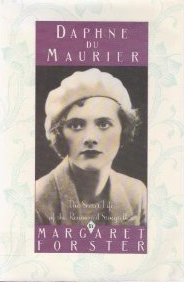
Day 119: Daphne Du Maurier: The Secret Life of the Renowned Storyteller

Cover for Daphne Du MaurierI have enjoyed reading Daphne Du Maurier’s books for many years, so I was interested to come across this biography by Margaret Forster. The main revelation of the biography is that Du Maurier struggled with bisexual and homosexual feelings all her life and always thought she was putting on a show of a normal life. She explained to others that she was two people, one with a female side–wife and mother–and the other with a male side–lover–that was the fuel for her creative energy.

The book examines Du Maurier’s life and works in terms of these feelings and how they conflicted with her roles as a wife and a mother. In fact, she seemed at times extremely self-obsessed and stunningly unkind to her children when they were young, as she was cold and immersed in her work. She was also unkind to her husband when he returned from service in World War II. By that time, she was living in the home in Cornwall that she never wanted to leave. Her husband “Tommy” Browning was asked to serve the royal family, which he had to do from London. He was obviously lonely, but she refused to move there or even visit. Instead, he made the trip out there every weekend for years after his strenuous, lonely weeks working for the royals. Until he didn’t. She eventually divorced him and later remarried.

The book also tells about Du Maurier’s long-time affair with the actress Gertrude Lawrence and her attraction to Ellen Doubleday, the wife of her American publisher.

Du Maurier tended to hide herself in her Cornwell home while she was writing. Although she became more sociable as she aged and many people remembered her as a warm and funny hostess, she eventually ended up almost a recluse who was devoted to her own daily routines.

The biography is interesting and well written.

Day 116: 22 Britannia Road

Cover for 22 Britannia RoadAlthough the subject matter of 22 Britannia Road should have been interesting, a major flaw of this novel by Amanda Hodgkinson is that I always feel removed from the actions and characters. This feeling of distance may be because we, the readers, are immediately thrust into their woes without first getting a chance to know them.

One minute they meet, the next minute they have a baby, the next he is off to war. The two main characters, Janusz and Sylvana, are natives of Poland before the invasion of the Nazis, but aside from knowing that, you wouldn’t believe that anything unusual is going on. Later, they are in Poland, fleeing, with the Nazis invading, but except for a few events, you wouldn’t know there was a war. It’s as though the author is unable to imagine what it might be like first to live in Poland when the war is building and worse to be there once the Nazis arrive.

The novel actually begins after the war, with Janusz waiting in England, where he has spent most of the war, for the arrival of Sylvana and their son Aurek from Poland. Later it tells the story of their meeting, courtship, marriage, and war through unconvincing flashbacks.

It also tells the story of their floundering marriage, which happens because they tell each other nothing. This post-war story is a little more realized than the story of their past.

I have some sympathy for Janusz at the beginning of the novel, when he is waiting for his family to arrive. He has obviously meticulously prepared for them and is hoping to give them a good life. But I think Sylvana is a stupid woman, who is cloyingly overprotective of Aurek. She is harboring a big secret, but I guessed it almost from the beginning.

Although I was mildly interested in the story of the novel, I felt it could have been done much better.

Day 110: Maus I

Cover for MausMaus I is a graphic novel that is both about Art Spiegelman’s relationship with his father, Vladek, and about Vladek’s survival of the Holocaust. The characters are depicted as different types of animals–Jews are mice, Poles are pigs, Germans are cats, Americans are dogs, and Swedes are reindeer. Spiegelman explained in The Comics Journal (according to a reader review on Amazon.com) that his idea for using these animals is not entirely original but is extrapolated and expanded from the names the Germans called Poles and Jews.

In the novel, as Vladek tells Art the story of his experience during World War II, they also argue. The story is compelling, although the relationship between the two is less so. Vladek is difficult and eccentric, but Art seems childish and spoiled, with no patience or understanding for his father. However, the novel makes the point that he, too, was scarred by his father’s experiences.

I am not by any means an expert on graphic novels, having only read one other, which was the beautifully illustrated Britten and Brülightly. However, the art in Maus I is so primitive that I could not tell any of the characters of a single species apart except for their clothes. I suppose, though, that that in itself is a statement. Still, the art shows a strength of line and a simplicity that make it interesting.

Maus I is apparently intended for young adults, and as such, is probably a powerful educational piece. I think it is less successful for adults.