Day 336: 61 Hours

Cover to 61 HoursEvery once in awhile when I want some purely escapist reading, I pick up a Jack Reacher novel by Lee Child. I haven’t read these books in order, in fact I’ve only read a few, but they are certainly exciting, to say the least. For those who are not familiar with Reacher, he is an ex-army major who has become a drifter, wandering around the country and taking care of situations that he mostly falls into.

Jack has hitched a ride on a bus full of senior citizens when an accident strands them in the small town of Bolton, South Dakota, in the middle of a snowstorm. With our inside information, we readers know that the car crash is not actually an accident. Outside of town, a Mexican drug cartel has taken over an abandoned military facility. The local police are guarding Janet Salter, an old lady who is  a key witness against the cartel.

It is simply chance that causes Reacher to become acquainted with Janet. But when he learns that the police are expecting a visit from an assassin, he decides to help protect her.

I have seen comments on Amazon from hard-core Jack Reacher fans complaining that this novel is not as action packed as the others and that the series is deteriorating. I don’t really have any complaints, but then I have only read a couple of the novels. I found the book fast paced and exciting.

Day 335: A Time of Gifts: On Foot to Constantinople: From the Hook of Holland to the Middle Danube

Cover for A Time of GiftsIn December 1933, nineteen-year-old Patrick Leigh Fermor set out alone on a great adventure, a walking trip from Amsterdam to Istanbul, or as Fermor still called it, Constantinople. (It was renamed in 1930.) He had no idea when he left that he would not return until 1937. In 1977, he collected his notebooks from the trip and wrote A Time of Gifts and its sequel Between the Woods and the Water.

Although Leigh Fermor had one notebook stolen from him with all the rest of his gear, he otherwise must have kept careful account and his memories of the trip must still have been vivid, for the result is an entrancing account of scenery and architecture, tales of chance encounters, glimpses of foreign customs and celebrations, and so on. Jan Morris, who wrote the introduction, calls him “one of the great prose stylists of our time,” and Wikipedia, quoting an unnamed British journalist, “a cross between Indiana Jones, James Bond and Graham Greene,” presumably for his work with the Cretan resistance in World War II as well as his writing. (He was also a friend of Ian Fleming.)

From his drinking bouts with Dutch barge men to his extended stays in various German, Austrian, and Czech castles, Leigh Fermor plunges enthusiastically into every experience on offer. At one moment he is sleeping in a barn, in the next hanging out with fashionable youth in Vienna. Along the banks of the Danube he is mistaken for a 50-year-old smuggler. All of these adventures as well as his observations of nature are described in beautiful, evocative prose. To add interest to the modern reader, he is describing a Europe that no longer exists.

If I have any complaint, it is one of my own education, for Leigh Fermor’s writing assumes for his audience a familiarity with classical culture that is no longer common. The book often alludes to mythology and refers to obscure historical events that I do not fully understand. Finally, in the footnotes, which are Leigh Fermor’s original ones, all utterances in modern languages (some of which I could have taken a stab at) are translated, but the quotations in Latin are not. They are not integral to comprehension, but it is a little frustrating to be unable to understand them. (Of course, I could have googled them, but I was almost always reading this on the bus.) That being said, I look forward to reading the sequel.

Day 325: Over Sea, Under Stone

Cover for Over Sea, Under StoneOver Sea, Under Stone is a charming children’s story with an Arthurian theme. Simon, Jane, and Barney Drew are vacationing with their parents and great uncle Merriman Lyon in a fishing village in Cornwall. While exploring the attic of the old house they rented, the children discover an ancient map of the local coast line. Barney realizes that the map refers to King Arthur.

The children’s parents are befriended by a Mr. Withers and his sister Polly, who invite the entire family to go fishing on their yacht. Jane is reluctant to go, though, and while everyone else is out, discovers a guide book that is similar to the map. It soon becomes clear that the Withers and perhaps other parties are looking for the secret that the documents reveal.

After a robbery, in which the robbers only rummaged through books and documents, the children decide to confide in great uncle Merry. They all figure out that the map and guide book may hold the secret to the Holy Grail. The children and their uncle become forces of the Light, while the others are forces of the Dark.

Over Sea, Under Stone is an entertaining book that should appeal to older grade school and middle school children. As an adult, my only quibble with it is the coincidence that other people suddenly begin looking for the map in the house just after the children find it. However, that is something that most kids wouldn’t think of.

The novel is well written and packed with adventure. I believe it is the first book in a series called The Dark Is Rising.

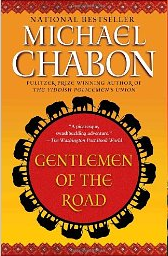
Day 278: Gentlemen of the Road

Cover for Gentlemen of the RoadGentlemen of the Road is like a boy’s adventure story for adults. Before 1000 AD, Zelikman and Amram are two adventurers travelling in the Caucasus Mountains. They make money by faking fights to be wagered on. Zelikman is a thin, gawky physician from Regensburg who has broken with his family, while Amram is a giant of an ex-soldier looking for his daughter, who was stolen from his village.

An old man hires the men to escort an unwilling young boy named Filaq to his grandfather. The boy’s father was a bek in Khazaria, a legendary Jewish country on the Caspian Sea, when he was murdered by a rival. The boy wants to return to take his revenge, but the rival is having his entire family murdered and enslaved. Filaq eventually persuades Zelikman and Amram to return to Khazaria and help him retake his father’s position.

Chabon originally published this novel as a serial in the New York Times Magazine, ending each chapter with a cliffhanger. He obviously had a great time writing it and it is lots of fun to read, with colorful characters, exotic settings, and deeds of derring-do.

Day 272: Moby Dick or, The Whale

Cover for Moby DickThose who know me well will be surprised to see me reviewing this book, because one of my stories is of my horror, when first trying to read it, to find an entire chapter about one rope. At that point, Moby Dick became the first book I ever stopped reading. However, I got interested in trying it again by listening to the Moby Dick Big Read. I listened to the beginning chapters and finally picked up a copy to finish it.

The plot, of course, is about the sailor Ishmael, who decides to go whaling for the first time, the people he meets, and his experiences–and about the obsession of his captain, Ahab, to kill the whale that took his leg.

Moby Dick is not for everyone. The novel is not simply an adventure tale about whaling but also a dissertation on whaling history, a series of philosophical essays, an explication on types of whales, on the different parts of a whale, on pieces of whaling equipment (hence, the chapter on the rope), even a musing on the color white.

The novel also has a sort of schizophrenic narration, starting out as first-person limited from the point of view of Ishmael, but then at other times taking the point of view of Ahab. The writing style rips back and forth from simple story telling to a kind of heightened, bombastic oratory. Characters do not so much speak as give speeches.

The novel is immense, but it is meant to be immense–the way Melville saw America and its possibilities. I have over the years read different interpretations of this work (the whale as a symbol of evil, etc.), but one that strikes a chord with me is that it is a reflection on some of the American political ideas of the time, particularly Manifest Destiny. While seeming to admire the grandiosity of such ideas, Melville is, with one whaling story, also warning of their possible effects and ramifications.

I can see why some academics have devoted their careers to this work, because it can be endlessly examined and interpreted. I finished reading it this time, but I can frankly admit that it is still a bit too much for me and is probably better suited for someone who is more contemplative in his or her reading.

Day 230: The Candlemass Road

Cover for The Candlemass RoadBest book of the Week!
At first The Candlemass Road seems like it will be a romantic adventure story similar to Lorna Doone, but George MacDonald Fraser was an expert on the border counties of England and Scotland and far too cynical for that, so it is an adventure certainly, but not a romance.

Lady Margaret Dacre has not been home to Askerton Hall in Cumberland since she was four years old, but now her grandfather Lord Ralph Dacre has been murdered and rumor has it that Lady Margaret has been sent away from court by Elizabeth I herself. At the beginning of the novel, all of the hall’s servants, including the narrator Frey Luis Guevara, a Catholic priest, are frantically preparing for her arrival.

Young and beautiful, she arrives in a temper. She has been accosted on the road by George Bell, one of her tenants, who has come to complain that he has received no help from her bailiff about the dreaded Nixon clan, who has demanded blackmail. None of Lord Dacre’s tenants have had to pay blackmail because he protected them, but after his death, his men at arms all departed.

When Lady Margaret asks Land Sergeant Carleton for protection for her people, he says the problem lays outside of his purview–he has merely come to pick up a prisoner. Incensed, Lady Margaret refuses to give him the prisoner, who was caught stealing bread and cheese from the kitchen.

The thief is a broken man–that is, one who has no master or clan–named Archie Noble the Waitabout. Lady Margaret is about to let him go free when she finds he got his horse from a famous villain, who tried to murder him in his camp. Already angered by Archie’s impudence, Lady Margaret declares him a murderer and threatens to hang him unless he goes by himself to aid the Bells, whose blackmailers return that night.

The short novel is beautifully written with dialog in a northern dialect that is still understandable, with Elizabethan expressions thrown in. The novel is an exciting yet chilling and occasionally humorous picture of the time and place.

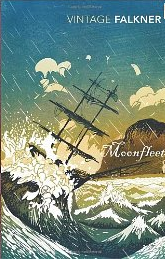
Day 151: Moonfleet

Cover for MoonfleetMoonfleet is a boy’s adventure story similar to Kidnapped or Treasure Island. Written by J. Meade Falkner in 1898, it was very popular for many years. I had actually never heard of it but picked it up out of curiosity a couple of years ago.

John Trenchard is an orphan boy who lives with his aunt in the small village of Moonfleet in the south of England in 1757. The village has been dominated by the Mohune family for centuries. There is a legend that Colonel John “Blackbeard” Mohune stole a diamond from King Charles I and that his ghost roams the crypts looking for it.

One day John hears noises from Mohune’s crypt, and when he goes to investigate, finds the landlord of the local inn, Elzevir Block, and Mr. Ratsey, the sexton, who say they are looking for damage from a storm. John assumes they are looking for Blackbeard’s ghost. He finds his way into the crypt through a large sinkhole and gets inadvertantly trapped there overnight. While he is trapped there, he overhears enough to realize that Block and Ratsey are actually smugglers.

John’s aunt assumes he has been up to no good when he doesn’t come back for the night, so she throws him out of the house. Fortunately, Block takes him in. But when Block’s lease expires, the lease goes up for auction and is purchased by Maskew, the unpopular local magistrate. Before Block leaves the area, John accompanies him on one last smuggling venture, during which Maskew, who has lain in wait for the smugglers with the excisemen, is accidentally shot by the excisemen. John is wounded and is falsely accused in absentia of murdering Maskew, so he must flee to the continent.

The rest of John’s adventures include diamond hunting, being imprisoned for theft when he is cheated by an avaricious diamond merchant, working as a galley slave, and shipwreck. Moonfleet is an exciting book with a gripping story line that is still popular with children.

Day 64: The River of Doubt: Theodore Roosevelt’s Darkest Journey

Cover for River of DoubtIn 1913, ex-President Theodore Roosevelt departed on a trip up an unknown river in the Amazon with a party that included his son Kermit, Brazil’s most famous explorer Candido Mariano da Silva Rondon, and the naturalist George Cherrie. Because the trip was originally planned to be less challenging and also because it was provisioned (by the leader of a failed arctic expedition) with more of an eye to comfort than practicality, the party soon found itself in dire straits, and by the end of the trip Roosevelt was near death.

In The River of Doubt: Theodore Roosevelt’s Darkest Journey, Candice Millard writes a compelling tale of this dangerous journey to a completely unexplored region, which ended by putting a 1000-mile river on the map of Brazil. In a hostile environment that the explorers found strangely lacking in food, they were at times very close to attack from the Cinta Larga Indians, who had only had a small amount of exposure to Brazilian rubber hunters–and that had been violent. The group also had to deal with boats that were unsuited to the rapids they encountered, disease, dangerous animals, and theft and murder by one of their party.

Whether Millard is explaining the scientific reasons behind the jungle’s apparent lack of food, the geology of the region, or the dramatic events of the trip, she writes with absolute clarity and interest. Although this book reminded me a great deal of The Lost City of Z, which I reviewed earlier and also enjoyed, I thought it was much more interesting and better written.

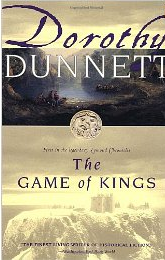
Day 61: The Game of Kings

Cover for Game of KingsBest Book of Week 13!

If you love an authentic, well-researched, exciting historical novel that makes you almost feel like you are in the period, then I can’t recommend a better author than Dorothy Dunnett.  I have been trying to get people to read her for years with the caveat that her books are challenging, not for the reader of light romantic history.

Lady Dunnett is described on her Wikipedia page as a “leading light in the Scottish arts world and a renaissance woman.” Her books are loaded with detail about medieval customs, dress, politics, religion, food, and literature, and have labyrinthine plots full of action. She is most renowned for two series, the Lymond Chronicles, written in the 1960’s and 70’s and set in 16th Century Europe and Africa, and the House of Niccolò, written in the 1980’s and 90’s and set in 15th Century Europe, Asia, and Africa. Dunnett died shortly after finishing the last book in this series.

Game of Kings is the first book in my favorite series, the Lymond Chronicles. Francis Crawford of Lymond makes a rollicking and disruptive re-entrance into his home country of Scotland despite the charge of treason hanging over his head. He forms a band of outlaws and begins roaming around the countryside, sneaking across the border to play tricks on the British and harassing his own family. For quite some time, you don’t know whether he is a hero or a villain. He never explains himself, so it is left up to the reader (and the other characters) to figure out his motives for sometimes seemingly wrongful acts. His enemies think he is responsible for the explosion that killed his sister and is trying to murder his older brother Richard so he can inherit the estate. His friends are absolutely devoted to him but suffer doubts when he misbehaves, as he often does. His brother doesn’t know what to think, and his mother, Sybilla, is silent.

Francis is a mimic and a rogue, a musician and a polyglot, a poet and a swordsman, as swashbuckling a character as you will ever meet with in a novel. In among the action of cattle raids, impersonations, intrigues, duels, and archery contests, you actually learn a lot about Scottish history and politics.

Game of Kings is Dunnett’s first book, and my only criticism of it is that Lymond is a bit too fond of quoting poetry in antique languages. Most of it is incomprehensible unless you are a medieval scholar, but skipping over it does not hurt your understanding of the novel. Dunnett does this much less in the other books in the series. If you read this book and continue with the series, by the second book you won’t be able to stop.

Day 51: With Fire and Sword

Cover for With Fire and SwordBest Book of Week 11!

Two years ago I read an exciting trilogy of Polish novels written in the 19th Century by Henryk Sienkiewicz, a Nobel prize winner for lifetime achievement in writing epic literature. The books were wildly popular for about 50 years, and Polish friends of mine tell me that they were their childhood reading. My review of the trilogy was published on Nancy Pearl’s blog (the librarian who has her own action figure), and I wrote to her awhile back asking if I could republish it here. She did not respond, so without further ado, I am going to write another review of the first book, With Fire and Sword. I will of course crib from my original review. The three books are stand-alone but with recurring characters, so you can read just one without missing important plot points.

It is 1647, and the Polish-Lithuanian Commonwealth is having some trouble—there are rumblings of rebellion among the Cossacks, who are a major force in the Polish army. Yan Skshetuski is a young Polish officer in the hussars of the Ukrainian Prince Yeremi Vishnovyetski. Prince Yeremi sends him on a mission as an emissary to Bohdan Hmyelnitzki, the leader of the Cossack rebellion. Yan has just become engaged to the beautiful Helen, but duty calls, so he makes his way through down the river to where the Cossacks are gathering.

Yan has been sent too late, though, for the rebellion has already started when he arrives, and he is made a prisoner. He escapes with difficulty and makes his way through the war-torn landscape, all the time worrying about Helen.

The political situation in Poland is very unstable, so no one comes to Prince Yeremi’s aid as he is attacked by hoards of Cossacks from the southeast. Even though Helen has been kidnapped by the wild Cossack Bohun, Yan cannot take time to look for her because he is embroiled in another mission for the Prince. So, his friends, the fat buffoon Pan Zagloba, the lovelorn knight and master swordsman Michal Volodyovski, and the gentle Lithuanian giant Longinus Podbipyenta decide to help Yan by rescuing Helen themselves.

This novel is all adventure and romance, and it is truly exciting. Along the way, you learn something about 17th century Polish history.

If you are interested in reading the book, you may have  a hard time finding it (although I see it is available in a print-on-demand basis). It is also available in several translations, about which there is some debate. The original translation by Curtin is said to be truer to the book, but I took a look at it, and it is also fairly badly written. The translation that I read by Kuniczak takes some liberties with the structure of the novel, but is eminently readable, if you can find it. The cover picture at the beginning of the article is from the edition that I read.