Review 2057: The Man in the Brown Suit

The Man in the Brown Suit is one of Agatha Christie’s early novels, and it isn’t quite like any of her others. Although it has a mystery of sorts, it’s not really one readers can figure out. Instead, it’s more of a romance/adventure story. The only thing that links it to some of her other novels is the presence of Colonel Race.

Anne Beddingfield has led a boring life, so when her father dies, the first things she wants is adventure. It seems obvious to her that she should go to London. While she is standing at the end of the train platform with another man, he looks up behind her and sees something that makes him back up quickly and fall off the platform in front of the train. When a man claiming to be a doctor checks him, Anne notices that he doesn’t check him correctly and in fact takes something from his pocket. She follows him out of the station and picks up a paper that he drops.

The man had been wearing a brown suit, and when Anne hears that a man in a brown suit is suspected of murdering a woman in a vacant house belonging to Eustace Pedler, she connects the two. She also figures out that the paper indicates an assignation to take place on a ship bound for South Africa, so she buys a passage on the ship.

The novel is written in such a jaunty style that it’s hard to take its dangerous situations seriously, and Anne has a rather primitive idea of a romantic partner (as are the ideas she expresses about men and women), but the novel is entertaining, as Anne falls into one predicament after another. She ends up with proposals from three different men, and although I think she picks the wrong one, Christie has had an exercise in fun.

Related Posts

The Seven Dials Mystery

Death on the Nile

Destination Unknown

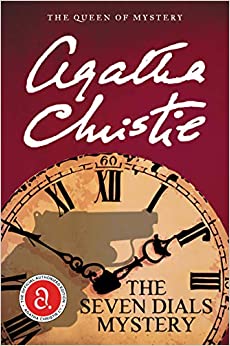
Review 2052: #1929 Club! The Seven Dials Mystery

It seems like whatever year is chosen for this club, this time 1929, there is an Agatha Christie book to be read. This time, it’s one of her earlier books that does not feature any of her well-known sleuths and is more of a satire on thrillers than a real mystery. This book also qualifies for R. I. P. XVII.

The young people staying at the home of Lord Coote decide to play a joke on Gerry Wade, who is known for sleeping late. They go to town and buy a bunch of alarm clocks to sneak into his room overnight and set to go off in the morning. However, in the morning Gerry is found dead of an apparent overdose, and seven of the eight clocks are arranged on the mantelpiece instead of on the floor, where they had been left.

Even though Gerry is known as a deep sleeper, the inquest brings in a verdict of accidental death, but Jimmy Thesiger thinks otherwise and gets “Bundle” Brent, Lord Caterham’s daughter, to help investigate. Their friend Ronny Devereux, who works in the foreign office, seems to have some idea of why Gerry might have been killed, but then he is shot to death.

Jimmy and Bundle get on the trail of a secret society known as the Seven Dials that is based in a hidden room in a nightclub. The crimes may revolve around plans to be leaked to the Germans.

The Seven Dials Mystery is Christie’s tongue-in-cheek answer to the thrillers that were popular in its time. Think The Thirty-Nine Steps. It is not entirely effective, but it has some witty dialogue and a few twists.

Related Posts

By the Pricking of My Thumbs

Destination Unknown

Sleeping Murder

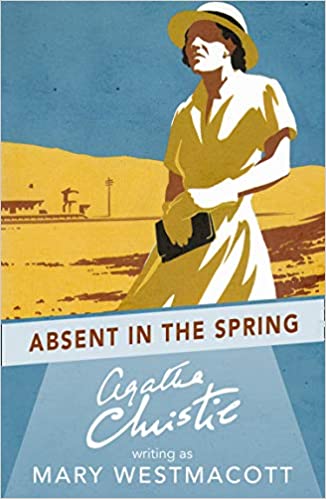
Review 1870: Absent in the Spring

For some reason, I always thought that the novels Agatha Christie wrote as Mary Westmacott were romance novels. Absent in the Spring, however, is a character study with an edge, reminding me more of some of the novels of Elizabeth Taylor.

Middle-aged Joan Scudamore gets stranded for several days at a guest house on her way from Baghdad to London. Before this happens, there is a revealing encounter between her and an old school friend, Blanche Haggard. Joan is judgmental toward Blanche, thinks she looks old and untidy and blames her appearance on the unfortunate choices she has made in life. Blanche cheerfully admits her bad choices but says she has enjoyed her life. She also hints at something about Joan’s daughter Barbara. We realize we like Blanche more than Joan.

During the five days Joan is stranded, she begins reconsidering her self-satisfied attitude, realizing some truths about herself and her family that she has hidden from herself. It is clear to the reader that she has bullied her husband and children, but she sees her behavior as doing her best for them. She thinks she has helped them to happy lives, but she has tried to make them all do what she thinks is right.

The big question is whether Joan can change her attitude. Let’s just say the novel is much more in the Realism school than Christie’s mysteries.

And by the way, let me just state my objection to this book being relabeled under Christie’s name. On the cover of my edition, the Christie name is more noticeable than Westmacott. Although I see no harm in acknowledging somewhere that they’re the same person, this is a marketing ploy that I don’t agree with. She wrote the book under the name Westmacott, so that should be the predominant name.

Related Posts

Appointment with Death

A View of the Harbor

Tales from the Queen of the Desert

Review 1840: #1954 Club! Destination Unknown

I read Destination Unknown for the 1954 Club, and it is really more of a suspense/espionage novel seemingly based on Cold War politics than it is one of her usual mysteries. It is also not nearly as effective.

Thomas Betterton is just the latest of a series of scientists and researchers who have seemed to drop off the face of the earth. Although his wife Olive says she doesn’t know where he is, Jepson and his colleagues in a labyrinthian government office building think he has defected. When Olive asks for permission to travel for her health, they decide to have her followed.

Hilary Craven has left England for Morocco in the hope that a change of scenery will lessen her despair after first her husband left her for another woman and then her only child died of meningitis. But it doesn’t help, and she soon is going from pharmacy to pharmacy collecting sleeping pills. She is about to take them when Jepson bursts into her room with an alternative. The plane she was supposed to take to Morocco has crashed. She missed it and got another one, but Olive Betterton was on it. Both women are physically similar and have red hair. Will Hilary take Olive’s place and hope to be contacted, to try to find out where the scientists are even though it’s likely she won’t survive this mission? She agrees.

Although there are some complicated strands to the plot, not only is the novel not a mystery but it doesn’t feature the deft characterization or humor that are usually part of Christie’s books. Not one of her best, I’m afraid.

Related Posts

Appointment with Death

By the Pricking of My Thumbs

Taken at the Flood

Review 1735: #1976 Club! Sleeping Murder

With the 1976 Club looming, I picked out some books to read for October that were published in 1976. Sleeping Murder also qualifies for RIP XVI! As usual, on this first post I’m also listing anything else I’ve reviewed published in 1976. As far as I know, there are only two:

Newlywed Gwenda Reed is house hunting along the south coast of England for herself and her husband Giles, both newly arrived from New Zealand. When she comes across a house in Dillmouth, she immediately feels at home there, although she experiences a fleeting panic on the stairs. Nevertheless, she buys the home.

Gwenda is residing in it to oversee updates to the house when she begins to experience something odd. She expects the stairs down from the terrace to be in one place but they are in another. When workmen remove some bushes where she thinks the steps should be, they find the stairs used to be there. Similarly, she keeps trying to walk through the wall in the dining room where she thinks there should be a doorway. When the workmen examine the wall, they say it had a door there. She imagines a particular wallpaper in what used to be the nursery, and when a blocked cupboard in that room is opened, she sees that wallpaper inside.

Gwenda is most upset because she’s had a vision of a woman dead at the bottom of the stairs and realized it was Helen. But she has no idea who Helen is. Feeling confused, she decides to consult friends in London. Accompanying the group out for the evening is her friends’ aunt, Miss Jane Marple. After she explains what’s been happening, Miss Marple says she should find out if she ever lived in England as a child.

Inquiries find that Gwenda lived in the house when she was three. At the time, her father had a second wife named Helen. But Helen supposedly ran off with another man. Gwenda and Giles find that Helen’s half brother, Dr. Kennedy, still lives in the area. He has some letters that she sent right after she left but hasn’t heard from her since.

Gwenda and Giles begin to believe that Helen was murdered. Did Gwenda’s father kill his wife, or did someone else?

It was hard for me to judge whether this was a difficult mystery, because I vividly remembered a TV production of it. However, knowing the identity of the killer made me appreciate how skillfully Christie salts in the clues without giving too much away. The characters are clearly defined, and Miss Marple is at her cleverest.

Related Posts

4:50 from Paddington

At Bertram’s Hotel

Murder at the Vicarage

Review 1646: The 1936 Club! The ABC Murders

Of course, you must pick an Agatha Christie for the 1936 Club, and my choice was The ABC Murders. In this novel, it appears at first as if Christie is telling us everything but motive. However, she has some tricks up her sleeve as usual.

Captain Hastings returns from South America to find Hercule Poirot retired but still taking the occasional case. Soon, one arrives in the form of a letter, which challenges Poirot and tells him to look for news from Andover on a particular date. On that date, an old woman named Mrs. Ascher is killed by being bludgeoned over the head. On the counter is an ABC map.

The next letter refers to Bexhill-on-Sea. On the specified date, Betty Barnard is strangled on the beach and an ABC is found underneath her body.

In between entries from Captain Hastings’ journal, we briefly follow a man named Alexander Bonaparte Cust.

Round about page 75, I got an inkling about something that might be happening, and I was right. But the whole picture was more complicated than I guessed.

This wasn’t my favorite Christie. For one thing, the solution was just too complicated. For another, I didn’t feel as if Christie’s characterizations were as rich as usual.

Related Posts

Appointment with Death

By the Pricking of My Thumbs

Murder at the Vicarage

Review 1407: Murder at the Vicarage – #1930Club

I decided to reread Murder at the Vicarage for the 1930 Club, but it also applies to Readers Imbibing Peril. It is the first Miss Marple book, and for much of it she seems like a minor character.

The novel is narrated by Len Clement, the vicar of St. Mary Meade. He is called away one evening by what proves to be a false call for help. He arrives home late for a meeting with Mr. Protheroe, a wealthy man who is disliked by many. In his study he finds Protheroe dead, shot in the head.

Of course, there are lots of suspects and red herrings. Mr. Hawes, the curate, is behaving oddly. Mrs. Protheroe had just decided to part from Lawrence Redding, who is in love with her. Lettice Protheroe has inconsistencies in her alibi. Rumor reports that a local poacher has a grudge. A team exploring the local barrow seems to be up to something besides archaeology.

No sooner does Inspector Slack appear on the scene when first Lawrence Redding then Anne Protheroe make confessions of guilt. Miss Marple lives next to the vicarage so has some testimony to offer about its comings and goings. And she also has some interesting ideas about who may be guilty.

Related Posts

4:50 from Paddington

At Bertram’s Hotel

A Caribbean Mystery

Review 1351: Taken at the Flood

Cover for Taken at the FloodHercule Poirot is the interested listener to the club bore one evening in 1944. Major Porter tells the story of a widow who went on to marry Gordon Cloade, a wealthy man. Mr. Cloade was recently killed in the blitz, but Porter’s story is about Mrs. Cloade’s previous husband, Captain Underhay. Underhay reportedly made remarks to the effect that if he was reported dead, he may not be. Instead, he might return to his widow under the name Enoch Arden, a reference to a poem. Later, he was reported dead in Africa.

Two years later, Poirot is consulted by another Mrs. Cloade, the sister-in-law of the woman from the story. She wants Poirot to find Robert Underhay, whom she believes may be alive. She presents this request as a favor to Rosaleen Cloade, the widow of Gordon Cloade, but in fact, the Cloades, who were taught to depend on Gordon financially, were disinherited by Rosaleen when Gordon died intestate. If Robert Underhay can be found to be alive, Rosaleen’s marriage to Gordon will be nullified, to the benefit of the rest of the Cloades. Two days later, Poirot reads that a man named Enoch Arden was found dead in Warmsley Vale, the home of the Cloades.

Who killed Enoch Arden? It seems that the only people with a motive are Rosaleen Cloade and her brother, David Hunter, assuming Enoch Arden was Captain Underhay. But was he?

This is a complicated mystery and not one of Christie’s best. Her talent for portraying characters is lacking in this novel, as many of them seem flat.  It also seems unlikely that anyone would ever guess the culprit, so few clues point in that direction.

Related Posts

Appointment with Death

At Bertram’s Hotel

Death on the Nile

Day 1154: Agatha: The Real Life of Agatha Christie

Cover for AgathaI occasionally read a graphic novel, but I am not at all attracted to the superhero kind. Although they generally have very polished illustrations, I don’t find them imaginative and am more attracted to unusual subjects.

Agatha is a biography in graphic novel form of Agatha Christie. It begins with her mysterious disappearance of 1926, something that has never been fully explained. (I confess, I prefer the Dr. Who explanation, in which she was off with the doctor fighting a giant alien wasp.) Then it covers the major events of her life from a girl. To add a touch of whimsy, her major detective characters appear occasionally to talk with her.

I’ve noticed that some graphic novels use the illustrations to tell parts of the story, while others depend heavily on the text. This novel is one of the latter. I would also comment that the illustrations are more workmanlike than beautiful. But they are interesting, colorful, and convey the story.

It’s difficult for me to rate a graphic novel as a book. This one, for example, makes no effort to build up to a climax as fiction would. It is more like a biography without the depth and without the effort to be accurate about details of the times. For example, when Christie is a nurse during World War I, they have her introducing herself to the patients, something that would not have been allowed.

All in all, I appreciate the subject matter, but I have been more impressed by some other graphic novels in terms of beauty of artwork and effectiveness of story line. So far, Hannah Berry is my favorite.

Related Posts

Maus I

Britten and Brülightly

RASL: The Lost Journals of Nicola Tesla

Day 1145: By the Pricking of My Thumbs

Cover for By the Pricking of My ThumbsBy the Pricking of My Thumbs is one of the books I read for the 1968 Club. It is one of Agatha Christie’s Tommy and Tuppence novels.

Tommy and Tuppence are a witty and urbane middle-aged couple who used to be involved in some sort of secret service organization.  The novel begins with a visit to Tommy’s Aunt Ada at a retirement home, where Tuppence makes the acquaintance of a Mrs. Lancaster. Mrs. Lancaster asks Tuppence if it was her child and talks about a child hidden behind a fireplace.

After Aunt Ada dies a few weeks later, Tuppence asks after Mrs. Lancaster only to learn that she was abruptly removed from the home. Before she left, she gave Aunt Ada a painting of a house that seems familiar to Tuppence, and she uses the excuse of trying to return the painting to find Mrs. Lancaster. For some reason, she fears that the woman is in danger.

1968 club logoTommy is away at a conference when Tuppence begins trying to track down Mrs. Lancaster. The address left for her at the retirement home is a hotel, which has no record of her. All inquiries seem to dead end, so Tuppence begins looking for the house.

Although Tommy and Tuppence are vibrant, I did not feel that the other characters showed Christie’s usual talent for adroit characterization. Even though they eventually connected, the two strands that the investigation uncovers make the novel overly complicated. I could have done without the crime syndicate angle and thought it was unnecessary to the story. Besides, the other thread was much more chilling. Still, I enjoyed reading this Tommy and Tuppence novel.

Other Books for the 1968 Club

Aside from the reviews I’ve published this week, here’s a list of other books published in 1968 that I previously reviewed:

Related Posts

Appointment with Death

At Bertram’s Hotel

Death on the Nile