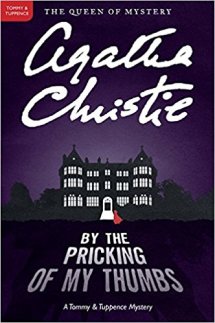
Day 1145: By the Pricking of My Thumbs

Cover for By the Pricking of My ThumbsBy the Pricking of My Thumbs is one of the books I read for the 1968 Club. It is one of Agatha Christie’s Tommy and Tuppence novels.

Tommy and Tuppence are a witty and urbane middle-aged couple who used to be involved in some sort of secret service organization.  The novel begins with a visit to Tommy’s Aunt Ada at a retirement home, where Tuppence makes the acquaintance of a Mrs. Lancaster. Mrs. Lancaster asks Tuppence if it was her child and talks about a child hidden behind a fireplace.

After Aunt Ada dies a few weeks later, Tuppence asks after Mrs. Lancaster only to learn that she was abruptly removed from the home. Before she left, she gave Aunt Ada a painting of a house that seems familiar to Tuppence, and she uses the excuse of trying to return the painting to find Mrs. Lancaster. For some reason, she fears that the woman is in danger.

1968 club logoTommy is away at a conference when Tuppence begins trying to track down Mrs. Lancaster. The address left for her at the retirement home is a hotel, which has no record of her. All inquiries seem to dead end, so Tuppence begins looking for the house.

Although Tommy and Tuppence are vibrant, I did not feel that the other characters showed Christie’s usual talent for adroit characterization. Even though they eventually connected, the two strands that the investigation uncovers make the novel overly complicated. I could have done without the crime syndicate angle and thought it was unnecessary to the story. Besides, the other thread was much more chilling. Still, I enjoyed reading this Tommy and Tuppence novel.

Other Books for the 1968 Club

Aside from the reviews I’ve published this week, here’s a list of other books published in 1968 that I previously reviewed:

Related Posts

Appointment with Death

At Bertram’s Hotel

Death on the Nile


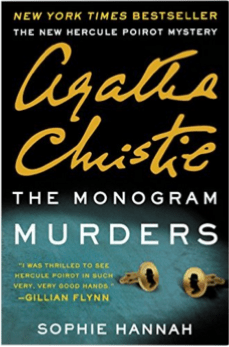
Day 900: The Monogram Murders

Cover for The Monogram MurdersThe Monogram Murders is the first Hercule Poirot mystery written since Agatha Christie’s death that was approved by her estate. It is written by the British thriller writer Sophie Hannah, whose books I have enjoyed. I was curious to see how authentic the novel seemed as a Christie mystery.

Hercule Poirot visits Pleasant’s Coffee House every Thursday night because he finds that its delicious coffee activates the little grey cells and he likes the astute observations of a waitress named Fee. One evening a regular patron comes in disturbed, behaving as if she fears for her life. When Poirot tries to convince her to confide in him or go to the police, she runs away. All Poirot can find out about her is that she works in some large house across town and her name is Jennie.

Hercule returns to his rooming house to confide in his fellow lodger, Mr. Catchpole, who works for Scotland Yard, but Catchpole is disturbed by having just attended the scene of a murder. Three people have been found dead at the exclusive Bloxham Hotel, and each had a monogrammed cufflink in his or her mouth.

Investigation soon finds that the two women victims, Harriet Sippel and Ida Gransbury, both lived in the small town of Great Holling. They traveled up separately to London and had rooms on different floors, but they both had tea with the third victim, Richard Negus, at 7:15 PM. They were all found dead in their rooms after 8 PM.

It soon becomes clear that the deaths have something to do with a tragedy years before in Great Holling, when lying rumors about the town’s vicar resulted in the loss of his reputation and the subsequent suicides of his wife and himself. The three dead were the couple’s biggest traducers, and a servant named Jennie Hobbs told the original lie. But who is the murderer? Some pieces don’t fit.

So, how does The Monogram Murders stack up against other Christie mysteries? It is certainly as complex as any other Poirot mystery and as difficult a puzzle. Hercule Poirot is very much himself. Catchpole is a suitably dense sidekick, a bit reminiscent of Mr. Watson in another series. The novel is engaging and interesting. The one distinctive characteristic of Christie’s novels that it lacks are her deft characterizations, her way of making readers be able to visualize them with just a few sentences. Still, this novel makes a fairly worthy entry into the series.

Related Posts

At Bertram’s Hotel

Death on the Nile

The Truth-Teller’s Lie

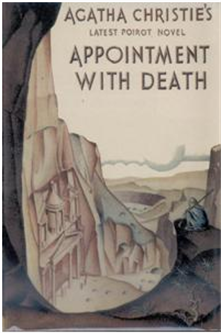
Day 387: Appointment with Death

Cover for Appointment with DeathHercule Poirot is in his hotel room in Jerusalem when he overhears two people discussing a murder. He finds that these two people, Raymond Boynton and his sister Carol, are discussing their stepmother, a sadistic, manipulative, demanding head of a wealthy family. The family is part of the expedition Poirot is taking to Petra.

All of the family are traumatized by their mother’s behavior. Raymond and Carol are eager to escape from their stepmother’s control. Their sister Ginevra is barely attached to reality. Lennox, the oldest son, rarely speaks, and his wife Nadine is threatening to leave him.

Poirot finds the rest of the party in the camp at Petra interesting. Sarah King is a studying psychiatrist who is romantically interested in Raymond, but Raymond does not have the courage to tell his mother. Dr. Gerard is a famous French psychiatrist. Lady Westholme is a well-known politician, and she is accompanied by her friend Miss Pierce.

When Mrs. Boynton dies, the cause is not clear. She was overweight and in poor health. Did she die of natural causes, or was she murdered? If she was murdered, there are plenty of suspects in their party, most of them in her own family. Colonel Carbury, an official assigned to the case who is known to Poirot, asks him to help.

This novel is not one of Christie’s best, even though she continues to deftly draw believable characters. It is marred by some silly psychobabble that was probably popular at the time. Perhaps Christie was trying to reflect then-modern topics of conversation, or perhaps she was writing dialogue that would be typical of the two psychiatrists. In addition, she pulls one of her tricks, making the solution depend upon information that is not possible for the reader to know.

Day 360: 4:50 from Paddington

Cover for 4:50 from PaddingtonWhile traveling by train, Miss Marple’s friend Elspeth McGillicuddy witnesses a murder on another train along a parallel track. The police find no trace of a victim, so they are inclined to think Mrs. McGillicuddy imagined the incident. Miss Marple knows her friend, however, and imagination is not her strong suit.

Jane believes the body must have been thrown off the train near an estate called Rutherford Hall. She sends her friend Lucy Eyelesbarrow in as a housekeeper to investigate, and Lucy eventually finds the body, not lying somewhere in the bushes along the track, but hidden away.

The money from the estate will eventually be divided among the grown children of Luther Crackenthorpe, a semi-invalid widower, while the house will go to his eldest surviving son. But does that have anything to do with the murder? All of the children seem to have their secrets. Cedric is a bohemian painter who lives in Ibiza, Harold is an aloof banker, Alfred is engaged in shady business deals, and Emma is a spinster who is in love with Dr. Quimper, Luther’s doctor.

The biggest puzzle is to identify the body. Who is the woman murdered on the train, and why does Lucy find her in a sarcophagus among a bunch of antiques in the stables? Soon Miss Marple is on the scene visiting Lucy at tea time. The solution will soon be divulged, we feel.

Christie is great at drawing convincing characters, and Lucy is one of her most attractive. We wish we could see more of her. 4:50 from Paddington is yet another entertaining mystery from Christie.

Day 340: Death on the Nile

Cover for Death on the NileIn this classic Agatha Christie mystery, Hercule Poirot observes a young couple at a restaurant in London and thinks their behavior indicates that the woman loves the man too much. A few months later he meets them again in Egypt, but the man, Simon Doyle, has married the woman’s rich friend Linnet. The first woman, Jacqueline de Bellefort, is haunting their every move during their honeymoon. Poirot thinks no good can come of it and tries to tell Jackie to leave the Doyles alone.

The Doyles sign on for the same Nile river cruise as Poirot. To their fury, Jackie appears on board. Also on board is Poirot’s friend Colonel Race. Race is hunting a criminal who has murdered several people. He believes the person is on board, but has not been able to identify him.

On a tour of some ancient ruins, a boulder falls, nearly missing Linnet and Simon. The obvious suspect is Jackie, but she was on the boat the entire time.

That evening, the drunken Jackie makes a scene in the lounge and then shoots Simon in the leg. The next morning Linnet is dead from a gunshot wound, but both Simon and Jackie seem to have solid alibis. The nurse was with Jackie all night, and Simon was incapacitated with his injury. Poirot and Colonel Race begin looking into other enemies that Linnet may have had.

I think Agatha Christie is the best of the “Golden Era” mystery writers at characterization. She quickly sketches convincing and sympathetic characters. Sometimes you even sympathize with the murderer. Her books are also often set in exotic locations and give you a flavor of a certain place and time. I always find Christie’s mysteries to be enjoyable, and they make fun beach reading.

Day 319: Murder on the Orient Express

Cover for Murder on the Orient ExpressMurder on the Orient Express is Agatha Christie’s classic mystery featuring Hercule Poirot. Everyone has of course seen the lush 1974 movie featuring a flock of movie stars and Albert Finney as Poirot.

Hercule Poirot is visiting Istanbul when he unexpectedly receives a telegram prompting him to cancel his plans and book a seat on the Orient Express leaving that night. He is able to book a compartment in first class, but only after some difficulty.

Poirot’s fellow passengers include a Russian princess, a Hungarian count and countess, a Swedish missionary, a British colonel, an annoying American widow, and other unusual characters. As always with Christie, her characters are expertly and colorfully drawn.

On board the train, Poirot is approached by the repellent Mr. Ratchett, an American businessman who believes his life is being threatened, asking for protection. Poirot dislikes Ratchett and declines his offer.

After a disturbed night, during which Poirot is awakened by a cry and spies a woman in a lurid silk kimono walking down the hall, Ratchett’s body is found dead in his compartment. He has been stabbed 12 times. The railroad executive traveling on the train begs Poirot to attempt to solve the crime before the train reaches Yugoslavia.

It begins to look as if an intruder disguised in a railway uniform broke into Ratchett’s compartment and murdered him then escaped out into the snow. Poirot’s investigation turns up a suggestion that Ratchett was the leader of a gang who kidnapped and killed the child Daisy Armstrong (a crime based upon that of the Lindbergh kidnapping), resulting in much tragedy for the family. He also begins finding links between some of the passengers and the Armstrongs.

This particular mystery is famous not only for its exotic locales but also for the unusual solution to the murder. Despite my familiarity with the plot, it made enjoyable reading.

Day 242: The Tuesday Club Murders

Cover for The Tuesday Club MurdersThe Tuesday Club Murders is a collection of Miss Marple short stories structured around a club in which the members tell each other about crimes or mysteries and the others try to solve them. Of course, Miss Marple is the only member to get the right solution, even though some of the club members are eminent jurists and a Scotland Yard detective. As usual, the other members of the club, except a few most in the know, completely underestimate her.

I’m not that fond of crime short stories because there isn’t really enough room to develop much of a plot. In particular, the format chosen for this book is even more sketchy than usual because the characters involved are only described by the story tellers. You don’t end up with a mystery so much as a puzzle, and one that you probably don’t have enough information about to solve. But then, Christie often withholds information in her novels, too.

That being said, Christie’s biggest talent is her ability to sketch believable characters with just a few words. Of course, her humor is another asset. I may have only solved half the crimes, but I laughed a few times.

Day 227: At Bertram’s Hotel

Cover for At Bertram's HotelMiss Marple’s nieces and nephews don’t have much luck sending her off for a rest. At her niece’s expense, she is spending a week at Bertram’s Hotel, a place she remembers from her childhood. Although at first the hotel seems exactly the same as it was when she was young, Edwardian in appearance and yet offering every comfort despite the intercession of the war, Miss Marple can’t help feeling something isn’t right.

Another guest at the hotel is the dashing Bess Sedgwick, who has lived a life of excitement and glamor. By coincidence, her daughter Elvira, whom she deserted at the age of two, also is staying there. Soon Miss Marple has spotted them meeting separately with the notorious race car driver Ladislaus Malinkowski.

Befuddled Canon Pennyfeather goes to the airport to fly to his conference in Switzerland on the wrong day. Returning unexpectedly to his room at Bertram’s, he opens the door to find–something–but is knocked out and disappears.

In the meantime Chief Inspector Davy is investigating a huge crime network responsible for a series of robberies. In two of the incidents a witness claimed to see a reputable citizen who was actually somewhere far away from the crime at the time, but both of these men were staying at Bertram’s Hotel.

And soon there is a murder to solve. As with much of Agatha Christie’s work, the plot is overcomplicated and somewhat silly. Still, At Bertram’s Hotel is a lot of fun.

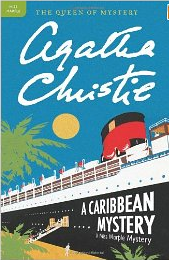
Day 74: A Caribbean Mystery

Cover for A Caribbean MysteryAgatha Christie is one of the best mystery writers of the so-called Golden Age of mystery writing because she so skillfully sketches believable characters and plots. Although many of the Golden Age mysteries concentrate on perplexing puzzles such as figuring out railway timetables, Christie was much more interested in the personality of the murderer and his or her motivations.

A Caribbean Mystery begins after Miss Marple has suffered a serious bout of pneumonia. Her affectionate nephew Raymond has arranged a vacation for her on an island in the Caribbean, where she can recover. But of course her vacation isn’t as restful as her nephew had hoped.

She is only half listening to boring Major Palgrave when he offers to show her the snapshot of  a murderer, but just then he sees something and quickly begins chatting about something else. That night he is found dead, apparently of a heart attack.

Miss Marple is having grave doubts about that heart attack when the chambermaid reports that before his death the Major Palgrave did not have the heart medication found in his room. Shortly thereafter, she is found stabbed to death.

Miss Marple begins sizing up her suspects. Molly Kendal, owner of the hotel with her husband Tim, has been behaving oddly, having nightmares and reporting blackouts and feelings of paranoia. Years ago, Greg Dyson’s wife died and he married her cousin Lucky within a month. Colonel Hillingdon and his wife Evelyn appear close, but are they really? And are they as friendly with the Dysons as they seem to be? The elderly and wealthy Mr. Rafiel is too feeble to be a murderer, but his secretary Esther Walters is secretive and Miss Marple spots his attendant Jackson skulking around.

As usual, Christie does a deft job of quickly limning believable characters and a complex mixture of motives and red herrings in a brief novel that is fun to read. I spotted the killer quickly but still enjoyed the book.