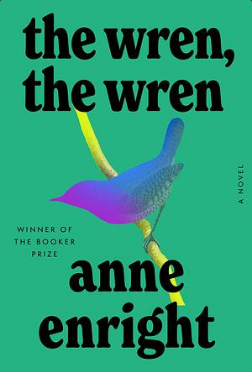
Review 2456: The Wren, The Wren

Just a quick note before my review: I’ll be posting during the next three weeks from various locations in the U. S., and Europe. So, my reviews may come out at funny times or may even be sporadic. I hope not.

The Wren, The Wren is the story of three generations of an Irish family and how they are affected by the desertion of a father.

The first section of the novel is narrated by Nell, the granddaughter of the Irish poet, Phil McDaragh. At first, her section is delightful—exuberant, funny, it made me laugh out loud. But then she unfortunately falls in love with Felim, neglectful and abusive.

The next section is from the point of view of Carmel, Nell’s mother and Phil’s daughter. She has a close relationship with Nell until Nell’s teen years, but she is haunted by memories of her father, who deserted his family while Carmel’s mother Terry was ill with cancer. It is Carmel’s memory that the last thing he did before he left was throw a tantrum about a missing wristwatch, which Carmel later spots on his wrist during a TV interview.

We briefly see a few things from Phil’s point of view, mostly about his own childhood, and chapters are separated by his poetry or by old songs translated from Celtic. There is a lot of bird imagery in all the sections. The McDaraghs are conscious of birds.

This is a powerful novel about lasting damage from a harmful act and the time it can take to heal. It is often funny, with a dry humor, and just as often sad.

Related Posts

The Green Road

The Gathering

So Late in the Day

Review 2428: The Green Road

The Madigan family centers its activities around Rosaleen, the mother. At the beginning of the novel, she takes to her bed, assuming the horizontal, after she learns her favorite son Dan is planning to become a priest. The family has to run itself around her until youngest daughter Hanna, the narrator of this chapter, returns from a visit to her brother with information that gets Rosaleen out of bed and on the attack.

In that chapter we learn of the tangled history of the village. The Considines, Rosalee’s family, always looked down on the Madigans, Rosaleen mocks other families for their pretentions, but it’s true that she married below her, and the Madigans have never made very much money. But Rosaleen doesn’t care about money. She would like her husband to fix a few things around the house, but he generally doesn’t.

The next chapter picks up eleven years later in 1991 New York City. This chapter is narrated by Greg Savalas, a gay man deeply in love with a man named Billy. Dan Madigan comes on the scene, and although he is not out, he begins an affair with Billy. This is the time when men are dying of AIDS, and Billy is suddenly stricken. Dan is not helpful.

Eleven years later we encounter oldest son Emmett, who is an aid worker in Mali. This chapter details his insufficiencies in his relationship with his girlfriend Alice.

The Madigans all seem to reserve themselves from deep attachments. The second half of the novel is set in 2005, when they all gather together for Christmas for the first time in years because Rosaleen decides to sell the house. It’s clear that everything is still revolving around her. We get more insight into Constance, the oldest daughter, who has her own family but is the only one left in the area to meet Rosaleen’s demands. Finally, there is Hanna, an actress who is not coping well with motherhood.

I always feel that Enright’s characters are absolutely believable and her families fraught with realistic complications. Her descriptions, too, of the Western Ireland scenery are gorgeous.

Related Posts

The Gathering

Small Things Like These

This Is Happiness

Day 295: The Gathering

Cover for The GatheringA large family in Ireland is gathering together for the wake of their brother, Liam, who drowned. Veronica Hegarty, his sister, travels to London to collect the body and keep vigil with it.

This novel follows her consciousness as she thinks about her relationships with her own husband and the rest of her family and considers why her brother’s life turned out the way it did. She describes Liam as a “terrible messer,” who was an alcoholic and finally put stones into his pockets and walked into the sea.

She also remembers her grandmother Ada, and imagines scenes involving her grandmother’s relationship to Veronica’s grandfather and to another man when she was a young woman. Veronica muses about life growing up in her grandparents’ house and the connection with her brother’s secrets and troubles. She feels guilty that she did not help him and that no one sympathized with him when he was alive.

This novel is angry, heavy, and sometimes repels the reader. By page 55, I felt that the narrator was inordinately concerned with the mechanics of men’s penises. Still, it is an evocative story about a woman’s grief and her struggle to understand her brother.