Review 1535: The House at Sea’s End

Forensic archaeologist Ruth Galloway is called in by DCI Harry Nelson when a group of archaeologists studying a Norfolk cliff find a collapsed cleft containing bones. There are six bodies, their hands bound. Ruth thinks they are recent, within the last hundred years, and all men.

Ruth’s university determines that the men were German, and Harry’s team begins concentrating on a time during World War II when the Home Guard of the village, Broughton Sea’s End, was preparing for a German invasion. The Home Guard men were led by Buster Hastings, father of the current owner of Sea’s End House, near where the body was found.

In the meantime, Ruth is struggling with the balance between her work, at the university and for the police, and her baby daughter, Kate. She is also concerned because Michelle, Harry’s wife, has been trying to befriend her, unaware that Kate is the result of a harrowing night during Ruth’s first case with Harry.

Aside from one ridiculously easy clue, I found this mystery much harder to guess than the first two. I continue to be interested in the characters and the setting, although it looks like we may be in for major melodrama in the next book. I like the concept of this series, which is inspired by the profession of Griffith’s husband.

Related Posts

The Crossing Places

The Janus Stone

206 Bones

Review 1528: The Janus Stone

In the second Ruth Galloway mystery, Ruth is called to a dig at a site of a mansion being converted to luxury flats, because bones are discovered under a doorway. The bones are a child’s, and Ruth is inclined to believe that the grave is more recent than otherwise.

DCI Harry Nelson begins looking at the building’s past as a children’s home. During that time, a teenage boy and his five-year-old sister disappeared. But the teeth put the death a little earlier, when the original family resided there.

This case hits Ruth a little more personally because she is pregnant. The child is Harry’s, the result of an emotional night during the last case, but Harry is married. Then someone begins leaving unpleasant surprises for Ruth.

Like with the first book, I easily guessed who the culprit was, in fact, almost as soon as the character appeared. It is hard for me to tell whether this would be obvious to most readers. I am interested in the characters, though, so I enjoyed the novel and look forward to reading more of the series.

I do want to say something about my Quercus paperback edition, which was not impressive. About halfway through the book, I came across a sticker that was printed over by the text of the book. Later, a half page cut zigzag fell out of the book. When I turned to that page, I found that half of the text was on the zigzag page and half was on the page fastened into the book, which was whole, leaving a zigzagged half-blank page. If the loose half page had fallen out of the book before I got it, I would not have been able to read that page.

Related Posts

The Crossing Places

Red Bones

206 Bones

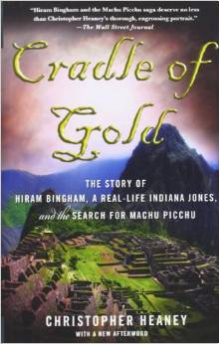
Day 541: Cradle of Gold

Cover for Cradle of GoldA few years ago I reviewed The Lost City of Z, which told about Percy Fawcett’s search for a fabled city in the Amazon jungle. That book alleged that Fawcett was a possible model for Indiana Jones. It is a minor point of Cradle of Gold that Hiram Bingham III is much more likely to be the model. Bingham was the man who brought the world’s attention to Machu Picchu.

At the time, Bingham was hailed by the western world as Machu Picchu’s discoverer, despite its being known about all along by the nearby farmers. Bingham’s story also has other examples of chauvinism and controversy, including his removal of artifacts without the permission of the Peruvian government. (He more or less permanently “borrowed” them.) Peru has only recently won a law suit against Yale University for the return of the collection, including many human remains. Still, Bingham is recognized even in Peru for his contributions to Peruvian history and archaeology.

The book begins in Hawaii, where Bingham was born the son of missionaries who expected him to study theology. But Bingham did not see himself taking up his father’s mantle. He was still fairly young when he took the money saved for his education and tried to embark for San Francisco. Although he was prevented from leaving and eventually ended up attending Yale University, he soon after became an explorer.

The book is named Cradle of Gold after Choqquequirau, supposedly the home of the Virgins of the Sun, which was the first site Bingham visited. He found it had been looted long before. Instead of pursuing it further, he became interested in finding Vilcabamba, the residence of Manco Inca, one of the last rulers of the Inca who was captured and slaughtered by the conquistadors. Initially attracted because no one knew what happened to Manco Inca’s great treasure, Bingham eventually became more interested in Incan history and artifacts.

This book is the engrossing story of Binghams’ origins and expeditions, his contributions to science, and the controversy that followed. Author Christopher Heaney is a Doctoral Fellow in Latin American history at the University of Texas, Austin. He has written a clear and interesting account for the general public but supported by extensive documentation. If you are interested in stories of exploration, you will like this one.