Day 848: RASL: The Lost Journals of Nikola Tesla

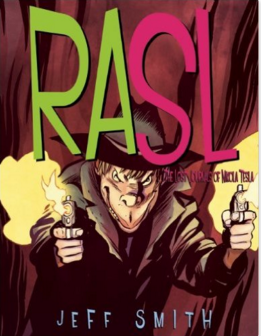
Cover for RASLEvery once in a while, I dabble in graphic novels, without really knowing much about them. I’m not at all interested in the violent or superhero ones that seem to dominate the genre but in the more unusual ones. This volume of RASL pulled me in with its reference to Nikola Tesla. Tesla is one of my husband’s interests, so I picked it up at the library to read together.

Alas, there was no indication on the book that it was part of a series, and it was a little difficult to pick up what was going on. Also, I should have paid more attention to the guy with two blazing guns on the cover.

RASL is an ex-military engineer and art thief whose discovery with his partner of Nikola Tesla’s lost journals has allowed them to create a machine that takes them across parallel universes. RASL has figured out that the work of his previous lab to draw energy from the parallel universes to use in ours will destroy people in all the universes involved. He returns from another universe to find the entire town surrounding one of the labs destroyed and the authorities lying about it being a small accident.

RASL sets out to destroy the labs and Tesla’s notebooks, pursued by the dastardly Agent Crow, who has apparently already killed RASL’s parter, Dr. Miles Riley. RASL is also betrayed by his ex-lover Maya.

The science is unlikely, although the story does give a good background about Tesla (ignoring the fact that he was insane when he died). However, the story devolves into the usual violence.

The art is pretty good, although I didn’t like Smith’s rendition of people’s faces. At least the book isn’t full of rippling muscles and pulchritudinous females.

Related Posts

Britten and Brülightly

Adamtine

Maus I

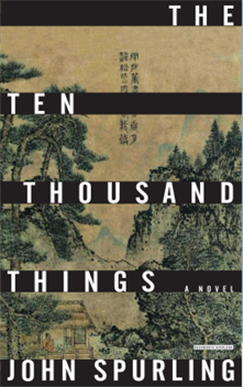
Day 758: The Ten Thousand Things

Cover for The Ten Thousand ThingsIn keeping with my goal to read all of the finalists and winners of the Walter Scott Prize, here is my review of the winner for 2015. The Ten Thousand Things is John Spurling’s novel about a turbulent period in Chinese history. It is written from the point of view of Wang Meng, an actual artist of the time, and inspired by Wang’s paintings of the ten thousand things, all of creation.

This novel is related by Wang from his prison cell, where he chooses to tell about his past in the third person. He has been arrested on charges of conspiracy because he accepted an invitation to view the art collection of the disgraced Chancellor Hu.

Wang’s story begins in a mountain retreat when he is already a grown man. He has resigned his minor government post to pursue his art, although strictly as an amateur. This action has disappointed his more ambitious wife, but she is barely a character in the novel.

China is uneasy under the Yuan dynasty, which is dominated by the Mongols. The Chinese upper class resent the fact that the powerful jobs go to Mongols. Taxes are heavy, and men are restricted to following the professions of their fathers. Wang’s own grandfather, General Meng, was controversial because of having decided to support the Yuan government instead of retiring from his government post as many of his peers did. In Wang’s time, revolts are underway under several different war lords and groups of bandits.

When Wang withdraws to his retreat, he has three fateful encounters. He meets Ni on the way there when he is forced to share a room in an inn. Ni is a great artist whose work affects how Wang views his own. Next, when Wang’s cousin Tao asks him to a nearby village to meet a woman he is thinking of marrying, Wang and Tao are just in time to witness a demand from the Red Scarf Bandits that she marry their chief. When her father asks Wang’s advice, he suggests that she choose for herself. She decides to marry the bandit, and soon becomes a bandit queen named the White Tiger. Finally, Wang meets Zhu, a would-be monk from a nearby monastery who asks Wang to take him as his servant. Wang politely explains he can’t afford to and advises him to join the bandits if he wants to learn about the world. Later, Zhu becomes a powerful war lord and then an emperor.

This novel documents the turbulent period of the overthrow of the Yuan dynasty and the establishment of the even more repressive, but Chinese-lead, Ming dynasty under the paranoid Emperor Hongwu. It moves a little slowly and is told in a detached way from the point of view of an artist who attempts to stay away from the seats of power. It also spends a good deal of time describing Wang’s paintings. The novel reflects a sophisticated and intellectual culture, although it certainly concentrates its story in the upper realms of this society.

link to NetgalleyI think it was this detached viewpoint that kept me from enjoying the novel more. The subject matter is interesting, as I know little of Chinese history and have long thought it was a ridiculous bias that we didn’t learn any history of the Far East in school except when it intersected with Western history. Yet most of the characters seem only sketchily drawn, and I didn’t fully engage. The novel is said to illustrate the principles of Daoism, but since my brief reading on that subject left me completely clueless, I did not understand in what way the philosophy is reflected, except perhaps in the perceptions of the narrator.

Related Posts

River of Smoke

The Blazing World

The Thousand Autumns of Jacob de Zoet

Day 732: The Blazing World

Cover for The Blazing WorldBest Book of the Week!
Every once in awhile I read a book that is so remarkable that I doubt my powers to convey it. Such a book is The Blazing World. This novel was long-listed for the Booker Prize in 2014, but frankly, I think it is better than the novel that won. It is stunningly filled with ideas about such varying subjects as perception and misogyny in the art world, but it is ultimately the touching story of a flawed but compelling human being.

Harriet Burden is already dead when this novel begins. It is purportedly a book about her life, assembled through interviews, excerpts from her diaries, and art reviews and journal articles.

Our examination of Harriet’s life really starts with the death of her husband Felix. Harriet realizes that she has spent her entire life submerging her identity to please first her father and then Felix. She is a ferociously intelligent, well-read woman who has sat by and let Felix take credit for her ideas. Even more importantly, she is an artist. Although Felix was an art dealer, he never helped her find a market for her art. She has become convinced that no one pays attention to her work because she is an older woman.

Harriet, or Harry, as her friends call her, concocts a project she calls Maskings. She will convince a series of young male artists to present her work as his. Once the work gains the recognition it deserves, she will reveal it to be her own.

This novel is remarkable for the character Hustvedt creates in Harry—intelligent, articulate, caring, and extremely angry. Other characters are also complex and insightfully depicted—her grown children Maisie and Ethan, her lover Bruno, her second mask Phinny who becomes her friend, and even the Thermometer, a mentally ill man whom Harry gives a place to stay.

The novel is also remarkable for its ability to describe Harry’s art so that you can imagine it and understand its power. Some of Harry’s ideas are too abstruse for me—she is much smarter than I am and I couldn’t follow all of them even with Hustvedt’s footnotes. Still, this novel is an accomplished feat of storytelling, intellectual and dazzling.

Related Posts

The Enchantment of Lily Dahl

The Life and Death of Sophie Stark

The Fountain of St. James Court or, Portrait of the Artist as an Old Woman

Day 683: By a Woman’s Hand: Illustrators of the Golden Age

Cover for By a Woman's HandBy a Woman’s Hand is essentially a picture book for adults. It does not have much in the way of written content, but it has many lovely illustrations.

A short preface tells about the prevalence of woman illustrators toward the end of the 19th century and the beginning of the 20th. Then the book provides a very brief, one paragraph or so, biography of about 20 illustrators, surrounded by several pages of their work.

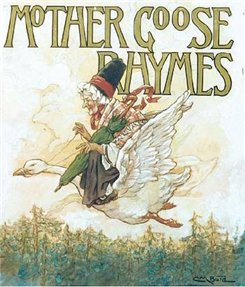
Mother Goose by Clara Burd

Although there are lots of chubby children, the illustrations show influences from several different art movements—Art Nouveau, the Pre-Raphaelites, for example. Some of the illustrations are complex and others look almost like paintings. Clara Burd also trained at the Tiffany Studios and designed stained glass windows.

I have been interested in illustrations for children’s books for a long time, although I have not made a study of it. This book is a nice little addition to my collection of children’s books with nice illustrations.

Related Posts

Clara and Mr. Tiffany

The Last Pre-Raphaelite

Studio St.-Ex

Day 572: Lisette’s List

Cover for Lisette's ListIn 1937, Lisette and André Roux are on their way to Provence. Lisette has abandoned the opportunity to become an apprentice at the Galerie Laforgue and André his job as the frame builder for famous artists. They have left their beloved Paris to take care of André’s grandfather Pascal, for Pascal has written to say that he is dying.

When they arrive in Pascal’s village of Rousillon, however, they find Pascal has been out playing boules. Lisette is horrified at leaving her life behind on a false pretense. Pascal is sometimes ill, but he is mostly lonely.

He also has a legacy he wants to pass down. Pascal owns seven paintings by masters that he traded for picture frames back when the painters were struggling. He wants to pass to Lisette the stories about these paintings, three by Pisarro and three by Cézanne and one study of heads by an unknown artist. Pascal is also proud of Rousillon, where workers have dug ochre out of the ground for centuries to make the paints used in these paintings.

Although Vreeland’s descriptions of Provence and Rousillon are evocative, I feel that the first part of the novel gets bogged down in these teaching moments of Pascal’s. Even though I am interested in art, these conversations are too didactic to come across as authentic.

There are other moments like this farther into the novel, but it picks up during and after World War II in Lisette’s efforts to survive as a Parisienne alone in the village. André leaves to fight at the beginning of the war. Before he leaves, though, he hides the paintings because he has heard that the Germans will search out art and either take it or destroy it because of decadence.

http://www.netgalley.comI was mildly interested in this novel. It is clear that Vreeland loves art, and she does a fine job of evoking the paintings and the gorgeous landscapes of Provence. She is so interested in these subjects, though, that we get a much sketchier idea of the character of Pascal, for example, or André.

Day 571: The Goldfinch

Cover for The GoldfinchBest Book of the Week!
Theo Decker is hiding in an Amsterdam hotel, ill and terrified. He is afraid to set foot in the street. Through most of The Goldfinch, Theo relates the roots of his troubles, which lie 15 years in the past.

Thirteen-year-old Theo is out in New York City for a day with his mother. Normally, this would be a day he’d enjoy, but he is in trouble at his prep school, and they are on the way to school for a meeting. They are early, though, and his mother wants to stop at the museum to look at an exhibit.

Inside the museum, he spots an unusual couple—a hunch-backed old man and a fairy-like red-haired girl. He is only half attentive to his mother’s explanations of the paintings because he is looking at the girl. They stop to view a painting called The Goldfinch, one of the few remaining works by a Dutch artist named Fabritius.

Theo’s mother goes off to the gift shop while Theo trails after the girl. A few minutes later, Theo is knocked out by an explosion from a terrorist attack. When he comes to, the museum is oddly empty, but he finds the old man dying. The man gives him a ring and tells him to take it to an address, and then he suggests that Theo pick up The Goldfinch from a pile of dust and take it with him. He does, an act that becomes a defining moment of his life.

Assuming that his mother got out okay, Theo goes home, but he soon finds that she was killed. Since his ne’er-do-well father disappeared from their lives, it has been just the two of them for years. Social services ends up taking him to stay with the wealthy family of one of his school friends, the Barbours.

Suffering from grief and untreated post-traumatic stress disorder, Theo tries to hide his insecurity and discomfort. As formal as the Barbour household is, he likes Mrs. Barbour and worries that the family might want him to leave. Eventually, he takes the old man’s ring to the address and meets the man’s partner Hobie and the girl, Pippa, who was badly injured in the explosion. She soon goes away to live with her aunt, but Theo continues to visit Hobie, who is a furniture restorer. And he is always in love with Pippa.

Just after Theo is invited to spend the summer in Maine with the Barbours, his whole life changes again. His father arrives and removes him abruptly from New York to Las Vegas. Theo is left to himself most of the time in a deserted suburb at the edge of the desert. His father at first appears to be well off, but soon it is clear he is living on the edges. Theo befriends another outcast, a Ukranian boy named Boris, and the two begin a slide into drugs and alcohol and the margins of society. Even after he returns to New York and tries to pull his life together, the secret of the painting serves as both a pleasure and a hidden terror.

It seems as if I am giving away a lot, but I have covered only the beginning of this long, involving novel. It explores such themes as the trauma of loss, the yearning for love, and the fragility of happiness and the present. In losing his mother, Theo seems to have lost his moral compass, so that even as he tries to help people, he creates problems for them and himself.

Tartt’s characters are complex and fully realized. Even the villains have facets to their personalities. Although Theo thinks of his father as a scoundrel—and he certainly has few redeeming qualities—Boris points out to him that when Boris was alone with nothing, Theo’s father took him in. An older Theo fears he has too much of his father in him.

The Goldfinch remains a golden, potent symbol throughout the novel. Theo loves the painting and feels that owning it somehow gives him stature. Yet at the same time he is terrified he’ll be found with it. Just as the bird in the picture is shackled, so Theo is captive to the painting.

Throughout the novel Theo disappointed me with his self-destructive tendencies even though he has good intentions. Still, Tartt tells a story that absolutely impels you to keep reading. This is a wonderful job of storytelling.

Day 497: The Last Pre-Raphaelite: Edward Burne-Jones and the Victorian Imagination

Cover for The Last Pre-RaphaeliteYears ago in London I was wandering through the Tate with my friends, tired of seemingly endless rooms of Italian Renaissance paintings, when I walked into another room and was simply blown away. The room was full of life-size paintings of stunning beauty, with gemlike colors, exact details of greenery and complex woven fabrics, and narrative depictions from myth and legend. They were by the Pre-Raphaelite Brotherhood, and they must be seen in person to be fully appreciated. Ever since then I have been interested in the Pre-Raphaelites, so when I read a glowing review of The Last Pre-Raphaelite in the New York Times, I tracked it down.

Although all art movements go in and out of fashion, the Pre-Raphaelites seem to come in for more than their fair share of controversy. I have even now picked up art history books that don’t contain a single Pre-Raphaelite picture. Edward Burne-Jones was the youngest of this group of painters, although he was outlived by Holman Hunt. He was also a prolific designer of stained glass windows and even jewelry.

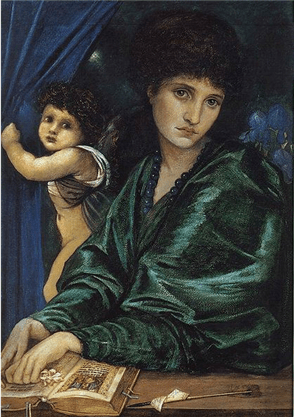
Portrait of Maria Zambaco
Burne-Jones Portrait of Maria Zambaco

MacCarthy’s biography is a fairly exhaustive study of Burne-Jones’ life and works, his marriage and family, life-long association and partnership with William Morris, his mentoring of younger painters and friendships with many important figures in art, literature, and politics and with a string of little girls, and his famous affair with Maria Zambaco. It discusses his association with the Pre-Raphaelites, the Arts and Crafts movement, and the philosophy of Aesthetics.

Burne-Jones believed strongly that beauty should be available to everyone. Hence, his involvement with William Morris in producing items of home decor, in illustrating manuscripts, and in designing stained glass windows for public venues. In fact, he is closely associated with the revival of the stained glass industry in England.

One surprise of this biography was to find the personality of a puckish jokester underneath Byrne-Jones’ ascetic, attenuated appearance. He continued throughout his life a schoolboy habit of drawing little caricatures of himself and his friends, particularly teasing ones of his good friend Morris. Although generally a moral person, he was understanding of the foibles of others and supportive of his friends, even those of whose habits he did not approve. He was beloved by many.

picture of Burne-Jones The Golden Stairs
Burne-Jones The Golden Stairs

I was interested throughout this book, even though much of it had to do with Burne-Jones’ struggles to finish work. He apparently had far more ideas than he could ever accomplish and was always working on many projects at the same time. The book is full of beautiful photographs of his art—although unfortunately most of them are too small to see the details—as well as of himself, his family and friends, residences, etc. The interiors of rooms are stunning examples of the Arts and Crafts movement.

A small quibble is the epilogue, which is concerned with the revival of interest in Burne-Jones. It is interesting up to a point, where it seems to be attempting to trace of ownership of every single work. Still, this is a fascinating biography.

Day 443: The Mischievians

Cover for The MischieviansThe Mischievians is a charming little book. It doesn’t have much of a plot but is entertaining nonetheless.

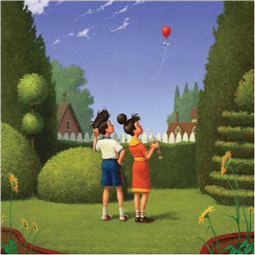
Two children send up a balloon asking for help. Their homework keeps disappearing, so they are in trouble with their parents. Next, a hole opens up in the earth and they fall through into the laboratory of Dr. Zooper, who tells them all about the little monsters lurking in their house.

What do the monsters do? Steal just one sock, hide the remote control, create belly button lint, and of course steal homework, among other serious crimes.

The book is breezily written with just a bit of gross humor that kids like.

Picture from the book
Sending up a message for help

As usual with Joyce, the illustrations are beautiful. The pictures featuring the children are charmingly retro, and the little monsters are cheerfully grotesque. Letters in the text are occasionally tweaked out of place by a mysterious hand. The cover is designed to look like an old, worn out book.

This book is for a little older kids than The Leaf Men, probably suitable for six- to eight-year-olds, although smaller kids will enjoy it, too.

Day 427: The Leaf Men

Cover for The Leaf MenEven when I was a small child, I looked for beautiful pictures in children’s books (or bunnies–bunnies were good, especially fluffy ones). I had some books that had belonged to my mother, and I used to spend hours looking at Arthur Rackham’s illustrations of fairies and twisted trees full of goblins. As a young adult, I collected children’s books that combined good stories with illustrations by artists such as Rackham, Kay Nielsen, or Mercer Mayer.

A few weeks ago I saw a feature on William Joyce and decided to buy some of his books for my young nieces and nephews. The first one that arrived was The Leaf Men, which I had to order used in hardcover, as it is older. It is written for a young child and is a simple story about the brave bugs who climb to the top of a tree to summon the leaf men in an attempt to save a dying garden and an old woman. (I have seen some editions of this book called just The Leaf Men but the one I purchased was called The Leaf Men and the Brave Good Bugs.)

The pictures are beautifully retro, with a 30’s or 40’s appearance. One of the things that attracted me to the book was the huge man in the moon on the cover, which was one of my favorite childhood images.

Good Bugs
The Brave Good Bugs

This is a lovely book. I think it is readily available new in paperback, but it is easy to find good used copies of the hardcover edition online. (I always think paperbacks are going to be totally destroyed, so I prefer to buy hardcover children’s books.)

People who have older kids are probably familiar with Joyce’s work, perhaps through the Guardians of Childhood series (several of which I have also bought for my older nephew). An animated movie called Rise of the Guardians was made from this series in 2012.

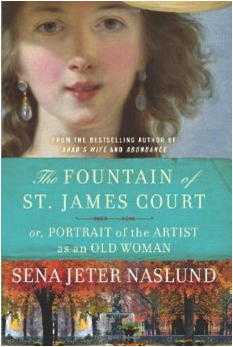
Day 394: The Fountain of St. James Court or, Portrait of the Artist as an Old Woman

Cover for The Fountain of St. James CourtI received this book in a First Reads giveaway from Goodreads. I haven’t read Naslund before, so I am not sure whether she adapted her writing style for this novel, but it took me awhile to accustom myself to it. She follows the activities of two artists, one Kathryn Callaghan, a fictional older writer in the current time, and the other a once-living person, Élisabeth Vigée-Le Brun, a painter known especially for her portraits of Marie Antoinette.

The modern-day story begins at midnight next to a fountain of Venus in a neighborhood of Louisville, Kentucky. Kathryn, or Ryn, is taking her newly finished manuscript to her friend Leslie’s door because she can’t wait to deliver it.

The novel’s structure is a book within a book. Chapters following one day in Ryn’s life are interleaved with chapters covering the whole of Vigée-Le Brun’s life, which are from Ryn’s book. Both stories are about the theme of what it means to be an artist and what you must give up of your personal life to pursue your profession. The novel is said to be a deliberate variation on Joyce’s Portrait of an Artist as a Young Man, but it has been so long since I’ve read it that I cannot comment on that.

This novel is contemplative, especially in the modern-day narrative, but the interleaving of stories in such short chapters slows down the pace too much. It literally takes until page 34 for Ryn to walk across the street and deliver the manuscript. Even with some chapters from the 18th century interleaved, the pace is frustrating. I found myself thinking, when is this woman going to make it across the street?

I found the story of Vigée-Le Brun’s life more compelling than the modern-day story, during which we follow Ryn’s every thought. She is an excitable, emotional woman who contemplates everything she looks at and repeatedly broods over the same things. We read about the russet and yellow fall colors or the appearance of the fountain many times. Nothing much happens all day until a late-night confrontation that seems artificially created to provide some tension.

I did not feel, however, that the two women, Ryn and Vigée-Le Brun, were two different people–they seemed to be the same person in different time periods. Vigée-Le Brun is slightly less emotionally excitable than Ryn, but their observations of the world around them, their attention to color and the details of design and structure, are very similar. Vigée-Le Brun’s narrative style, in first person where Ryn’s is in third person, is a little more formal as befitting an earlier age, but conversations in this story often sound stilted, and her first conversation with Marie Antoinette is positively sycophantic.

Naslund’s writing style, although sometimes vibrant and lyrical, often seems affected, particularly in the modern-day story. The copy I read was an advanced reader’s edition and it had quite a few typos, which I assume will be corrected. I was not quite as sure of some self-consciously unusual phrases, whether they were stylistic choices rather than errors. Naslund’s writing style tends to the unusual, to be sure, but I stumbled over some of these phrases. The only one I wrote down was an instance where some characters “made quick chat.”

I wanted to like this novel more than I did. I think the theme of women and art is worth exploring, although I’m not sure how much this novel actually explored this issue, despite its obvious intentions. I am actually curious about the alleged feminist leanings of Naslund and their effect on this book. Vigée-Le Brun has to put up with her father and then husband appropriating all her money and, in her husband’s case, only giving her a bit of it back as an allowance. When they divorce, he gets almost everything. Yet, she is determined not to let it bother her. I am not sure whether that is a feminist viewpoint or not.

However, the characters in this novel certainly reflect the “gift for pleasure” noted in reviews of Ahab’s Wife (which I am currently reading). The women go on pursuing their lives and dreams without much heed to their menfolk, they have cordial relations with those around them, they delight in color and the fineness of life. Their regrets and sorrows mostly focus on their children.

One thing that surprised me about the historical story was that Vigée-Le Brun hardly seemed to notice the causes of the French revolution or the revolution itself. There is one scene where a woman confronts her on the street and another where she grieves for the fate of so many. That’s about it.

Conversely, it is hard to believe that she would be shocked to the core by seeing a model of internal organs, as artists had been studying the body for hundreds of years. I do not know how much of this novel actually reflects Vigée-Le Brun’s true thinking and feeling. The danger when portraying a historical person is that you are imagining who the person really is–you don’t know–and you have no idea if you are doing them justice or injustice.