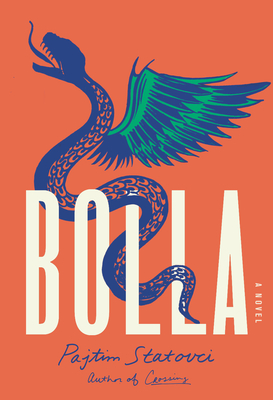
Review 2314: Bolla

Arsim is an Albanian literature student in Pristina, Kosovo, in 1995 when he meets Miloš, a Serbian medical student. They are immediately attracted to each other and soon begin a torrid affair. Although he is young, Arsim has already been married for four years to Ajshe, and on the day he consummates his relations with Miloš, she tells him she is pregnant.

The affair continues through Miloš’s graduation, but shortly thereafter, it becomes too dangerous for Albanians to stay in Kosovo, and Ajshe and her brother arrange for the family to leave the country. As soon as he learns Arsim is leaving, Miloš joins the Serbian army.

Arsim’s relatively linear narrative is broken by short sections narrated by Miloš that are harder to understand and move back and forth through time. He is the more fragile of the two and becomes damaged by his war experience.

This novel, which I read for my James Tait Black project, is beautifully written and ultimately haunting. However, I so disliked Arsim that it was hard for me to read. He is absolutely vile in his behavior to almost everyone in the book but especially to his wife and children, whom he periodically deserts and beats when he is there. When he thinks later that he did his best by them, he defines this as financial support. Really, he deserts anyone who poses any difficulties.


Related Posts

The Tiger’s Wife

The Great Fortune

Trespasses

Review 2250: The Wheel Spins

The Wheel Spins is the novel upon which the many versions of the movie The Lady Vanishes are based. Although I am familiar with the story in all its incarnations, I still found the book exciting.

Iris Carr is on holiday with a group of her friends in a Balkan country, possibly Romania. Rich and spoiled, the friends have been cheerfully disrupting their small hotel, leading the other English guests to dislike them. The last day, she finds she is tired of them herself, so she decides to stay a day longer than the others. When she does leave, she has a touch of sunstroke and has to be helped. The train is crowded, so the porter crams her into a compartment for six as the seventh person.

In the compartment are a commanding woman in black who turns out to be a baroness, a family of three, a cold blonde lady, and a nondescript middle-aged woman in tweeds. Iris isn’t feeling well because of her sunstroke, but the nondescript woman turns out to be English, Miss Froy, and takes her to the dining car for lunch. There she prattles about returning to England to her elderly parents and dog, her job as governess for the baroness, and her next job for the baron’s political opponent.

Back in the train compartment, Iris falls asleep. When she wakes up, Miss Froy is gone. When she doesn’t appear, Iris searches the train for her, but she doesn’t seem to be on it. In growing alarm, she finds her compartment companions denying that Miss Froy ever was there. On her way to the dining room, Miss Froy met some of the English people from the hotel, but when Iris speaks to them, some have not seen her and others lie for their own reasons. So, even though a young man named Hare and the professor with him try to help her, Hare believes she has hallucinated because of her sun stroke, and the professor thinks she is hysterical.

As the train nears Trieste, Iris begins to fear Miss Froy is in danger, but what can she do about it? This all makes an thrilling novel.

Missing from the movie adaptations are passages that visit Miss Froy’s elderly parents and dog as they await her coming. In a way, they are unnecessary, but they make the ending much more touching, especially the dog.

I received this novel from the publishers in exchange for a free and fair review.

Related Posts

Some Must Watch

Juggernaut

Twice Round the Clock

Day 59: The Tiger’s Wife

Cover for The Tiger's WifeIn The Tiger’s Wife, Téa Obreht has written an involving novel about the power of myth, memory, and story-telling. In the aftermath of the Balkan war, Natalia Stefanovic travels to the “other side” to help vaccinate children. While she is there, her grandmother calls to tell her that her beloved grandfather has died after telling his family he is going to visit her. When she learns his belongings were left in the clinic of a nearby village, she goes to fetch them, particularly his copy of The Jungle Book, which he has carried since he was a boy.

In remembering her grandfather, Natalia relates two stories that she says contain everything necessary to understand his life, one that he told her and one that he didn’t, that she learned about by traveling to the village where he grew up. The story he told her is about the deathless man, a man he has met time after time who claims he cannot die. The other story is about the tiger’s wife, an abused woman who befriends a tiger that escaped from the zoo during World War II, when Natalia’s grandfather was a boy.

Although I sometimes am unable to suspend my disbelief for magical realism, that is, the technique of mixing realistic story-telling with the magical or supernatural, Obreht skirts it without falling into it. Her book is a meditation on life and death, told in an almost  a dreamy way but also in a style reminiscent of a folk tale or myth. The book is also about how people deal with the past by transforming history into myth. The realistic story is interleaved with the two tales.

Although one of the themes is the separation between the groups of people in the Balkans, it is also about their similarities. In a village where Natalia has gone to give vaccinations, she encounters the same types of stories and superstitious beliefs as reflected in her grandfather’s stories about his youth and her grandmother’s injunctions about how to treat her grandfather’s death and possessions.

The book is stunning–a meditation and tribute to the author’s own grandfather, who died before she wrote it, and memories of the country in which she was born.