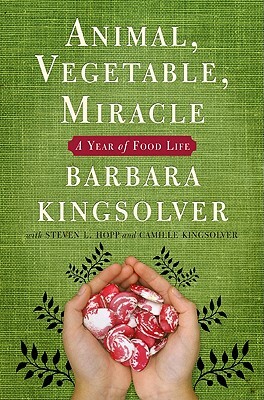
Review 2564: Animal, Vegetable, Miracle: A Year of Food Life

I usually enjoy Barbara Kingsolver, but even in her fiction, she can get preachy, so I have avoided her nonfiction. That is, I avoided it until I saw that this book filled a hole in my A Century of Books project. (At the book’s reading, I had seven or eight to go. Now, while I’m typing up this review, I have three. By the time it appears, I hope to have finished.)

Although Kingsolver is the primary author of the book, it also contains essays or informational sidebars written by her husband, Steve L. Hope, and her oldest daughter, Camille Kingsolver. It is about food—in particular, her family’s decision to act on its principles. To do so, they move from Arizona to her husband’s farm in Southern Appalachia (somewhere in Virginia). The idea is to try to live for a year only on food they grew or raised themselves or on local food.

Kingsolver has chapters on issues, for example, an early one is on the growth cycle—which vegetables and fruits are started when and when they are ready to be picked. (I didn’t find her concept of the vegetannual helpful at all. A timeline might have worked better.) But for the most part, she tells the story of the year, the things they plant or raise and when, the people they meet, the things they learn. These chapters were mostly interesting and sometimes entertaining. I was truly wrapped up in suspense about whether the turkey eggs would hatch.

Kingsolver talks also about issues around local food, such as how much gas is used transporting food that isn’t local to supermarkets; the takeover of Federal funds for farmers by large conglomerates (your local farmer isn’t getting the money); the negative effects genetically engineered seeds have on farmers, especially for organic farms; the growing local food movement and how to support it; and so on. The sidebars were some of the same topics, though, so I sometimes felt as if I was in church—tell them, tell them again, and tell them again. (Just as my own sidebar, I remember at about age ten asking my father after church why they did that and finishing my polite question with, “Do they think we’re idiots?”) You can see I have no patience with that kind of thing.

So, that’s a criticism, but on the other hand, lots of things in the book were interesting, and the descriptions of the meals had me licking my lips, recipes included in the book.

I personally have made steps at times to eat more locally. I belonged to a CSA for years, and I’m thinking of signing up for another one. I kept a vegetable garden here until growing trees cut off my sunlight, so now I just grow tomatoes on the back deck (in the tomato wagon). I try to stop often at a local farm store. (During the summer, I stop by every week, and I have stopped buying grocery store strawberries—I just wait for the fresh ones in late spring, because once I moved to this area and ate a real one, I realized that the ones in the store were not real.) In any case, this book has made me think of all this again.

Those of you who worry about the higher cost of local food may be very interested in the chapter about the food economics for a year. It turns out that when you forgo processed foods and do most of the cooking yourself, it’s a lot less expensive for a family to eat for a year even if paying more for some local foods. Of course, they were growing most of theirs, which everyone cannot do. However, like Michael Pollan also points out, Americans spend less money on food than people in most other countries. And even in the city, it’s possible to grow some of your food.

Related Posts

The Omnivore’s Dilemma

Cod: A Biography of a Fish That Changed the World

John Saturnall’s Feast

Review 2215: Demon Copperhead

Everyone has been raving about Demon Copperhead, but I’ve had a more mixed reaction to it. This is because the novel is an update for Dickens’s David Copperfield, which is one of my favorite books.

In one way, this is a good match, because both Dickens and Kingsolver are political writers with social consciences. Dickens’s target was the effects of industrialization on poor children. Kingsolver’s in this novel is the effects on the people of Appalachia of what she sees as a war on agriculture.

Damon Fields, named Demon Copperhead because of his red hair, is a young Melungeon (I had to look it up) boy at the start of the novel. His father died before he was born, and his teenage mother has a very weak control of her sobriety. Residents of Lee County in Southwestern Virginia, they live in a single-wide mobile home owned by the Peggots next door. The kindly Peggots provide most of the stability in young Demon’s life.

Readers familiar with David Copperfield will be familiar with the plot, for it follows that book almost exactly. Although they are very poor, things are going fairly well and Demon’s mother has been sober for two years when she meets Stoner, soon to become Demon’s abusive stepfather. It goes mostly downhill from there, with Demon, after a brief career as a high school football hero, becoming addicted to oxy after an injury.

I couldn’t help noticing differences from Dickens, though. For one thing, the McCob family, Kingsolver’s equivalent of the Micawbers, are not the feckless, lovable, comic characters of Dickens, but a couple who, as Demon’s foster family, illegally send him to work instead of school, illegally charge him rent, and steal his money. (The Micawbers send David to work, too, but that assumed to be at the behest of his stepfather.) That leads to the biggest difference. Although Kingsolver can depict sympathetic characters, she doesn’t really do funny ones, Dickens’s gift. Further, the very young Demon at the beginning of the novel lacks the absolute innocence of young David that makes him so endearing. Demon’s narrative is too cynical.

Finally, Dickens is more willing than Kingsolver to let his story make his political points. Still, it’s a gripping novel with a serious message about the rural addiction problem, the lack of services for rural citizens, and the mistreatment of the poor. Although I read this novel before it made the list, Demon Copperhead is part of my James Tait Black project.

Related Posts

Unsheltered

David Copperfield

The Lacuna

Review 1370: Unsheltered

Unusual for Barbara Kingsolver, Unsheltered is a dual time-frame novel, changing centuries every other chapter. The setting is the same, though, the odd town of Vineland, New Jersey.

In the present time, Willa’s family has discovered that the house she inherited in Vineland is no asset. Both she and her husband, Iano, have recently lost their jobs through no fault of their own. Willa’s magazine failed, and so did the college in West Virginia where Iano was tenured. When he finally got hired in an inferior level for a one-year position, the inherited house nearby had seemed like a godsend. But now she has found that it is falling down, with part of the old house not even on a foundation, and too expensive to fix.

To make matters worse, they are the only people in the family who offered to take in Iano’s ornery dying father. Their daughter, Tig, has also unexpectedly returned from a year in Cuba. Finally, their son Zeke’s partner has committed suicide, leaving him in an apartment he can’t afford with a baby son. Willa and Iano offer him a place to stay, but what he wants is to leave his son with them.

In mid-19th century Vineland, Thatcher Greenwood has moved his new bride, Rose, back into the house she grew up in. They are also living with her mother, Aurelia, and young sister, Polly. Thatcher is delighted with his wife but is soon to find that they don’t share the same values. His position as a science teacher pays very little, but Rose and her mother continue to demand elegancies that belong to their former life, before Rose’s father went broke.

Next door, Thatcher meets Mary Treat. Rose knows her as the poor woman who was deserted by her husband, but Thatcher learns that she is a scientist, whose correspondents include Charles Darwin.

Vineland was founded as a sort of utopia by Captain Landis, but Thatcher begins to see the cracks in that utopia. One of them is his employer, who will not allow him to teach anything more than rote memorization and hates most recent scientific theories, particularly Darwin’s.

Both of these main characters are concerned with keeping shelter over their families’ heads, but while Kingsolver links the stories through Willa’s growing interest in Mary Treat, she is also able to draw many parallels between the two times. The present uncertainty in the poor economy of the Eastern Seaboard she compares to the uncertainty in the lives of Vineland’s population, of workers promised much by a man who can repossess their property if they fail. An unmistakable political figure in the present day, nicknamed by Willa The Bullhorn, bears a metaphorical resemblance to Landis, who is essentially a conman. The main characters’ housing insecurity stands for the insecurity of the entire population as a result of climate change and the death of the American dream. Kingsolver has lots to talk about.

I’m not so sure how much I liked the dual narrative. I was far more interested in the present-time story than I was in the older one. Kingsolver seemed to want to write about Mary Treat, but Treat features more as an important secondary character. And I have to say that some of Willa’s discussions with her daughter and her ruminations about those discussions border on the didactic (which we know has been a fault of Kingsolver in some other books).

Still, it is great to have another book out by Kingsolver. She can be hit or miss, but I have very fond memories of some of her books.

Related Posts

The Lacuna

The Weight of Ink

Maddaddam

Day 66: The Lacuna

Cover for The LacunaBest Book of Week 14!

My experience with reading Barbara Kingsolver has been uneven. Her first books were interesting and heartwarming, but some of her later work is more political and sometimes degenerates to lecturing on certain causes. However, The Lacuna is an absolutely enthralling historical novel.

Harrison Shepherd is a young man, half Mexican and half American, who survives an upbringing by a feckless mother and a cold father and finally begins making his own way in 1930’s Mexico. He finds a job working in Diego Rivera’s kitchen and ends up as the cook and plaster mixer in Rivera’s household with Frida Kahlo. Later, when they give Leon Trotsky a home, Shepherd works for Trotsky as a secretary and translator, and finally he returns to the United States to write Aztec historical potboilers.

The novel covers major historical events in a turbulent period, including the Communist Worker’s Movement, Trotsky’s assassination, FDR’s terms in Washington, World War II, and the House Unamerican Activities Committee. Although Shepherd’s life is extraordinary by any standards, Kingsolver was able to make it feel absolutely persuasive. While I usually dislike historical novels where ordinary people keep running into famous people, I completely accepted every sentence of this book.

Told by diary entries, newspaper articles, and letters, the novel gets going a little slowly, but eventually enthralls. Kingsolver does a great job of creating colorful and believable characters from the lives of real, historic people, something that is not simple, and completely involves readers in the events of their lives.