Day 22: Cleopatra: A Life

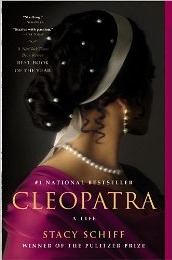
Cover for Cleopatra: A LifeWhen my grandmother traveled to Egypt in the 1960s, she wanted to buy a bust of Cleopatra. She was surprised to find out that the Egyptians consider Cleopatra a traitor. No images of her were available, so Granny Billie came back with a bust of Nefertiti instead.

When you think about Cleopatra, maybe you imagine the beautiful seductress played by Elizabeth Taylor in the movie. Maybe you think about the scheming whore in Antony and Cleopatra. Maybe you even think Cleopatra was Egyptian. (The Ptolemys were Greek.) Stacy Schiff, whose book Cleopatra: A Life was selected by the New York Times for its best books of 2011 list, would point out to you that Cleopatra’s history was written by the victors, her defeaters.

Schiff tells us the engrossing story of what is known of Cleopatra’s true life. Certainly she married her brother. So too did most of the Ptolemaic rulers marry their own siblings. Certainly her brother was executed when he revolted against her. The Ptolemys were noted for lopping off the extra branches of the family tree.

What you may not know is probably more to the point. Schiff shows us a picture of Egypt, the wealthiest country in the ancient world when Cleopatra gained the throne, but already on the wane. And there is its powerful ruler, Cleopatra, not beautiful but cultured and intelligent, reportedly fascinating in conversation, educated. Not the type of woman the patriarchal Romans are used to dealing with.

A clever strategist and negotiator and witness to Rome’s attempt to gobble up the known world, Cleopatra early realized that she needed to carefully pick her allies in Rome’s continuous battles for control of the empire. First she picked Pompey over Julius Caesar—not ultimately the wisest decision, but her family had ties to him, and her brother’s betrayal of him was one of the horror stories of the age. Then she negotiated a partnership with Julius Caesar, but unfortunately he was soon assassinated. Her next choice was not as percipient, but Marc Antony seemed to be the greatest soldier of his time.

There are few unbiased records of Cleopatra’s life, and none that are biased for her, but Schiff does an excellent job of examining the various allegations made in the existing records and judging their likelihood. Rather than the ruthless vixen reviled through the ages, Schiff depicts Cleopatra as a strong woman who was doing her best for her country.

Although some have criticized the book as heavy going (one actually commented that it “lacked dialogue”—I don’t know what source that person thought the dialogue would come from), I didn’t find it so. It was written for the general public but reflects serious scholarship, and Schiff has found an elegant balance between that and entertainment.

Day Twelve: A Heartbreaking Work of Staggering Genius

Cover for A Heartbreaking Work of Staggering GeniusBefore I start this review, I have to apologize for the untimely posts this week. I’ve told several people that I would try to post a review every weekday during my lunch, but lately we’ve been having a lot of Internet outages. So, I’m posting when I can.

A Heartbreaking Work of Staggering Genius is based upon true events of Dave Eggers’s life. When he was 22 years old, his mother and father died within months of each other, leaving his family to split up and himself in charge of his eight-year-old brother, Toph. They live in bachelor squalor while Eggers obsesses. Eventually, they move to San Francisco, where he becomes a founder of Might Magazine.

I didn’t read this book for a long time because I was put off by its title, but it received so many good reviews that I finally picked it up from curiosity. I have to preface my remarks by saying that I have lately gotten some clues that I don’t understand modern humor (i.e., I am officially a geezer), especially when I’ve tried to watch movies that are dubbed “hilarious.”

Readers might get a clue about how this book is going to proceed from its set of “Rules and Suggestions for the Enjoyment of this Book.” One of them is to skip the middle of the book. Good suggestion.

I found the first 100 pages or so about his parents’ deaths and his subsequent struggles affecting and absorbing. However, this is one of the few books that I just couldn’t finish. I found it so juvenile and smug that it was absolutely grating, but that’s not why I stopped. When Eggers abandons his straight narrative, he begins musing, and his prose devolves into unbelievably long, rambling paragraphs. His approach has been deemed “inventive” and even “the memoir as metafiction” (yikes!). I was actually only 30 pages from the end of the book when he started another of his lengthy asides, and I just couldn’t take it anymore. I gave up.

Day Nine: Mary Boleyn

Cover for Mary BoleynIn the introduction to Mary Boleyn, biographer Alison Weir talks about the many misconceptions we have about Anne Boleyn’s less famous sister, which were not only derived from such popular fictions as The Tudors (wildly inaccurate, but I still loved it!) and The Other Boleyn Girl (ditto), but also from biographers and historians over the centuries. Weir calls her book both a biography and a historiography, because she tackles many published statements about Mary’s life and attempts to show the extent of their truth or even likelihood.

Because most of Mary’s life was spent in the background of her glittering, ambitious family, not many actual records or letters that mention her exist, and only a couple of her own letters survive. Even the exact date of her birth is unknown, so that there has been been debate about whether Mary is the older or younger of the two sisters. (Weir makes a good case for older.)

Weir examines Mary’s life from as early as it is known and explores such subjects as whether she had an affair with the King of France (yes, probably a short one), whether she came from that with a ruined reputation, as has been alleged (no, but her family may have sent her away from court), whether she had an affair with Henry VIII (yes, but possibly reluctantly), whether she was then labeled a “famous whore” as has also been alleged (no, hardly anyone knew about it), whether she was married off to an unworthy but complaisant husband as a result (no, she married before the affair to William Carey, a wealthy and influential courtier who was one of Henry VIII’s trusted friends), and so on.

The picture Weir paints is of a woman who has repeatedly been smeared over the centuries. She certainly did not seem to be ambitious, like the rest of her family, because she got very little from her royal lovers. She was almost certainly also not well regarded by her family, probably because she had taken these lovers without gaining an advantage. After her first husband died, she eventually remarried for love, William Stafford, a relatively poor man much lower in status who was 12 years her junior. After she was cut off from her family and court as a result, she described the time of her widowhood as “bondage” and stated in a letter to Thomas Cromwell that no one in the world cared for her except Stafford.

Mary seems to have been slighted by her family for much of her adult life and was finally exiled from them because of her second marriage. This separation may be the only reason she survived her sister and brother.

Weir makes a strong case for Mary’s first child, Katherine Carey, being the unacknowledged daughter of Henry VIII. An appendix relates what happened to Mary’s descendants. Weir remarks that Henry VIII’s line is believed to have died out with Elizabeth I, but assuming she is correct about Katherine’s birth, she provides a fascinating list of some of the famous British people who can trace their lineage back to Mary’s daugher—and so to Henry—including Winston Churchill, Charles Darwin, Lord Nelson, Vita Sackville-West, Ralph Vaughn Williams, Princess Diana, Camilla Parker-Bowles, and Queen Elizabeth II herself.