
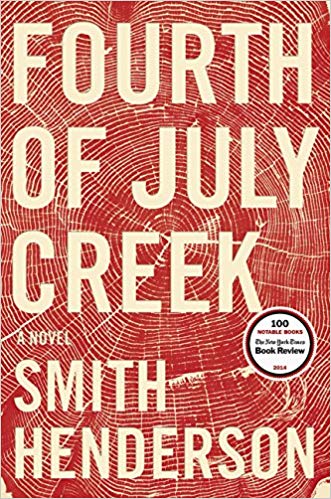
 The Best Book for this period is Fourth of July Creek by Smith Henderson!
Tag: book lists
If I Gave the Award
 Since I just reviewed Fourth of July Creek by Smith Henderson, the last of the shortlisted novels for the 2015 James Tait Black Fiction Prize, it is time for my feature, where I give my opinion about whether they got it right or not. The 2015 list is a difficult one, because I didn’t love any of the shortlisted novels, but I thought all of them were excellent in different ways.
I read We Are Not Ourselves by Matthew Thomas the longest ago, in the same year that it was published. I recollect that, while I stayed interested in the novel, it was a long time before I was very vested in this story about a family coping with Alzheimer’s.
Fourth of July Creek was another novel with a more straightforward narrative. It focuses on people on the fringes of society in Montana. It is interesting and involving and ultimately touching as it explores the stresses upon an already fanatical man being pressured by the government.
Dear Thief by Samantha Harvey uses a more inventive approach to narrative, it being a long love/hate letter from a woman to her former best friend. While it recounts the reasons for the destruction of their friendship, it reveals how the woman yearns to see her friend again.
 Also a novel about a friendship and the winning entry, In the Light of What We Know by Zia Haider Rahman is the most ambitious of the novels and also the one least likely to appeal to some readers. It is a tour de force in narration, consisting mostly of a long series of narratives by one character on a wide variety of subjects. It is the most thought-provoking of the shortlisted books and the most difficult.
I can understand why the judges chose In the Light of What We Know, but as I think about it, I have to choose the book that I connected with most. Although I enjoyed the winning novel, I also was just on the edge of irritation with it as I read it. So, for its slightly inventive approach and the connection I felt to the material, I am picking Dear Thief with a strong nod to Fourth of July Creek.
Best Book of Five!
 This period’s Best Book is The Clockmaker’s Daughter by Kate Morton! Also recommended is In the Light of What We Know by Zia Haider Rahman!
Classics Club Spin #19
 The Classics Club has announced a spin for the end of this month. If you post a numbered list of 20 of your Classics Club books by November 27th, the club will spin to pick the number of your next read for the club. The deadline for reading the book and posting a review is January 31, 2019, so the club has challenged us all to put our biggest tomes on the list because of the extra reading time.
So, with no further ado, here is my list. I will say ahead of time that I have no idea whether some of these books are tomes are not:
- To the Lighthouse by Virginia Woolf
- The Expedition of Humphry Clinker by Tobias Smollett
- Challenge by Vita Sackville-West
- Aurora Floyd by Mary Elizabeth Braddon
- The Viscount de Braggalone by Alexandre Dumas
- Madame de Treymes by Edith Wharton
- The Old Man’s Birthday by Richmal Crompton
- The Good Soldier by Ford Madox Ford
- Oroonoko by Aphra Behn
- Owls Do Cry by Janet Frame
- Evelina by Frances Burney
- The Lady and the Unicorn by Rumer Godden
- Joanna Godden by Sheila Kay-Smith
- Mary Lavelle by Kate O’Brien
- Kenilworth by Sir Walter Scott
- The Last of the Wine by Mary Renault
- The Prince by Machievelli
- The Brothers Karamazov by Fyodor Dostoevsky
- Memories: From Moscow to the Black Sea by Teffi
- The Winged Horse by Pamela Frankau
Happy reading to everyone, and I hope the spin selects a good book for you.
As it is Thanksgiving Day here in the U. S., Happy Thanksgiving to everyone!
Best Book of Five!
 The Best Book for this period is Snowdrops by A. D. Miller!
Best Book of Five!
 The Best Book for this period is The Forty Days of Musa Dagh by Franz Werfel!
Best Book of Five!

This period’s Best Book is They Were Sisters by Dorothy Whipple! Also recommended is Mistress of the Art of Death by Ariana Franklin.
Best of Five!
 The Best Book for this period is Alas, Poor Lady by Rachel Ferguson!
Best of Five!
 The Best Book for this period is The Last Painting of Sara de Vos by Dominic Smith!
Best of Five!
 The Best Book for this period is Closed Doors by Lisa O’Donnell!

