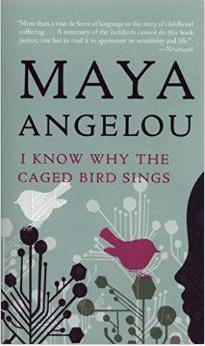
Day 583: I Know Why the Caged Bird Sings

Cover for I Know Why the Caged Bird SingsThe picture on the cover of my old copy of I Know Why the Caged Bird Sings shows an angry and dignified woman, and in some ways this is an angry memoir. Although I’m sure this anger helped sustain Maya Angelou during a difficult life and pushed her to make significant advances for herself and her people, I hope she became happier later. She earned it.

This book is the powerful story of the first 16 years of Maya Angelou’s life. She and her brother Bailey were raised by their grandmother in the small town of Stamps, Arkansas, after being sent there alone on a train from California at the ages of three and four by their parents. Much of the book deals with her upbringing by a strict and religious, somewhat reserved but caring grandmother in the racially segregated South.

Although life in Stamps was no picnic, her brief visit to her mother in St. Louis when she was eight was disastrous. There she was raped by her mother’s boyfriend. That was not the only event in her life that could have proved catastrophic.

Angelou speaks with raw transparency about the feelings of insecurity that she battled through her girlhood, a combination of her treatment by whites and her own feelings of unattractiveness. In her younger years she was saved by her love of reading, later by her own dignity and will to succeed.

This book is deeply involving and at the same time sometimes disturbing reading. I was brought to tears at the description of Angelou’s nearly ruined graduation, not when the pompous white guest speaker put the class in its place, but by how the valedictorian rescued the occasion. I was thrilled when Angelou’s perseverance won her a position, at the age of 15, as the first African-American cable car employee of San Francisco.

I think this story of pride and dignity against bigotry is inspiring for anyone.

Day 537: The Jane Austen Book Club

Cover for The Jane Austen Book ClubI am sometimes rather contrary about bestsellers. I assume that I’m not going to like them and avoid reading them. This attitude isn’t entirely irrational as I am familiar with the writing of many consistently bestselling authors that I do not like at all. The idea behind The Jane Austen Book Club also seemed like something I wouldn’t enjoy, as I am a little tired of all the Jane Austen spin-offs and other hoopla (although never tired of Austen herself). So, it wasn’t until I picked up the book at a used book sale that I decided to try it.

I found the novel extremely light reading but enjoyable and sometimes witty. Of course, it is about a book club of Austen lovers who get together to read all of Austen. Only one member is male, and Grigg is also the only one who has never read Austen.

The novel does not have much of a plot. There are some romances and a banquet. That’s about it. As in Austen novels, it is more about the characters and their relationships.

Jocelyn, the founder of the club, is a dog breeder in her 50’s who likes to arrange things and make matches. Sylvia is her best friend from high school whose husband Daniel recently left her for a younger woman. Allegra is a strong, adventurous lesbian. She isn’t so much an Austen fan but is in the club because she’s Sylvia’s daughter. Bernadette, a kind older woman with a colorful past, talks a lot and repeats herself. Prudie, the married French teacher, annoys everyone by speaking French during the club meetings. Grigg is a little more of an enigma, a science fiction reader in his 40’s who just moved to town.

Each section of the novel focuses on a book club meeting and tells us more about the character who hosts the meeting. Throughout the novel, quotes from Austen and other sources appear appropriately, or maybe with an angle we need to figure out. Strikingly, the novel is narrated in the second person plural, apparently by the entire book club, and in omniscient viewpoint.

I found myself liking the characters and drawn into their dramas. Early on, we feel Grigg is interested in one of the women, but I don’t think we’re supposed to guess which one. I thought it was obvious.

If you are looking for some light, amusing reading with just a hint of romance, you may enjoy this novel. I did.

Day 428: Annals of the Former World: Assembling California

Cover for Annals of the Former WorldAssembling California is the fourth volume of McPhee’s massive book about the geologic structure of the country. It dwells mostly on how the ideas of plate tectonics by themselves do not explain the geology of California.

As explained in my reviews of the previous volumes, McPhee spent years traveling along I-80 in the company of different geologists with the aim of describing the geologic formation of the country. In this volume, McPhee continues his travels along I-80, this time with geologist Eldridge Moores. They begin a series of journeys at the eastern border of California near Donner Pass, crossing to the Oakland/San Francisco area.

McPhee introduces the concept of the ophiolitic sequence, a sequence of rock strata that has been found to originate from ocean floor crusts. These crusts were ripped from the floor and mashed upward when an island arc, like that of Japan, collided with the western coast of the continent. Thus the ophiolites, which are the oldest rock, end up on top of mountains. The theory is that three such island arcs joined with the continent over the ages to form California.

McPhee also travels with Moores to Cyprus and Macedonia, two areas with similar rock. He introduces some other structures that are not completely explained by plate tectonics, such as the whole of Southeast Asia, which appears to be a part of the continent that was pushed sideways by the impact of India smashing into Asia and creating the Himalayas.

McPhee finishes this book with a dissection of the 1989 earthquake in San Francisco-Oakland (which occurred after his initial visits). He returns to examine the damage and explain how the shockwave spread and why some areas were more damaged than others.

As in the other volumes, McPhee imparts a great many concepts and theories in clear and interesting prose. This series of books (or the larger volume) makes for reading that can be a little difficult to grasp, as plates and continents seem to whirl and gyrate all over the earth (only, of course, very slowly), but it is nonetheless fascinating.

Day 399: Beautiful Ruins

Cover for Beautiful RuinsAt times I wasn’t sure how much I liked this novel, whether it wasn’t going to wrap its many threads into too neat a package. It does wrap things up, but ultimately in a satisfying way.

The novel begins in 1962, when Pasquale Tursi is a young man. He dreams of turning his very small Italian seaside village into a tourist attraction, so he is futilely trying to create a beach on a small strip of waterfront when a boat pulls in. It is carrying Dee Moray, an American actress who has been working on the troubled set of the movie Cleopatra. She has fallen ill and has come to Porto Vergogna to wait for her lover at Pasquale’s hotel, the Hotel Adequate View. Pasquale is immediately smitten.

In present-day Los Angeles, Claire Silver is contemplating leaving what she thought was her dream job, as chief development assistant for the legendary film producer Michael Deane. Claire’s vision for the job had been that she would help develop many exciting projects, but unfortunately for her, Deane hadn’t produced a hit in years until Hookbook, a TV “reality” show, like Facebook for dating. Since then, she has spent her time listening to pitches for sleazy reality programs.

This day might be her last Wild Pitch Wednesday, when anyone who can get an appointment can pitch her an idea. If she takes the new job she’s been offered, she’ll return to film archiving–for the Church of Scientology.

Shane Wheeler is on his way from Portland, Oregon, to present an idea at Wild Pitch Wednesday. A failed novelist, he has decided to trying pitching an idea for a movie about the Donner Party. On the way into the building, he encounters Pasquale, who has come all the way from Italy to try to find Dee Moray. Pasquale’s only lead is an ancient business card he got from Michael Deane, who was an assistant on the movie at the time, taking care of problems such as those posed by the scandalous affair between Elizabeth Taylor and Richard Burton. Shane, Claire, and Michael Deane soon find themselves involved in helping Pasquale find Dee.

These are only a few of the characters we encounter as the story moves backwards and forwards in time, moves from person to person in point of view, and takes us from rural Italy to Rome to the inner circles of Hollywood to the Fringe Festival of Edinburgh to an amateur theatre performance in Idaho. On the way we are entertained by wry observations on the Hollywood film business and the music business, and the straight narrative style is carried forward by partial movie scripts, acts from plays, pitches, pseudo-pitches, a chapter from a novel, and some brief notes.

At times knowing, at times amusing, at times sweet, Beautiful Ruins is an engaging postmodern love story and commentary on the entertainment industry.