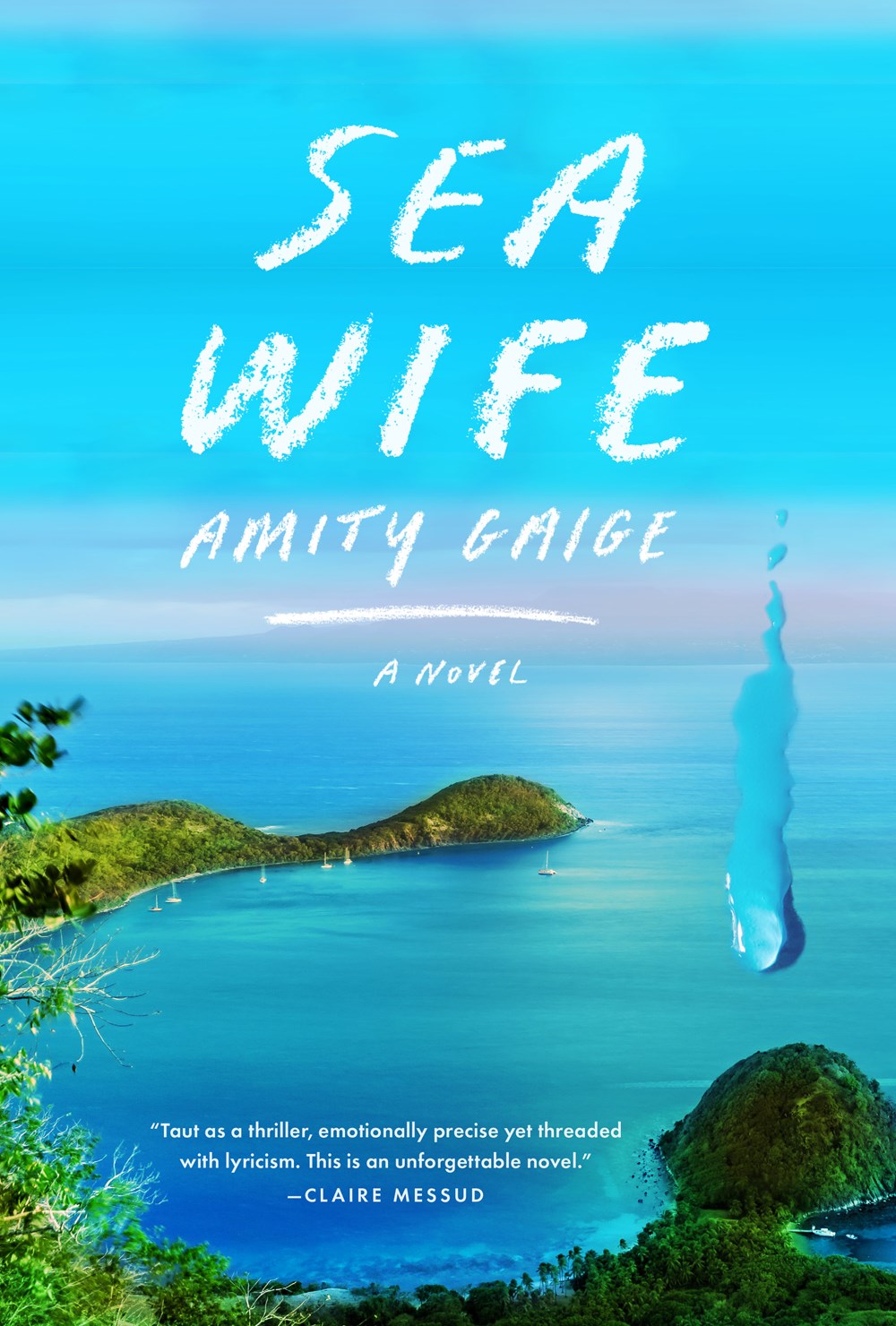
Review 2231: Literary Wives! Sea Wife

Today is another review for the Literary Wives blogging club, in which we discuss the depiction of wives in fiction. If you have read the book, please participate by leaving comments on any of our blogs.

Be sure to read the reviews and comments of the other wives!

My Review

At the beginning of Sea Wife, I thought, oh no, it’s in he said/she said format, which I’m already sick of. That’s not really what’s going on, though. Eventually we realize that Michael’s ship log entries are interspersed with Juliet’s thoughts as she reads them.

Juliet is home after a voyage in the Caribbean. Before the trip, she had been suffering from post-partum depression since the birth of her 2 1/2-year-old boy George (or Doodle). Then her husband Michael convinced her they should buy a sailboat and go to sea. She was terrified of this idea, having no sailing experience herself. However, eventually she agreed. Michael wanted to sail around the world, but she convinced him to sail in the Caribbean off Panama, where they ended up buying the boat, so they could stay near land. Along with them went Doodle and seven-year-old Sybil.

Michael is right about one thing—the adventure forces Juliet out of herself. It also focuses attention on their marriage. They have some lovely moments, but dread arises as we slowly realize that Michael has not returned home.

After my initial bad reaction, which only lasted a few pages, I found this novel absolutely compelling. The descriptions of their stops and of the seas are vivid and beautiful. Both Michael and Juliet have the opportunity to unearth some of their own demons.

What does this book say about wives or about the experience of being a wife?

Literary Wives logo

First I have to rant a little about how unprepared this couple were to take on this kind of trip. Michael’s teenage years spent doing a few trips on Lake Erie were definitely not enough experience to set sail on the ocean with his family, especially when Juliet has never sailed. They’re not sailing on a cabin-cruiser-type yacht but on a sailing vessel, which is much more complicated. He tries to teach her during the trip, but she gets confused about the names of things and is afraid of doing something wrong. This mid-life crisis experiment seemed so stupid to me that it took me a while to get past it. They lived in Connecticut, for heaven’s sake. As this was supposed to be his life-long dream, he could have rented a boat and taught her to sail before they went.

In any case, a sailboat, however large, is a good place to focus the mind on the family problems. Michael seems to have been breathtakingly self-absorbed during Juliet’s depression, leaving her alone with the kids almost all the time and not helping with the housework.

Michael loves Juliet, but he harbors a lot of resentment against her for being depressed and for focusing on her memories of being abused by a family friend. He seems angry that she turned out to be a different person than she seemed to be when they met, a woman he thought was brave and self-assured..

Juliet is afraid she no longer loves Michael. Her political beliefs are opposite to his and he hasn’t handled her depression well.

I like how their relationship ebbed and flowed during the trip, with good times and not so good, like a real marriage, instead of (more common with our Literary Wives books) being unrelentingly bad. Living the dream, Michael is nicer and more involved with the kids even though he is occasionally impatient and Juliet has gotten out of herself. The couple end up really having adventures, as well as working out some of their problems. But how does it end? I’m not telling.

Related Posts

Ahab’s Wife, or The Star-Gazer

Dept. of Speculation

Happenstance

Day 770: Captain in Calico

Cover for Captain in CalicoThe foreword to Captain in Calico, written by George MacDonald Fraser’s daughter, says that it is closely based on the careers of the pirates Captain Jack Rackham and Anne Bonny (Bonney). I would suggest it is more loosely based. With the little I know about the subject, I spotted inaccuracies, and the novel has a completely fabricated ending.

Calico Jack Rackham arrives in the Bahamas full of hope. Although he fell into piracy against his will, he’s kept at it for the past few years, and he and his shipmates have captured a ship full of Spanish silver. But he has heard about a pardon being available, and he hopes to take his pardon so he can marry the girl he left behind, Kate Sampson.

Governor Woodes Rogers isn’t content to simply give his pardon. Jack must betray his shipmates and be captured along with the silver before he gets a pardon. What the governor knows and Jack does not is that his betrayal will be for nothing. Kate Sampson is engaged to be married, to the governor himself.

So, Jack betrays his crew, loses his fortune, and gets his pardon, but he does not get Kate. Afterwards, drunk and angry, he ends up in a duel and is wounded. A voluptuous married woman named Anne Bonney takes him home to heal him and promptly seduces him.

Soon Anne is trying to talk him back into piracy. She has heard the governor is shipping treasure, and she knows the name of the ship. She wants Jack to raise a crew, steal a boat, and stop the ship on the high seas. Jack thinks it’s a risky business, but she talks him into it. In turn, he persuades his friend Major Penner, with whom he had signed on as a privateer, to join him.

George MacDonald Fraser’s novels are marked by more realism and less romanticism than most historical novels, especially from his time. His protagonists are often unsavory types. In this case, Jack starts out by betraying his friends, but I presume we are supposed to be sympathetic with him. I wasn’t. In Fraser’s Flashman novels, in contrast, we are amused by Flashman’s lack of scruples but find his morals abhorrent. Next, Fraser’s novels are usually marked by impeccable research, but this one differs in several respects from the other reading I’ve done on Anne Bonny. For one thing, she ran away to marry Bonny, a poor sailor. In this novel, she was basically sold to Bonney, a rich plantation owner.

link to NetgalleyFinally, this novel falls into a genre that leaves a bad taste in my mouth, wherein a man’s troubles are the fault of a seductive, unprincipled woman. I really don’t like these novels. No matter which sex is leading the other astray, it’s presumed the victims can’t think for themselves. Since a large proportion of the women in American prisons are there for abetting their partners in crime (a statistic I read a while back, so I can’t back it up with a citation), this does seem to happen to women, but in literature it is much more frequently the men who are betrayed. Why do you think that is? (That’s a rhetorical question, but you can answer it if you like.)

So, not one of Fraser’s best, as he frankly admitted. Still, Fraser is a good writer who always manages to keep your attention.

Related Posts

The Candlemass Road

Flashman

Treasure Island

Day 74: A Caribbean Mystery

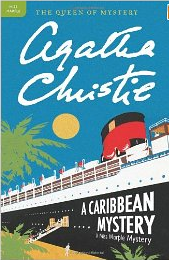
Cover for A Caribbean MysteryAgatha Christie is one of the best mystery writers of the so-called Golden Age of mystery writing because she so skillfully sketches believable characters and plots. Although many of the Golden Age mysteries concentrate on perplexing puzzles such as figuring out railway timetables, Christie was much more interested in the personality of the murderer and his or her motivations.

A Caribbean Mystery begins after Miss Marple has suffered a serious bout of pneumonia. Her affectionate nephew Raymond has arranged a vacation for her on an island in the Caribbean, where she can recover. But of course her vacation isn’t as restful as her nephew had hoped.

She is only half listening to boring Major Palgrave when he offers to show her the snapshot of  a murderer, but just then he sees something and quickly begins chatting about something else. That night he is found dead, apparently of a heart attack.

Miss Marple is having grave doubts about that heart attack when the chambermaid reports that before his death the Major Palgrave did not have the heart medication found in his room. Shortly thereafter, she is found stabbed to death.

Miss Marple begins sizing up her suspects. Molly Kendal, owner of the hotel with her husband Tim, has been behaving oddly, having nightmares and reporting blackouts and feelings of paranoia. Years ago, Greg Dyson’s wife died and he married her cousin Lucky within a month. Colonel Hillingdon and his wife Evelyn appear close, but are they really? And are they as friendly with the Dysons as they seem to be? The elderly and wealthy Mr. Rafiel is too feeble to be a murderer, but his secretary Esther Walters is secretive and Miss Marple spots his attendant Jackson skulking around.

As usual, Christie does a deft job of quickly limning believable characters and a complex mixture of motives and red herrings in a brief novel that is fun to read. I spotted the killer quickly but still enjoyed the book.