Review 2200: Near Neighbours

The last book I read before this one was This Mournable Body, and after reading that, I felt in need of something light. So I skipped through my queue until I found this book, and it answered the purpose very well.

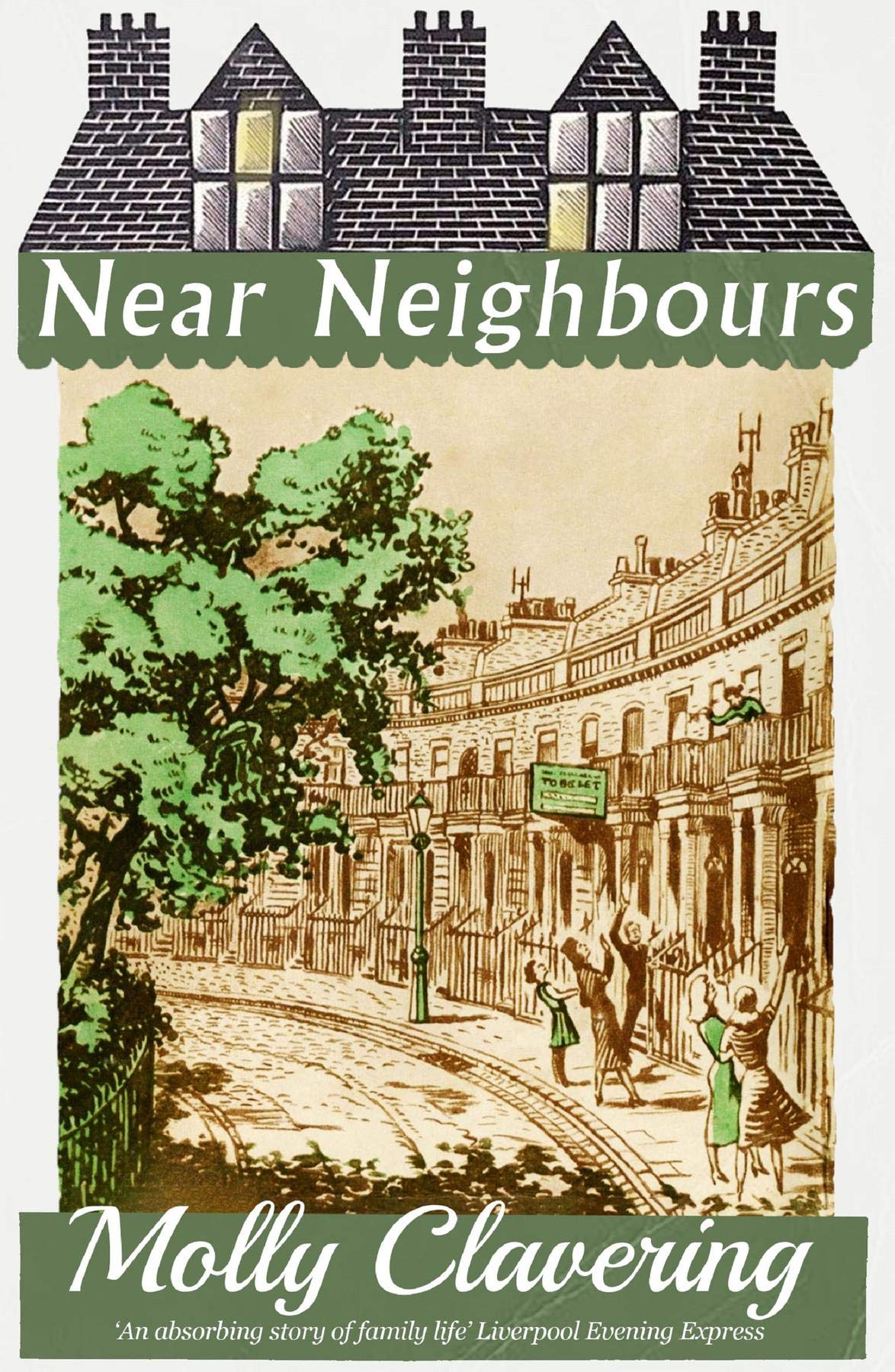
Unlike the other Clavering works I’ve read, which were set in small towns or villages in the Scottish borderlands, Near Neighbours is set in Edinburgh, in a once-exclusive neighborhood where stately homes are being split up into flats. The two surviving single-family homes are next to each other.

In one, elderly Miss Dorothea Balfour has been dominated all her life, first by her father and then by her older sister. But now her sister is dead, and Miss Balfour has just begun to realize that her life is her own. Still, she is lonely, as her sister considered them to be socially above their neighbors. However, she has always been interested in the activities next door, where the Lenox family, a widow with five grown or nearly grow children, live.

Young Rowan Lenox notices Miss Balfour at the window one day and decides to call on her to offer condolences. She finds the house gloomy but gets along with Miss Balfour well and invites her to tea. Everyone likes her and soon there are friendly visits back and forth.

The three oldest Lenox girls have a romantic concern. Willow is married, but because her husband is in the navy and is often away, she still lives at home. Her mother wishes they would get their own place, and Rowan is disturbed to notice Willow spending a lot of time with Mickey Grant while Archie is away.

Hazel Lenox is a level-headed nurse who is surprised to learn that the hospital heartthrob, Adam Ferrier, approves of her. He even asks her out a few times but then informs her he needs to concentrate on his career as a surgeon. Hazel hadn’t realized until then that she cares for him.

Rowan’s new Highland Dance partner is a brooding Byronic type but the best dancer in the class, Angus Todd. He is sensitive about his lack of background, being adopted, but shows an alarming tendency to be possessive of her, while she thinks of him as a friend.

Miss Balfour is surprised to receive a call from a strange man, who turns out to be the brother-in-law her sister split from six months after she married him. Mr. Milner seems not quite reputable, and Charles Frasier, Miss Balfour’s solicitor, is alarmed because the sister left her entire estate in such a way that Mr. Milner could lay claim to all of it. Through Miss Balfour, Charles meets the Lenoxes and is struck by Rowan.

The novel is a pleasant story about nice people with few real surprises, but the characters are interesting and you want to know what happens to them.
Related Posts

Mrs. Lorimer’s Quiet Summer

Dear Hugo

Yoked with a Lamb

Review 2198: #ThirkellBar! Never Too Late

Purely by error, I read most of the next book in the series before this one (apparently my stack got rearranged), which spoiled a key surprise of this book. So I will not spoil it for you.

Much of this book deals with young Edith Graham, who can’t decide what to do with herself. As, in fact, did the last book and as does the next one. It’s unusual for Thirkell to spend so much time with one character, although she certainly revisits characters time and again. To a certain extent, though, she also did this with Clarissa Graham, who was also a little spoiled. Edith is clearly discontented, especially when she feels she is not getting enough male attention.

But the novel also deals with the problems of George Halliday and his mother. George has been working hard to keep his father’s farm going and to keep his patience with his father’s advice. But now Mr. Halliday is failing in mind and body. George is too busy with the farm to help his mother care for his father, and both of them are exhausted. So, Agnes Graham, working with friends, takes a hand in the situation.

Aside from George’s problems there are newcomers to meet—the Carters, cousins of Everard Carter, the headmaster of Southbridge School—and two very understated romances of the middle-aged variety. So, I found Never Too Late to be as delightful as usual.

Related Posts

Enter Sir Robert

What Did It Mean?

Jutland Cottage

Review 2191: Sally on the Rocks

Sally Lunton has been living in Paris as it waits for a German invasion in 1915, and she is at her wit’s end. Her sketchy career as an artist has been finished by the war, and she is stone broke. She has changed from a blithe Bohemian to a woman nearly middle-aged (by the standards of 1915—she’s 29) who thinks her only hope is to marry someone well off.

Then Sally gets an apparently friendly letter from Miss Maggie Hopkins telling her that there is a new bachelor in her home town of Little Crampton, a bank manager, and he will soon be snapped up by a young widow with a daughter. Sally thinks Mr. Bingley will be horrible, but she goes home prepared to fight for him. She returns to the home of her guardian, the mild-mannered and affectionate Reverend Adam Lovelady.

Mr. Bingley turns out to be worse than Sally expected. He is plump and unattractive but full of himself for his lofty position in town. He is also religious and judgmental and is looking for a wife who is above reproach. He is guided by a book left by his deceased mother telling him what to look for in a wife—or rather what to avoid (hint—everyone).

Unfortunately, Sally has a skeleton in her closet. Six years ago, madly in love, she went off to Italy with Jimmy Thompkins. But after a summer in Italy, he left her. Sally has never really recovered, but it is vital that Mr. Bingley not learn of this escapade. Unfortunately, Jimmy is living in the village with his wife and two children, and he thinks Sally should not marry Mr. Bingley without telling him.

Another peril is Miss Maggie, who senses there is something between Jimmy and Sally and is determined to ferret it out.

Despite these complications, Sally’s appearance and pretenses of admiration are getting her ahead of her rival, Mrs. Dalton. However, soon there is another problem. Up on the moors, Sally meets Robert Kantyre, a disgraced former officer on the point of suicide. Sally is determined to save him from himself and from alcoholism.

This is a complex little book considering when it was written. Not only is it a satire of village life, but it makes some surprising observations about the differences in how men and women in the same circumstances are viewed and treated. Although Mr. Bingley is usually a figure of fun, he shows another side, even though his feelings for Sally fight with his yearning for his dinner at times. The only real villain is Miss Maggie, whose idea of fun is mischief making at the expense of others’ lives.

Except for tiring a little bit of Mr. Bingley’s internal battles, I found this novel very enjoyable and insightful.

I received this book from the publishers in exchange for a free and fair review.

Related Posts

The Stone of Chastity

Nightingale Wood

Much Dithering

Review 2185: The Transit of Venus

The Transit of Venus spans the 1950s through the 1970s. It is a modernist exploration of the love affairs, both unconsummated and consummated, of the characters surrounding two Australian sisters in England, Caroline and Grace Bell.

The novel begins when Grace Bell is engaged to Christian Thrale. Grace is a few years younger than her sister Caroline, who is 21. Both are staying with the Thrales when Ted Tice, an astronomy graduate, arrives to plan the placement of a new telescope with Professor Sefton Thrale, Christian’s father. Ted, who is shabby and unprepossessing at the time, falls in love with Caroline at first sight.

Caroline, for her part, falls in love with Paul Ivory, whose play is being produced and who has just become engaged to Tertia Drage, the daughter of a neighboring lord. Caroline and Paul have an affair, but Paul drops her for Tertia, choosing position and wealth over love.

Caroline is devastated. She goes off with a friend of the Thrales, a middle-aged roué who has been bedding Tertia, but she ends up in London, working at a poorly paid government job and leading a bleak existence. All the while, she is loved by Ted Tice.

As the years go by, most of the main characters of the novel are overtaken by love. Caroline and Paul rekindle their affair for a time, but Caroline eventually happily marries a wealthy American philanthropist, Adam Vail. Christian becomes briefly obsessed with a young secretary, while Grace falls deeply in love with her son’s noble doctor. Grace and Caroline’s difficult older half-sister marries, to their relief, but then is robbed and abandoned by her husband.

Until the ending of the novel, I felt that the novel was a fairly detached examination of these various relationships in terms of the dynamics of who holds the power. Then Caroline learns a secret that makes her re-examine her entire adult life and made me re-evaluate my liking for the book. It turns everything on its head and makes the novel a great one.

Related Posts

Outline

Old Filth

Stoner

Review 2182: The Love Child

I guess I can say I’ve been theme reading lately with no plan to do so. By this I mean that I’ve been accidentally reading books with something unusual in common within weeks of each other. For example, I never read any books set in Sri Lanka (except one historical romance I read several years ago), yet within weeks I ended up reading two literary novels set there, one in the 80s and one more recently. Similarly, last summer I read two books set in Madagascar. Now, who would think that there were two books about an imaginary person who comes to life? Yet, a few weeks ago I reviewed Miss Hargreaves for the 1940 Club, and here is another novel on the same subject.

The Love Child is a different kettle of fish from Miss Hargreaves, though. The latter is an amusing romp, while the former looks more seriously at the fate of women in post-World War I England, where there was a surplus of them by nearly two million.

With the death of her mother, Agatha Bodenham (considered middle aged at 32) finds herself unexpectedly lonely. She and her mother have been very reserved and have not engaged in society, so she has no friends.

She remembers having an imaginary friend when she was a girl, a friend named Clarissa whom she romped with until her mother told her she was too old for such things. She begins by remembering the games she played with Clarissa, and eventually Clarissa reappears as an 11-year-old girl. Clarissa is a graceful, delicate girl, completely Agatha’s opposite. Agatha plays make-believe games with her and enjoys herself. But slowly Clarissa becomes visible to others.

When called upon to account for Clarissa’s existence, Agatha is confused and says she is her “love child.” No one believes this, but everyone assumes Clarissa is some relative.

Problems begin, though, when Clarissa starts to have a mind of her own.

This novel is quite a sad story, maybe, depending on how you understand the ending. It rests on then-current beliefs about how the lack of motherhood might affect women (it was published in 1927) and in the fate of unmarried women. I found it sometimes flagging for me but was interested to see how it ended.

I received this book from the publishers in exchange for a free and fair review.

Related Posts

Miss Hargreaves

Strange Journey

Miss Plum and Miss Penny

Review 2180: They Do It With Mirrors

I am fairly sure I have never read They Do It With Mirrors before, but as I recently watched a TV adaptation, it was difficult for me to judge how easy it would have been to predict the outcome. I suspect it wouldn’t be.

Jane Marple has not seen her old school friend Carrie Louise for many years, but their mutual friend Ruth thinks something is not right, so she asks Jane to visit if invited. Carrie Louise is a frail woman whom others yearn to protect. She was left with a fortune after the death of her first husband. Her second husband left her for a dancer. Her third husband, Lewis Serrocold, is using wings of her massive home as a rehabilitation center for young criminals.

When Jane arrives, she finds quite a few people residing in or visiting the main house. Carrie Louise’s granddaughter Gina is there with her American husband Walter. Carrie Louise’s daughter Mildred is widowed and living there. Alex and Stephen, the two sons of Carrie Louise’s second husband, are there (well, Alex soon arrives on a visit), and they all get a surprise visit from Christian Gulbrandsen, an executor of the estate trust and Carrie Louise’s stepson. He is there to talk to Lewis, who is momentarily away, but Miss Marple sees them conferring outside when Lewis returns home.

After dinner, Christian has gone to his room to write letters when one of the inmates, Edgar Lawson, strikes up an argument with Lewis Serrocold and starts flashing a gun around. Edgar sometimes says different important men are his father and has moments of confusion and paranoia. This time he says Serrocold is his father and has been spying on him. The two go into his office, from which the others can hear the argument. They hear a gun fired outside, and then the gun in the office is fired, but when they get into the office, both men are fine. Later, though, Christian Gulbrandsen is found shot to death.

When questioned by the police, Lewis tells them Christian suspected Carrie Louise was being poisoned, her arthritis symptoms being similar to slow arsenic poisoning. And sure enough, when the police check a bottle of tonic that Serrocold told her not to take, it’s poisoned.

Soon there are two more deaths, and insights are needed from Miss Marple.

There are a lot of characters in this story and perhaps they’re not as vivid as Christie’s usually are, but she has set us an entertaining puzzle to solve.

Related Posts

4:50 from Paddington

Sleeping Murder

Murder at the Vicarage

Review 2176: The Duke’s Children

This last of Trollope’s Palliser novels begins with the unexpected death of the Duchess of Omnium, Glencora Palliser. This event begins a series of incidents that makes the Duke even more unhappy.

First, he learns that his daughter Mary has fallen in love with his son’s friend Frank Tregear while Mary and Glencora were traveling in Italy. Apparently, Glencora approved of the situation even though Tregear has neither position nor fortune. The Duke feels that Tregear does not have a position fit for his daughter, so he refuses permission but is upset that Mary is so unhappy.

Then Lord Silverbridge, his oldest son, tells him he has decided to run for Parliament—on the Conservative side, when the Pallisers have been prominent Liberals for generations. This despite the fact that Silverbridge doesn’t seem to have any strong political beliefs at all. However, the Duke is very pleased when Silverbridge tells him he would like to marry Lady Mabel Grex.

Lady Mabel has known Tregear for years, and they pledged to love each other. But neither of them has any money, so Mabel recently released him, only a few months before he met Mary. Although she has had several proposals of marriage, she cannot bear the idea of being married to any of those men until she meets Silverbridge, whom she sees is kind. However, when he proposes to her, she doesn’t want to be too hasty, so she turns him down.

Much to her later regret, Silverbridge, who thinks Mabel has been unkind, meets Miss Isabel Boncassen, the daughter of a prominent American of inferior roots. After a series of misunderstandings, Silverbridge decides he prefers Isabel.

The Duke remembers how his Glencora had been in love with another man when she was talked into marrying him, and that had worked out well. But Mary isn’t yielding, and soon he has two children of whose choices he disapproves.

I found this novel a fitting end to the series, although I was sorry Glencora died. The Duke seems to become closer to his children as a result, though. The interchanges between him and his two sons, Silverbridge and Gerald, are well handled, and it is nice to see all behaving affectionately. I have to admit that I preferred Lady Mabel to Isabel, who doesn’t have much of a personality until the end. However, I enjoyed this series very much.

Related Posts

The Prime Minister

Phineas Redux

The Eustace Diamonds

Review 2173: Iza’s Ballad

When Ettie Szȍcs’s husband Vince dies, she is terrified of being left alone in her house in the small town where they’ve lived for many years. So, she is relieved when her daughter Iza tells her Ettie will come to live with her in Pest, in her modern apartment. Iza has always been the light of her and Vince’s lives, a proud defender of her father as a child after he was dismissed from his position as a judge for political reasons, an excellent student who worked against the Nazis during the war, now a respected doctor, a post-Stalinist modern woman. Ettie also has an invitation to stay in her own house with Antal, her ex-son-in-law, who bought it. But even though she still treats Antal like a son, she pays little attention to his invitation. In fact, she is more than a little befuddled by grief.

Iza is self-assured and always tries to do the right thing. However, she allows her mother no input into her own fate. She arranges to sell her mother’s house to Antal and puts her mother on a train directly after the funeral, not even giving her time to attend the little gathering that was planned. When eventually Ettie arrives in Pest expecting to see her furniture and little keepsakes, she finds Iza has sold or given away most of her possessions.

Ettie just wants to be useful. Although a simple soul who is easily frightened, she is still an active woman in her 70’s who is used to doing everything for herself and her husband. In Pest, she thought she could cook and clean for her daughter, but Iza has a housekeeper and doesn’t want Ettie to interfere. Iza believes Ettie should be happy to relax, but Ettie literally has nothing to do.

Iza works hard and then wants time alone or with her friends. It takes a remark from Domokos, Iza’s lover, to make her realize that Ettie is lonely. But even when they try to arrange a treat for Ettie, it’s something they want to do rather than something that would please Ettie.

The introduction to the NYRB edition says the novel asks what to do with the old and talks about Ettie’s inability as a country person to adapt to the city, but I think this novel is more a character study of Iza, a person who always thinks she knows best and is blind to the feelings of others. Her marriage to Antal was her only failure, and she still doesn’t understand why he left, since he was clearly in love with her. It’s a fascinating but sad novel.

Related Posts

Abigail

The Invisible Bridge

Effi Briest

Review 2171: Stories for Christmas and the Festive Season

Although May is an odd time to review a collection of Christmas stories, I didn’t receive a copy of this book until much after the season. This entertaining collection is ordered by when the story occurs during the festive season and includes works by women published during the 20th century. Some of the authors are well known and others are only remembered now for a specific work. The introduction by Simon Thomas discusses each story in turn and tells something interesting about it.

The first story, “The Turkey Season” by Alice Munro, provides insight into a side of the holidays we may not have considered, factory workers processing turkeys. As usual, Munro is a masterly storyteller.

Some of the stories are amusing, such as “This Year It Will Be Different” by Maeve Binchey, about a housewife who goes on strike during the holidays, or “Skating” by Cornelia Otis Skinner, about a woman’s attempt to learn ice-skating. Others start out amusing but have a deeper meaning, for example, “The Christmas Pageant” by Barbara Robinson, about what happens when “the worst children in the world” get involved in the pageant or “Christmas in a Bavarian Village,” which subtly foreshadows World War II.

I especially liked “The Little Christmas Tree” by Stella Gibbons, about how a solitary woman’s Christmas plans are changed with the arrival of some children and “The Christmas Present” by Richmal Crompton, about an unusual gift passed down in the family from mother to daughter. The book finishes with a sprightly monologue by a black maid in “On Leavin’ Notes” by Alice Childers.

I received this book from the publishers in exchange for a free and fair review.

Related Posts

The Mistletoe Murder and Other Stories

A Christmas Carol

A Christmas Party

Review 2167: Weir of Hermiston. Some Unfinished Stories

I wasn’t aware when I picked up Weir of Hermiston that it was Robert Louis Stevenson’s last and unfinished novel. But unlike The Mystery of Edwin Drood, only nine chapters of it exist. It has been packaged in the slim volume I found, dated 1925, with several other unfinished novels or stories, but of the others only one or two chapters or partial chapters exist. Between most of the fragments is a note from the editor containing what is known about the fragment and Stevenson’s intentions.

Weir of Hermiston tells the story of Archie Weir, whose mother brought him up to fear and distrust his father, the Lord Justice-Clerk. As a young man, Archie reacts in a disgraceful way, possibly treasonous, to a hanging, so his father sends him to his estate in Hermiston to learn to run it. Archie is ashamed and is not socially adept, so he becomes a bit of a recluse. However, he meets Christina, a cousin, and begins to fall in love with her. He is joined by Frank, a financially embarrassed friend, who decides to give him some competition for Christina. Things aren’t looking good when the fragment ends.

The next fragment is Heathercat, about a young boy whose mother keeps disobeying the law in regard to religion—I didn’t really understand the details—to the point where his father is being ruined by fines. She is using her son, whose nickname is Heathercat, to run illegal errands and keep guard on illegal services of worship. The notes explain that this novel was going to be based on a true story about a young boy who was married to an older girl to prevent her being forced to marry someone else.

Other stories are about a beautiful wife of a wine seller who falls in love with an aristocratic customer, a prince, presumably Prince Charlie, who tires of waiting around and decides to act; a man who takes over the household of a friend who has fled the country; and so on. The fragments are set in Scotland, England, or France during the 15th to 17th centuries, except Weir of Hermiston, which is set in the 19th.

I forgot to add that my copy begins with a description of Stevenson’s death and funeral, written by his stepson, Lloyd Osbourne, who was apparently very fond of him.

I found a book composed of fragments to be frustrating, but it made me want to read more of Stevenson’s adult novels.

Related Posts

Kidnapped

Treasure Island

Travels with a Donkey in Cévennes