Review 1862: Strange Journey

Polly Wilkinson, a middle-class suburban housewife and mother, is leaning on her garden gate, tired from housework. She sees a woman in a Rolls Royce stopped in traffic and wishes she was that woman. For a moment, she is, but it doesn’t last long and she thinks the experience is a daydream.

After that, Polly is periodically removed from her life and takes the place of aristocratic Lady Elizabeth Forrester. After some initial confusion about what is happening, she believes Elizabeth is causing this exchange, and she is put in some awkward positions, such as finding herself in the middle of a fox hunt when she can’t ride. She purposefully makes Elizabeth do things she doesn’t usually do, such as play bridge brilliantly, in a sort of revenge. She also returns home to find the furniture moved and her children demanding stories she’s not familiar with. What could be causing these body exchanges?

I wasn’t sure I was going to like this novel, which reminded me of The Victorian Chaise-Longue, but it grew on me. It wasn’t as dismal as the other novel, and I liked how Polly’s more open and positive personality had an effect on Elizabeth’s life while Elizabeth’s confidence helped Polly and her husband’s career.

Of course, the novel comments on class issues, but Cairnes’s representation of Polly’s suburban life is so realistic that I was surprised to find Cairnes came from a background closer to Elizabeth’s. She doesn’t skewer or patronize the suburban characters. If anything, Polly’s frank kindness opens Elizabeth’s eyes to some truths. Sadly, (small spoiler) the class divide is still strong enough in 1930’s England that the women can’t remain friends in the future.

I received this novel from the publishers in exchange for a free and fair review.
Related Posts

The Victorian Chaise-Longue

The Squire

Mamma

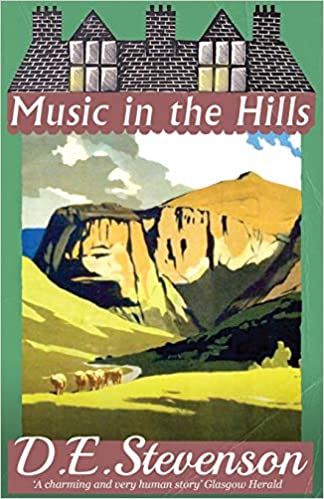
Review 1859: Music in the Hills

Music in the Hills is the second book in Stevenson’s Dering family series. The first book, Vittoria Cottage, is about Caroline Dering. This book has as its main characters Caroline’s sister, Mamie Johnstone, and Caroline’s son, James. The last book, which I read second, is Winter and Rough Weather.

James has returned from service in Malaysia and wants to become a farmer, so Mamie and her husband Jock have invited him to their farm in the borderlands of Scotland, Mureth, to learn farming. Although James settles in well and loves Mureth, he is unhappy, because he is in love with an art student named Rhoda. He proposed to her, but she has been clear that she’s picking her career over marriage.

This novel is mostly about the everyday events and people on the farm and in the nearby village, nearby in terms of straight distance but a bit remote along a hilly, twisty road. In the novel, as in the next, the landscape is an important character. There are two major subplots, however. One is about sheep being stolen from Mureth. The other is about Holly, the niece of Lady Shaw. She’s making a dead set at James, but there’s something about her that Mamie distrusts.

Another lovely book from Stevenson. I haven’t read Vittoria Cottage for a long time, but it makes me want to revisit it.

Related Posts

Vittoria Cottage

Winter and Rough Weather

Five Windows

Review 1854: The Weather at Tregulla

Una Beaumont (again, the publishers got the name wrong on the cover) is 19 and very much still a sulky teenager. She finds her home in a small Cornish village to be absolutely boring. Her father, Captain Beaumont, had promised her that she could live in London and study to be an actress. However, her mother has unexpectedly died and her money was entailed, so the Captain can no longer afford to send Una. Even her distraught father notices that she is more upset by this than by her mother’s death.

The weather in Tregulla is tumultuous, at least in regard to several love affairs. Una meets Terrence Willows, an artist leasing a cottage in the neighborhood, and his sister Emmeline. Terrence is a bit of a bounder, but Una immediately falls in love with him. Emmeline has the kind of looks admired by Una’s friend Barnabas, and she has in fact moved to the area in hopes of getting him to marry her, even though she hadn’t met him before. She is tired of the chaotic existence of her brother and his friends, but when she thinks of Barnabas, she always thinks of his parents’ estate first. Barnabas, although believing he is cautious, is smitten. Finally, his brother Hugo is in love with Una.

At first, I didn’t think I was going to like this novel as well as I did others by Gibbons. I didn’t like Una, and the novel has several more unlikable characters. However, Gibbons is a great storyteller and satirist, and her characters are believably written. Further, some of them improve, particularly Una.

Related Posts

The Woods in Winter

Nightingale Wood

A Pink Front Door

Review 1849: Much Dithering

Jocelyn Renshawe is a young widow who has always done what is expected of her, that expectation arising from two older ladies, Mrs. Pallfrey, her aunt, and the Honourable August Renshawe, her mother-in-law. She leads a quiet life, mostly doing good works. At the beginning of the novel, she is about to suffer a visit from her mother, Ermyntrude.

Ermyntrude is the most selfish being in this novel, which is full of them. She finds her daughter a bore, and her only reason for visiting her is because she is what Lambert calls a “baby-stealer” and what we would call a cougar. She is interested in cementing her affair with Adrian Murchison-Bellaby, whose parents have just taken a house near the village of Much Dithering, where Jocelyn lives. Ermyntrude wants to show Adrian’s parents how suitable she would be as a wife. However, when Adrian meets Jocelyn, Ermytrude is unable to see that he falls in love with her daughter.

In a thunderstorm on the way back from one of her good deeds, Jocelyn accepts a ride from a stranger who is having trouble finding Much Dithering. He is Gervase Blyth, who has unexplained business in the area.

Soon, Jocelyn unaccountably has three men in love with her. But the one she prefers is most likely to force her out of her protective shell.

It’s not very hard to guess the outcomes of this entertaining light novel, but that doesn’t make it any less fun to read. Its characters’ foibles are all too human, but still funny. This was a perfect light read for me from my Classics Club list.

Related Posts

Rhododendron Pie

The Blue Sapphire

Wild Strawberries

Review 1847: #ThirkellBar! Marling Hall

Lettice Watson, the Marling’s older daughter, has moved back home with her two little daughters after the death of her husband at Dunkirk more than a year ago. The younger Miss Marling, Lucy, is one of those bouncing, hearty girls that Thirkell depicts so well. Brother Oliver, whose poor eyes don’t allow him to serve, has a job in the regional government offices. Mr. Marling is aggressively deaf and likes to play what his children call “the olde squire.” Mrs. Marling is a bit silly.

From the beginning of Marling Hall, we realize we’re going to encounter some familiar characters. The Marlings, along with Miss Bunting, their former governess (who gets her own book later in the series), go to call on the Leslies at Rushwater. It was David and John Leslie who made up two thirds of a love triangle in Wild Strawberries, and David very soon is trying his charm on Lettice. Soon after, Lucy brings home Captain Tom Barclay, a much steadier young man, who is also attracted to Lettice.

Because of this visit, we meet again the charming but disorganized Lady Emily as well as her daughter Agnes, so besotted with her own children that she can talk of nothing else. And we continue not to meet Agnes’s husband Robert. The efficient Miss Merriman also reappears on the scene. We hear about characters from Pomfret Towers and other books in the series.

Some newcomers to the area are the Harveys, who both work in Oliver’s office. Geoffrey Harvey is one of the artistic types that Thirkell likes to make fun of. His sister Frances is Oliver’s very organized assistant. The Harveys have been living with the Nortons and wish to find a house for themselves, but housing, along with everything else, is difficult to find during these days of war. They find the Red House, a repulsively decorated place owned by Mrs. Smith. A lot of the comedy of this novel comes from their encounters with Mrs. Smith, who, after she leases them the house, continues to return to it to remove one object after another, including the beans from the garden and the eggs from the chickens the Harveys purchased, and eventually the chickens themselves.

Unfortunately for me, more humor is derived from the visits of Harvey’s old French teacher and later her nephew. Although Thirkell has poked fun at the French before, she hasn’t actually included so much dialogue in French, which I don’t really know. Last time, it was little enough for me to type into my iPad and get a translation or simple enough for me to muddle out myself, but this time there was a lot more, also, I think, including some mocking of the quality of one character’s French. The part with the nephew was funnier because of being told the gist of what he was saying rather than the exact words.

In this novel, the difficulties of life during the war become more apparent, especially in regard to food and clothing shortages. However, it continues on in the Thirkell vein—funny, with its little side comments directed at the reader, insightful, touching, and certainly snobbish, but more as if she is laughing at her own and her characters’ snobbery. Another good one.

Related Posts

Wild Strawberries

Pomfret Towers

Cheerfulness Breaks In

Review 1846: Classics Club Spin Book! The Dead Secret

The latest Classics Club Spin ended up with The Dead Secret as the book I should read. It is Wilkie Collins’ first full-length novel but unfortunately not his best.

Mrs. Treverton is on her deathbed at Porthgenna Tower, but she has a secret. She wants to disclose it to her husband but can’t bring herself to do it. So, she forces her maid, Sarah Leeson, to write it down. She makes Sarah promise not to destroy the confession or remove it from the house, but she dies before she can make her promise to give it to her husband. So, Sarah hides it in a ruined wing of the house and then flees.

Fifteen or sixteen years later, Mrs. Treverton’s daughter Rosamond is a young wife. She and her blind husband, Leonard Frankland, are on their way to Cornwall to take up residence at Porthgenna Tower, where Rosamond has not lived since she was five. They intend to renovate the house, including the ruined north wing, but they have had to stop their journey because Rosamond has gone into premature labor.

The local doctor, in seeking a nurse for the new mother and son, consults a householder only to have her housekeeper, Mrs. Jazeph, unexpectedly volunteer to do it herself. However, Mrs. Jazeph’s odd behavior that evening causes her to be dismissed. Before leaving, she tells Rosamond to stay out of the Myrtle Room.

With a ruined old mansion on the coast of Cornwall that is possibly haunted and a secret too awful to tell, this novel promises to be all that a sensation novel should be. However, Collins is clearly learning here, for this novel is dripping with sentimentality and soppiness. Moreover, the behavior of the maid (it’s not hard to guess who she is) is so exaggerated that I could hardly stand to read about her at times. Collins took Dickens for his model, and Rosamond is a typical type for Dickens—sweet, a little foolish at times, loving, needing the guidance of her morally correct husband. Without having spent enough time with Sarah for us to care much for her—in fact, at times her behavior is extremely irritating—he spends too long a time with a supposedly heart-rending scene.

The secret isn’t very hard to guess, nor are the events of the plot difficult to predict. This isn’t a terrible novel, but Collins has written better ones.

Related Posts

The Haunted Hotel

Hide and Seek

The Moonstone

Review 1842: #1954 Club! Nectar in a Sieve

I don’t usually post on Saturdays, but I had one more book that I read for the 1954 Club.

When I saw that Nectar in a Sieve qualified for the 1954 Club, I was excited to read this landmark novel. It depicts the life of poor Indian peasants, and as the Afterword of my Signet Classics edition states, nothing much has changed for them in the 80 years since it was written.

As the daughter of the village headman, Rukmani might have expected a more memorable wedding, but she is the youngest daughter, so no dowry was forthcoming and she is plain. So, Rukmani is married at the age of twelve to a poor rice farmer, Nathan, who does not even own his own land. But, she thinks as an old woman recollecting her life, her parents made a good choice, for Nathan was good and kind.

Rukmani remembers her life, a precarious one where they were never able to afford to buy the land, where one misfortune could mean disaster—and they had several.

Rukmani thinks things start to go wrong with the arrival of the tannery, which turns their village into a town and brings in many strangers. But one year of flood followed by one of drought cause starvation and worse problems when Rukmani and Nathan are middle-aged.

By coincidence, just before I read this novel, I read The Year of the Runaways by Sunjeev Sahota, about the life of Indian illegal immigrants in London. In all these years, nothing much seems to have changed except the ultimate outcome.

In some ways, Nectar in a Sieve is more like social reporting than a character- or plot-driven novel. The only character we really get to know is Rukmani herself. However, the novel is poetically written and tells a powerful story.

Related Posts

The Lowland

Sea of Poppies

The Lives of Others

Review 1841: #1954 Club! The Bird’s Nest

When I saw that a Shirley Jackson novel I hadn’t read qualified for the 1954 Club, I knew I had to read it.

Twenty-three-year-old Elizabeth Richmond is a quiet girl with very little affect. Her mother died a few years ago, and she lives with her aunt Morgen. When she reluctantly seeks help for debilitating headaches, she is referred to Doctor Wright. After a series of baffling hypnosis sessions, Dr. Wright realizes that Elizabeth is exhibiting multiple personalities.

Elizabeth herself is restrained and has difficulty expressing herself. Another personality, which Dr. Wright calls Beth, is sweet and melancholy. Eventually, a third teasing and raunchy personality, Betsy, appears, and after a disastrous trip to New York, there is Bess, obsessed with the money she is due to inherit. Wright believes he can fuse these partial personas into a whole person, but soon they are fighting for their existence.

I don’t know how likely this novel would be considered now by those in the mental health profession, but it seems to be right up there for the 1950s. The novel is both bizarre and a little frightening and weirdly, macabrely funny, both effects which are probably intended. As to the novel’s resolution, well, that’s less likely but entirely 50s in nature.

I can see why some other of Jackson’s works are better known and more widely read, but The Bird’s Nest is still very good.

Related Posts

Hangsaman

Let Me Tell You

Turtles All the Way Down

Review 1839: #1954 Club! Go Tell It on the Mountain

Reading Go Tell It on the Mountain checked off some boxes for me. Not only does it qualify for the 1954 Club, but it is on my Classics Club list. In addition, it’s been a long time since I’ve read anything by Baldwin.

Fourteen-year-old John Grimes is in rebellion. His stepfather, Gabriel, is a deacon in a Black Pentacostal church. Gabriel is a man who believes himself bound for heaven, but John sees his faults. He is self-righteous and treats John harshly while he is kinder to his own scapegrace son. He is cruel to John’s mother, Elizabeth, because she had John out of wedlock. He has other faults that John doesn’t know about but Gabriel’s sister Florence does. John sees his hypocrisy and that of the “saints,” as the novel calls the church faithful, and stands aloof from the frenzied religious services.

The novel is divided into three sections. The first explores John’s frame of mind. The second is divided into thirds, which explore the thoughts of Florence, Gabriel, and Elizabeth. Finally, in the third section, John is forced to confront his feelings in a service at church.

This novel is powerful, and its language is masterful. As I am an atheist, it’s hard for me to conceive of the characters’ mindset, in which everything is about the acceptance or rejection of God and all others are sinners. I thought it was interesting to explore this world, but I found especially the last, hallucinogenic section, and the resolution of John’s dilemma, to be a bit too much.

Related Posts

Gilead

Religion and the Decline of Magic

The Brothers Karamazov

Review 1836: Rhododendron Pie

Ann Laventie comes from an artistic and elegant family, all of whom are witty and have excellent taste. All, that is, except for Ann, who thinks they are wonderful but likes ordinary things and people. While her family disdains their solid Sussex neighbors and stays away from them, she likes them, especially the large and noisy Gayford family. Still, she feels she must be at fault.

A young film maker, Gilbert Croy, comes to stay and pays Ann a lot of attention. After Ann’s sister Elizabeth moves to London, Ann goes to visit her, convinced that she is in love with Croy and determined to come back engaged. But once in London, she begins to notice things. Her brother Dick’s sculptures, for example, all look alike. She absolutely adores a girl that everyone in her siblings’ group of friends shuns.

Rhododendron Pie is Margery Sharp’s first novel, and it’s quite funny as it explores the bohemian world of her upbringing versus the more mundane. Ann is an appealing heroine, and frankly I liked the Gayfords a lot better than the Laventies, especially in their reaction to Ann’s engagement. Her mother, though, an invalid who is mostly just a presence in the novel, gives a wonderful speech at the end. A fun one from Margery Sharp. I’m glad to have read it for my Classics Club list.

Related Posts

Harlequin House

Cluny Brown

The Stone of Chastity