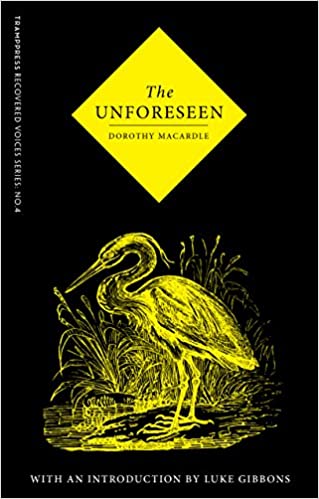
Review 1786: The Unforeseen

Although I haven’t yet read Dorothy Macardle’s The Uninvited, the movie based on it remains one of my favorites for Halloween. I didn’t realize that The Unforeseen is not a sequel to it but a follow-up and that a few of the characters make a reappearance. So, I’m reading and reviewing out of order.

Virgilia Wilde cannot afford to live in the city while she is sending her daughter Nan to art school in London, so she buys a cottage in the wilds of Wicklow. There she enjoys herself rambling the countryside and working on a children’s book about birds. However, she begins having strange experiences. First, she thinks she is seeing ghosts—a shadow in the doorway when no one is there, a telegram being delivered when one isn’t. She fears she is losing her mind so consults Dr. Franks, a psychiatrist. But he thinks there is nothing wrong with her. He consults his son Perry, who is a doctor with an interest in parapsychology, and eventually they realize that Virgilia is having visions of the future.

In the meantime, Nan has a frightening encounter with a sculptor and decides to come home for the summer while she works on illustrations for a book. Virgilia doesn’t want Nan to know about her visions, but soon she has some frightening ones.

This is a good little thriller with a supernatural angle to it. It has convincing characters and beautiful descriptions of the Irish countryside, reflecting the relative peace of Ireland during World War II.
Dark Enchantment

The Uninhabited House

The Victorian Chaise-Longue

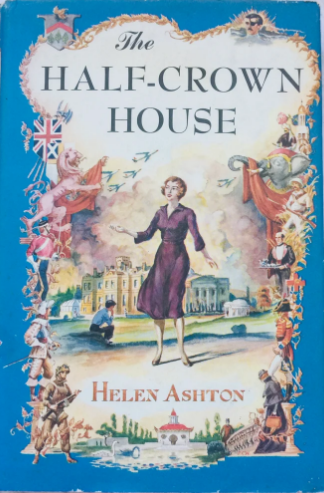
Review 1785: The Half-Crown House

The Half-Crown House is Fountain Court, a once-stately home that has fallen into disrepair after years of money and estate mismanagement and crippling death taxes. Its heir is Victor Hornbeam, a little boy who is coming to live there for the first time, his widowed mother preparing to marry. The property has been supported for years by Victor’s young aunt, Henrietta, who opens the house for viewing, and her cousin Charles, wounded during the war, who runs a market garden. They are struggling to support the estate so that they can hand over something to Victor when he comes of age. The only other family member living in the house is their grandmother, now bedridden, whose ferocious spending and mismanagement has bankrupted the family.

As the novel opens, Victor is arriving on one of the visitor’s days. Henrietta has a wealthy American suitor who wants to buy one of the valuable paintings, and she is hoping to sell it. However, that morning her grandmother tells her that it, along with many of the other paintings and jewels in the house, is a worthless copy that she had made when she needed to sell the original to pay her debts.

The household is wondering if Henrietta will marry the American, but it was apparent to me early on that her heart lay elsewhere. That only increases the little bit of suspense around this decision.

This novel is a meandering one. At times, it is much more concerned with the past elegance of the house and the events of the long-dead Hornbeams than with the living, for it goes off into little vignettes either through the memories of its inhabitants or during the descriptions of its current state. Thus, it particularizes the postwar state of the country, when many large homes were being dismantled or sold.

It’s an odd little book that reminded me a bit of Lady Rose and Mrs. Memmary and a couple of Rumer Godden novels that center around a house over the generations.

Lady Rose and Mrs. Memmary

China Court

A Harp in Lowndes Square

Review 1781: Good Evening, Mrs. Craven: The Wartime Stories of Mollie Panter-Downes

A woman feels as if some evacuees have taken over her home. The Red Cross sewing party is enlivened by arguments between the good-natured Mrs. Peters and the bloodthirsty Mrs. Twistle. A woman bravely faces her husband’s deployment and then is devastated to find he hasn’t left yet and she has to face it all over again. A couple finally gets rid of their evacuees only to have an acquaintance ask for room in their house. A man who has been working in a ministry feels guilty about not joining up.

These are a few of the stories about ordinary people during World War II that Mollie Panter-Downes published in the New Yorker. They are slice-of-life stories, although most of them have an upper-class perspective, of changing social conditions, of changes in everyday life, of people keeping a stiff upper lip.

I was surprised to learn from the Afterword that Panter-Downes, a prolific British journalist, short story writer, and novelist, was much better known in the United States than in Britain because she published almost everything in the New Yorker. So, even though she wrote hundreds of short stories, her legacy was almost lost in her native country.

Ordered by when they were written, this collection provides an insightful look, beautifully written, at the lives of ordinary people during the war.

One Fine Day

My Husband Simon

To Bed with Grand Music

Review 1778: #ThirkellBar! The Brandons

Although I know the season is busy, I hope some others of you joined me in reading The Brandons for Reading Thirkell’s Barsetshire Series in Order.

Mrs. Brandon attributes her good temper and blooming if languid looks to having been many years a widow. She also likes to imply that she was unhappily married even though she had just started to be bored by her husband when he died. Whatever the reason, she is charming and captivating enough to make men fall devotedly in love with her, including the vicar, Mr. Miller, and his pupil, Mr. Grant, who is the same age as her son Francis.

Mrs. Brandon’s elderly aunt by marriage, Miss Brandon, has been holding the bequest of her money and hideous house over Francis’s head for years, hinting when she is displeased—which is almost always—that she will leave it to someone else. Francis doesn’t want it, but when she summons them all to her house, Mrs. Brandon feels that they must go. There she finds that Miss Brandon has been ill and is actively mistreating her companion, Miss Morris.

At her house they also find Mr. Grant, who it turns out is a cousin in the same situation as Francis, alternately promised and denied a legacy that he doesn’t want. Part of the novel deals with what happens when Miss Brandon dies.

Thirkell is brilliant at describing the silliness of infatuations, and here she does not spare Mrs. Brandon’s admirers. A delight of this book is its conversations, especially those involving such eccentric characters as Mrs. Grant, Mr. Grant’s mother, who patronizes others about her life in Italy and constantly embarrasses her son with her lack of manners and clanking jewelry. Some favorites reappear in this novel, including Mrs. Morland and Tony, Lydia Keith, and Noel Morton.

Thirkell continues to entertain us with her witty and charming novels.

Pomfret Towers

Summer Half

August Folly

Review 1767: Classics Club Spin! A Town Like Alice

Best of Ten!

I haven’t ever read anything by Nevil Shute, so I decided to put A Town Like Alice on my Classics Club list, and then it was chosen for the latest spin. I’m glad I chose it for my list, because it’s a really good book, hard to categorize—part war story, part love story, part adventure story, about brave and resourceful people and challenges faced. I loved it.

The novel is narrated by Noel Strachan, an elderly solicitor, who finds himself the trustee for a young woman named Jean Paget. After they befriend each other, Jean confides to him that during World War II she was in Malaya when she and a group of women and children were taken prisoner by the Japanese. Since the Japanese didn’t know what to do with them, they were marched hundreds of miles back and forth over the Malay peninsula. Half of them died until Jean made a deal with a village headman that he would allow them to stay there if they helped with the rice harvest. During the time they were wandering, an Australian POW who was driving trucks for the Japanese tried to steal food for them and was crucified by the Japanese. Jean decides to use part of her legacy to dig a well in the Malayan village to thank them for helping.

While in Malaya, Jean learns that the Australian man, Joe Harman, did not die as she thought. She decides to go to Australia to try to find him. As fate would have it, however, he comes to Strachan’s office in London looking for Jean, having learned that she was single after thinking all this time that she was married.

About half the novel is about the couple finding each other, but then Jean sees the nearby town to the remote station where Joe works. She learns that the girls won’t stay in town because there is nothing there for them, and Joe can’t keep men on the station because there are no girls. The resourceful Jean decides that if she can’t bear to live in the town, something must be done to improve it.

It’s easy to see why this novel is so beloved, although caution—there is incidental racism that reflects the times. That being said, I found this novel deeply satisfying—engrossing, touching, full of life and spirit.

The Narrow Road to the Deep North

My Brilliant Career

Salt Creek

Review 1766: China Court

Old Mrs. Quin dies, leaving her beloved house, China Court, dilapidated from lack of money and her even more beloved garden tended only in a few places. Her descendants gather, assuming the house and contents will have to be sold to pay for the taxes and the leftover money divided. Among them is Tracy, her only grandchild, who loved the house as a child but was taken away by her mother to lead a wandering existence. Mrs. Quin’s children are indignant about the presence of Peter St. Omer, who abandoned an aimless life four years ago to work the estate farm at Mrs. Quin’s encouragement.

When the will is read, there is a surprise for all, as Mrs. Quin has left the house to Tracy and the farm to Peter with an unusual proviso. But can they find the money to save the properties?

China Court was the novel I chose to read for Rumer Godden Week, hosted by Brona at This Reading Life. With a great deal of fluidity, it tells the story of the lives of several generations of Quins in their home of China Court. It moves back and forth among generations, the shifts triggered by an object or a smell, as it tells what happened to the family—the smart girl denied an education because of her sex, the wife madly in love whose husband was unfaithful at the first opportunity, the girl in love with one brother who married another.

Godden does this skillfully, inserting the seeds of the stories into the first chapter so that readers want to find out about them. She structures the novel by dividing it up like a book of hours, beginning each chapter with a description of the page of that hour from a specific book. I was perplexed about the reason for this device, but all is eventually made clear.

Godden uses a similar technique in A Fugue in Time (written in 1945) but less successfully there, I think. In this novel I became very involved in the stories of some of the characters and the fate of the house. Godden has perfected this approach to fiction by the time she published this book in 1961.

A Fugue in Time

The Lady and the Unicorn

A Harp in Lowndes Square

Review 1761: #ThirkellBar! Pomfret Towers

Cover for Pomfret Towers

It’s time to talk about the sixth book in Angela Thirkell’s Barsetshire series, Pomfret Towers. Who read it and what did you think?

This novel is another one that I reviewed several years ago, so I will not repeat the plot synopsis and review but simply supply a link to the original review.

What struck me this time around was how sweet a story this is, with Thirkell creating characters we like tremendously but not forgetting a couple we can dislike. Yet, she’s subtle about all of this and shows a little sympathy for one of the most irritating characters.

Little Alice, so young and shy, is both a sympathetic character and one who provides some good-natured comedy. For example, her reaction to being invited to Pomfret Towers for the weekend—a terrifying prospect—is to hope the house burns down overnight before she has to go. She is silly and adolescent in her attachment to the odious Julian Rivers and very brave when she finally sees through him.

On the other side is Mrs. Rivers, so full of herself as a Writer of popular novels that sound dreadful, so managing in a house where she is not the hostess, and so irritating in her attempts to throw together her daughter Phoebe and the mild-mannered Gillie Foster, the heir to the earldom. But when she is humiliated by her son at the end of the novel, Thirkell deftly makes us feel sorry for her (but not for Julian).

I liked practically everyone in this novel, even Lord Pomfret, known for his rudeness. Another charming novel by Thirkell.

Summer Half

August Folly

The Demon in the House

Review 1757: To Bed with Grand Music

To Bed with Grand Music opens with Deborah Robertson in bed with her husband Graham swearing perfect fidelity before his deployment to Cairo during World War II. Graham more honestly doesn’t promise that but says he won’t sleep with anyone that matters. At first, Deborah contents herself at home, but when, in her boredom, she begins snapping at her little son, Timmy, her mother suggests she get a job.

Her mother is thinking about a job nearby in Winchester, but Deborah makes arrangements to visit a friend in London, Madeleine, and see about a job there. Intending to go home on the evening train, she ends up getting drunk and spending the night with a man.

Shocked at herself, Deborah is determined to stay home, but she has a talent for convincing herself that what she wants to do is right, so it’s not too long before she turns down a job in Winchester only to take a lower-paying one in London. From there, she begins a career of connecting with men of increasingly higher rank.

Deborah is definitely an antihero. She starts out selfish and nervous and becomes deceitful, amoral, and avaricious as she goes on. Her faint motherly instincts become almost nonexistent. This is an insightful, sardonic character study of a particular type of woman.

The Victorian Chaise-Longue

A Fugue in Time

Vanity Fair

Review 1755: The Snow-Woman

For nearly half a century, Maude Barrington has been grieving for her three brothers who died in World War I. To the rest of the world she has been cold, letting friendships fall away, living with just her maid Millie, and having just a few neighbor acquaintances.

Then one day, an old frenemy, Lionel Crozier, invites himself to tea. Thinking of him as malicious, Maude doesn’t know what to expect but is not surprised when he arrives with a hugely pregnant young woman from a lower class named Teddie Parker. Soon, the girl begins to give birth on Maude’s couch.

Once Teddie has been dispatched to the hospital, Lionel tells Maude he wants her to come to France, where an old friend, Charles, a famous expert on modern art, is dying. Although Maude has done nothing for years, she agrees to go, and thus begins a kind of opening up, where she reconciles with old friends.

This experience continues when she arrives home and gets more involved, through Millie, with Teddie and her family. The result is the revelation of long-held secrets and a new life for Maude.

Although I wondered why Maude wasn’t curious about how Lionel knew Teddie or why he would have brought her to Maude’s house, and although I also wondered at some point where the novel was going, it turned out to be thoroughly satisfying and heart-warming. Another win for Gibbons.

The Woods in Winter

A Pink Front Door

Nightingale Wood

Review 1747: Cromartie vs. the God Shiva

In its Afterword, Rumer Godden calls Cromartie vs. the God Shiva a twin to Coromandel Sea Change. It is partially set in the same location, the Patna Hotel on the Coromandel Sea, and has some of the same characters. When I realized this, I was excited, because I loved that book.

Michael Dean is chosen by his law firm to represent the government of India against Mr. Cromartie, a Canadian art dealer who is alleged to have purchased a stolen statue of the God Shiva worth a quarter of a million dollars. The statue was purchased from him, but now he is suing for money, so the government has to prove it was stolen.

Michael travels to the hotel. The statue was originally found when the hotel was built, so the owner made a shrine for it in the hotel ballroom. A noted archaeologist, Dr. Ellen Webster, had examined it several years before and told Auntie Sanni, the hotel manager, that it was valuable. A few years later, she realized it had been substituted for a good fake. When Michael questions the employees about it, they are all oddly evasive, and Auntie Sanni advises him to leave it alone. Dr. Webster arrives with her yearly tour group, and Michael falls in love at first sight with her assistant, Artemis.

This novel is a peculiar mixture. It evokes the flavors and smells of the village as do most of Godden’s India-set novels, but it turns into more of a mystery story. I don’t think it is quite as successful as some of her others, although it was nice to return to the Coromandel Sea. I believe this is my last book in my project to read Rumer Godden’s India novels.

Related Posts

Coromandel Sea Change

The Lady and the Unicorn

The Peacock Spring